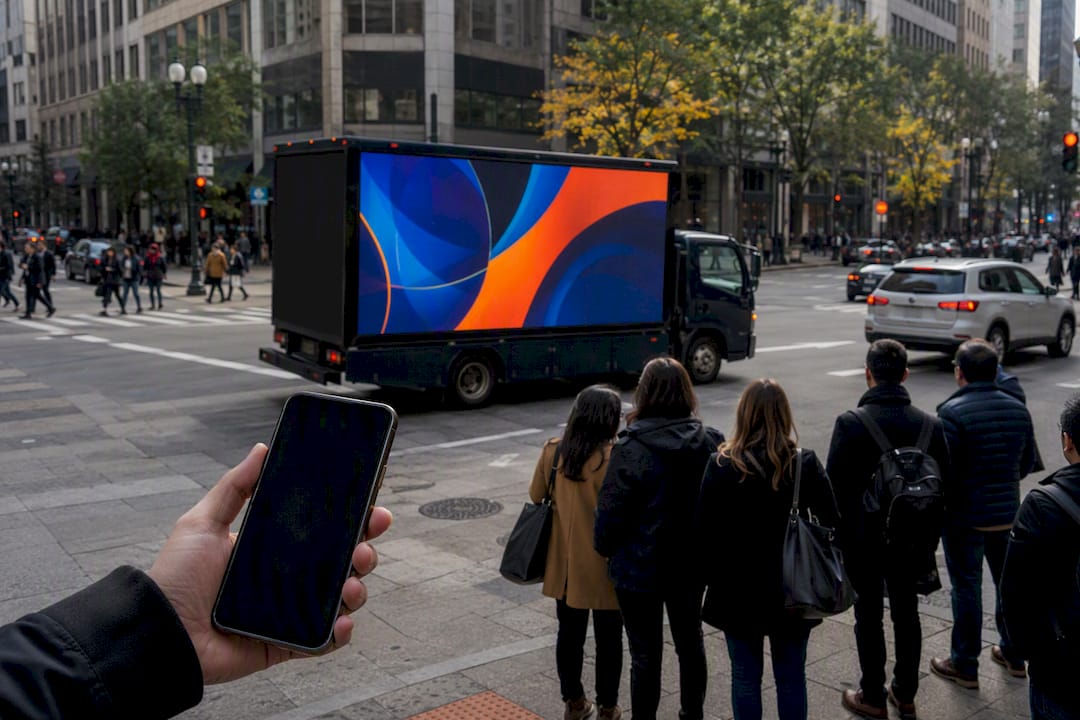
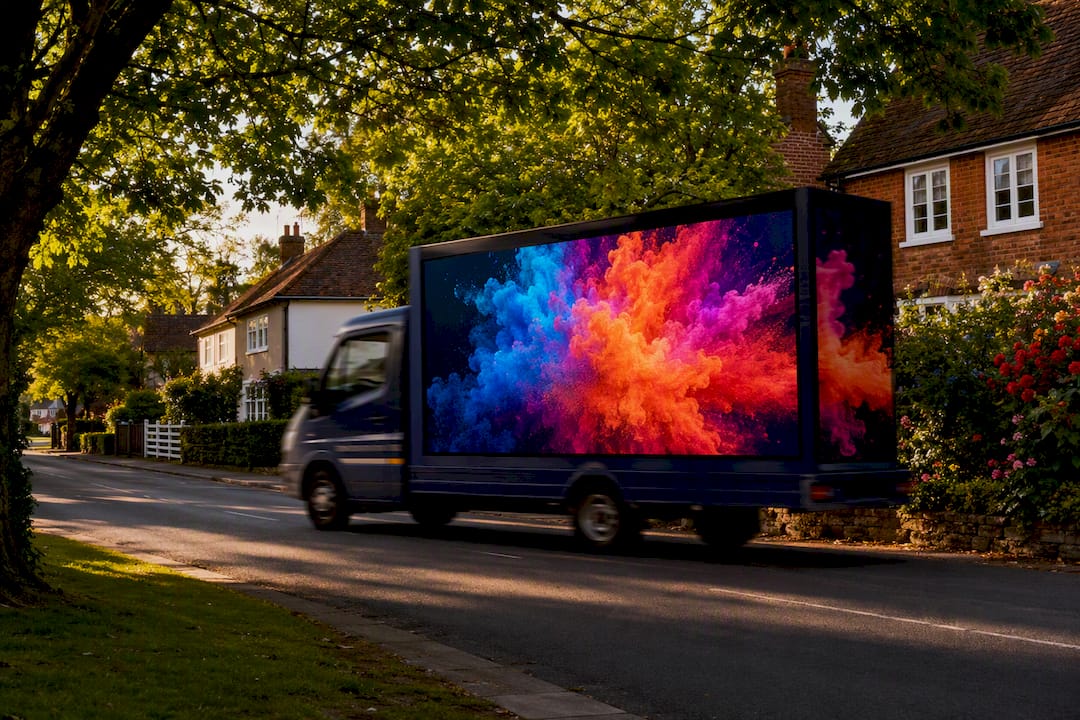
A LED ad truck is a vehicle fitted with one or more high-brightness LED screens that plays video or still images while driving or parked in targeted locations. Use it when you need dynamic, context-aware outdoor reach in high-footfall areas, at events, or anywhere a static billboard simply cannot go.
When a mobile LED billboard makes sense:
- You need to swap creatives mid-campaign without reprinting anything
- Your audience concentrates at a specific event, venue, or neighborhood window
- You want proof-of-posting with GPS logs and timestamped photos, not just an invoice
- Attribution matters: QR-code scans, geofencing lift, or foot-traffic data are part of your KPIs
For a broader look at where this format fits among OOH advertising formats, mobile LED is the format that combines physical presence with digital-campaign flexibility.
Table of Contents
- How does a led ad truck actually work?
- What specs should you evaluate on any mobile LED display?
- Why pick a digital LED truck over static OOH?
- How much does an LED ad truck cost?
- Campaign planning checklist for a mobile billboard campaign
- Creative best practices for mobile LED ads
- How do you measure an LED truck campaign’s performance?
- What should you ask any LED ad truck provider before signing?
- How Beacon-ads runs LED ad truck campaigns
- Key Takeaways
- What actually separates a good LED truck campaign from a forgettable one
- Beacon-ads runs campaigns built to prove results
- Useful sources
How does a led ad truck actually work?
The hardware starts with LED modules mounted on a truck, trailer, or van body. Those modules connect to a controller that manages content playback, brightness, and multi-zone scheduling. Power comes from a dedicated onboard generator or, in smaller van-mounted builds, from the vehicle’s electrical system. Weatherproofing is handled through ingress protection ratings (more on that in the specs section), and most professional units use aluminum or steel enclosures rated for rain and dust.
On the software side, content management systems let operators schedule playlists, push remote updates over 4G or Wi-Fi, and run multi-zone playback so a truck can show different creative on its front, rear, and side panels simultaneously. Some turnkey mobile LED solutions include remote ad control and scheduled commercial blocks, which matters when you’re running dayparted messaging.
Operations involve more than just driving. Route planning, driver briefings, and local permit acquisition all happen before the truck rolls. Proof-of-posting, meaning GPS traces and timestamped photos captured throughout the campaign, is the standard verification artifact you should demand from any provider.
Route and permit lead time is the most common campaign delay. Major cities like New York, Los Angeles, and Chicago each have distinct permitting requirements for mobile advertising vehicles. Build at least five to seven business days of permit processing into your timeline before the truck goes live.
Pro Tip: Ask your provider for a sample proof-of-posting report before you sign anything. If they can’t show you a real GPS trace and photo log from a past campaign, that’s a red flag.
What specs should you evaluate on any mobile LED display?
Not all LED screens are equal, and the wrong spec choice means your ad is unreadable at highway speed. Here’s what to check:
| Spec | What to look for | Why it matters |
|---|---|---|
| Pixel pitch | P4–P6 for truck-mounted; P2.5–P5 for smaller vehicle displays | Determines minimum readable viewing distance; pixel pitch and viewing distance scale together |
| Brightness | around 5,000 to 6,000 cd/m² or higher for outdoor daytime | Direct sunlight washes out screens below this threshold |
| IP rating | — | Protects against rain and road dust |
| Refresh rate | — | Prevents flicker in video and photography |
| Connectivity | 4G/5G + Wi-Fi with local backup | Enables remote content updates and redundancy |
| Screen size | 10 ft wide | Larger panels extend readable distance in moving traffic |

Brightness is the spec most buyers underestimate. Outdoor LED modules in the 5,000–6,000 cd/m² range handle direct sunlight, but screens without automatic ambient light sensors will either blind viewers at night or wash out during midday. Insist on auto-dimming as a baseline.
Pro Tip: For a moving truck in urban traffic, a P5 pixel pitch is usually the sweet spot between cost and readability at 30–50 feet. Go tighter (P3.9 or P4) only if your route includes slow-moving or stationary placements like event staging.
Why pick a digital LED truck over static OOH?
The core argument is flexibility, and it’s not a small difference. A static billboard locks you into one creative for the entire campaign. A digital advertising truck lets you run a breakfast promotion at 8 AM, a lunch offer at noon, and a brand awareness spot in the evening, all on the same vehicle, same day, with no reprinting.
Practical advantages over static formats:
- Multiple creatives per route: Run A/B creative tests or daypart-specific messaging without additional production costs
- Real-time data triggers: Connect live sports scores, weather conditions, or social feeds to dynamic ad content
- Contextual targeting: Park or route the truck near a competitor’s location, a concert venue, or a trade show entrance
- Measurement: Mobile DOOH attribution includes geofencing lift, QR-code scans, and website visit tracking, none of which static wraps can deliver natively
- Speed to market: When content and route are finalized, campaigns on mobile LED inventory can launch quickly compared to traditional print production timelines
The logistical advantage at events is real. A truck can stage at a venue entrance, move to a parking lot during intermission, and reposition to a bar district afterward, covering three audience moments in one booking.
How much does an LED ad truck cost?

Purchase prices for LED truck hardware range from roughly $50,000 for entry-level single-panel builds to $200,000 or more for turnkey all-weather systems with full-perimeter panels, onboard generators, and remote content management. The wide range reflects panel size, pixel pitch, weatherproofing grade, and whether the chassis is included.
Rental rates vary more than purchase prices because they fold in labor, permits, fuel, and market demand. Event-adjacent bookings in major metros typically run higher than standard route campaigns. Daily rates for a single-truck campaign in a mid-size market can differ significantly from a multi-truck event activation in New York or Los Angeles.
What drives rental costs up:
- Event proximity (concerts, sports, conventions add a premium)
- Permit complexity in dense urban markets
- Extended operating hours or overnight campaigns
- Multi-truck fleet coordination
- Creative production and content scheduling services
When buying makes sense vs. renting:
- Buy if you’re running campaigns more than 20–25 weeks per year, want white-label control, or are building an agency fleet
- Rent for one-off activations, market tests, or campaigns where logistics and permitting are someone else’s problem
Hidden costs catch first-time buyers. Generator fuel, driver overtime, permit fees, and weather-delay rescheduling are rarely included in a base quote. Always ask for a fully loaded cost estimate before comparing vendors.
Pro Tip: If you’re evaluating a purchase, request the total cost of ownership over 36 months, including maintenance, insurance, and content management software. That number often makes renting look more attractive for brands running fewer than 15 campaigns per year.
Campaign planning checklist for a mobile billboard campaign
- Define your audience and route. Use geofencing data, event calendars, and foot-traffic analysis to identify the highest-density windows for your audience. Dwell-time locations (stadium exits, convention center entrances, transit hubs) outperform random routing.
- Confirm permits early. Research city-specific requirements for mobile advertising vehicles. Some municipalities require permits per route segment; others issue blanket city permits. Five to seven business days minimum.
- Lock creative and content schedule. Finalize all ad files, aspect ratios, and dayparting rules before the truck rolls. Last-minute creative changes cause operational delays.
- Set proof-of-posting requirements. Specify GPS log frequency, photo intervals, and reporting cadence in the contract. Daily photo logs and end-of-campaign GPS exports are standard.
- Build operational contingencies. Identify a weather backup plan, confirm generator fuel logistics, and brief the crew on rerouting protocols if a permitted zone becomes unavailable.
Dayparting is underused in mobile LED campaigns. Scheduling your highest-impact creative for the 90-minute window around a venue’s event start and end can double effective impressions without adding a single mile to the route.
Pro Tip: For data-driven OOH campaigns, pair your truck route with a geofence that retargets exposed audiences on mobile within 24 hours. The combination of physical impression and digital follow-up consistently outperforms either channel alone.
| Planning element | DIY approach | Managed service |
|---|---|---|
| Permit acquisition | Research per city, file independently | Provider handles all permits |
| Route optimization | Manual mapping | Geofencing + foot-traffic data |
| Proof-of-posting | Self-documented GPS + photos | Automated GPS logs + photo reports |
| Creative scheduling | Manual content upload | Remote CMS with dayparting rules |
| Attribution reporting | Basic QR tracking | Full funnel: geofence, foot-traffic, web lift |
Creative best practices for mobile LED ads
The viewing window on a moving truck is roughly three to five seconds. Every creative decision should start from that constraint.
Rules that hold across every mobile LED campaign:
- One idea per card. A single message, one visual, one CTA. If you need to explain it, it won’t read at 30 mph.
- Large type, high contrast. Minimum 10% of screen height for body copy; white or yellow on dark backgrounds outperform every other combination in daylight
- Slow, deliberate motion. Fast cuts and complex animations are invisible to a passing audience. Hold each card for 3–5 seconds; transitions under one second get lost
- QR codes that work. Smart QR codes on mobile OOH should link to a mobile-optimized landing page and be large enough to scan from 15–20 feet. Short URLs and SMS short codes work for audiences who won’t scan
- Brand lockup in the first frame. Don’t save the logo for the end; a viewer who sees only the first card should still know who ran the ad
The most common creative mistake on LED trucks is designing for a desktop monitor. Thin fonts, subtle gradients, and multi-element layouts that look polished on a 27-inch screen become unreadable on a moving panel viewed through a car windshield. Design for the worst-case viewer: moving, distracted, 50 feet away.
Pro Tip: Test your creative by exporting a still frame and viewing it as a thumbnail at roughly 2 inches wide on your phone. If you can read the headline and identify the brand, it will work on the truck.
How do you measure an LED truck campaign’s performance?
Attribution for mobile OOH has improved significantly. Here’s the practical toolkit:
| Method | What it measures | Reliability |
|---|---|---|
| Smart QR code scans | Direct engagement, landing page visits | High (direct signal) |
| UTM-tagged short URLs | Web traffic from OOH exposure | High (direct signal) |
| Geofence dwell analysis | Audience exposure by location and time | Medium-high |
| Incremental foot-traffic lift | Store or venue visits vs. control group | Medium |
| Website visit lift | Branded search and direct traffic during campaign | Medium |
| Brand lift survey | Aided/unaided recall, purchase intent | Medium (sample-dependent) |

QR codes and UTM-tagged URLs are the cleanest signals because they require an active response. Geofencing and foot-traffic lift require a control methodology to isolate campaign effect from baseline traffic. Mobile DOOH campaigns support all of these methods, which puts them ahead of static formats on measurability.
Set KPIs before the campaign launches. Reasonable baseline expectations depend on market, creative quality, and route density, but you should define target QR scan rates, foot-traffic lift thresholds, and reporting cadence in the contract. Proof-of-posting artifacts (GPS traces, photo logs) are the foundation; attribution metrics build on top of them.
Demand these reporting artifacts from every provider:
- GPS trace files exportable by date and time
- Timestamped photos at defined intervals (hourly minimum)
- Aggregated impression estimates by route segment
- QR scan data tied to campaign creative and time of day
What should you ask any LED ad truck provider before signing?
Proof-of-posting and reporting:
- Can you provide a sample GPS trace and photo log from a completed campaign?
- What is your reporting cadence (daily, weekly, end-of-campaign)?
- Do you provide analytics exports in a format compatible with our attribution tools?
Fleet and technical specs:
- What is the brightness rating (cd/m²) of your panels, and do they auto-dim at night?
- What pixel pitch and IP rating do your truck-mounted screens carry?
- What redundancy exists if a panel or controller fails mid-campaign?
Operations and compliance:
- Who handles permit acquisition, and what markets do you cover?
- What insurance does your operation carry, and does it cover third-party liability?
- What is your weather contingency plan, and how are rescheduled days handled?
Campaign services and pricing:
- Is creative production included, or is it a separate line item?
- What’s included in the base rate: driver, fuel, generator, permits, and content scheduling?
- Do you support dynamic content triggers (dayparting, event-based, weather-based)?
How Beacon-ads runs LED ad truck campaigns
Beacon Mobile Media builds campaigns around route customization, geofencing, and attribution from the start, not as add-ons. Every campaign includes proof-of-posting with GPS logs and timestamped photos, smart QR codes for direct engagement capture, and analytics exports clients can verify independently.
What clients receive on a standard campaign:
- Route planning based on geofencing data, event calendars, and affinity targeting
- Smart QR codes linked to mobile-optimized landing pages for lead capture
- Real-time retargeting that follows exposed audiences into digital channels within 24 hours
- GPS trace files and timestamped photo logs delivered per reporting cadence
- Full attribution reporting: geofence lift, QR scans, foot-traffic analysis, and funnel metrics
Beacon Mobile Media’s approach treats the LED truck as the first touchpoint in a measurable funnel, not a standalone impression. The combination of physical reach and digital retargeting is what separates a campaign with provable ROI from one that just looks good on a recap deck.
Beacon-ads operates across all 50 states, which matters for brands running multi-market activations or national event tours. The LED mobile billboard agency capabilities page shows campaign examples and proof-of-posting samples.
Pro Tip: Ask Beacon-ads for a campaign proposal that includes a sample attribution report alongside the route plan. Seeing the reporting format before you commit tells you exactly what you’ll be able to prove to your stakeholders after the campaign ends.
| Capability | What Beacon-ads delivers |
|---|---|
| Route customization | Geofencing + event-calendar-driven route planning |
| Proof-of-posting | GPS traces + timestamped photos per campaign |
| Smart QR codes | Lead capture tied to campaign creative and time of day |
| Digital retargeting | Mobile follow-up to audiences exposed on-route |
| Attribution reporting | Geofence lift, foot-traffic, QR scans, funnel metrics |
Key Takeaways
A LED ad truck delivers measurable, dynamic OOH reach that static formats cannot match, but only when specs, creative, and attribution are planned before the truck rolls.
| Point | Details |
|---|---|
| Choose the format for measurability | LED trucks support QR scans, geofencing lift, and foot-traffic attribution that static OOH cannot provide. |
| Specs determine readability | Require high brightness, appropriate pixel pitch in the P4 to P6 range, and weatherproofing as baseline specs from any provider. |
| Creative must survive 3–5 seconds | One idea, large type, high contrast, and a QR code or short URL are the only elements that read reliably on a moving panel. |
| Demand proof-of-posting | GPS trace files and timestamped photos are non-negotiable verification artifacts; no provider should hesitate to show samples. |
| Beacon-ads adds digital lift | Beacon Mobile Media pairs LED truck reach with geofencing retargeting and full attribution reporting across all 50 states. |
What actually separates a good LED truck campaign from a forgettable one
Most marketers focus on the truck itself: the screen size, the brightness, the route. Those matter, but they’re table stakes. The campaigns that actually move metrics are the ones where the physical impression is the start of a funnel, not the end of it.
A truck driving past 10,000 people is an awareness event. A truck driving past 10,000 people, followed by a geofenced mobile ad 20 minutes later, followed by a retargeted display ad the next morning, is a campaign with compounding frequency and a measurable conversion path. The LED display is the trigger. The digital follow-up is where the ROI gets built.
The other thing most guides skip: creative failure is the most common reason LED truck campaigns underperform. Not bad routes, not weak specs. Ads designed for a desktop that get loaded onto a moving panel and become unreadable at 40 feet. The three-to-five-second viewing window is unforgiving. One headline, one visual, one action. That’s the whole brief.
Beacon-ads runs campaigns built to prove results
If you’re ready to put a mobile LED billboard to work, Beacon Mobile Media gives you more than a truck and a route. Every campaign comes with route planning driven by geofencing data, smart QR codes for direct lead capture, and a full attribution report you can hand to your CMO.

The introductory call covers your market, campaign objectives, and the proof-of-posting format you’ll receive. You’ll see a sample GPS trace and attribution report before you commit. Beacon-ads operates across all 50 states, so whether you’re activating at a single event or running a multi-market tour, the infrastructure is already in place.
Request a campaign proposal and see what a measurable mobile OOH campaign looks like from brief to final report.
Useful sources
The sources below back the technical specs, format comparisons, and operational guidance in this guide.
- The rise of mobile OOH: Why LED billboard trucks are having a moment — OOH Today’s industry analysis on mobile DOOH attribution and real-time creative capabilities
- LED Billboard Truck for Advertising – How Does it Work? — Unilumin’s technical overview of truck-mounted LED hardware, variations, and rental context
- Static billboard vs digital billboard benefits — Megasign’s comparison of static and digital OOH, useful for dayparting and contextual targeting arguments
- BoxLED Digital LED Advertising Van — Screen-LED’s product page for turnkey van-mounted LED systems with remote ad control specs
- Taxi Top LED Display — HSC LED’s spec sheet illustrating pixel pitch ranges (P2.5–P5) and viewing distance trade-offs for smaller vehicle displays
- Outdoor P10 LED Display Sign — Leadleds/UNTSMART product page with brightness (5,000–6,000 cd/m²), connectivity, and operating temperature specs
Use the manufacturer spec pages to verify brightness and IP ratings when evaluating any provider’s fleet claims. Published product specs give you a baseline to compare against what a vendor tells you in a sales call.
| Source | Best for |
|---|---|
| OOH Today (mobile OOH article) | Attribution methods and real-time creative capabilities |
| Unilumin blog | Hardware overview and rental cost context |
| Megasign blog | Static vs. digital OOH comparison and dayparting rationale |
| Screen-LED BoxLED page | Turnkey van-mounted system specs and remote control features |
| HSC LED taxi-top page | Pixel pitch and viewing distance reference for smaller displays |
| Leadleds/UNTSMART product page | Brightness, connectivity, and weatherproofing spec benchmarks |