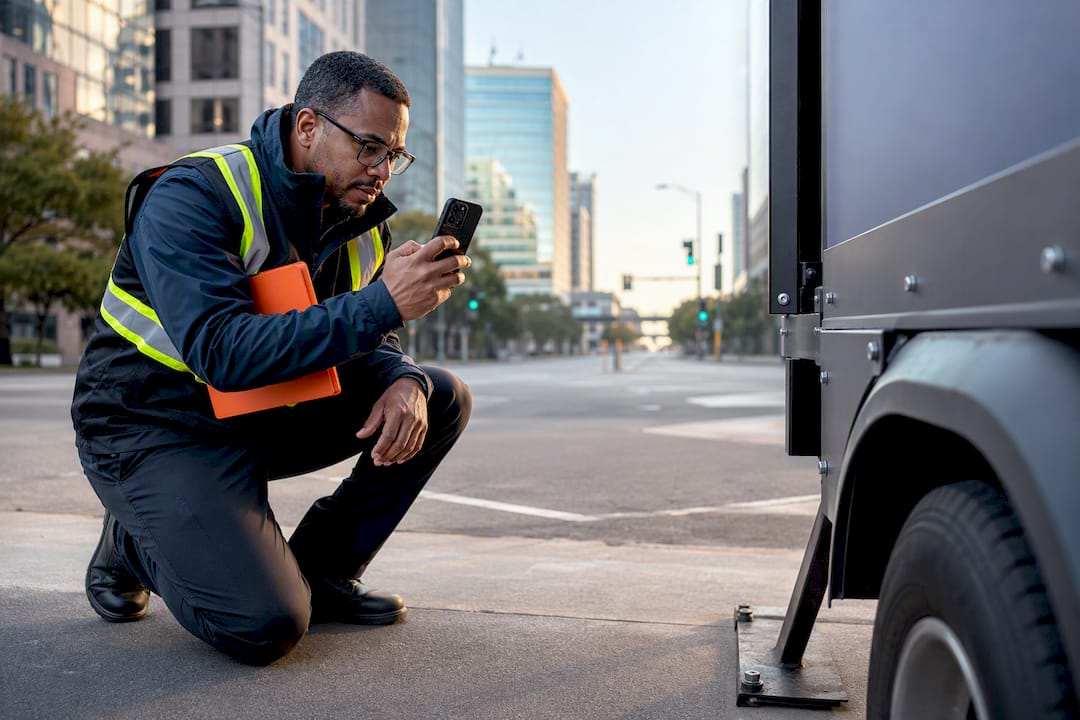
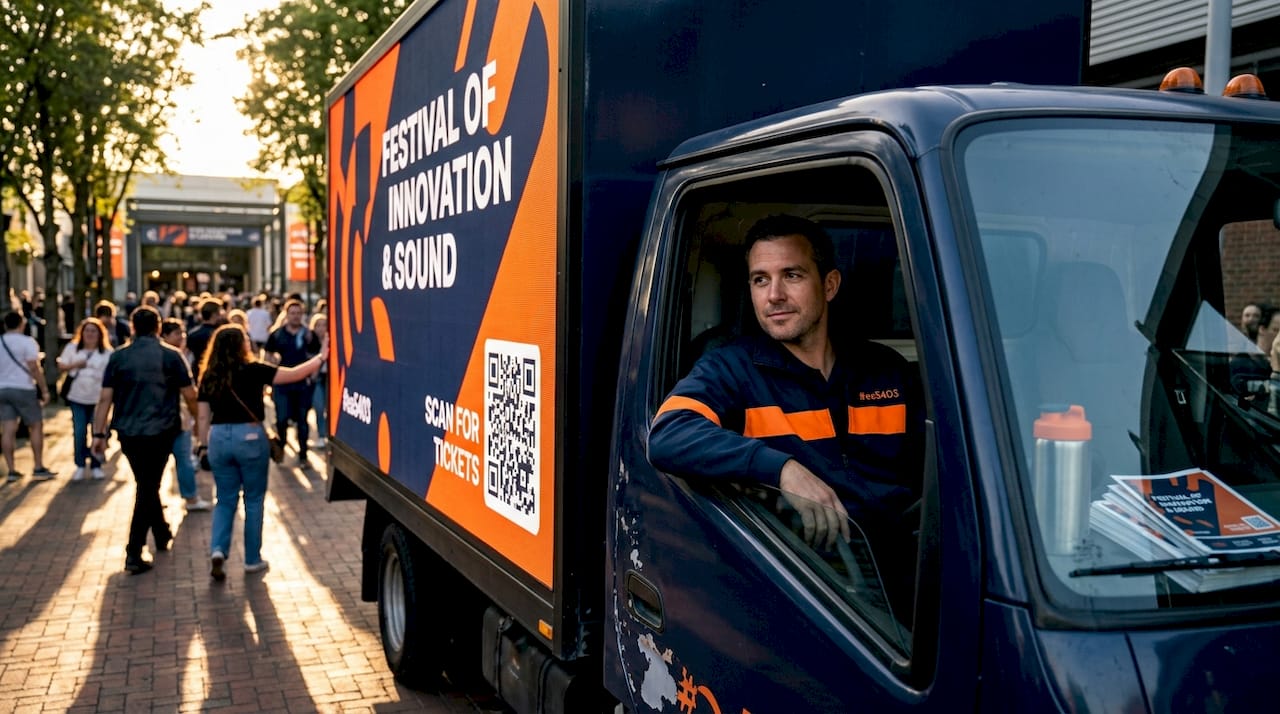
A display truck is a mobile LED billboard mounted on a vehicle chassis that you rent or buy to get high-visibility outdoor reach wherever your audience actually is. For U.S. brand and event marketers, the recommended configuration is a self-contained, hybrid-powered LED truck with P3 or P4 pixel pitch, a brightness rated for full daylight legibility, and GPS/photo proof-of-posting. Shortlist vendors who can supply park-and-play units that deploy very quickly and provide attribution analytics alongside delivery documentation.
The single most important question to ask any vendor: “Can you show me a sample proof-of-posting report with GPS coordinates and timestamped photos?” If they hesitate, move on.
Key requirements to confirm before signing:
- Pixel pitch at P4 or better (P3/P2.9 for close-range activations)
- Brightness rated at 5,000 nits minimum for full daylight legibility
- Hybrid or solar power option for noise-sensitive venues
- GPS tracking and photo documentation at every stop
- Nationwide service coverage if your campaign spans multiple markets
Beacon Mobile Media operates LED mobile billboard trucks and wrapped rideshare vehicles across all 50 states, with integrated smart QR codes, real-time retargeting, and campaign-level attribution reporting built into every campaign.
Table of Contents
- What do display trucks actually look like?
- Which technical specs actually determine visibility?
- How do power and deployment work in practice?
- Where does a display truck deliver the most impact?
- What does a display truck campaign actually cost?
- How do you prove a display truck campaign actually ran?
- How to choose a display truck vendor before you book
- What sets Beacon Mobile Media apart in data-driven campaigns
- Key Takeaways
- When a display truck beats every other OOH option
- Ready to run a data-driven display truck campaign?
- Useful sources and further reading
What do display trucks actually look like?
The term “display truck” covers four distinct form factors, and choosing the wrong one for your campaign is an expensive mistake.
LED vans are the most maneuverable option. They fit in standard parking spaces, navigate urban grids without permits in most cities, and work well for neighborhood-level activations or tight event footprints. The trade-off is screen size: side panels on a van typically reach sizes suitable for neighborhood-level visibility, which limits visibility beyond 150 feet.

Trailer-mounted units decouple the screen from the tow vehicle, which matters when you want to park the display at a fixed location for hours while the truck does something else. Mobile billboard trailers with 1080p LED panels and IP65 ratings can run on battery power for extended periods continuously, making them practical for multi-hour stationary activations at festivals or sporting events.
Full truck-integrated units carry the largest screens. The Spark 818, for example, mounts large side screens suitable for maximum visibility with P2.97 pixel pitch panels. Some manufacturers offer tri-fold panoramic configurations that unfold into a single 40-foot display using a patented UV coating on outdoor LED panels. These are the right choice for stadium approaches, major parades, or any placement where you need to stop traffic from a block away.

Wrapped rideshare vehicles (Uber, Lyft) occupy a different category entirely. They don’t carry LED screens; instead, the vehicle body itself is the ad surface. Cost per impression runs lower, frequency is high in dense urban markets, and the format requires no permits or power logistics. The limitation is creative flexibility: you’re locked into a static wrap, and there’s no dynamic content capability.
| Format | Best for | Typical screen width | Mobility | Permit complexity |
|---|---|---|---|---|
| LED van | Urban, tight venues | 8 ft | High | Low |
| Trailer-mounted | Long stationary holds | 10 ft | Medium | Medium |
| Full truck-integrated | Maximum visibility | 18 ft | Lower | Higher |
| Rideshare wrap | High-frequency urban reach | N/A (wrap) | Very high | Very low |
Screen placement also shapes your creative options. Side-facing panels are the standard for route-based campaigns. Rear-facing screens work well in slow-moving traffic or parade routes where dwell time is longer. Tri-fold panoramic setups create a three-sided presence that works for stationary event placements where foot traffic approaches from multiple directions.
Which technical specs actually determine visibility?
Pixel pitch is the distance in millimeters between LED clusters. Smaller numbers mean higher density and sharper images at close range. P2.9 panels (like those on the Spark 510) are appropriate for activations where audiences stand within 30–50 feet of the screen. P3–P4 is the practical standard for most street-level campaigns, where the viewing distance is 50–150 feet. Beyond 150 feet, P4 holds up fine and costs less per square foot of panel.
Brightness is where outdoor mobile displays live or die. FTL Displays specifies 5,000–6,000 nits as the operational range for outdoor mobile trucks, with UV coatings adding daylight legibility on top of raw brightness. The Spark 510 lists brightness above 5,500 cd/m² with automatic adjustment that dims the screen at night to avoid blinding pedestrians and brightens it in direct sun. For reference, a typical indoor display runs 500–1,000 nits. Anything below 4,000 nits on a mobile outdoor unit will wash out in afternoon sunlight.
Pro Tip: Ask vendors for the brightness spec at full white, not peak brightness. Some manufacturers quote peak figures that only apply to a small portion of the screen. Full-white brightness is what matters for text legibility on a bright day.
| Spec | Entry range | Recommended minimum | Premium range |
|---|---|---|---|
| Pixel pitch | P5–P6 | P3–P4 | P2.9 or finer |
| Brightness | 5,000 nits | 5,000–6,000 nits | 5,500–6,000 nits |
| IP rating | IP65 | IP65 | IP65+ |
| Content zones | 1 | 2–4 | Up to 6 |
IP ratings tell you how well the screen handles rain and road dust. IP65 is the baseline for a unit that will operate in variable weather. The Spark 510 supports up to four HDMI and four USB3 inputs alongside up to six independent content zones, which means you can run different creative on different screen sections simultaneously. That’s useful for sponsors who want their own panel during a multi-brand event.
Resolution and aspect ratio matter for your creative team. Most full-truck-integrated units run widescreen formats close to 16:9, but confirm the exact pixel count before you build assets. A mismatch between your creative resolution and the screen’s native resolution degrades image quality in ways that are obvious to anyone watching.
How do power and deployment work in practice?
The choice between generator power and hybrid/solar battery power affects more than your electricity bill. Generators are loud, require fuel management, and are prohibited or restricted at many indoor-adjacent venues, parks, and residential events. Spark Videotrucks’ Voltaic solar/hybrid system supports generator-free operation for parked displays, which eliminates noise complaints and simplifies venue permitting.
For campaigns where the truck stays stationary for several hours, battery-backed trailer units rated for 8+ hours of continuous operation are a practical alternative to any generator setup. The trade-off is recharge time between activations, so multi-day tours with back-to-back long stationary holds may still require a generator as backup.

Hydraulic lift systems change the game at crowded events. FTL Displays documents hydraulic lifts that raise screens up to 20 feet, converting a truck into a stationary billboard in under three minutes. At a street festival where sightlines are blocked by tents and crowds, an elevated screen visible from two blocks away is a fundamentally different asset than a ground-level panel.
Deployment sequence for a park-and-play unit:
- Drive to the activation location and confirm GPS coordinates are logging.
- Engage the hydraulic lift system and raise the screen to operating height.
- Connect shore power if available, or confirm battery/hybrid system is active.
- Load content via HDMI/USB or confirm remote administration is live.
- Verify brightness settings for ambient light conditions.
- Confirm GPS tracking and photo documentation are running before the campaign clock starts.
Operational considerations to plan for:
- Shore power connections reduce battery drain on long stationary holds; confirm the venue has accessible 30A or 50A service if needed.
- Travel distance between stops adds cost and time; cluster activation locations when building multi-stop routes.
- On-site staffing requirements vary by vendor: some units run with one operator, others require a two-person crew for hydraulic setup.
- Contingency power planning matters for multi-day campaigns; confirm the vendor’s protocol if the primary power system fails mid-activation.
Where does a display truck deliver the most impact?
Mobile advertising trucks outperform static placements when proximity and timing are the campaign’s core variables. A fixed billboard near a stadium reaches everyone who drives that road for months. A display truck parked at the stadium entrance on game day reaches exactly the audience you paid to reach, at the moment they’re most receptive.
Targeting conferences and trade shows with LED mobile trucks is one of the highest-ROI applications: the audience is pre-qualified, geographically concentrated, and often unreachable through digital channels during the event itself. Circling a convention center or parking at the main entrance during badge pickup hours puts your brand in front of decision-makers who are actively in buying mode.
Product launches benefit from route-based strategies that hit commute corridors in the days before and during the launch window. A truck running a loop through a city’s highest-traffic neighborhoods during morning and evening commutes generates repeated exposures across a defined geographic footprint. Pair that with geofenced digital retargeting and the people who saw the truck start seeing your digital ads within hours.
Event venue activations work differently: the truck becomes a satellite presence outside the venue perimeter, capturing foot traffic that never enters the paid event space. Concerts, sporting events, and festivals all draw large crowds to surrounding streets, parking areas, and transit stops. A stationary elevated display at those perimeter locations reaches an audience the venue itself can’t monetize.
Pop-up retail, brand tours, and citywide awareness campaigns are natural fits for multi-day or multi-city deployments. The truck moves with the campaign, which means your media spend concentrates in the markets where you need it most rather than being locked into a fixed location for 30 days.
What does a display truck campaign actually cost?
Purchase pricing separates into two line items: the LED body and the truck chassis. Spark 818 widescreen units start at $230,980 for the body alone, with chassis costs adding roughly $40,000–$60,000 depending on the model. The Spark 510, the more accessible entry point, starts at $119,980 for the body before chassis. These figures represent the upper end of what most marketers will encounter; smaller van-mounted units and trailer configurations come in lower.
Rental pricing is driven by different variables: screen size, campaign duration, travel distance, power configuration, and whether you need proof-of-posting and attribution reporting. Day rates, multi-day tour packages, and day-part pricing (morning drive, evening prime) are the most common structures. Always request an itemized quote.
Hidden fees to ask about before signing:
- Setup and teardown labor charges
- Mileage or fuel surcharges beyond a base radius
- Permit fees (city-specific; some vendors handle this, others pass it through)
- Site fees for premium locations
- Technician overtime for activations that run past scheduled hours
- Creative production or content upload fees
- Cancellation penalties and rescheduling terms
Cost drivers to evaluate in any quote:
- Screen size and pixel pitch (larger, finer-pitch panels cost more to rent and purchase)
- Power system (hybrid/solar power options command advantages over generator-only units)
- Hydraulic lift capability (adds to both unit cost and rental rate)
- Route complexity and total mileage
- Reporting package (basic delivery confirmation vs. full GPS trace, attribution analytics, and QR engagement data)
For high-traffic campaign placements, the cost-per-impression math often favors mobile trucks over static OOH in markets where premium billboard inventory is scarce or priced at a premium.
How do you prove a display truck campaign actually ran?
Proof-of-posting has become a baseline expectation for enterprise campaigns: GPS coordinates logged at every stop, timestamped photos of the truck in position, and a delivery report that ties both to the contracted schedule. Without it, you’re taking the vendor’s word that the truck showed up where and when it was supposed to.
GPS traces do more than verify delivery. They feed into geofence-based impression windows: the system draws a boundary around each stop location and counts mobile devices that entered that zone during the activation window. Those device IDs become the seed audience for digital retargeting, so people who physically saw the truck start seeing your digital ads across apps and websites within hours of the exposure.
Smart QR codes on mobile displays lift measurable engagement and generate clean first-party data for follow-up campaigns. A viewer scans the code, lands on a campaign page, and that interaction is logged with timestamp and location. Short URLs, promo codes, and on-screen CTAs serve the same function for audiences who don’t scan but do act later.
Reporting cadence matters for multi-day campaigns. Expect daily delivery summaries during active campaigns and a final report with aggregated exposure estimates, GPS traces, photo documentation, and engagement metrics. If a vendor can’t describe their reporting format before you sign, that’s a red flag.
How to choose a display truck vendor before you book
The vendor evaluation process is faster when you work from a fixed checklist rather than open-ended conversations.
- Confirm vehicle variants available. Does the vendor offer van, trailer, and full truck-integrated options, or only one format? Campaign flexibility depends on having the right form factor.
- Get the exact pixel pitch and brightness spec. Ask for operational brightness under full-white conditions, not peak brightness. P3 or finer at brightness ratings suitable for outdoor daylight campaigns.
- Ask about hybrid or solar power. Generator-only vendors create logistics problems at noise-sensitive venues. Confirm whether generator-free operation is available and at what cost.
- Request a sample proof-of-posting report. A vendor who can’t produce one from a past campaign either doesn’t generate them or doesn’t want you to see them.
- Verify nationwide coverage. If your campaign spans multiple cities or states, confirm the vendor can execute in every market without subcontracting to unknown operators.
- Clarify permit and insurance responsibility. Some vendors handle city permits and carry commercial liability insurance; others pass responsibility to the client. Know which situation you’re in before the campaign date.
- Ask about lead times and cancellation terms. Premium markets and high-demand event dates book weeks out. Understand the cancellation penalty before you commit.
Red flags that should end the conversation:
- No GPS/photo proof-of-posting capability
- Vague or bundled pricing with no itemization
- Generator-only power for events where noise is a concern
- No route customization; fixed routes only
- Inability to describe the reporting format before signing
What sets Beacon Mobile Media apart in data-driven campaigns
Beacon Mobile Media runs LED mobile billboard trucks and wrapped rideshare vehicles across all 50 states, with a campaign infrastructure built around measurement from the start. Every campaign includes GPS tracking and timestamped photo proof-of-posting, integrated smart QR codes for first-party data capture, and attribution analytics that connect physical exposure to digital behavior.
The measurement gap is where most mobile OOH campaigns fail. Beacon Mobile Media’s approach closes it by pairing GPS delivery verification with geofence-based impression windows and real-time retargeting, so the audience that saw the truck keeps seeing the brand across digital channels after the truck moves on.
Route customization and affinity targeting let campaigns concentrate exposure in the specific corridors, neighborhoods, and event perimeters where the target audience is densest. Geofencing and demographic filtering layer on top of that physical targeting to ensure the retargeting audience matches the campaign’s actual buyer profile, not just everyone who happened to be nearby.
For event-focused campaigns, Beacon Mobile Media’s trade show and conference targeting capabilities are particularly relevant: the combination of physical truck presence at event perimeters and digital retargeting of attendees creates a multi-touch sequence that neither tactic achieves alone.
[Insert author professional credentials and background here.] [Insert case studies or client testimonials demonstrating campaign success here.]Key Takeaways
A display truck campaign delivers measurable results when you specify the right pixel pitch, confirm hybrid power capability, and require GPS proof-of-posting and attribution analytics before signing any contract.
| Point | Details |
|---|---|
| Minimum specs to require | P3–P4 pixel pitch and 5,000–6,000 nits brightness for full daylight legibility on any outdoor campaign. |
| Power matters for venues | Hybrid or solar power eliminates generator noise and simplifies permitting at parks, residential events, and indoor-adjacent venues. |
| Proof-of-posting is non-negotiable | GPS coordinates and timestamped photos at every stop are the baseline for verifying delivery and feeding retargeting audiences. |
| Purchase pricing structure | LED body and truck chassis are separate line items; body prices start around $119,980 for entry-level units, with chassis adding $40,000–$60,000. |
| Beacon-ads for nationwide campaigns | Beacon Mobile Media provides LED trucks and wrapped rideshare vehicles across all 50 states with integrated QR capture, geofencing, and attribution reporting. |
When a display truck beats every other OOH option
The conventional wisdom in out-of-home advertising is that reach and frequency favor static placements: a billboard on a high-traffic corridor accumulates impressions passively over a 30-day cycle. That logic holds until your campaign has a specific time window, a specific audience, or a specific geography that static inventory can’t serve.
A display truck wins when all three of those conditions are true simultaneously. A product launch at a trade show in a city where you have no static inventory, targeting an audience that’s only in that location for 72 hours, is not a problem a billboard solves. It’s exactly the problem a park-and-play LED truck with geofenced retargeting solves.
The mistake I see marketers make is treating mobile OOH as a supplement to a static buy rather than as the primary tactic for time-sensitive, location-specific campaigns. When mobility and proximity are the campaign’s core variables, the display truck isn’t a nice addition. It’s the only format that actually fits.
The other underrated factor is creative pacing. A truck that runs the same 15-second loop for eight hours is wasting the format’s flexibility. The best campaigns I’ve seen use the multi-zone capability and remote content management to rotate creative by time of day, location, and audience context. That’s where the format earns its cost premium over static.
Ready to run a data-driven display truck campaign?
Static billboards lock your media spend into one location for weeks. A mobile LED campaign from Beacon Mobile Media puts your brand exactly where your audience is, on the schedule you need, with the attribution data to prove every impression.

Beacon Mobile Media’s data-driven OOH campaigns combine LED billboard trucks, wrapped rideshare vehicles, smart QR codes, and real-time retargeting across all 50 states. You get GPS proof-of-posting, geofence-based impression tracking, and a final attribution report that connects physical exposure to digital engagement. No guesswork about whether the truck showed up. No mystery about who saw it.
Request a proposal or ask for a sample delivery report at beacon-ads.com. A campaign planning call takes a short consultation and gets you a route recommendation, format recommendation, and itemized quote for your specific market and dates.
Useful sources and further reading
- Portable Display Options for Marketing Events — Arrowhead Sign Company: Practical guidance on how on-site displays and mobile trucks interact with other event marketing assets.
- Visual Marketing Display Best Practices — Arrowhead Sign Company: Analysis of brightness considerations and visual impact factors relevant to daylight legibility decisions.
- Beacon Mobile Media — OOH Services: Overview of Beacon’s full out-of-home advertising offerings, including mobile billboard and rideshare wrap options.
- QR Code Engagement Guide — Beacon Mobile Media: Practical guide to using smart QR codes for engagement tracking and first-party data capture on mobile billboard campaigns.
- Localized Ad Targeting — Beacon Mobile Media: Details on geotargeting approaches that complement route-based mobile billboard campaigns.