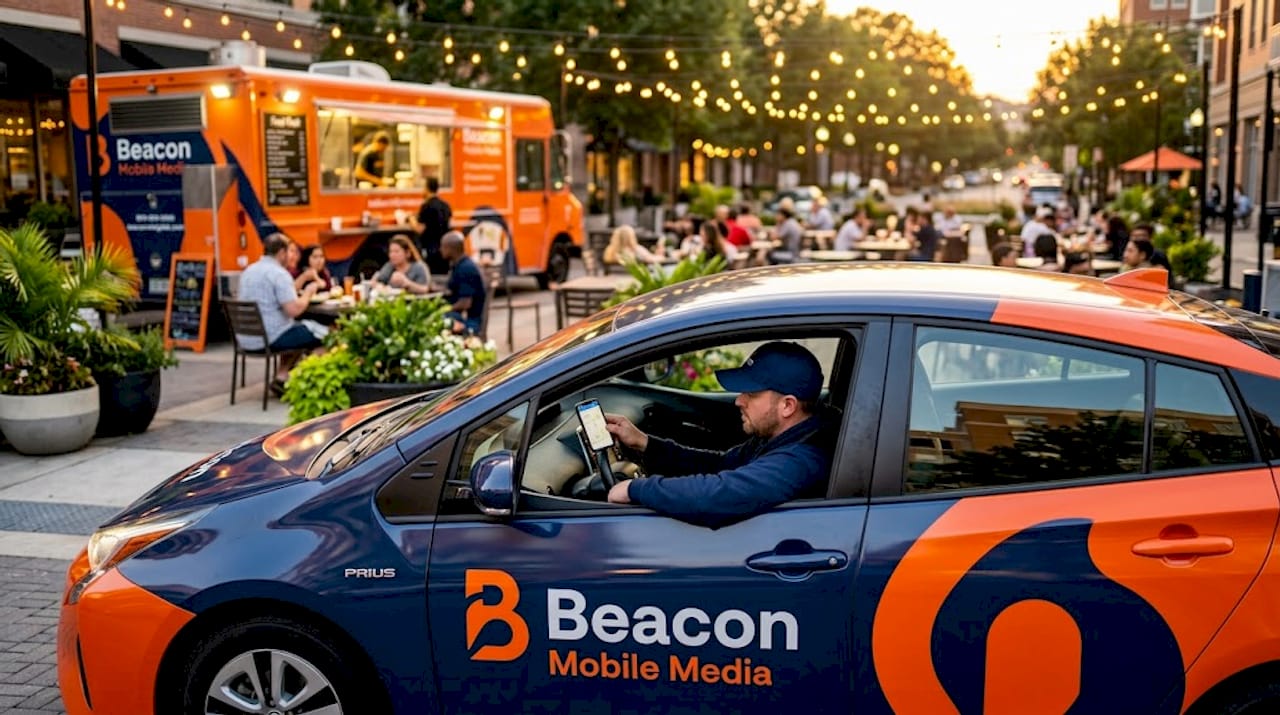
A media truck is a vehicle carrying a large LED digital display that drives programmed routes to deliver outdoor advertising to specific neighborhoods, events, or foot-traffic zones. If your brand needs high-impact visibility tied to a launch, event, or hyperlocal push, a short, well-targeted campaign with built-in measurement is the right move right now.
Before signing anything, confirm three things: GPS proof-of-posting, smart QR codes for lead capture, and attribution analytics that tie exposure to action. Those three separate a real media truck operator from a truck with a screen bolted on.
Your immediate next steps:
- Ask for GPS-verified proof-of-posting from a past campaign.
- Request a sample route map for your target zip codes.
- Get an estimated cost-per-thousand (CPM) impressions figure in writing.
Key Takeaways
A media truck campaign delivers measurable results only when GPS proof-of-posting, route control, and QR-based attribution are built into the vendor agreement from day one.
| Point | Details |
|---|---|
| Definition matters | A media truck pairs an LED digital screen with programmed routes for hyperlocal, high-impact outdoor advertising. |
| Demand proof-of-posting | GPS logs and time-stamped photos are the only way to verify a truck ran its promised route. |
| Specs drive cost | Screen brightness, pixel pitch, and fleet size all affect both visibility and your final invoice. |
| Pair QR codes with retargeting | Scan data plus a retargeting pixel turns a visibility campaign into a trackable lead-generation channel. |
| Choose a measurement-first vendor | Beacon Mobile Media builds proof-of-posting, geofencing, and smart QR capture into every mobile LED truck and rideshare campaign. |
Table of Contents
- How Does a Media Truck Work?
- What Are the Best Uses for a Media Truck Campaign?
- What Fleet Size and Screen Specs Should You Expect?
- How Much Does a Media Truck Campaign Cost?
- How Do You Measure Media Truck Campaign Results?
- What Should You Ask Before Hiring a Media Truck Company?
- What Results Have Marketers Seen From Media Truck Campaigns?
- When Does a Media Truck Make Sense Over Other OOH Tactics?
- How Do You Get a Media Truck Campaign Started?
- Where Can You Find More Technical Background?
- Frequently Asked Questions
- Sources
How Does a Media Truck Work?
A media truck runs on four core components: the LED screen panel, a content player that schedules your creative, a GPS unit for route tracking, and telemetry that logs speed, dwell time, and location stamps. Everything else, the wrap, the generator, the crew, supports those four systems.
A typical campaign moves through five stages:
- Brief. You define audience, geography, and campaign goal.
- Creative. Your team (or the vendor’s) builds static or looping video assets sized to the screen.
- Permits. The operator secures local permissions where required.
- Deployment. The truck runs scheduled routes or parks at high-traffic events.
- Reporting. You receive proof-of-posting, impression estimates, and scan data.
Before hiring, request these specs:
- Screen brightness (measured in nits) for daytime visibility
- Pixel pitch, which determines image sharpness at viewing distance
- Vehicle footprint and turning radius for tight urban routes
- Power source (generator versus vehicle battery draw)
Most campaigns use a mix of static images for quick-glance recall and 10 to 15 second video loops for richer storytelling. Loop length is more relevant in situations where the truck stops or dwells for longer periods.
What Are the Best Uses for a Media Truck Campaign?
Media trucks earn their keep on five fronts: hyperlocal reach, high-impact creative real estate, event amplification, flexible scheduling, and the ability to combine physical visibility with digital retargeting. Unlike a static billboard, the truck goes where the audience already is instead of waiting for the audience to pass by.
The strongest use cases include:
- Grand openings and store launches needing a concentrated local push
- Festivals, concerts, and outdoor gatherings with dense foot traffic
- Conferences and trade shows where attendee density is predictable
- Product sampling tours that pair a truck with an activation team
- Drive-to-store campaigns tied to a specific retail radius
- Guerrilla and experiential stunts built around a single striking visual
Industry-cited estimates suggest mobile LED units can generate meaningfully higher recall than static roadside boards, largely because motion and novelty capture attention that a fixed panel can’t. Treat vendor-specific recall numbers as directional, not guaranteed, until you’ve run your own test.
Pro Tip: Pair a QR code on the truck’s screen with a retargeting pixel on your landing page. That combination lets you track who scanned, then follow up with digital ads to close the conversion loop days later.

What Fleet Size and Screen Specs Should You Expect?
Fleet size and screen specifications drive both your impression count and your final invoice, so nailing them down before you sign is the highest-leverage negotiation you’ll have. A single truck running one dense route delivers different results than three trucks saturating a metro over the same week.
Expect these ranges when comparing vendor proposals:
- Truck lengths typically run from van-based units to larger box trucks, with broadcast-industry production platforms showing how much variation exists across the mobile vehicle category generally.
- Screen dimensions vary by vendor, but larger panels increase visibility at distance and in daylight.
- Pixel pitch affects clarity up close; a tighter pitch matters more for pedestrian zones than highway routes.
- Brightness in nits determines whether your creative reads clearly at noon versus after dark.
Coverage decisions matter as much as specs. A single-city saturation play differs entirely from a multi-city rotation, and route dwell time (trucks parked at an event) generates different exposure than drive-by impressions on a moving route. Always ask your vendor to confirm who handles local permitting, since ordinances on vehicle advertising and parking vary by municipality.
How Much Does a Media Truck Campaign Cost?
Media truck pricing typically follows one of three models: a daypart or route-hour rate, a flat campaign fee for a set duration, or a CPM-style estimate based on projected impressions. None of these is inherently better. The right one depends on whether your goal is sustained presence or a tight event window.
Cost drivers to ask about upfront:
- Fleet size and number of trucks running simultaneously
- Dayparts covered (morning commute versus weekend evening)
- Geographic scope, since modular truck platforms with more power and rack capacity cost more to operate and permit
- Creative production, especially if you need custom video built from scratch
- Crew and logistics for driver hours and route supervision
- Measurement add-ons like retargeting or scan analytics
A realistic planning checklist looks like this:
- Lock creative at least two to three weeks before launch.
- Confirm permit windows with your vendor’s local contacts.
- Schedule production and truck setup a few days ahead of go-live.
- Run the campaign across the agreed dayparts and routes.
- Collect post-campaign reporting within a week of the final run.
Ask every vendor for a line-item cost breakdown, not a bundled quote. That’s the only way to compare CPM across proposals honestly.
How Do You Measure Media Truck Campaign Results?
Insist on GPS proof-of-posting paired with time-stamped photos and route telemetry before you approve any invoice. Without that combination, you’re paying for a truck’s word that it drove where it says it did.
A complete reporting package should include:
- The impressions estimation methodology, not just a final number
- GPS route logs showing exact streets and timestamps
- Dwell-time estimates for parked or event-based placements
- QR-scan data tied directly to the campaign window
- Mobile retargeting reach, if your vendor offers pixel-based follow-up
Ask for these specific metrics in every report: estimated impressions, the viewability window (hours the truck was active in-market), scan and click counts, and, where the vendor can access it, store visit uplift.
Proof-of-posting is the paper trail that ties your invoice to actual delivery. Without GPS logs and photo timestamps, there’s no way to confirm the truck ran the promised route on the promised schedule. That documentation is also what separates a defensible attribution report from a vendor’s unverified claim.
What Should You Ask Before Hiring a Media Truck Company?
Prioritize vendors who can prove three things: measurable results, control over the actual route, and real audience-targeting capability. Everything else, the sales pitch, the polished deck, matters less than whether they can back up their numbers.
Ask every vendor these questions directly:
- What are your exact fleet specs, and can I see a sample route map for my zip codes?
- What does your proof-of-posting process actually capture?
- How often will I receive reporting, and can I access raw data, not just a summary PDF?
- Do you handle local permitting, or is that my responsibility?
Watch for these red flags:
- No GPS or photo proof offered as standard practice
- Vague language around “impressions” with no methodology explained
- No mention of permit support in your target market
- Reach or recall claims that sound too clean to verify
Trust signals worth weighing: documented case studies, client references you can actually contact, transparent line-item pricing, and a written service-level agreement covering reporting turnaround. A vendor’s willingness to commit reporting cadence to paper tells you more than any pitch deck.
What Results Have Marketers Seen From Media Truck Campaigns?
A regional retailer running a grand opening pushed a three-day route saturation campaign in a five-mile radius and tracked a measurable jump in first-week foot traffic tied to QR scan data from the truck’s screen. A conference sponsor parked a truck outside a convention center for two days and logged several hundred scan-driven landing page visits, more than their static banner ever generated. A local service business ran a two-week neighborhood route and used geofenced retargeting to follow up with everyone who passed near the truck, converting a portion into booked consultations.

Achievable KPIs across these formats typically include scan rate, verified impressions from GPS logs, and foot-traffic uplift near activation zones. Beacon Mobile Media keeps proprietary client campaign details anonymized here to protect customer confidentiality.
When Does a Media Truck Make Sense Over Other OOH Tactics?
I recommend a media truck when you need concentrated visibility tied to a date, a neighborhood, or an event, rather than broad, sustained awareness better served by fixed billboards. The mobility is the point.
Two things move the needle most: pairing dayparting with your event’s actual schedule, and layering QR capture on top of every placement so the truck does double duty as a lead-generation tool. Beacon’s route customization and proof-of-posting mean you’re not just buying visibility, you’re buying a documented, auditable campaign.
How Do You Get a Media Truck Campaign Started?
Beacon-ads runs mobile LED truck campaigns and wrapped rideshare programs (Uber, Lyft) across all 50 states, built around the same measurement standards this article just walked through: GPS proof-of-posting, geofencing, real-time retargeting, and smart QR code capture built into every route.

That last piece, the QR integration, is what turns a visibility play into a lead-generation channel. Every scan feeds directly into your attribution reporting, so you’re not guessing at recall, you’re counting actual engagement. Combine that with route customization for your exact target zip codes, and you get a campaign built around your goals rather than a generic city-wide loop.
If you’re ready to see what a route plan and cost estimate look like for your market, start with Beacon’s out-of-home advertising guide or request a proposal directly through Beacon Mobile Media to get fleet availability and a sample route for your target area.
Where Can You Find More Technical Background?
- Production truck overview: general specs on mobile production vehicle classes.
- Rolling Unit OB van specs: compact unit dimensions and deployment times.
- MU-16 technical specs: high-end production truck power and workflow details.
Frequently Asked Questions
How long do media truck ads typically run?
Most campaigns run anywhere from a single day for an event activation to several weeks for sustained neighborhood coverage. The right duration depends on whether your goal is a one-time push or ongoing local presence.
How much does a media truck cost?
Pricing depends on fleet size, dayparts, geography, and whether you need custom creative production. Request a line-item breakdown from any vendor so you can compare CPM estimates apples-to-apples.
Are media truck campaigns profitable?
Profitability depends on tracking the right metrics: scan rates, retargeting conversions, and foot-traffic uplift near your activation zones. Campaigns that skip measurement can’t answer that question at all.
What exactly is a media truck?
A media truck is a vehicle equipped with a large LED digital screen that displays advertising content while driving programmed routes or parking at high-traffic events, combining outdoor visibility with digital-style targeting and reporting.