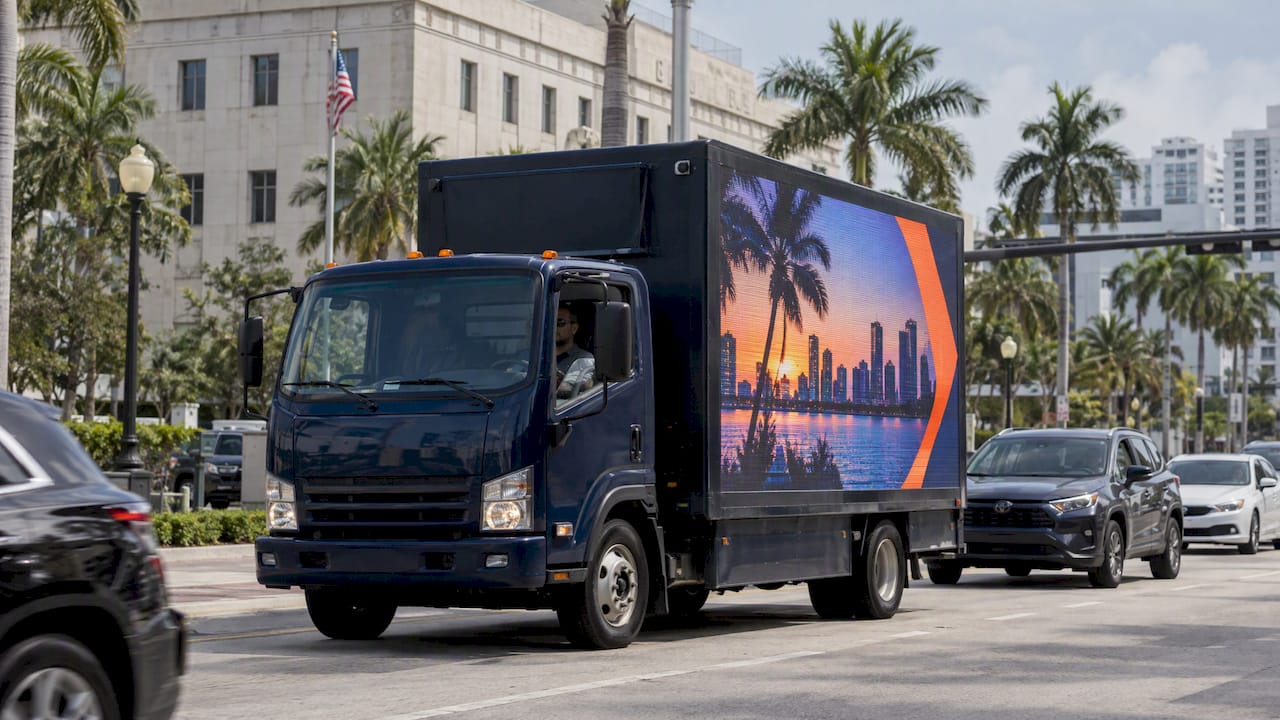
Static vinyl trucks run roughly $500 to $1,800 per day, while LED trucks typically cost $1,200 to $3,500 per day depending on market and screen spec. Most campaigns of shorter duration should rent; longer-term or very frequent use starts to favor ownership. Either way, budget extra for attribution if you want proof your spend actually worked.
TL;DR:
- Renting a static vinyl truck ranges from $500 to $1,800 daily, while LED trucks typically cost $1,200 to $3,500 per day, with discounts for longer commitments.
- Market location, route density, hours, and exclusivity significantly influence campaign pricing, often adding surcharges for major metros or special routes.
- Long-term use usually justifies ownership costs, which can range from $18,000 to over $145,000 depending on the vehicle type and features.
- Additional costs such as insurance, permits, staffing, and maintenance can add thousands annually, making rentals cheaper for short or infrequent campaigns.
- Campaign measurement with attribution features like geofencing and device retargeting is essential for tracking actual ROI, especially for conversion-focused objectives.
Table of Contents
- How Much Does A Mobile Billboard Cost Per Day, Week, And Month?
- What Drives The Price Of A Mobile Billboard Campaign?
- What Hidden Costs Come With Mobile Billboard Advertising?
- Should You Rent Or Buy A Mobile Billboard Truck?
- How Do You Measure ROI On A Mobile Billboard Campaign?
- What Should Go In A Mobile Billboard Advertising Quote Request?
- Where Does Beacon-ads Fit Into A Measurable Mobile Billboard Budget?
- What Actually Separates A Good Mobile Billboard Campaign From A Wasted One?
- Ready To Get A Quote With Real Attribution Built In?
- Sources
How Much Does A Mobile Billboard Cost Per Day, Week, And Month?
Rates hinge on format, and the gap between a plain vinyl wrap and a full LED rig is bigger than most first-time buyers expect. A static box truck with printed vinyl panels typically runs $500 to $1,800 per day in most markets, and that range holds whether you’re wrapping a single panel or going three-sided. LED/digital trucks cost more to operate, so day rates commonly land between $1,200 and $3,500, with the top of that band reserved for major metro markets and rush bookings.

Multi-day commitments bring the effective daily rate down noticeably. Weekly LED truck bookings often fall between $5,500 and $11,000, which works out to roughly $800 to $1,570 per day, a real discount off the single-day rate. Monthly contracts push that per-day number even lower, since operators would rather lock in predictable revenue than chase one-off bookings.
Lower-cost formats exist for smaller budgets. Towable trailers and pedestrian or bike-mounted billboards can run a few hundred dollars a day, making them a workable entry point for local businesses that can’t justify a full truck buy.
- Vinyl box truck: $500 to $1,800/day; $3,000 to $9,000/week; $9,000 to $28,000/month
- LED/digital truck: $1,200 to $3,500/day; $5,500 to $11,000/week; $16,000 to $35,000/month
- Towable trailer: $400 to $1,200/day; $2,000 to $6,000/week
- Pedestrian/bike billboard: $150 to $600/day
| Format | Day rate | Weekly rate | Monthly rate |
|---|---|---|---|
| Static vinyl truck | $500 to $1,800 | $3,000 to $9,000 | $9,000 to $28,000 |
| LED truck | $1,200 to $3,500 | $5,500 to $11,000 | $16,000 to $35,000 |
| Towable trailer | $400 to $1,200 | $2,000 to $6,000 | Varies by market |
| Pedestrian/bike billboard | $150 to $600 | $500 to $1,800 | Varies by market |
Expect a premium on top of any of these numbers for major-metro launches, event weekends, or routes with limited parking, since market tier and lead time drive real surcharges that quotes don’t always spell out up front.
What Drives The Price Of A Mobile Billboard Campaign?
Two campaigns with identical vehicle types can land $2,000 apart, and the reason almost always traces back to five factors.
Market and route density matter more than most buyers assume. A truck circling downtown Chicago during rush hour costs more to book than the same truck parked at a suburban strip mall, because the operator is trading away higher-value inventory to serve you.
Hours of operation and exclusivity also move the number. A standard 6 to 8 hour day is the baseline; asking for extended hours, overnight parking at a venue, or exclusive category rights (no competitor trucks in the same market during your run) adds a line item.
Vehicle engineering explains most of the static-versus-LED gap. Higher-grade LED chips, IP65 or better waterproofing, and hydraulic lift mechanisms all raise both the purchase price and the day rate an operator needs to charge to recoup it.
- Creative production (design, animation, video editing) is billed separately from print and install
- Permits for certain cities or restricted zones can add a flat surcharge per booking
- Route guarantees and impression reporting sometimes carry their own fee tier
Pro Tip: Ask every vendor to break out the creative fee from the media fee on your quote. Bundled pricing hides which part you’re actually negotiating.
What Hidden Costs Come With Mobile Billboard Advertising?
The quoted day rate is rarely the full story, especially if you’re evaluating a long-term contract or considering buying a truck outright instead of renting one.
Insurance is the first line item people forget. Commercial auto and advertising liability coverage for a mobile billboard typically runs $3,000 to $7,000 annually, and that cost gets baked into every rental quote whether the vendor itemizes it or not.
Driver staffing is the second. Full-time drivers for a fleet vehicle cost $35,000 to $55,000 a year in wages, which is why short campaigns almost always make more financial sense as rentals than as owned assets.
- Generator and fuel maintenance for LED trucks: roughly $4,000 to $9,000 per year
- Post-warranty LED module repairs: replacement panels can run several hundred dollars each
- City licensing and annual permits: $2,000 to $10,000+ depending on jurisdiction
- Storage and truck maintenance: often overlooked in early budget drafts
Digital inventory skips the print and install fees a vinyl wrap requires, but that savings gets offset by power and content-ops costs that static formats simply don’t have.
Should You Rent Or Buy A Mobile Billboard Truck?
The math here is simpler than it looks once you know the break-even point most operators use internally.

Renting wins for almost any campaign under roughly 60 to 90 booked days per year. Above that threshold, ownership starts to pencil out, because the fixed costs (insurance, driver, storage) get spread across more revenue-generating days.
Here’s a rough comparison for a single vehicle:
- Rental math: A 6-hour day at $1,500 for a static truck, run 20 days a year, costs $30,000 total, with zero maintenance or insurance exposure for you.
- Ownership math: A vinyl box truck costs $18,000 to $40,000 to buy outright, plus $10,000 to $20,000 a year in insurance, driver pay, fuel, and storage, before you’ve booked a single client.
- LED ownership math: LED trucks run $90,000 to $145,000 new, with high-end trailer and tri-vision rigs reaching $250,000 or more, which only makes sense if you’re running your own agency and booking that truck out most weeks of the year.
If you’re leaning toward buying, most operators recommend keeping 4 to 6 months of operating capital in reserve beyond the purchase price. That reserve covers slow booking months without forcing a fire sale on your rates.
How Do You Measure ROI On A Mobile Billboard Campaign?
Cost only means something next to a number that tells you what you got for it. Start with impressions: multiply your truck’s daily route mileage by average traffic counts along that route, then divide total campaign cost by impressions in thousands to get your CPM.
Mobile OOH tends to land in the $7 to $18 CPM range, which puts it in a comparable tier to targeted digital display, but with the advantage of a physical presence people actually remember.
- GPS proof-of-posting confirms your truck ran the promised route and hours, usually included in the base rate
- Geofencing tracks foot traffic or app opens near your route, typically an add-on fee
- Device-ID retargeting serves digital ads to phones that were near your truck, the priciest but most trackable upgrade
Campaigns tied to a specific conversion event (a store opening, a conference booth, a limited-time offer) benefit most from device-ID retargeting, since you can connect the physical impression to an actual click or visit days later.
Pro Tip: If your budget only stretches to one attribution upgrade, pick geofencing over device-ID retargeting for brand awareness campaigns and device-ID for anything with a hard conversion goal.
What Should Go In A Mobile Billboard Advertising Quote Request?
A vague quote is how budgets blow past their target. Before you sign, confirm these items in writing:
- Exact hours per day, route guarantee, and whether you get market exclusivity from competitors
- Impressions methodology (how the vendor counts them, not just the final number)
- LED chip grade, IP rating, and warranty terms if you’re booking digital inventory
- Whether creative design, print, and install are included or billed separately
- Who covers permit fees and insurance, and whether those are itemized or bundled
Negotiation levers worth pushing on include total hours, campaign duration (weekly and monthly discounts are almost always available), and whether measurement add-ons can be bundled at a lower combined rate than buying them separately.
Watch for red flags: a vendor who can’t explain their impressions math, skips warranty details on LED panels, or won’t confirm a weatherproof rating in writing. Those gaps tend to show up as disputes later.
Where Does Beacon-ads Fit Into A Measurable Mobile Billboard Budget?
Once you’re paying LED-truck rates, you should expect LED-truck accountability. That’s the gap a data-driven partner closes.
A company runs LED mobile billboards and wrapped rideshare vehicles (including rideshare platforms) across many states, paired with geofencing and device-ID retargeting so the truck’s route connects directly to measurable engagement. Smart QR codes on the vehicle itself capture scans in real time, turning a passive drive-by into a lead you can follow into your funnel.
- Nationwide LED truck and rideshare wrap coverage
- GPS-based proof-of-posting so you can verify the route actually ran
- Geofencing and device-ID retargeting for post-impression conversion tracking
- Smart QR code integration for direct data capture
- Attribution analytics and reporting built into the campaign, not sold as an afterthought
Paying more for these capabilities makes sense once your campaign has a real conversion goal attached, not just a brand-awareness impression count. If your objective is a trackable lead or a store visit, the extra line item is what makes the spend defensible to your finance team.
What Actually Separates A Good Mobile Billboard Campaign From A Wasted One?
Route quality, honest measurement, and a seller who answers hard questions before you sign, that’s the whole game. Most budget overruns trace back to skipping one of those three.
Two tactical notes worth remembering: always ask for the weekly rate even if you only need three days, since some vendors will quote it anyway if it’s close to their minimum booking. And never let a vendor round impressions up without showing you the traffic count source behind the number.
If measurement matters to your campaign, ask any vendor you’re considering for a quote that includes attribution pricing broken out separately, not folded into the media rate.
— Scott
Ready To Get A Quote With Real Attribution Built In?
Most mobile billboard vendors will hand you a day rate and a route map. Beacon-ads hands you that same route, plus proof it ran, plus a way to see who engaged with it after the truck drove past. That’s the concrete difference between paying for exposure and paying for a measurable result.

When you request pricing, ask for the same three things every time so quotes are actually comparable: the hourly and route breakdown, the attribution options available (geofencing, device-ID retargeting, smart QR codes), and how proof-of-posting gets delivered after the campaign wraps. Beacon-ads builds all three into its out-of-home advertising formats, whether you’re running a single LED truck or a wrapped rideshare fleet nationwide. Reach out for a quote scoped to your market and duration, and you’ll have real numbers to compare against anything else in your budget.
Sources
- How do you start a mobile billboard advertising business in 2027?
- LED Billboard Truck Cost 2026: Prices, Specs & Buyer Guide – SoStron