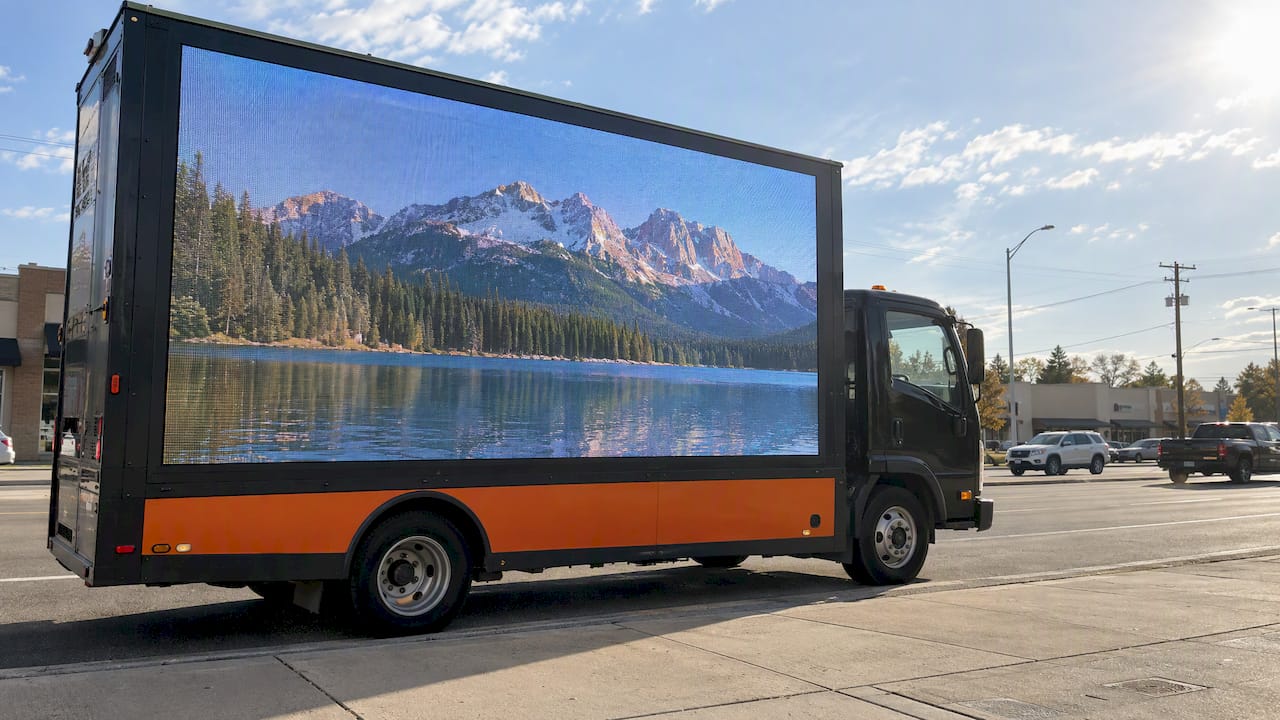
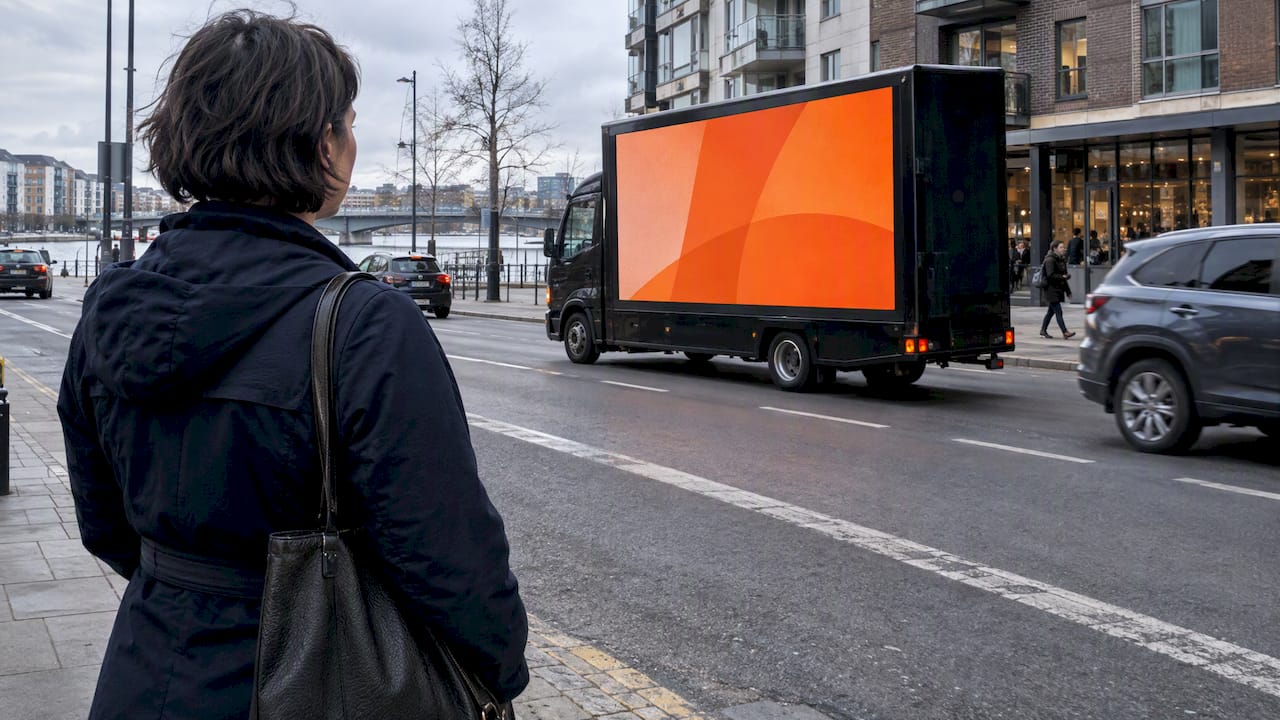
A convention-week mobile billboard is an LED truck or wrapped rideshare car that follows the paths attendees take between the show floor, their hotels, restaurants and evening venues. It works because it reaches people where a booth cannot: in the hours when they are outside the hall. To run one well, you need a route built around attendee movement, a permit check for the host city, and tracking set up before the first truck rolls. The planning order below applies to Las Vegas, which most searchers have in mind, and to any other show city.
TL;DR
- A convention-week campaign covers the show’s surroundings: the venue approaches, the host hotels and the dining and entertainment areas attendees walk or ride through.
- Build routes around the attendee day (morning arrival, lunch, evening), not around a single street.
- Rules differ by city and county. Las Vegas rules sit in Clark County’s mobile-billboard ordinance, so confirm licensing before you book.
- Decide what you will measure (QR scans, geofenced visits, booth traffic) before launch, and read the numbers as directional evidence rather than proof of every sale.
- Start planning early. Trucks, drivers and good time slots are tightest during the biggest shows.
Table of Contents
- What a convention-week mobile billboard campaign is
- Where attendees actually move
- How to plan timing and routes
- Permits and local rules
- What drives the cost
- Measuring results, and reading them honestly
- How far ahead to plan
- Perspective
- Plan your convention-week campaign with us
- FAQ
- Sources
What a convention-week mobile billboard campaign is
A trade show concentrates thousands of buyers, partners and competitors in one place for a few days. Almost every exhibitor is shouting at the same audience inside the hall. A mobile billboard moves the conversation outside it.
There are two main formats:
- LED billboard trucks. A large digital screen on a truck that drives a planned loop. Creative can change by hour or by day, so a morning message about your booth can become an evening message about a party or demo.
- Wrapped rideshare vehicles. Cars wrapped in your creative and driven by Uber or Lyft drivers through the normal flow of passengers. These cover the airport, hotel and venue corridors that attendees use constantly.
Many advertisers combine both. The truck delivers the big, high-impact moments near the venue, and the rideshare cars add steady coverage across the wider area. We run both formats nationwide, which is why we plan them as one campaign instead of two separate buys.
Why Las Vegas dominates the conversation
Las Vegas is the market people think of first, and the reason is spending behavior as much as show volume. A Clear Channel Outdoor executive writing in The Drum cited LVCVA data from 2022 estimating that many eventgoers, gamers, clubbers and business travelers spend an average of over $1,000 per trip. Visitors who are already in a spending mindset, away from their desks and moving between venues, are a receptive audience for an offer, an invitation or a reminder to stop by your booth.
The same logic holds in Orlando, Chicago, Atlanta, Anaheim and every other city with a major convention center. The Las Vegas detail below is a worked example you can adapt.
Where attendees actually move
The mistake we see most often is treating the convention center as the only target. Attendees spend a large part of the day elsewhere. A useful way to think about it is the attendee day:
| Time of day | Where attendees are | What the campaign should do |
|---|---|---|
| Early morning | Hotels, shuttle stops, rideshare pickups | Reinforce your booth number and what you are showing |
| Midday | Venue approaches, nearby restaurants, food courts | Drive traffic to a specific demo, meeting slot or giveaway |
| Late afternoon | Leaving the show floor, heading back to hotels | Promote an evening event, hosted dinner or happy hour |
| Evening | Dining and entertainment districts | Invite people to a party, a suite or a next-day meeting |
In Las Vegas, that picture is shaped by geography. Industry guides on Strip advertising point to the Center Strip, where the resorts sit within easy reach of the Las Vegas Convention Center, the Venetian Expo and Caesars Forum, as a place where decision-makers walk between restaurants, shows and attractions. Hosts of large conferences also book blocks of rooms at properties near the convention center, so those hotel corridors matter as much as the hall itself.
The practical takeaway: map the three or four places your specific audience will be, not every place attendees could be. A cybersecurity buyer and a consumer-electronics retailer attending the same week may sleep and eat in different parts of town.
How to plan timing and routes
Start with the show schedule
Pull the official show agenda. Note when the floor opens, when it closes, when keynotes end and when the biggest crowds leave. Peak foot and vehicle traffic follows those moments, and your truck should be at the right place just before them, not during them.
Build loops, not lines
A good route is a loop that passes your target points repeatedly, so the same attendee sees the message more than once in a day. Frequency is what turns a glance into recall. Keep loops short enough that the truck returns to each key corner often, and avoid routes that depend on one street that may be closed or jammed during the busiest hours. Our guide to planning billboard truck routes walks through how we balance coverage, traffic and dwell time.
Allow for convention-week traffic
Show weeks are slow on the roads. Shuttles, taxis, rideshare pickups and street closures change the speed of a truck loop from one hour to the next. Build in buffer time, and plan a backup route for each key block. A truck that is stuck in a standstill near the hall still delivers impressions to the people on foot around it, but a loop that never completes does not.
Change the creative through the week
Opening day, mid-show and the final afternoon call for different messages. Day one is for awareness and booth location. Midweek is for meetings and demos. The last day is for last-chance offers and follow-up prompts. LED screens make this easy, and it is one of the strongest arguments for digital trucks over static formats.

For a deeper walkthrough on show-specific targeting, see our guide on targeting conferences and trade shows with LED mobile billboards and our trade show advertising checklist.
Permits and local rules
Mobile billboards are regulated differently in almost every city and county, and getting this wrong can mean fines or an impounded vehicle in the middle of your show. Plan for compliance before you plan creative.
In unincorporated Clark County, Nevada, which includes the Las Vegas Strip, Chapter 7.95 covers mobile-billboard business licensing, operating requirements, fees and penalties, and allows animation in certain areas of the county. The Las Vegas Review-Journal reported when the rules were adopted that they regulate licensing, traffic operation and storage, and require operators to submit an annual report detailing citations. The practical point for you: use an operator that holds the right license for the area you want to cover, and ask where animated content is permitted on your planned route.
Rules in other cities can be stricter or more restrictive still. Some cities cap hours, restrict zones or limit screen content. Our resources on mobile billboard permits across the U.S., mobile billboard laws and impoundment risk and ad truck compliance and proof requirements cover what to confirm in an RFP. For rideshare, review the rideshare advertising policies that apply before you finalize creative.
Always verify current rules with the county or city office and your operator before the show, since ordinances can change.

What drives the cost
We do not publish set prices, because convention-week campaigns vary too much for a single number to be honest. The main drivers are:
- Number of vehicles. One truck on a tight loop is a different investment from a fleet plus rideshare cars.
- Hours per day and number of days. Longer daily coverage and more show days raise the total.
- Format mix. LED trucks and wrapped rideshare cars are priced differently. Our overview of rideshare wrap cost explains the line items to look for.
- Geographic spread. A compact loop around one hall costs less to run than coverage across several districts.
- Digital add-ons. Geofencing, retargeting, smart QR codes and attribution reporting add setup and management.
- Timing and demand. Show weeks are in demand, and the biggest events tighten availability.
- Creative production. Several rotating messages require more design work than one static message.
When you compare quotes, make sure each one lists the same hours, vehicles, permits, reporting and creative changes. A quote that looks cheaper often leaves out something you will pay for later.
Measuring results, and reading them honestly
Mobile billboards used to be hard to measure. That has changed, but it pays to know what each measure tells you.
- Proof of posting. GPS records and photos confirm that the truck was where and when it was supposed to be. This is the baseline for any campaign and gives you a documented record of what you paid for.
- Smart QR code scans. A scan is a direct action by a person who saw the ad, and it can capture lead data. It is the cleanest signal, though not everyone who sees an ad will scan it, particularly from a moving vehicle.
- Geofencing and retargeting. Digital audiences built around the venue and host hotels let you follow up with people who were near the show. Treat this as an estimate of exposure and interest.
- Booth and meeting attribution. Ask visitors how they heard about you, use a unique offer code, or track meeting bookings against the days the truck ran.
The limit is that outdoor media is seen by many people who never act in a measurable way. A scan count will understate awareness, and an exposure count will overstate intent. Pick two or three metrics before launch and compare them with a baseline from a previous show. Our guide on proving mobile billboard effectiveness outlines a two-week approach.
Extend the reach beyond the street
What happens after someone sees your truck matters. Many attendees will search for your company on their phones, and nearby searches on maps are a natural next step. Making sure your listing is current helps those searches convert, and Google Maps local search ads are one way to reach high-intent people near a location. Coordinate those with your truck schedule so the street message and the search result tell the same story.
How far ahead to plan
Begin as soon as your show participation is confirmed. In practice, that means:
- Several months out: pick the show days, the target zones and the formats, and confirm your budget range.
- Two to three months out: lock the operator, review permits for the area, and start creative.
- Four to six weeks out: approve route maps, QR landing pages and tracking setup.
- Final weeks: finalize message rotation, brief your booth staff on the offer, and confirm the schedule.
We offer short lead times on many campaigns, but the biggest shows book up, and rushed creative and untested QR pages are the most common reasons a campaign underperforms. Earlier is safer.
Perspective
Most exhibitors spend heavily to get a booth and then leave the rest of the attendee’s day to chance. We think that is where mobile out-of-home earns its place.
What we have built is a way to put a physical, high-impact message in the path of the people you want, and then connect it to data. LED trucks give you the big moment near the venue. Wrapped rideshare cars give you the quiet, repeated presence across the places attendees ride. Geofencing, real-time retargeting and smart QR codes tie both back to leads, and proof-of-posting and attribution reporting show you what ran and what it did.
Our advice is to plan the route around your buyer’s day, keep the message simple enough to read at a glance, and decide what you will measure before the first truck moves. Do that, and convention week becomes a campaign you can evaluate, not just a cost you absorb.
Scott
Plan your convention-week campaign with us
Beacon Mobile Media runs LED mobile billboards, wrapped rideshare cars and localized mixed-media campaigns in all 50 states. We combine route customization, audience filtering, geofencing, real-time retargeting and smart QR code lead capture with proof-of-posting and attribution reporting, so you can see what ran and what it produced.

If you have a show on the calendar, talk to our team about a convention-week campaign and we will help you map the route, the creative and the reporting.
FAQ
Do mobile billboards work for trade shows?
They can, because they reach attendees in the hours they spend outside the hall: travelling, eating and heading to evening events. The strongest campaigns tie the message to a clear action, such as a booth visit, a demo slot or a QR code scan, and track that action.
Do I need a permit for a mobile billboard in Las Vegas?
In unincorporated Clark County, the county’s mobile-billboard ordinance covers business licensing, operating requirements, fees and penalties. Your operator should hold the proper license for the areas you want to cover. Confirm current requirements with Clark County before the show.
Should I use an LED truck or rideshare cars?
It depends on your goal. LED trucks deliver a large, changeable message on a planned loop near the venue. Rideshare cars give continuous coverage across hotel, airport and dining corridors. Many convention campaigns use both.
How do I know the campaign worked?
Use proof-of-posting records to confirm delivery, smart QR scans and landing page visits to see direct response, and booth or meeting data to see impact on the show floor. Agree the metrics and a baseline before launch.
How early should I book?
As soon as your participation is confirmed. Major show weeks are in demand, and early planning leaves time for permits, route testing and creative approval.
Sources
- What Happens in Vegas Doesn’t Always Stay in Vegas, The Drum
- Mobile billboard update, Clark County, NV
- Clark County adopts mobile billboard rules on Las Vegas Strip, Las Vegas Review-Journal