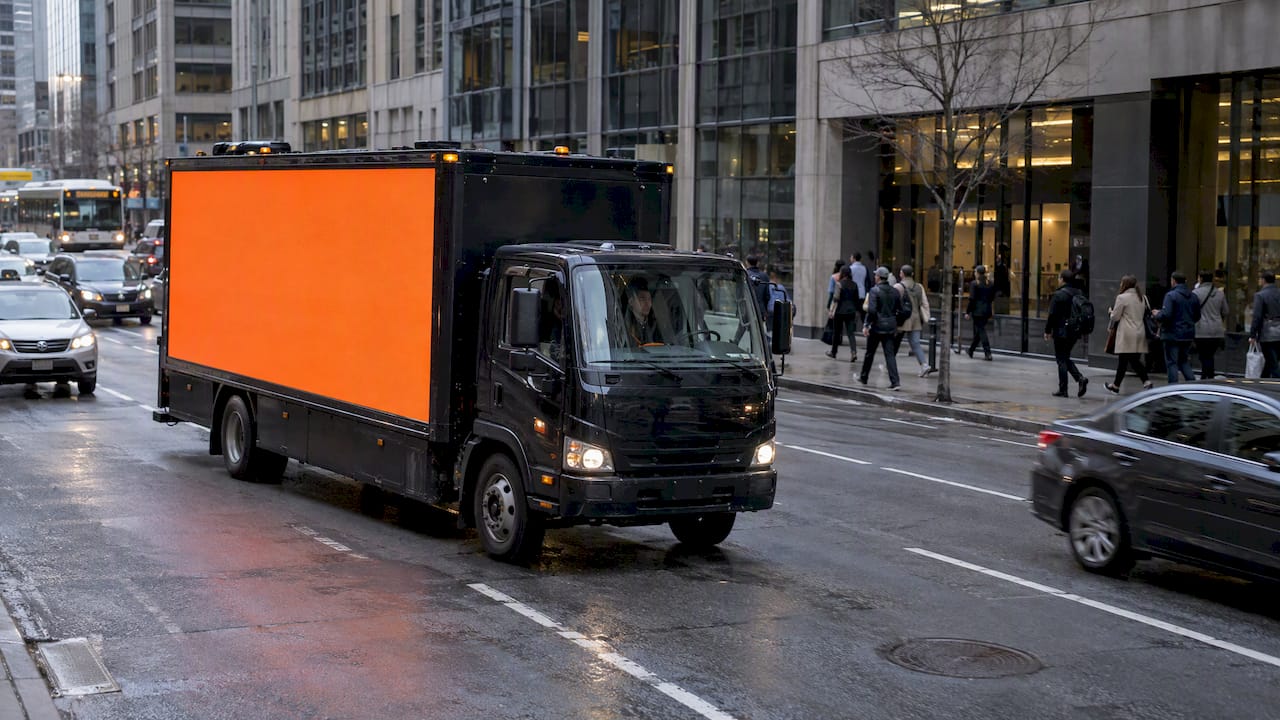
Photo verification ads are photographic proof that a mobile billboard ad was actually posted or displayed. Require negotiated photo proof in your contract, specifying type, volume, quality, and delivery timing. For digital displays, accept affidavits or webcam access instead, as industry guidance allows.
TL;DR:
- Treat photography as a billable service: specify installation, rotation, or sales photos, quantity, technical quality, delivery deadline, and remedies in the contract.
- Choose per unit photos for small fleets and representative samples for large rotations, since photographing every unit can add cost without useful evidence.
- For digital displays, request affidavits, play logs, or webcam access instead of photos; industry standards recognize affidavits as valid posting proof.
- Keep original files with timestamps and GPS metadata when available, then compare proof against route or dispatch records and log file receipt.
Table of Contents
- Why photo verification matters for mobile and out-of-home campaigns
- Types of photo verification and when photos aren’t the right proof
- Contract checklist: exact photo verification language to include in your SOW
- A practical workflow for collecting, verifying, and archiving photo proof
- Why negotiated photo proof makes campaigns better
- How we support verified photo proof and reporting
- FAQ
- Sources
Why photo verification matters for mobile and out-of-home campaigns
When you buy photo verification ads, you are buying evidence, not just impressions. Photos are how your team confirms the campaign ran as sold, and how finance confirms the invoice matches reality. OAAA’s photography best practices list the reasons buyers ask for them:
- Proof of installation: the ad physically went up on the vehicle or unit you paid for.
- Correct creative: the copy posted is the approved version, not an outdated file.
- Correct location: the unit sits where the contract says it should.
- Installation quality: the substrate material was applied properly, with no peeling or bubbling.
- Inventory match: what you purchased lines up with the sales sheet.
Those images then feed proof-of-performance reporting and your post-buy analysis. Without them, a report is just a vendor’s word.
There is a cost angle too. OAAA business guidelines treat photography as a billable service, and they advise buyers to negotiate the volume, type, and quality of photos in the campaign contract. Asking for a photo of every unit on every day sounds thorough, but it can inflate costs for evidence you will never review. Scope the proof to your reporting needs and your budget.
Types of photo verification and when photos aren’t the right proof
Not every photo serves the same purpose, so know which kind you are asking for:
- Sales (approach) photographs: taken by staff or contractors and used as collateral to show what a placement looks like. Vendors update them periodically, per OAAA’s standard business practices.
- Installation photographs: taken by the crew at completion. They are typically emailed or uploaded to a portal within an agreed window after posting.
- Rotation photographs: captured during the campaign, as negotiated, so you can see how the creative holds up over time.
You also have a choice between photographing every unit and a representative sample. A small fleet may justify per-unit photos. A large rotation often does not. Decide that in the contract, not after the campaign starts.
Digital formats are the clear exception. Photos are not typically provided for digital billboards. OAAA’s guidance points to affidavits, play logs, or webcam access instead. The MRC out-of-home measurement standards define an affidavit as legitimate proof of posting. If you are mixing formats, our guide to types of out-of-home advertising shows where each one fits.
Contract checklist: exact photo verification language to include in your SOW
Copy these items into your statement of work and adjust the details to your campaign:
- Photo types required. Name each one: installation photos, representative rotation photos, and sales approach photos.
- Quantity and sampling rules. State whether you need photos per unit, per rotation, or a representative sample.
- Delivery timing. For example, “installation photos delivered within an agreed window after posting.”
- Technical specs. Set minimum resolution, file format, and permitted cropping. Industry practice is that photographs stay unaltered except for nominal cropping. Add original timestamps and GPS coordinates in the metadata if you want them.
- Delivery method. Specify a secure portal, emailed files, or a proof-of-performance link with credentials.
- Report fields. Require that photos arrive inside a report that follows the fields in OAAA’s sample proof-of-performance report: report dates, campaign details, unit counts, photograph or validation fields, and an authorized signature.
- Acceptance criteria and remedies. Define what counts as an acceptable photo, who decides, and what happens if photos are late, unreadable, or missing: a re-shoot, a credit, or withheld payment.
- Digital clause. For digital units, require affidavits, play logs, or live webcam access instead of photographs.
Pro Tip: Attach one sample photo that you consider acceptable to the SOW as an exhibit. It ends arguments about “quality” before they begin.
A practical workflow for collecting, verifying, and archiving photo proof
A contract only helps if someone checks what arrives. Here is a workflow your team can run:
- Assign owners and deadlines. One person receives proof, one reviews it, and both know the delivery window from your SOW.
- Keep unedited originals. Retain the original files with timestamp and GPS metadata where available, and store any cropped versions separately.
- Centralize storage. Use one secure folder or proof portal with a consistent naming convention, such as campaign, unit ID, and date, plus access controls. OAAA planning guidance notes that proof-of-performance reports and online portals let buyers and sellers communicate execution details quickly.
- Spot-check against other records. Compare photos to route logs, dispatch records, and QR scan data. A photo of a truck downtown means little if the route log says it was elsewhere. Our data-driven out-of-home strategies guide covers how to combine these sources.
- Preserve an audit trail. Log who received each file, when, and from whom, so you can defend the record in a billing dispute.
- Verify digital spots separately. Check affidavits and play logs against vendor reporting or webcam captures. For deeper background, see our piece on digital out-of-home advertising.
Pro Tip: Line up your verified OOH dates with your paid social windows. This Meta Ads structure guide is a useful reference for matching channels during reconciliation.
Why negotiated photo proof makes campaigns better
Our view is simple: scope the photos to match how you will use them. If you only need to prove installation and creative accuracy, a tight set of installation photos plus a clean report beats a folder of unreviewed images. The extra files cost money, and in a moving-vehicle campaign they can also push crews to shoot in places that are not safe.

Photos are strongest when they are tied to other data. At Beacon Mobile Media, we pair photo documentation with GPS tracking and route data, and with QR scan capture when a campaign uses it. That turns a picture into something you can check, not just file away.
My advice: write down what proof you will actually review, then pay for that and nothing more.
— Scott
How we support verified photo proof and reporting
Marketing teams and agencies come to us when they want proof they can hand to a finance lead without caveats. Our campaigns include proof-of-posting documentation, GPS and photo tracking, and attribution reporting, so verification is part of the buy, not an afterthought.

Here is what you get when you run a campaign with us:
- Proof-of-posting documentation with GPS and photo tracking
- Route and audience data you can cross-check against the photos
- Attribution reporting that connects exposure to results
[Remove]
Tell us your markets, dates, and reporting needs, and we will scope the photo proof to match. Start at our LED mobile billboards and rideshare campaigns page.
FAQ
What does photo verification mean in mobile billboard advertising?
It means photographic proof that your ad was posted or displayed as contracted. The photos show the correct creative, location, and installation quality. They support the proof-of-performance report you receive after the campaign.
Do digital billboards require photo proof?
Typically not. For digital displays, OAAA guidance points to affidavits, play logs, or webcam access instead. The MRC standards recognize affidavits as legitimate proof of posting.
How quickly should installation photos arrive?
Negotiate the deadline in your contract. Installation photos are delivered within an agreed window after posting, by email or through a portal.
Are photos free in an out-of-home contract?
Not necessarily. OAAA treats photography as a billable service, so specify the volume, type, and quality you need up front to avoid paying for extras.