Conference floors are loud, crowded, and brutally competitive. Every brand at a trade show is fighting for the same pool of attendee attention, and the standard playbook of booth banners and branded tote bags simply does not cut through anymore. LED mobile billboards change that equation entirely. This guide walks you through everything from pre-event strategy and creative planning to on-the-ground execution and post-event measurement, so your next conference activation delivers real brand impact and trackable results.
Table of Contents
- Planning your LED mobile billboard campaign
- Executing for maximum visibility and recall
- Common mistakes and how to avoid them
- Measuring success and proving ROI
- Why mobile billboards outperform static displays at events
- Start your high-impact event campaign with Beacon Mobile Media
- Frequently asked questions
Key Takeaways
| Point | Details |
|---|---|
| Strategic route planning | Maximize reach by targeting key event touchpoints and times. |
| Simple, bold creative | Use concise messages and high-contrast visuals to capture attention quickly. |
| Integrated measurement | Track your campaign with GPS, QR codes, and digital tools for clear ROI. |
| Common pitfalls | Avoid random routing, overcrowded designs, and missing measurement opportunities. |
| Mobile advantage | LED mobile billboards outperform static signs through flexibility and visibility. |
Planning your LED mobile billboard campaign
Now that you understand the attention challenge, let’s focus on the essential ingredients to launch a successful LED billboard campaign at your next event.
The first step is defining what you actually want the campaign to accomplish. Are you driving booth traffic, generating leads, building brand awareness among a specific job title, or retargeting attendees who visited your website before the event? Your goal shapes every downstream decision, from route selection to creative messaging to the metrics you track afterward. Vague goals produce vague results, so get specific: “We want 500 QR code scans during the three-day event” is a goal you can build a campaign around.
Next, map the event lifecycle. Most conference campaigns fail because they treat the event as a single moment rather than a sequence of phases. Pre-event buzz builds anticipation among registered attendees before they even arrive. During the event, your billboard needs to intercept people at peak movement windows. Post-event, you can retarget attendees who scanned your QR code or visited your landing page, extending the campaign’s reach well beyond the venue. Thinking across these three phases is the foundation of strong cross-channel marketing strategies that compound your return on investment.

Strategic route planning based on audience movement and peak hours like arrivals, lunch breaks, and departures, combined with geo-targeting, multi-truck caravans for saturation, and integration with digital retargeting or QR codes, forms the methodological backbone of effective event campaigns.
Key planning elements to address before launch:
- Define one primary campaign objective and one secondary objective
- Identify the event venue, surrounding streets, and attendee hotels
- Map peak movement windows: morning arrivals, lunch, evening networking events
- Select your creative assets and confirm QR code destination URLs are live
- Verify local permitting requirements for mobile billboard operation
- Assign a campaign manager who can make real-time routing decisions on-site
Pro Tip: Build your campaign calendar around the event lifecycle. Pre-event impressions warm up your audience, in-event impressions drive immediate action, and post-event digital retargeting closes the loop on attendees who showed interest but did not convert.
| Planning phase | Key action | Tool or resource | Timing |
|---|---|---|---|
| Pre-event | Define goals and KPIs | Campaign brief template | 4 to 6 weeks out |
| Pre-event | Route scouting and permitting | Local municipality contacts | 3 to 4 weeks out |
| Pre-event | Creative asset production | Design team, QR code generator | 2 to 3 weeks out |
| During event | Live route adjustments | GPS tracking dashboard | Real-time |
| Post-event | Attribution and reporting | Analytics platform, QR scan data | Within 48 hours |
Executing for maximum visibility and recall
With a solid campaign plan, you’re ready to bring your event message to life. Here’s how to execute for true dominance.
Execution is where strategy becomes results. The difference between a forgettable drive-by and a campaign that generates genuine buzz comes down to five disciplined steps.
1. Lock in your routing strategy before day one. Random routes are the single biggest waste of mobile billboard budget. Map every route based on where attendees will actually be, not where it is convenient to drive. Focus on hotel drop-off zones, convention center entrances, nearby restaurants popular with conference crowds, and shuttle pickup areas.
2. Finalize creative with readability as the top priority. High-contrast creative with 6 to 10 words maximum and one clear call to action consistently outperforms cluttered designs. Your audience is moving, often distracted, and has roughly two to three seconds to process your message. Make every word earn its place.
3. Deploy vehicles strategically, not uniformly. A single truck circling the venue perimeter is a start. A multi-truck caravan creates saturation and share-of-voice dominance that competitors simply cannot match with static signage alone. Position trucks to complement, not duplicate, any static OOH placements you already have near the venue.
4. Make live adjustments based on real crowd behavior. Conferences rarely run on schedule. A keynote that runs long shifts the lunch break crowd by 30 minutes. A surprise networking reception moves hundreds of attendees to a different block. Your campaign manager needs the authority and the data to reroute trucks in real time when crowd patterns shift.
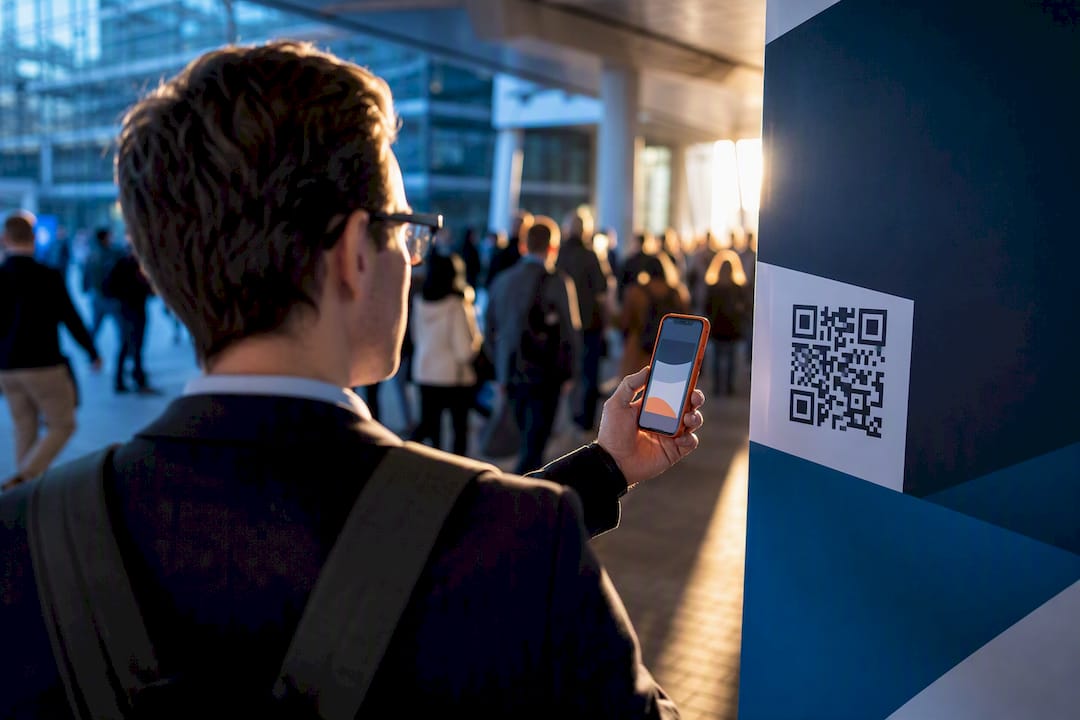
5. Integrate digital touchpoints at every contact point. QR codes on your billboard connect the physical impression to a measurable digital action. Pair this with geofencing so that anyone who sees your truck also receives a targeted digital ad on their phone within minutes. This combination of physical and digital is what transforms a single impression into a multi-touch funnel, and it is the core of integrating OOH with digital attribution at scale.
“Avoid random routes for best ROI. Strategic routing paired with digital integration is what separates brands that dominate conference share-of-voice from those that simply show up.”
| Factor | Random approach | Strategic approach |
|---|---|---|
| Route selection | Driver discretion | Data-driven, peak-hour focused |
| Vehicle count | Single truck | Multi-truck caravan for saturation |
| Creative message | General brand awareness | Event-specific CTA with QR code |
| Digital integration | None | Geofencing plus retargeting |
| Measurement | Estimated impressions only | GPS, QR scans, attribution data |
Mobile LED billboards achieve a 98% notice rate compared to 29% for static formats, and they drive 70% higher recall among audiences who see them. Those numbers are not accidental. They are the result of movement, brightness, and contextual relevance working together.

Common mistakes and how to avoid them
Understanding the right moves is only half the battle. Success depends on sidestepping these costly errors.
Even well-funded campaigns underperform when avoidable mistakes creep into execution. Here are the most common pitfalls and exactly how to fix them.
Uncoordinated or random routing. This is the most expensive mistake in mobile OOH advertising. A truck driving aimlessly near a convention center generates impressions, but those impressions are not targeted to the right people at the right moment. Avoid random routing and always build routes around verified attendee movement patterns. Use event schedules, hotel shuttle routes, and venue maps to build your routing grid before the campaign launches.
Overloading the creative with too much information. Marketing teams sometimes treat the billboard as a brochure. They want to include the booth number, the product name, the tagline, the website URL, the QR code, and a promotional offer all at once. The result is a message no one can read at 25 miles per hour. Pick one message. One CTA. One QR code. Everything else is noise.
Ignoring venue and local regulations. Some convention centers have agreements with local authorities that restrict mobile advertising within a certain radius. Some cities require permits for LED trucks on specific streets. Skipping this step can result in your trucks being turned away on day one of a three-day event. Always confirm restrictions and secure permits well in advance.
Forgetting to set up measurement infrastructure before launch. Attribution only works if you configure your tracking tools before the campaign starts. This means your QR code destination URL must have UTM parameters attached, your geofencing zones must be active, and your GPS tracking must be logging data from the moment the trucks roll. Trying to reconstruct attribution after the fact is unreliable and often impossible.
Failing to complement static OOH placements. If you have a static banner inside the venue, your mobile billboard should reinforce that message outside, not compete with it. Consistent creative across formats builds recall faster than fragmented messaging. Think of dynamic triggers in OOH as amplifiers for your existing placements, not standalone tactics.
Pro Tip: Call the venue’s event operations team directly before booking routes. They often know about local restrictions, competing brand agreements, and high-traffic zones that are not publicly documented.
Quick checklist to avoid the most common mistakes:
- Route plan reviewed and approved by campaign manager
- Creative tested for readability at speed (walk away from a printed version at 20 feet)
- All permits confirmed in writing
- QR code tested on three different devices before launch
- GPS tracking and geofencing zones active before trucks depart
- Static OOH and mobile creative visually aligned
Measuring success and proving ROI
Even the most dazzling display means little if you can’t prove its value. Here’s how to close the loop on your results.
Measurement is where most OOH campaigns lose credibility with finance teams and agency clients. The good news is that modern mobile billboard campaigns generate far more trackable data than traditional outdoor advertising ever did.
“Proper attribution keeps budgets flowing. When you can show a direct line between a mobile billboard impression and a website visit or booth scan, you stop defending your OOH spend and start expanding it.”
Step-by-step event tracking setup:
- Before the event: Configure UTM parameters on all QR code destination URLs, set up geofencing zones around the venue and surrounding blocks, and establish baseline website traffic benchmarks for comparison.
- During the event: Monitor QR scan volume in real time, track truck GPS routes to confirm coverage, and log any route adjustments made in response to crowd shifts.
- After the event: Pull QR scan data, compare website traffic from the event location against the baseline, review GPS logs for impression estimates, and compile a proof-of-posting report.
Measuring via GPS, impressions, and attribution to foot traffic and website visits gives you a complete picture of campaign performance that you can present to stakeholders with confidence.
The table below maps each core metric to its business impact so you can prioritize what to report:
| Metric | What it measures | Business impact |
|---|---|---|
| GPS-verified impressions | Total audience exposures along the route | Reach and frequency baseline |
| QR code scans | Direct response to the billboard CTA | Lead generation and engagement |
| Website traffic lift | Increase in visits from event geo-zone | Brand consideration and intent |
| Booth traffic correlation | Attendees who visited booth after seeing truck | Direct conversion attribution |
| Digital retargeting conversions | Actions taken after geofenced ad delivery | Full-funnel ROI measurement |
For proving ROI for mobile OOH, the most compelling reports combine GPS impression data with QR scan counts and website attribution. This three-layer approach gives you a story that resonates with both brand marketers and performance-focused agency buyers.
Why mobile billboards outperform static displays at events
Static signage at dense conference venues has a fundamental problem: it blends in. When every brand has a banner, a retractable display, and a branded tablecloth, the visual environment becomes wallpaper. Attendees stop seeing individual messages because the cumulative noise cancels everything out.
Mobile billboards work differently because movement triggers attention. The human visual system is hardwired to notice things that move in a static environment. A bright LED truck rolling past a hotel entrance at 7 AM when attendees are arriving for day two of a conference cuts through in a way that no fixed sign ever will. It creates a moment of anticipation, a brief interruption that the brain registers and stores.
The deeper advantage is adaptability. Static OOH is committed to a location from the moment it is installed. Mobile billboards can follow the crowd. If the afternoon session runs long and the networking reception moves to a different venue block, your truck can be there in minutes. That kind of real-time responsiveness is simply not possible with any fixed format.
We also believe that share-of-voice at events is no longer about quantity of signs. It is about the right sign in the right place at the right moment. One well-routed LED truck during the morning arrival window can generate more qualified impressions than a dozen static placements scattered around the convention center. The math changes when you factor in context and timing.
Finally, the combination of physical OOH and digital retargeting builds a longer engagement funnel than either channel can achieve alone. An attendee who sees your truck, scans your QR code, and then receives a targeted ad on their phone that evening has experienced three brand touchpoints in a single day. That layered exposure is what drives recall, consideration, and ultimately conversion well after the conference ends.
Start your high-impact event campaign with Beacon Mobile Media
Ready to put these strategies into practice? Here’s how Beacon Mobile Media can help you seize conference attention.
Beacon Mobile Media manages every element of your LED mobile billboard campaign, from strategic route planning and creative consultation to real-time GPS tracking and post-event attribution reporting. Our team has executed campaigns at major conferences and trade shows across all 50 states, and we bring that experience directly to your planning process.

When you work with us, you get more than trucks and screens. You get a data-driven partner who understands how to position your brand for maximum visibility at high-stakes events. Whether you need a single vehicle for a regional conference or a multi-truck caravan for a national trade show, we have the infrastructure and the expertise to deliver. Explore mobile billboard packages tailored to event campaigns, or review our recent case studies to see how brands like yours have used mobile OOH to dominate conference environments and generate measurable results.
Frequently asked questions
How do I choose the best route for my LED mobile billboard at a conference?
Plan routes around high-traffic event areas during arrivals, breaks, and departures, focusing on locations where attendees naturally gather. Strategic route planning based on audience movement and peak hours consistently outperforms routes chosen for convenience.
What is the optimal message length for LED mobile billboard ads?
Use 6 to 10 words with one clear call to action for the greatest impact and readability. High-contrast messaging with a single CTA ensures your audience processes the message in the two to three seconds they have to view it.
How is campaign performance tracked with mobile billboards?
Performance is measured through GPS route verification, QR code scan counts, website traffic attribution, and digital retargeting conversion data. GPS and impression attribution to foot traffic and website visits gives you a multi-layer proof-of-performance report.
Should I use multiple trucks or just one at large events?
Multi-truck caravans significantly increase share-of-voice and are the recommended approach for large conferences where saturation matters. Multi-truck caravans for saturation ensure your brand appears consistently across all key attendee movement zones throughout the event.