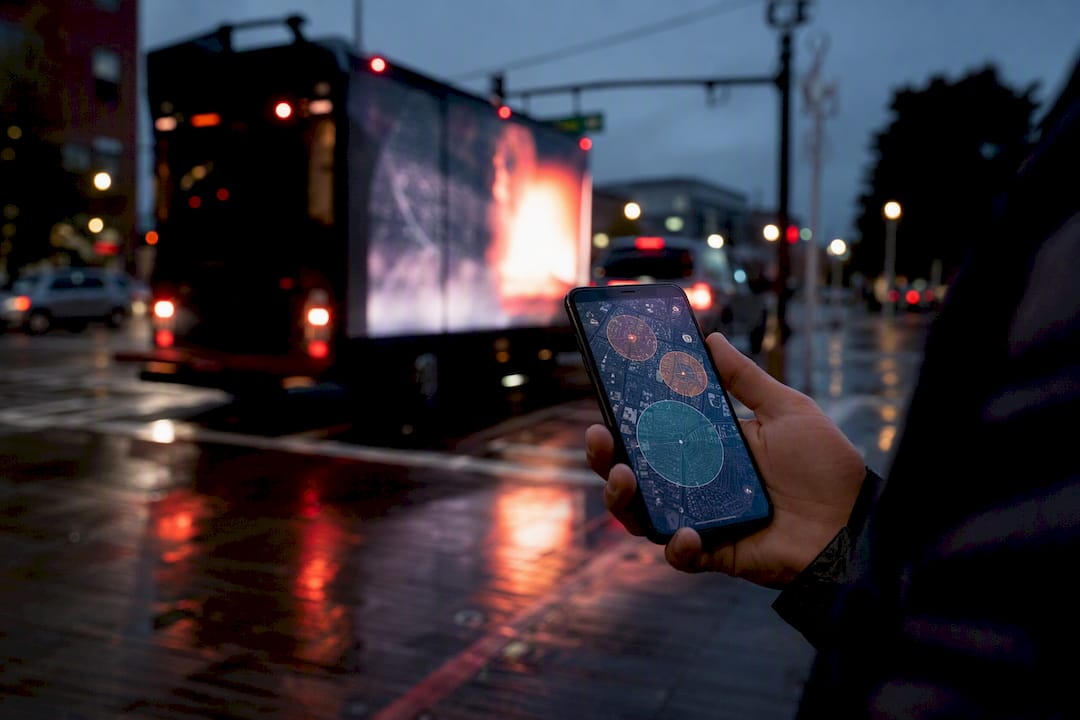
Most marketers still treat QR codes like they’re a novelty from 2012. Slap one on a flyer, hope someone scans it, never know if anyone did. That assumption is costing brands real money and real audience insight. Smart QR codes are a fundamentally different tool. They turn every scan into a data point, every printed surface into a live campaign channel, and every passive viewer into a trackable lead. This guide breaks down exactly what smart QR codes are, how they work, and how marketing professionals can use them to drive measurable results from out-of-home and integrated campaigns.
Table of Contents
- Defining smart QR codes and how they work
- Comparing smart QR codes to traditional QR codes
- Unlocking campaign insights: Analytics and data collection with smart QR codes
- Engagement beyond the scan: Interactive and personalized experiences
- What most marketers miss about smart QR codes
- Transform your campaigns with smart QR solutions
- Frequently asked questions
Key Takeaways
| Point | Details |
|---|---|
| Dynamic versus static | Smart QR codes are editable and trackable, unlike standard static QR codes. |
| Actionable analytics | They offer rich data insights, enabling marketers to optimize campaigns in real time. |
| Personalized engagement | Smart codes enable interactive, tailored user experiences beyond just a website link. |
| Campaign adaptability | Smart QR codes can be updated post-launch, saving costs and enhancing flexibility. |
Defining smart QR codes and how they work
A traditional QR code is essentially a printed URL. Once it’s generated and printed, it’s frozen. You can’t change where it points, you can’t see who scanned it, and you can’t learn anything from it. A smart QR code, by contrast, is built on a dynamic redirect system. The printed code points to a short, trackable URL that lives on a server. That server then redirects the user to whatever destination you choose, and it logs data about every single scan along the way.
This architecture is what makes smart QR codes powerful for marketers. The code itself never changes. What changes is the server-side destination and the data it captures. You can update your landing page, swap out a promotional offer, or redirect users to a new product page without ever reprinting a single piece of collateral. For out-of-home campaigns running on LED mobile billboards or wrapped rideshare vehicles, this flexibility is a significant operational advantage.
Here’s what specifically makes a QR code “smart”:
- Dynamic destination URLs that can be edited after the code is printed or deployed
- Real-time analytics including scan counts, device type, location, and time of scan
- Audience segmentation that routes different users to different content based on rules you set
- A/B testing capability so you can test two landing pages against each other without changing the code
- Retargeting pixel integration that adds scanners to digital ad audiences automatically
The underlying technology relies on short URL redirection, similar to how link shorteners work, but with a full analytics and campaign management layer on top. When a user scans the code, their device sends a request to the redirect server, which logs the scan data and sends the user to the destination in milliseconds. The experience feels instant to the user, but behind the scenes, your campaign dashboard is capturing actionable intelligence.

| Feature | How it works | Campaign benefit |
|---|---|---|
| Dynamic redirect | Server routes scan to current destination URL | Update campaigns without reprinting |
| Scan analytics | Server logs device, time, location per scan | Real-time performance visibility |
| Audience routing | Rules-based redirect by segment or time | Personalized user journeys |
| Pixel integration | Retargeting tags fire on scan redirect | Builds digital ad audiences from OOH |
| A/B destination testing | Traffic splits between two URLs | Optimize landing pages live |
Pro Tip: When setting up your smart QR code, always use a branded short domain for the redirect URL. It builds trust with users who may hesitate before scanning an unfamiliar link, and it reinforces your brand at every touchpoint.
For brands exploring QR code marketing strategies, understanding this redirect architecture is the foundation. Everything else, the analytics, the personalization, the retargeting, flows from this core mechanism.
Comparing smart QR codes to traditional QR codes
The difference between static and smart QR codes is not just a feature gap. It’s a strategic gap. Traditional QR codes were designed as a convenience tool, a faster way to type a URL. Smart QR codes are designed as a campaign tool, built for measurement, optimization, and audience development.
Here’s a direct comparison that matters for campaign planning:
| Capability | Traditional QR code | Smart QR code |
|---|---|---|
| Destination URL | Fixed at creation | Editable anytime |
| Scan tracking | None | Full analytics dashboard |
| User data capture | None | Location, device, time, frequency |
| A/B testing | Not possible | Built-in |
| Retargeting integration | Not possible | Pixel-ready |
| Campaign lifespan | Single use | Reusable across campaigns |
| Cost to update | Reprint required | Software update only |
The practical implications are significant. Imagine you’re running a six-week out-of-home campaign on mobile billboards across three cities. With a traditional QR code, if your landing page underperforms in week two, you have no data to confirm it, and you can’t change the destination without reprinting. With a smart QR code, you see the drop in engagement on day three, update the landing page by week two, and measure the improvement in real time.
The user experience difference is also worth noting. Smart QR codes can serve different content to different users, which means someone scanning in Los Angeles might land on a localized offer while someone scanning in Chicago sees a different promotion. This kind of relevance drives higher conversion rates and better post-scan engagement.
“The brands winning at out-of-home right now are the ones treating every physical touchpoint as a live digital channel. Smart QR codes are what make that possible.”
Key advantages that matter most for out-of-home campaign strategies:
- No reprint costs when campaign messaging or offers change mid-flight
- Attribution data that connects physical ad exposure to digital actions
- Audience building that turns OOH viewers into retargetable digital segments
- Performance benchmarks across locations, routes, and time periods
The shift from static to smart is not just about technology. It’s about treating your physical advertising inventory as a living, breathing campaign channel rather than a one-way broadcast.
Unlocking campaign insights: Analytics and data collection with smart QR codes
Data is where smart QR codes earn their place in a serious marketing stack. Every scan is a signal, and the aggregate of those signals tells you things about your audience and your campaign that no other OOH measurement tool can match at this level of granularity.
Here’s what smart QR codes can collect with each scan:
| Data type | What it tells you | How to use it |
|---|---|---|
| Scan location (GPS or IP) | Where your audience is engaging | Optimize route placement and geofencing |
| Device type and OS | Mobile vs. tablet, iOS vs. Android | Tailor landing page design and app deep links |
| Time and day of scan | Peak engagement windows | Schedule campaigns and offers accordingly |
| Repeat scan rate | Audience loyalty and intent signals | Identify high-value prospects for retargeting |
| Scan-to-conversion rate | Post-scan action completion | Measure true campaign ROI |
Real-time data access changes how you manage campaigns. Instead of waiting for a post-campaign report, you’re making optimization decisions while the campaign is still running. This is particularly valuable for mobile billboard campaigns where route performance can vary significantly by neighborhood, time of day, or event proximity.
Here’s a practical workflow for using smart QR analytics in an active campaign:
- Set baseline benchmarks in the first 48 to 72 hours of the campaign to understand your starting scan rate and device mix.
- Identify top-performing routes or placements by comparing scan volume against GPS data from your billboard vehicles.
- Analyze time-of-day patterns to determine when your audience is most likely to engage, then prioritize those windows.
- Review repeat scan rates to flag users who scanned more than once, as these are your highest-intent prospects.
- Connect scan data to conversion events on your landing page to calculate a true cost-per-acquisition from your OOH spend.
Smart QR codes also integrate directly with retargeting platforms. When a user scans the code, a pixel fires and adds that device to a custom audience in your ad platform. This means your OOH campaign doesn’t just generate awareness. It actively builds a warm digital audience that you can follow up with paid social or display ads. Studies show that retargeted users convert at significantly higher rates than cold audiences, making this integration a direct revenue driver.

The statistic that changes how most agencies think about OOH measurement: campaigns using smart QR codes with retargeting integration consistently show lower cost-per-lead compared to campaigns relying on traditional QR codes or no digital bridge at all.
Engagement beyond the scan: Interactive and personalized experiences
Analytics tell you what happened. Personalized experiences determine what happens next. Smart QR codes don’t just track users. They actively shape the journey those users take after they scan.
The most powerful application is dynamic destination routing. You set rules that determine where a user lands based on criteria you define. A user scanning in the morning might see a breakfast promotion. A user scanning on a Saturday might land on a weekend event page. A user who has scanned before might be routed to a loyalty reward page instead of a generic offer. This level of personalization was previously only possible in email marketing or paid social. Smart QR codes bring it to physical advertising.
Here’s what you can drive through the post-scan experience:
- Coupon and offer redemption with unique codes generated per scan to prevent fraud and track usage
- Event registration and sign-up forms that capture first-party contact data directly from the scan
- Video and multimedia content including product demos, brand films, or influencer integrations
- App download deep links that route iOS users to the App Store and Android users to Google Play automatically
- Survey and feedback forms that collect audience sentiment while engagement is highest
- Augmented reality (AR) experiences triggered by the scan, adding an interactive layer to static OOH placements
The coupon and sign-up use cases deserve special attention because they generate first-party data. With third-party cookies continuing to phase out, first-party data collected directly from engaged consumers is increasingly valuable. A smart QR code on a mobile billboard that drives a user to a sign-up form is not just an awareness play. It’s a direct lead generation mechanism tied to a physical ad placement.
Pro Tip: Always match the post-scan experience to the context of the scan. If your billboard is near a sports venue on game day, route users to a game-day specific offer. Contextual relevance between the physical ad and the digital destination is the single biggest driver of post-scan conversion rates.
The brands that get the most from smart QR codes are the ones thinking about the full journey, not just the scan event. The scan is the handshake. What you do with the user after that handshake determines whether the campaign generates revenue or just impressions.
What most marketers miss about smart QR codes
Here’s the uncomfortable truth: most brands treat smart QR codes as a “set and forget” feature rather than a campaign lever. They generate the code, place it on their creative, and then check the scan count once at the end of the campaign. That approach wastes most of the tool’s value.
Smart QR codes are not a passive measurement tool. They’re an active campaign control system. The ability to change destinations, split-test content, and route users by segment means you should be making decisions based on your data every week, not just at the end of the flight. If your scan-to-conversion rate drops mid-campaign, that’s a signal to change the landing page. If one route is generating three times the scans of another, that’s a signal to shift budget or increase frequency on that route.
The second thing most brands get wrong is the disconnect between the physical ad and the digital destination. We see it constantly. A bold, visually striking mobile billboard with a smart QR code that leads to a generic homepage. The user scanned because something in the ad caught their attention. Landing on a homepage with no connection to what they just saw breaks the experience and kills conversion. Every smart QR code destination should be a dedicated landing page that mirrors the message, visual identity, and offer from the physical ad.
The third mistake is measuring success by scan volume alone. Scans are a vanity metric if they don’t connect to downstream actions. The metrics that actually matter are scan-to-lead rate, scan-to-purchase rate, repeat scan rate, and the size and quality of the retargeting audience built from the campaign. Brands that optimize for scans end up with creative designed to attract curiosity rather than intent. Brands that optimize for post-scan conversion design the entire journey with the end goal in mind.
Smart QR codes give you more data than most OOH campaigns have ever had access to. The brands that win are the ones who build processes around acting on that data in real time, not just reporting on it after the fact.
Transform your campaigns with smart QR solutions
The gap between a campaign that generates impressions and one that generates leads often comes down to the tools you use to bridge physical and digital.

Beacon Mobile Media builds smart QR code capabilities directly into mobile billboard and rideshare advertising campaigns, giving brands and agencies a single platform for physical placement, audience targeting, real-time analytics, and retargeting. Every scan from a Beacon campaign feeds into a live dashboard, and every campaign can be updated mid-flight without touching the printed creative. If you’re ready to move beyond static OOH and start treating every billboard as a data-generating asset, shop smart QR solutions and see how Beacon’s integrated approach connects physical reach with digital precision. Your next campaign can do more than get seen. It can build your audience, capture leads, and prove its own ROI.
Frequently asked questions
How does a smart QR code differ from a regular QR code?
A smart QR code uses a dynamic redirect system that can be edited, tracked, and analyzed after deployment, while a regular QR code is static and provides no tracking, analytics, or post-launch flexibility.
What types of data can smart QR codes collect in campaigns?
Smart QR codes capture scan location, device type and operating system, time and date of scan, repeat scan frequency, and downstream engagement metrics like form completions and conversions.
Can smart QR codes be updated after a campaign launches?
Yes, because the printed code points to a redirect server rather than a fixed URL, you can update the destination page, offers, or routing rules at any time without reprinting your creative.
Are smart QR codes secure for end users?
Smart QR codes use the same HTTPS security standards as standard web links, and when managed by reputable platforms like Beacon Mobile Media, they are safe and transparent for end users to scan.