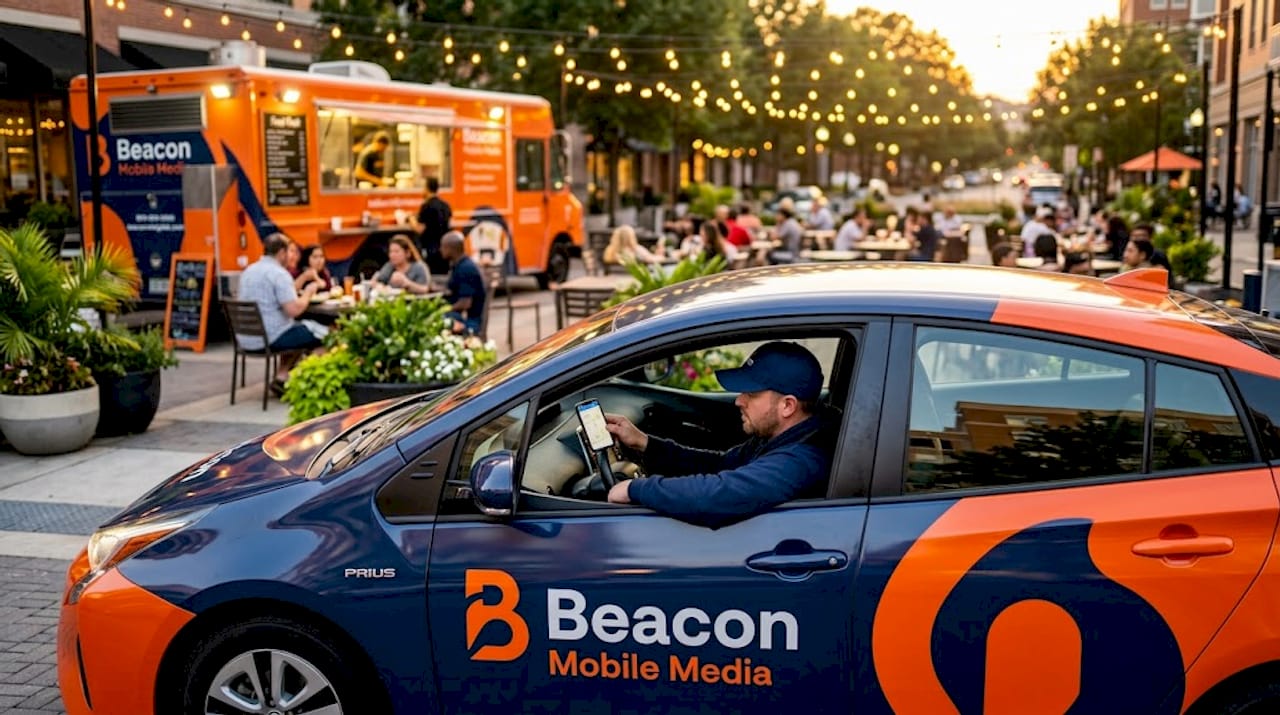
Out-of-home advertising in high-traffic urban areas generates massive visibility, but proving its business value has frustrated marketing teams for decades. You run a wrapped rideshare vehicle through downtown for three weeks, impressions pile up, but what actually changed? The challenge is not exposure. It is attribution. Marketers who treat OOH like a digital display channel and chase last-click metrics end up with misleading data and misallocated budgets. This article cuts through that frustration with seven research-backed, data-first strategies that help you set clear goals, choose smarter placements, measure real impact, and optimize spend across every channel.
Table of Contents
- Set measurable OOH campaign objectives
- Leverage location and audience data for site selection
- Use credible measurement methods for campaign impact
- A/B test creative and messaging in the wild
- Attribute cross-channel lift and adjust budget allocation
- Why honest measurement beats attribution gimmicks
- Drive better results with Beacon Mobile Media
- Frequently asked questions
Key Takeaways
| Point | Details |
|---|---|
| Set clear objectives | Measurable goals are essential for any data-driven OOH campaign. |
| Use audience and location data | Rely on mobile movement and demographics to target high-impact sites. |
| Choose credible measurement | Prioritize brand lift and footfall attribution over digital-only metrics. |
| Test and optimize creative | A/B test messaging to maximize real-world effectiveness before scaling. |
| Balance cross-channel signals | Use OOH feedback to guide smarter budget decisions across channels. |
Set measurable OOH campaign objectives
Every high-performing OOH campaign starts with a specific, honest objective. Not “increase brand awareness” as a vague aspiration, but a defined metric you can track before, during, and after flight. The type of objective you set determines which measurement method you use later, so getting this right at the start saves enormous time and budget downstream.
OOH campaigns typically serve three distinct purposes. Brand awareness campaigns focus on reaching new audiences and building recognition in a target geography. Recall lift campaigns aim to increase the percentage of consumers who remember your message after exposure. Store visit or location-based campaigns drive measurable increases in foot traffic to physical locations. Each goal requires a different KPI and a different measurement approach.
Here are sample OOH KPIs worth tracking across campaign types:
- Recall rate percentage: Measured via brand lift surveys pre and post campaign flight
- Footfall change: Percentage increase in store visits within an exposed geographic zone
- Impression volume: Estimated exposures based on verified traffic counts along routes
- Aided vs. unaided brand awareness: Tracked through panel surveys in exposed versus control markets
- QR code scan rate: Direct engagement data captured from smart codes on mobile or static placements
- Search volume lift: Branded query increases during and after OOH flight in targeted DMAs
Understanding that DOOH measurement methods must match realistic expectations is critical. As the research shows, “honest approximation” approaches like brand lift studies, footfall attribution, and matched-market testing are far more credible than applying last-click attribution to an awareness-stage medium. OOH primes purchase intent. It does not close a transaction the way a paid search ad does, and your KPIs need to reflect that reality.
Pro Tip: Always align your OOH objective with your current marketing funnel stage. If you are running a product launch, brand recall and aided awareness metrics are your primary KPIs. If you are driving a local promotion, footfall lift and QR scan data are more telling signals.
Leverage location and audience data for site selection
Setting goals is only half the equation. The other half is putting your message in front of the right people at the right physical locations. Gut instinct about “busy intersections” is no longer sufficient when mobile movement data and demographic overlays give you precise, quantifiable guidance for every placement decision.

Footfall attribution using mobile data has become one of the most credible tools for both pre-campaign site selection and post-campaign measurement. Before you launch, the same anonymized mobile location data that shows where people go after seeing an ad also tells you which physical corridors attract your target audience most frequently.
Follow these steps to analyze location data effectively for OOH site selection:
- Define your target audience profile using first-party CRM data or third-party demographic segments, including age, income bracket, shopping behavior, and commute patterns.
- Pull mobile movement heatmaps for your target metro area to identify corridors with high index concentrations of your audience during relevant dayparts.
- Cross-reference traffic count data from city transportation departments or independent measurement vendors to validate impressions at shortlisted sites.
- Apply demographic overlays to confirm that raw traffic volume aligns with your audience profile, not just total passerby volume.
- Score locations by combining audience index, impressions per day, and proximity to your conversion points such as retail locations or event venues.
Here is how sample location data translates to campaign performance for reference:
| Location type | Daily traffic count | Audience index | Avg. recall lift |
|---|---|---|---|
| Downtown transit corridor | 85,000 | High (1.8x) | 14% |
| Suburban retail strip | 32,000 | Medium (1.2x) | 8% |
| Event district route | 60,000 | Very high (2.1x) | 19% |
| Highway interchange | 110,000 | Low (0.7x) | 5% |
The data above illustrates a counterintuitive but important point: raw traffic volume alone does not predict recall lift. An event district route with 60,000 daily exposures outperforms a highway interchange with 110,000 because the audience index is more than three times higher. Matching placement to audience composition consistently beats chasing raw impression counts.
Use credible measurement methods for campaign impact
Once your campaign launches, the measurement infrastructure you built around your objectives becomes your real competitive advantage. Most OOH measurement failures happen because teams apply digital attribution logic to a physically immersive medium. OOH works differently, and your methodology must respect that.
The three most credible approaches, confirmed by current research, are brand lift studies, footfall attribution, and matched-market testing. Brand lift studies, footfall attribution, and matched-market testing consistently outperform other methodologies for effective DOOH measurement in real-world campaign conditions.
| Method | Data used | Reliability | Key limitation |
|---|---|---|---|
| Brand lift study | Pre/post awareness surveys | High | Requires panel recruitment; 3-4 week lag |
| Footfall attribution | Mobile location signals | High | Privacy restrictions; device penetration gaps |
| Matched-market testing | Control vs. exposed geo comparison | Very high | Requires similar markets; longer time horizon |
| Last-click attribution | Digital conversion tracking | Low for OOH | Ignores priming effects entirely |
| Promo code tracking | Redemption data | Medium | Self-selection bias; depends on offer appeal |
“Honest approximation is the gold standard for OOH measurement. Campaigns that accept credible approximations over false precision consistently make smarter budget decisions and demonstrate more durable ROI to stakeholders.”
Last-click attribution fails OOH campaigns because it assigns full credit to the final touchpoint before a conversion, typically a paid search click or a direct website visit. But the brand recall generated by a mobile LED billboard three days earlier is what prompted the search in the first place. Ignoring that upstream priming effect systematically undervalues OOH’s contribution and pushes budget toward channels that harvest intent rather than create it.
A/B test creative and messaging in the wild
Even the best site selection and measurement setup cannot save weak creative. The physical and mobile nature of OOH demands that you test which messages resonate before scaling your spend. Unlike digital display where you can pause a bad ad in minutes, OOH placements run on contracted schedules, so knowing what works in advance is worth real money.
Matched market testing is especially powerful for OOH creative testing because it compares real-world outcomes in similar but separated geographic environments, eliminating the noise that confounds digital A/B tests.
Follow this process to design effective OOH split-tests:
- Select two or more comparable markets with similar demographics, population density, and baseline brand awareness levels to ensure a clean comparison.
- Assign one creative variant to each market and keep all other campaign variables constant, including placement type, daypart scheduling, and flight duration.
- Set a pre-campaign measurement baseline using brand awareness surveys or footfall counts in each market before ads launch.
- Run the campaign for a minimum of four weeks to accumulate statistically meaningful exposure levels in both test markets.
- Collect post-campaign data across recall, footfall, and any digital signals like branded search spikes in each market.
- Compare results using the difference in lift between markets to identify which creative variant drove stronger performance.
- Scale the winning variant to additional markets and retire the underperformer, applying insights to future creative briefs.
Digital OOH placements, including LED mobile billboards and DOOH screens, make this process faster because creative updates do not require physical reprinting. You can rotate two headline variants across different route segments within the same metro in a single week.
Pro Tip: Use QR code scans as a fast, real-time signal for creative resonance. A variant with a 40% higher scan rate in its first 10 days is almost certainly generating stronger engagement, even before recall survey data arrives.
Attribute cross-channel lift and adjust budget allocation
OOH does not operate in a vacuum. When your mobile billboard runs through a high-density neighborhood, it does not just influence the people who see it directly. It generates ripple effects across other channels that you can measure and use to optimize your full media mix.
Brand lift studies and matched-market results are especially valuable here because they reveal OOH’s influence beyond direct response by capturing changes in awareness and consideration that feed into downstream digital activity. This is the clearest evidence that integrated media measurement pays for itself many times over.
Watch for these cross-channel signals when an OOH campaign is active:
- Branded search volume spikes: A sudden uptick in Google searches for your brand name or product category in the same DMA where your OOH runs is one of the strongest indicators of campaign recall.
- Direct website traffic increases: More users typing your URL directly, or arriving via branded search, suggests OOH prompted top-of-mind awareness.
- Social media mention growth: Increases in organic brand mentions, tags, or user-generated content in your target geography correlate with effective OOH creative.
- Retail partner scan data: If your distribution partners share scan or POS data, look for category share shifts in stores near high-traffic OOH routes.
- Email open rate changes: Existing subscribers in exposed geographies often show higher engagement rates during active OOH flights as brand salience increases.
When you detect these signals, use them to make concrete budget reallocation decisions. If branded search volume surges during an OOH flight, temporarily increase paid search budget for branded terms to capture intent you are already creating. This is not a coincidence. It is OOH doing its job, and smart media teams allocate budget to harvest that demand efficiently.
Why honest measurement beats attribution gimmicks
Here is an uncomfortable truth most OOH vendors will not tell you: the pressure to show hard ROI is making some campaigns worse, not better. When brand managers demand cost-per-acquisition numbers from a brand awareness medium, measurement teams reverse-engineer attribution models to produce the “right” answer. The result is data that feels satisfying in a presentation but drives genuinely bad budget decisions.
We have seen this pattern repeatedly. A campaign running LED mobile billboards through a downtown corridor generates measurable brand recall lift, a documented spike in branded search, and increased foot traffic near conversion locations. Then someone asks for last-click attribution, and the campaign appears to underperform because most converters clicked a retargeting ad as their final step. Budget shifts to retargeting. Brand awareness declines over the following quarter. Retargeting efficiency drops because there are fewer aware prospects to retarget. The whole funnel degrades.
The professionals who build durable OOH programs understand that different parts of the funnel require different measurement philosophies. Awareness and recall are best measured with brand lift surveys and panel-based research. Behavioral outcomes are best tracked through footfall attribution and matched-market testing. Conversion efficiency belongs to digital performance channels that operate closer to the transaction. Mixing these up, particularly forcing digital conversion logic onto awareness-stage OOH, produces noise instead of signal.
At Beacon Mobile Media, we believe the most sophisticated marketers are the ones who resist the temptation to oversimplify. They present brand lift data with confidence because they understand it represents real business impact, even when it cannot be mapped to a specific sale. That intellectual honesty is what separates campaigns that compound value over time from ones that look great in month one and collapse by month three.
Drive better results with Beacon Mobile Media
Knowing the right strategies is one thing. Executing them with the data infrastructure and physical coverage to make them work is another challenge entirely.

Beacon Mobile Media gives marketing teams the tools to run every strategy covered in this article, from credible footfall attribution and smart QR code capture to route-optimized LED mobile billboards and wrapped rideshare vehicles across all 50 states. Our platform layers geofencing, real-time retargeting, and audience-specific filtering on top of physical OOH placements so you measure what actually matters. Whether you are running a brand awareness campaign, testing creative across matched markets, or attributing cross-channel lift, we provide the proof-of-posting documentation and attribution analytics your stakeholders need. Browse our OOH campaign products, review real results in our campaign gallery, and connect with our team to build a smarter OOH strategy for your next campaign.
Frequently asked questions
What are the most reliable ways to measure OOH campaign effectiveness?
Brand lift studies, footfall attribution, and matched-market testing are the most credible OOH impact measurement methods because they account for awareness and behavioral change rather than just direct response signals.
How does footfall attribution work for out-of-home ads?
Footfall attribution uses mobile location data to track changes in store visits or site traffic among consumers who were exposed to OOH placements within a defined geographic zone during a campaign flight.
Why isn’t last-click attribution effective for OOH campaigns?
Last-click attribution ignores OOH’s priming effect by assigning full credit to the final digital touchpoint, missing the brand awareness and purchase intent that OOH exposure created earlier in the consumer journey.
Which data should guide OOH site selection?
Mobile movement heatmaps, verified foot traffic counts, and demographic overlays combined give you the clearest picture of which physical locations will reach your specific audience at scale, rather than just generating raw impression volume.