Marketing professionals who have run local campaigns know the frustration well. You can geofence a radius, buy radius-targeted social ads, and still watch foot traffic numbers flatline. The problem is rarely budget. More often, it’s choosing localized advertising ideas without a clear framework for what each tactic actually does well. The field of place-based and community-focused marketing, what industry practitioners call hyperlocal marketing, has expanded fast. AI tools now influence local recommendations, 45% of consumers use AI for local business suggestions, and digital out-of-home has gone interactive. This article gives you the evaluation criteria, the tactics, and the measurement thinking to act with confidence.
Table of Contents
- Key takeaways
- How to evaluate localized advertising ideas before you spend
- 1. Google Local Services Ads for intent-driven lead capture
- 2. Geofencing and competitor conquest campaigns
- 3. AI-augmented hyperlocal targeting
- 4. Video ads with radius and demographic targeting
- 5. Digital out-of-home with interactive participation mechanics
- 6. Customer review integration and AI discovery optimization
- 7. Local influencer partnerships and community sponsorships
- Comparing localized advertising ideas: strengths and trade-offs
- How to select and implement the right strategies for your brand
- My honest take on where localized advertising is headed
- How Beacon-ads can power your next localized campaign
- FAQ
Key takeaways
| Point | Details |
|---|---|
| AI discovery demands review management | With AI tools now a top source for local recommendations, your review presence directly affects ad campaign outcomes. |
| Measurement must go beyond clicks | Foot traffic lift, brand-lift surveys, and control-group comparisons tell the real story of localized campaign performance. |
| Interactive formats outperform static | Participatory DOOH and QR-enabled campaigns generate deeper engagement than traditional outdoor placements alone. |
| Geo-targeting paired with AI multiplies results | AI-augmented hyperlocal targeting shows median sales lifts of 89% in local business tests. |
| Pilot before you scale | Test multiple tactics against real audience segments before committing budget to a single channel or format. |
How to evaluate localized advertising ideas before you spend
Before you pick a tactic, you need a filter. Not every local advertising strategy performs equally across industries, geographies, or business sizes. Here is the framework that separates campaigns that build real community engagement from ones that burn budget.
Audience relevance and geo-precision. Does the tactic let you reach people based on their physical location and demonstrated behavior? Basic zip-code targeting is a starting point, not a finish line. The best options let you layer in demographic and affinity data on top of geography.
Measurability and conversion linkage. Can you tie exposure to an actual outcome, whether that is a store visit, a call, a form submission, or a purchase? Tactics that only report impressions are hard to defend in budget reviews.
Review and reputation integration. 97% of consumers read reviews before choosing a local business, and AI tools now pull from those reviews to make recommendations. Your ad can drive someone to search your brand, and a thin review profile will lose them before they ever call.
Creative engagement potential. Does the format invite participation, sharing, or a response? Passive formats like static print reach people. Interactive ones create memory.
Budget flexibility and management effort. Some tactics, like Google Local Services Ads, require careful eligibility setup and active bid management. Others, like wrapped rideshare vehicle placements, run with minimal ongoing work once live. Match the management demand to your team’s capacity.
Pro Tip: Build a simple scoring matrix with these five criteria before evaluating any new tactic. Rate each one from one to five across your shortlist of options. The highest-scoring ideas are your pilots.
1. Google Local Services Ads for intent-driven lead capture
Google Local Services Ads sit at the top of search results with a “Google Verified” badge, connecting searchers who have urgent, location-specific intent directly to your business via calls, forms, messages, or bookings. Unlike traditional Google Ads, LSAs operate on lead-based billing and use a separate business profile setup. They work best for service industries where someone searches “electrician near me” or “plumber in Dallas” with immediate intent to hire. Eligibility restrictions apply by industry and location, so check qualification status early. When managed well, these ads deliver leads that often convert the same day.
2. Geofencing and competitor conquest campaigns
Geofencing draws a virtual boundary around a specific location, whether that is your own store, a competitor’s location, or a high-traffic venue your audience frequents. When a mobile device enters or exits that boundary, it triggers a targeted ad. Geofencing campaigns targeting competitor locations have produced average in-store engagement times exceeding 22 minutes, a sign that intercepted consumers are genuinely open to switching. The tactic works especially well for retail, restaurants, and service businesses near competitive clusters. Pair it with time-of-day filtering to avoid wasting impressions outside of decision-making windows.

Pro Tip: Don’t optimize geofencing campaigns on click-through rate alone. Set up a control group of non-geofenced users and track store visit lift against that baseline to get honest performance data.
3. AI-augmented hyperlocal targeting
Standard geo-targeting segments by location. AI-augmented hyperlocal targeting adds behavioral prediction, audience lookalike modeling, and real-time bid adjustments on top of location data. The results in early adoption tests have been notable. AI-powered geo-targeting shows median reported lifts of 89% in sales and 84% in engagement for local businesses. These numbers come from self-reported data, so treat them as directional rather than absolute. The practical advantage is micro-segmentation: reaching the right sub-audience within a neighborhood rather than blanketing a zip code with generic creative.
4. Video ads with radius and demographic targeting
Locally targeted video content on platforms like YouTube, Instagram, and connected TV is one of the most underused tactics in community marketing. Video and social media ads tailored by radius and demographic remain among the highest-impact digital formats for local reach. A 15-second pre-roll ad showing your actual store, staff, or neighborhood context outperforms a generic brand spot every time. Layer in radius targeting of one to five miles around your location and add mobile-specific placements to capture on-the-go searchers who are closest to conversion.
5. Digital out-of-home with interactive participation mechanics
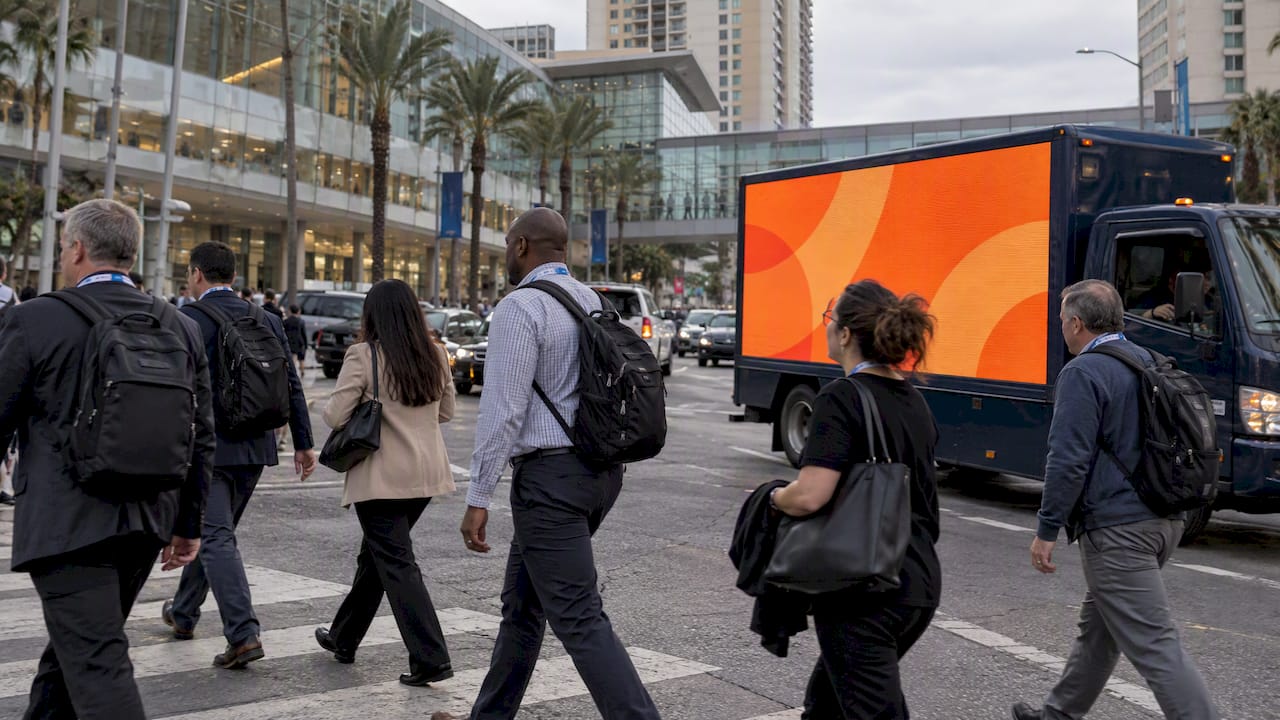
Digital out-of-home advertising, often called DOOH, has moved well beyond static screen placements. The most effective campaigns now invite the audience to participate. Cadbury Dairy Milk ran a DOOH campaign where consumers submitted personal messages via QR code that were then displayed on digital billboards. The result: over 1,800 message submissions and roughly a 16% conversion rate. The lesson for brand managers is that participation creates emotional investment. When someone sees their own message on a screen, they share it. That transforms a one-to-many media format into a word-of-mouth engine. Mobile LED billboard campaigns using QR codes follow the same mechanic and work particularly well for event-based or neighborhood-specific activations.
6. Customer review integration and AI discovery optimization
Your localized ad campaigns and your review presence are no longer separate workstreams. Branded review profiles need recency, accuracy, and breadth across platforms to support AI-powered local discovery. When someone sees your ad and searches your name in ChatGPT or Google, the AI synthesizes your reviews into a recommendation. A stale or sparse review profile can undo an otherwise well-executed campaign. Build review solicitation into your post-purchase or post-service workflow, and treat it as part of the campaign creative brief, not an afterthought. Learn more about combining review management with targeted placements for better outcomes.
7. Local influencer partnerships and community sponsorships
Neighborhood-level influencers, those with audiences of 5,000 to 50,000 followers concentrated in a specific city or district, offer something national influencers cannot: genuine local credibility. A fitness studio sponsoring a local running group gets its name in front of physically active residents within a two-mile radius who already trust the person recommending it. Community sponsorships, whether for youth sports leagues, neighborhood festivals, or school events, build the kind of ambient brand familiarity that makes your paid ads more effective when someone encounters them later. These tactics cost less than most digital placements and often produce stronger brand recall.
Comparing localized advertising ideas: strengths and trade-offs
Not every tactic fits every campaign objective. Here is a practical side-by-side comparison to help you prioritize.
| Tactic | Foot traffic impact | Engagement level | Cost range | Management effort | Best for |
|---|---|---|---|---|---|
| Google Local Services Ads | High (intent-driven) | Moderate | Medium-High | High (setup + bids) | Service businesses |
| Geofencing campaigns | High (measurable lift) | Moderate | Medium | Medium | Retail, restaurants |
| AI hyperlocal targeting | High (with AI overlay) | Moderate-High | Medium-High | Medium | Multi-location brands |
| Radius-targeted video | Moderate | High | Medium | Low-Medium | Brand awareness |
| Interactive DOOH | Moderate-High | Very High | Medium-High | Low (post-setup) | Events, activations |
| Review optimization | Indirect but strong | Low-Active | Low | Medium | All business types |
| Local influencers | Moderate | High | Low-Medium | Medium | Community trust |
A few patterns worth noting here:
- Interactive DOOH delivers the highest engagement-per-impression but requires thoughtful creative and a smooth QR or submission workflow upfront.
- Geofencing is the most directly measurable tactic for foot traffic, especially when you apply proper control-group methodology instead of relying on CTR benchmarks alone.
- Review optimization has no direct ad cost but produces compounding returns as your AI-powered local discovery presence grows over time.
- Local influencer and sponsorship tactics build long-term neighborhood recognition that makes every other paid tactic more efficient.
How to select and implement the right strategies for your brand
Knowing which tactics exist is one thing. Choosing and deploying the right combination for your specific brand context is where most campaigns succeed or fail. Here is a structured approach.
Start with your business objective, not the tactic. If the goal is immediate lead volume, Google Local Services Ads or geofencing conquest campaigns are your fastest paths. If the goal is building neighborhood authority over six to twelve months, community sponsorships and review management compound more effectively.
Map your local audience characteristics. A service business in a dense urban neighborhood has different targeting options and creative needs than a regional retail chain. Use advanced targeting tools to understand your actual customer’s behavioral and demographic profile before setting geo parameters.
Set up a real measurement framework. Evaluating geofencing ads requires control-group comparisons and brand-lift surveys, not just campaign-side CTR data. Apply the same logic across all your local tactics. If you cannot measure it against a baseline, you cannot improve it.
Pilot two or three tactics simultaneously. Give each one a defined budget and a four-to-six week test window. Collect data on store visits, calls, conversions, and review volume during the test period. Use those results to decide which tactics earn more budget and which ones get cut.
Pro Tip: Treat your review solicitation program as a media channel. A consistent increase in fresh, keyword-relevant reviews improves your AI discovery ranking the same way fresh ad creative improves click-through rates. Both require ongoing attention.
My honest take on where localized advertising is headed
I have worked with enough marketing teams to see a recurring pattern. Budgets go to geo-targeting tools. Months later, the question is why foot traffic did not move as expected. When you dig into it, the ads reached the right people in the right places. But the review profile was two years stale, the creative was generic, and nothing invited any kind of response.
The shift happening right now in local advertising is not primarily about AI. It is about participation. Consumers who feel personally connected to a brand’s local presence, whether because they submitted a message on a billboard, saw a neighbor’s review quoted in a recommendation, or recognize a sponsored team’s jersey at the park, convert at higher rates and stay longer. That connection does not come from precision targeting alone.
What I have learned is that the marketers who will define best practice over the next two to three years are the ones who treat geo-targeting as the entry point, not the strategy itself. The real benefits of localized campaigns show up when reach precision is combined with creative that earns a response and a reputation that earns trust.
Measure what matters. Build for participation. Manage your reputation as seriously as your media spend.
— Scott
How Beacon-ads can power your next localized campaign

Beacon-ads brings together the physical reach of mobile LED billboards and wrapped rideshare vehicles with the precision of digital geo-targeting, QR code data capture, and real-time retargeting. If you are looking to run campaigns that generate measurable foot traffic, capture leads at street level, and retarget by audience segment, Beacon-ads operates across all 50 states with route customization and attribution analytics built in.
Their digital out-of-home campaigns integrate QR-enabled participation mechanics similar to the interactive DOOH formats this article covers, including smart QR codes that capture customer data on scan. For a full breakdown of how different OOH formats stack up for your campaign objectives, the 2026 OOH advertising guide is a direct-use resource for brand managers planning Q3 and Q4 activations. For teams that want to pair physical placements with localized ad targeting and geofencing retargeting in a single workflow, Beacon-ads has the infrastructure to make that happen without stitching together multiple vendors.
FAQ
What are the most effective localized advertising ideas for driving foot traffic?
Geofencing campaigns, interactive DOOH placements, and Google Local Services Ads consistently deliver measurable foot traffic impact. Combining physical presence with digital retargeting, as in mobile billboard campaigns with QR codes, adds a participation layer that amplifies results.
How does AI affect local advertising strategy in 2026?
AI tools now drive local business recommendations for 45% of consumers, up from 6% in 2025. Marketers need to optimize their review presence across platforms so that AI-generated recommendations work in their favor alongside paid ad placements.
How should I measure a geofencing campaign’s real performance?
Measure geofencing effectiveness using a control group of users outside the geofence and compare store visit lift, not just click-through rate. Proper geofencing evaluation also includes brand-lift surveys and conversion tracking post-exposure.
What makes interactive DOOH more effective than standard outdoor advertising?
Interactive formats invite consumer participation, which creates stronger emotional connection and organic sharing. The Cadbury DOOH campaign that used QR-enabled message submissions generated a 16% conversion rate, a result that passive billboard formats rarely match.
How do community marketing ideas differ from standard regional advertising?
Community marketing operates at the neighborhood or micro-community level, building trust through sponsorships, local influencers, and event presence rather than broad reach. Regional advertising concepts focus on scale across a geographic market, while hyperlocal tactics prioritize depth of relationship within a smaller, more defined area.