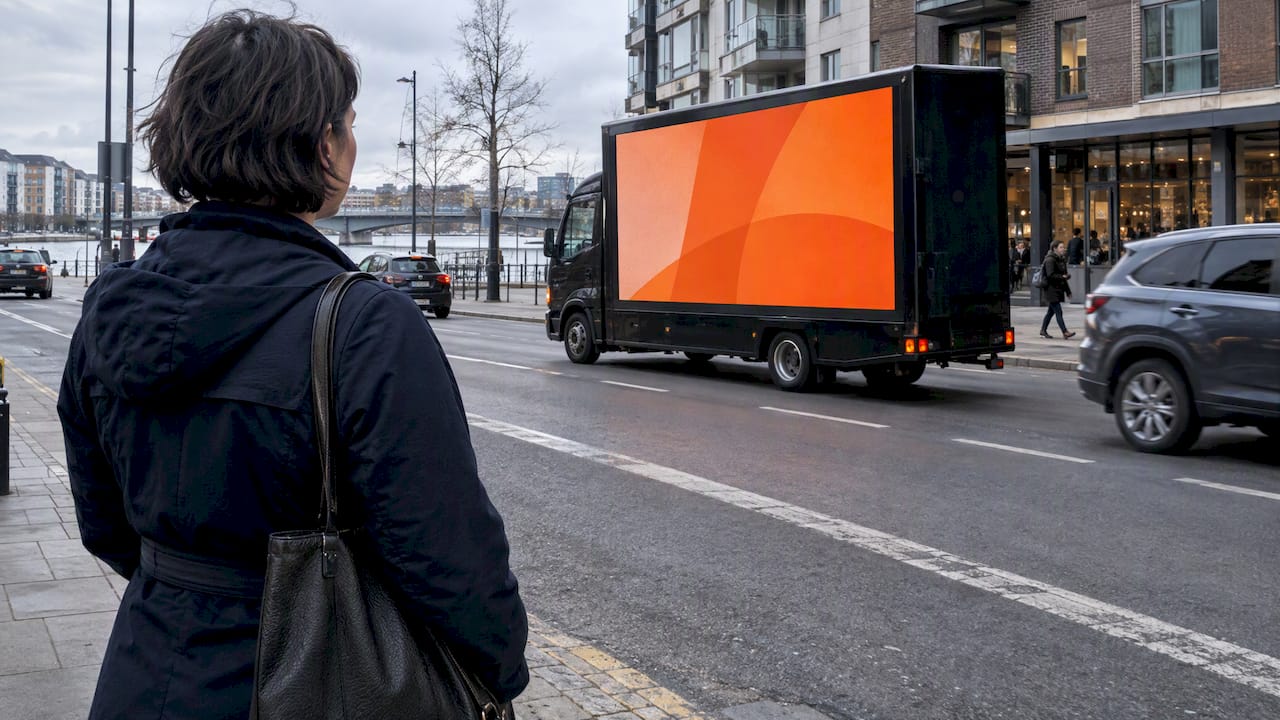
Physical advertising, defined by the industry as out-of-home (OOH) media, is the top-performing channel for measurable brand lift and consumer action in 2026. A joint OAAA and Kochava analysis of hundreds of campaigns found that OOH delivers a median +20% lift for in-person outcomes and +14% for digital outcomes, outpacing connected TV and broadcast TV. Formats range from LED mobile billboards and wrapped rideshare vehicles to static posters, transit wraps, and experiential installations. Understanding why choose physical advertising in 2026 starts with that data point: physical media does not just build awareness. It drives both foot traffic and online conversions at rates that most digital channels cannot match.
How does physical advertising outperform digital channels in 2026?
OOH is now a proven performance medium, not just a brand awareness tool. The OAAA and Kochava study compared OOH against connected TV (CTV) and broadcast TV across multiple verticals, and the gap is significant. CTV and broadcast TV average roughly 10% lift across performance metrics. OOH doubles that for in-person outcomes and comes close to doubling it for digital outcomes.
The frequency story is equally compelling. OOH conversion rates increase up to 7.1x as exposures climb from 1 to 10, and sustained frequency builds consideration rather than triggering the ad fatigue that plagues pre-roll video and display. That distinction matters for budget planning. Digital channels often require frequency caps to prevent irritation. Physical media does not carry the same psychological penalty.
OOH also plays a structurally different role in the consumer journey. Device-level measurement shows that OOH precedes Search 96% of the time and Social 94% of the time in certain sectors. This means last-touch attribution models, which are the default in most digital dashboards, systematically undercount OOH’s contribution. The billboard a commuter sees Monday morning is often what drives the branded search on Thursday afternoon.

| Metric | OOH | Connected TV | Broadcast TV |
|---|---|---|---|
| In-person outcome lift | +20% (median) | ~10% | ~10% |
| Digital outcome lift | +14% (median) | ~10% | ~10% |
| Frequency curve | Up to 7.1x at 10 exposures | Diminishing returns | Diminishing returns |
| Journey position | Precedes Search 96%, Social 94% | Mid to lower funnel | Mid to lower funnel |
Pro Tip: When reporting OOH performance to leadership, pull multi-touch attribution data rather than last-click reports. Last-click will always undervalue OOH because the channel operates at the top and middle of the funnel, not at the conversion moment.
What unique benefits does physical advertising offer in 2026?
The benefits of physical advertising extend well beyond raw performance numbers. Physical presence builds brand stature in a way that a banner ad cannot replicate. A wrapped vehicle moving through a city neighborhood or a large-format billboard on a commuter corridor signals investment, permanence, and credibility. As marketing budgets shift back toward physical channels, brands are explicitly citing consumer skepticism about AI-generated digital ads as a driver. Physical media is, by definition, real.

Creative constraints in OOH are actually a strategic advantage. Because a moving billboard or transit wrap gives a viewer roughly three seconds of exposure, the creative must be legible, memorable, and singular. This discipline produces stronger brand assets. Successful OOH creative prioritizes quick legibility and exposure-to-memory mechanics, which differ fundamentally from the assumptions behind digital ad creative. The brands that understand this produce OOH work that also strengthens their digital assets.
The reach and frequency math also favors a mixed physical format strategy. Adding moving OOH to stationary-only campaigns increases unique reach by up to 2.8x relative to impression growth and improves unique audience reach by 60% to 80%. That is not incremental improvement. It is a structural change in how many distinct people a campaign actually touches.
Strategic advantages of physical advertising over digital alternatives in 2026:
- No ad blocking. Physical ads cannot be filtered, skipped, or hidden behind a subscription paywall.
- Ambient credibility. A brand seen in the physical world is perceived as more established than one seen only in a social feed.
- Audience co-presence. OOH reaches people in shared public spaces, creating social proof at scale.
- Persistent exposure. A billboard stays up for weeks. A digital ad disappears the moment the budget runs out.
- Authentic engagement. Physical ads contribute to authentic brand engagement in an era when consumers are increasingly skeptical of digital-only brand signals.
Pro Tip: Pair a stationary format like a transit shelter poster with a moving format like a wrapped rideshare vehicle in the same geography. The Reveal and Firefly research shows this combination expands unique reach far beyond what either format achieves alone.
How are marketers adapting to leverage physical advertising effectively?
The budget data tells the clearest story. DSW and other brands are shifting from 90% digital to nearly 70% digital and 30% in-person marketing when targeting younger consumers. That is not a minor reallocation. It reflects a strategic reassessment of where trust and attention actually live. About 41% of U.S. ad buyers plan to increase investment in experiential and in-person marketing in 2026, according to IAB outlook data reported by Digiday.
The most effective physical campaigns in 2026 are not analog. They integrate smart QR codes, geofencing, and real-time retargeting to create a closed loop between the physical impression and the digital conversion. Beacon-ads, for example, deploys LED mobile billboards and wrapped rideshare vehicles with embedded QR codes that capture customer data at the point of exposure. That data feeds directly into retargeting audiences, turning a physical impression into a measurable digital lead.
Programmatic buying for digital OOH (DOOH) screens has also matured significantly. Marketers can now purchase OOH inventory with the same audience-targeting logic they apply to programmatic display, including affinity segments, behavioral data, and location-based triggers. This makes the importance of offline marketing easier to justify in a performance-marketing culture because the measurement infrastructure now exists to support it.
Best practices for implementing effective physical ad campaigns in 2026:
- Define journey-based KPIs. Set metrics that reflect OOH’s role at the top and middle of the funnel, not just last-touch conversions.
- Integrate QR codes with retargeting pools. Every physical impression should have a mechanism to capture intent signals for downstream digital follow-up.
- Mix moving and stationary formats. Use the Reveal and Firefly reach-expansion data to justify a blended format budget.
- Align creative to context. A vehicle wrapping through a sports district before a game needs different creative than one running a weekday commuter route.
- Use route and geofence data. Platforms like Beacon-ads provide proof-of-posting documentation and GPS-verified route data, which makes campaign reporting defensible to finance teams.
How does real-world exposure data transform OOH measurement?
Traditional OOH measurement relied on opportunity-to-see (OTS) estimates and post-campaign recall surveys. Both methods are imprecise. OTS counts how many people could have seen an ad based on traffic models. Recall surveys measure memory, not behavior. Neither tells you what actually happened after someone saw your billboard.
Real-world exposure data changes that equation. Channel 4’s campaign, measured by On Device and Talon, found that using actual exposure data produced significant uplift in consideration (+4 percentage points) and brand favorability (+9 percentage points) compared to category benchmarks. Those are not modeled estimates. They are measured outcomes tied to verified exposures. The implication for media planners is direct: campaigns optimized against real exposure data outperform campaigns optimized against modeled reach.
OOH campaigns that use context-driven creative alongside real-world exposure measurement drive stronger brand engagement across the full marketing funnel. Context matters because the same creative performs differently depending on when and where it appears. A food delivery brand running creative near transit hubs at 5:30 PM is reaching a fundamentally different mindset than the same creative running at 10 AM.
| Measurement method | Data source | What it measures | Accuracy |
|---|---|---|---|
| Opportunity-to-see (OTS) | Traffic models | Potential exposure | Low to moderate |
| Recall surveys | Self-reported memory | Brand awareness | Moderate |
| GPS device-level data | Real device movement | Verified exposure | High |
| Attribution analytics | Behavioral data post-exposure | Conversion and lift | High |
Pro Tip: When evaluating OOH vendors, ask specifically whether they provide GPS-verified exposure data or modeled reach estimates. The difference in measurement quality directly affects your ability to optimize mid-campaign and report accurately post-campaign.
Key takeaways
Physical advertising in 2026 delivers measurably superior performance over digital-only channels, with OOH producing up to 2x the lift of CTV and broadcast TV while playing a structurally earlier role in the consumer journey.
| Point | Details |
|---|---|
| OOH outperforms TV channels | OOH delivers +20% in-person lift and +14% digital lift versus ~10% for CTV and broadcast TV. |
| Frequency builds, not burns | OOH conversion rates increase up to 7.1x from 1 to 10 exposures without triggering ad fatigue. |
| Moving plus stationary formats | Combining moving and stationary OOH increases unique reach by up to 2.8x relative to impression growth. |
| Real exposure data is required | GPS-verified exposure data, not OTS models, produces accurate lift measurement and campaign optimization. |
| Budget reallocation is accelerating | 41% of U.S. ad buyers plan to increase in-person marketing spend in 2026, with some brands moving to 30% physical allocation. |
The case for physical that the data alone doesn’t make
I’ve spent years watching brands chase the lowest CPM in digital channels while their physical presence eroded to nothing. The OAAA and Kochava numbers are important, but they don’t capture the full argument. What the data shows is that OOH outperforms TV. What the data can’t fully quantify is the compounding effect of being physically present in someone’s world over time.
The brands I’ve seen win with physical advertising are not the ones who treat it as a one-off awareness play. They are the ones who treat it as infrastructure. A wrapped vehicle running consistent routes through a target neighborhood for three months does something to brand recognition that no six-week digital burst can replicate. It becomes part of the visual environment. That is a different kind of asset.
The integration piece is where most marketers leave performance on the table. Physical and digital are not competing budgets. They are sequential steps in the same journey. OOH precedes search and social the vast majority of the time. If your digital campaigns are not set up to capture the demand that physical media generates, you are paying for the top of the funnel and then losing the conversion to a competitor who shows up in the search results.
My practical advice: start with a geography where you have real business density, run a moving format alongside a stationary one, integrate QR codes tied to a retargeting audience, and measure against journey-based KPIs rather than last-click. The results will make the budget conversation for next year much easier.
— Scott
How Beacon-ads powers physical advertising campaigns with real data
Physical advertising works best when it is built on verified exposure data, precise routing, and integrated digital follow-up. Beacon-ads combines LED mobile billboards and wrapped rideshare vehicles across all 50 states with geofencing, real-time retargeting, and smart QR code capture to create campaigns that are both physically impactful and digitally measurable.

If you are evaluating formats and strategies for your 2026 OOH investment, the 2026 OOH format guide from Beacon-ads covers every major physical advertising format with performance context and targeting options. For brands ready to run data-driven campaigns with attribution analytics and proof-of-posting documentation, Beacon-ads provides the infrastructure to make physical advertising fully accountable. Explore data-driven OOH campaigns to see how the platform supports measurable results at scale.
FAQ
What is physical advertising, and how does it differ from digital?
Physical advertising, also called out-of-home (OOH) media, includes billboards, transit wraps, mobile LED displays, and experiential installations that reach audiences in real-world environments. Unlike digital ads, physical formats cannot be blocked, skipped, or filtered, and they operate earlier in the consumer journey by preceding search and social actions the vast majority of the time.
Are flyers and print media still effective in 2026?
Print and flyer formats remain effective for hyper-local targeting and high-trust environments, but the strongest performance data in 2026 centers on large-format and moving OOH. The OAAA and Kochava study focused on billboard and transit formats, which deliver measurably higher lift than most digital channels.
Why use billboards in 2026 when digital targeting is so precise?
Billboards reach audiences without requiring data consent, ad accounts, or algorithmic approval. They also build brand credibility through physical presence, and device-level data shows they precede Search 96% of the time, meaning they generate the intent that digital ads then capture.
How do you measure the ROI of physical advertising campaigns?
Modern OOH measurement uses GPS device-level data to verify real exposures and then tracks subsequent behavioral changes, including store visits, branded searches, and online conversions. Channel 4’s campaign with On Device and Talon demonstrated +9 percentage points in brand favorability using this approach, compared to category benchmarks.
What is the cost-effectiveness of physical campaigns versus digital?
Cost-effectiveness of physical campaigns depends on format and market, but OOH consistently delivers 2x the performance lift of CTV and broadcast TV at comparable or lower CPMs in high-traffic markets. The added benefit is that physical impressions generate downstream digital demand, which means the true return spans both channels.