The outdoor advertising targeting process is the strategic method of selecting and engaging specific audience segments through location data, audience analytics, and creative messaging to maximize campaign effectiveness. Modern out-of-home (OOH) advertising has moved far beyond renting a billboard on a busy highway. Today, programmatic DOOH platforms, spatial analytics tools like CARTO, and mobility data providers give brand managers the ability to buy panels based on precise demographic matches rather than raw traffic volume. This guide breaks down every component of an effective targeting strategy so you can plan, execute, and measure outdoor campaigns with the same rigor you apply to paid digital.
What are the key data sources for outdoor ad targeting?
The outdoor advertising targeting process rests on three data pillars: audience segmentation, location intelligence, and programmatic buying infrastructure. Each one feeds the others, and skipping any one of them produces a campaign that looks good on paper but underperforms in the field.
Spatial analytics shifts OOH from raw traffic counts to audience enrichment by scoring panels based on the consumer profiles and demographics of passersby. That means a panel near a fitness district scores differently for a protein supplement brand than for a luxury car dealer, even if both panels see identical daily impressions. The practical result is that planners can buy fewer, better placements and spend less on wasted reach.

Location intelligence goes deeper than GPS pings. Origin-destination patterns provide superior audience interception compared to focusing on panel volume alone, because they reveal where your audience comes from and where they are going, not just where they happen to be standing. A commuter who passes a panel every morning on the way to a financial district office is a fundamentally different prospect than a tourist who walks by once.
OOH geomarketing relies on continuous historical traffic data going back to 2008 to analyze seasonal trends and optimize campaign timing. That depth of history lets you model whether a retail push in November outperforms one in March for a specific corridor, before you commit budget. Pair that with point-of-interest mapping and consumer spending profiles, and you have a targeting stack that rivals most digital media buys.
| Data input | What it tells you | Example tool or source |
|---|---|---|
| Mobility and foot traffic data | Who passes each panel and when | CARTO, Placer.ai |
| Origin-destination patterns | Audience routes and behavioral context | Location Company, StreetLight Data |
| Consumer spending profiles | Purchase behavior near each panel | Experian, Nielsen |
| Point-of-interest mapping | Proximity to relevant venues | Google Maps API, HERE Technologies |
| Programmatic audience signals | Real-time bidding and segment matching | Vistar Media, Place Exchange |
How to plan and execute a targeted outdoor campaign step by step
A structured approach separates campaigns that generate measurable lift from those that simply generate impressions. Follow these steps in order, and treat each one as a checkpoint rather than a formality.
- Define your marketing objective first. The most common planning mistake is selecting ad formats before setting a clear objective. Brand awareness, foot traffic, and direct response each require different panel types, locations, and frequency mixes.
- Build data-driven audience personas. Use mobility data, consumer spending profiles, and demographic overlays to define who you are trying to reach. A persona built on real movement data is far more useful than one built on assumptions.
- Conduct location and market analysis. Map your target audience’s commute corridors, retail clusters, and neighborhood microzones against available inventory. Prioritize panels where your audience concentration is highest, not where traffic volume is highest.
- Select formats and frequency mix. Large-format bulletins build awareness at scale. Street-level posters and transit shelters drive frequency and proximity. Effective campaigns balance location intelligence with a frequency mix of formats tailored to specific marketing objectives.
- Create concise, high-impact creative. Billboard copy limited to 5-7 words meets the 6-second rule, which is the maximum time a driver or pedestrian has to absorb your message. Every additional word reduces comprehension and recall.
- Activate programmatic and dynamic creative. Use Dynamic Creative Optimization (DCO) to serve contextually relevant messages based on weather, time of day, or local events. Programmatic platforms let you adjust bids and creative in real time rather than waiting for a campaign flight to end.
- Implement measurement and attribution. Set up geofence-based footfall tracking, brand lift surveys, and QR code scan analytics before launch. Attribution is not an afterthought. It is the mechanism that tells you which panels, formats, and messages drove results.
Pro Tip: When comparing panel options, run a scenario analysis inside your spatial analytics platform before finalizing the buy. CARTO’s interactive scenario planning lets you model audience reach and demographic fit across multiple configurations in minutes, which cuts negotiation time and improves placement quality.
Here is a quick comparison of the two primary targeting approaches you will encounter when building your outdoor advertising strategy:
| Approach | Best for | Key advantage | Key limitation |
|---|---|---|---|
| Traditional GRP-based buying | Broad awareness campaigns | Simple to plan and negotiate | No audience-level precision |
| Programmatic audience targeting | Segmented, measurable campaigns | Real-time optimization and demographic matching | Requires richer data infrastructure |

What advanced technologies improve outdoor targeting precision?
The gap between a good outdoor campaign and a great one is almost always a technology gap. The brands winning in 2026 are not spending more. They are using smarter data pipelines and context-aware creative systems.
Dynamic creative pulling live data improves ad relevance by making messages feel timely rather than generic. A coffee brand that serves “Warm up your commute” on cold mornings and “Beat the heat” on hot afternoons is not just being clever. It is responding to the same contextual signals that drive consumer behavior in the moment.
Dual-namespace targeting combines IAB taxonomy with custom audience namespaces to enable hyper-specific segment bidding in programmatic DOOH. This approach significantly increases clearing CPMs and campaign efficiency because the inventory is matched to a narrower, higher-value audience. Programmatic DOOH inventory with full audience signal payloads achieves 20 to 40% higher clearing CPMs compared to standard inventory. That premium reflects the real value of precision: advertisers pay more per impression because each impression is worth more.
Hyper-local targeting combines commuter corridors, retail clusters, and neighborhood microzones for maximum relevance and impact. A neighborhood-level campaign for a local urgent care clinic performs better when panels are concentrated within a two-mile radius of the clinic rather than spread across a metro area. Micro-geography is not just a budget tactic. It is a relevance strategy.
Integrating OOH data with your digital marketing stack creates cross-channel synergy that neither channel achieves alone. When a consumer sees your billboard on their commute and then receives a retargeted display ad on their phone two hours later, recall and conversion rates climb. Beacon-ads builds this connection directly into its platform through geofencing and real-time retargeting tied to physical ad exposure.
Pro Tip: Use advanced targeting technology to layer affinity data on top of mobility data. Knowing that your audience passes a panel is useful. Knowing that they also index high for premium grocery spending tells you exactly what message to serve.
Common mistakes in the outdoor advertising targeting process
Even experienced brand managers make avoidable errors in outdoor campaigns. Recognizing these patterns early saves budget and prevents a poor campaign from running to completion before anyone intervenes.
- No clear objective before format selection. Choosing a large-format digital bulletin because it looks impressive, rather than because it fits your awareness objective, is the most common and most expensive mistake in OOH planning.
- Ignoring the 6-second rule. Creative with eight words, a tagline, a logo, a phone number, and a website URL fails every time. Drivers cannot process that volume of information at speed. Copy that exceeds 5-7 words actively reduces recall.
- Overlooking origin-destination data. Buying panels based on raw impression counts without analyzing audience routes means you are paying for exposure to people who have no behavioral connection to your brand or offer.
- Poor frequency balance. Too few exposures and your campaign never builds recall. Too many exposures on the same panels and you generate fatigue without incremental lift. A frequency mix across formats solves this problem by varying the context of each exposure.
- Skipping directional cues. Micro-directions and arrows on billboards improve conversion by helping drivers act immediately. A panel that builds awareness but gives no physical direction to your location leaves conversion entirely to chance.
- Inadequate measurement setup. Launching without geofence tracking, QR codes, or brand lift surveys means you cannot optimize mid-flight or prove ROI post-campaign. Attribution is not optional for any campaign with a measurable business objective.
Key takeaways
The outdoor advertising targeting process works when audience data, location intelligence, and context-aware creative operate as a single integrated system rather than separate campaign elements.
| Point | Details |
|---|---|
| Start with a clear objective | Define awareness, foot traffic, or response goals before selecting any format or placement. |
| Use origin-destination data | Audience route analysis outperforms raw traffic volume for precise panel selection. |
| Apply the 6-second rule | Limit billboard copy to 5-7 words to maximize comprehension and recall among moving audiences. |
| Activate programmatic DOOH | Full audience signal payloads deliver 20-40% higher CPMs and measurable demographic precision. |
| Measure before and after | Set up geofence tracking and QR attribution before launch to enable mid-flight optimization. |
Why the targeting conversation in OOH is just getting started
I have watched the OOH industry spend a decade arguing about whether digital targeting principles could ever apply to physical media. That argument is over. The planners still buying on GRP alone are leaving measurable performance on the table, and their clients are starting to notice.
What I find most underused in 2026 is the integration layer. Most brand managers I talk to are running their OOH and digital campaigns in parallel but not in connection. They are not feeding billboard exposure data back into their CRM or using geofence triggers to activate retargeting sequences. When you close that loop, the attribution picture changes completely. You stop asking “did the billboard work?” and start asking “which panels, at which times, drove the most downstream conversions?”
The shift from traffic counts to enriched audience insights is not a technology story. It is a discipline story. The data exists. The platforms exist. What is missing is the workflow that connects campaign planning to measurement in a single pipeline. Brands that build that workflow now will have a compounding advantage over the next three years as OOH inventory becomes increasingly programmatic and audience-addressable. The data-driven OOH approach is not a premium option anymore. It is the baseline for any campaign that needs to prove its value.
— Scott
How Beacon-ads powers your outdoor targeting strategy
Beacon-ads gives marketing professionals the tools to execute every step of the outdoor advertising targeting process described in this guide, from audience segmentation and route customization to real-time retargeting and attribution analytics.

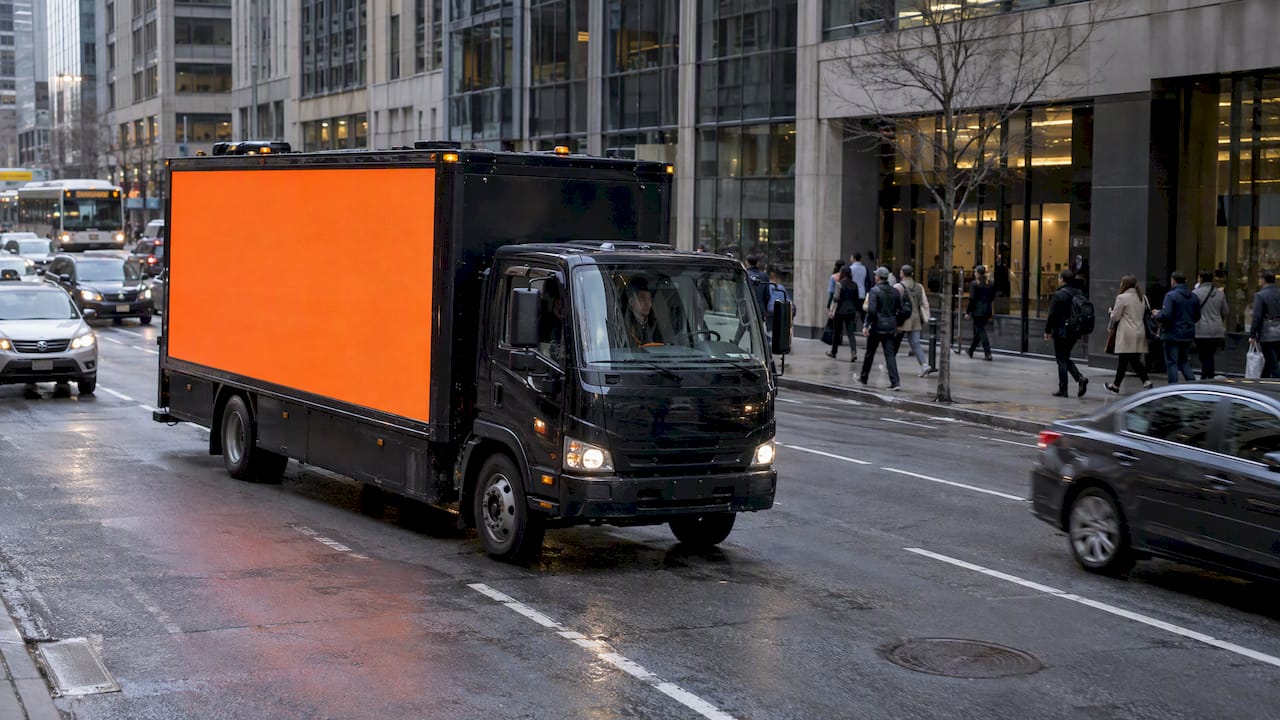
Beacon-ads operates LED mobile billboards and wrapped rideshare vehicles across all 50 states, combining physical reach with geofencing, affinity targeting, and smart QR code data capture. Every campaign includes proof-of-posting documentation and funnel metrics so you can measure performance at each stage. If you are ready to move beyond impression counts and into audience-level precision, explore the full 2026 OOH advertising guide or review the types of OOH formats available for your next campaign.
FAQ
What is the outdoor advertising targeting process?
The outdoor advertising targeting process is the structured method of using audience data, location intelligence, and programmatic tools to select ad placements that reach specific demographic or behavioral segments. It replaces generic traffic-based buying with precision audience matching.
How does programmatic DOOH improve targeting accuracy?
Programmatic DOOH platforms use real-time audience signal payloads to match inventory to specific consumer segments, achieving 20 to 40% higher clearing CPMs than standard inventory. This means each impression is delivered to a more relevant audience rather than a broad geographic mass.
What is the 6-second rule in outdoor advertising?
The 6-second rule states that billboard creative must be understood and recalled within six seconds, which limits effective copy to 5-7 words. Exceeding this threshold reduces comprehension among drivers and pedestrians moving past the panel.
Why does origin-destination data matter for OOH campaigns?
Origin-destination data reveals where your audience travels from and to, not just where they are at a given moment. This allows planners to intercept audiences along their actual behavioral routes rather than buying panels based on raw impression volume alone.
How do you measure the effectiveness of an outdoor advertising campaign?
Effective measurement combines geofence-based footfall tracking, QR code scan analytics, and brand lift surveys set up before campaign launch. These tools connect physical ad exposure to downstream consumer behavior, giving brand managers the attribution data needed to optimize and justify spend.