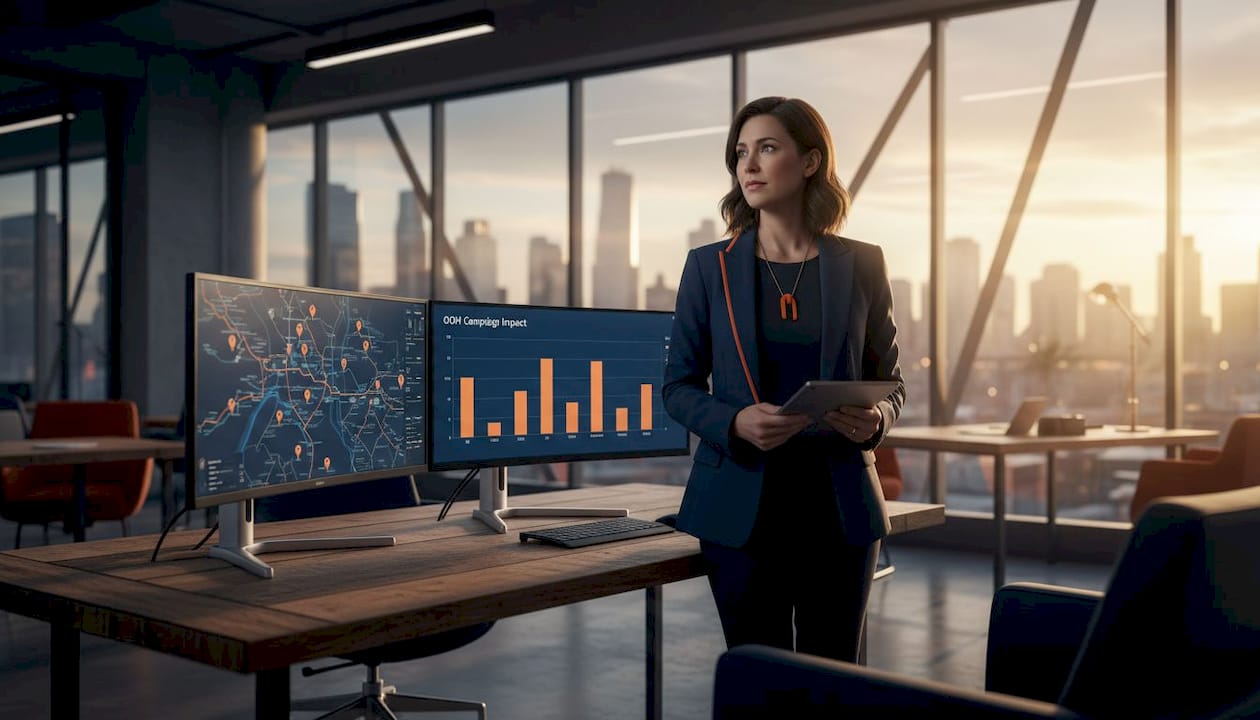
Smart data collection in out-of-home advertising is defined as the systematic use of location intelligence, computer vision, mobile device tracking, and IoT sensors to generate audience insights that make OOH campaigns measurable, targetable, and attributable. The role of smart data collection in OOH has shifted from a nice-to-have capability to the primary mechanism by which marketing professionals justify budget, optimize placements, and connect physical ad exposure to digital behavior. Platforms like AdMobilize, CARTO, and Graphisads have moved the industry beyond traffic counts into real audience intelligence. For decision-makers evaluating OOH advertising impact, understanding these data layers is now a prerequisite for competitive campaign planning.
What technologies enable smart data collection in OOH?
The foundation of smart data in OOH rests on four technology categories, each contributing a distinct layer of audience intelligence.
Location intelligence and mobile ID tracking capture anonymized device IDs as phones pass through geofenced zones around billboard locations. Geofencing and mobile ID capture improve audience demographic profiling and foot traffic pattern analysis, giving planners a behavioral picture of who actually passes a given placement rather than a raw vehicle count. This distinction matters because two locations with identical traffic volumes can serve completely different audience segments.

Computer vision measures actual human exposure at OOH placements. Cameras mounted on digital displays count faces, estimate dwell time, and classify broad demographic categories without storing any personally identifiable information. Unified platforms integrating computer vision replace manual workflows and reduce reliance on dedicated engineering teams, making exposure measurement scalable across large networks.
IoT and environmental sensors add a contextual layer. IoT sensors enable dynamic content adjustment based on live conditions like weather and pedestrian flow, transforming static billboards into responsive systems. A coffee brand can serve a hot beverage creative when temperature drops below 40°F and switch to iced drinks when it climbs above 80°F, all triggered automatically.
Unified data platforms tie these sources together. Aggregating camera data, location tracking, and audience segments into a single platform overcomes data fragmentation and provides comprehensive audience intelligence covering reach, attention, demographics, and attribution from one source.
Key data inputs that feed these platforms include:
- Anonymized mobile advertising IDs from location data providers
- Computer vision exposure counts and dwell time metrics
- Points of interest data for contextual audience profiling
- Weather and environmental sensor feeds for dynamic triggers
- Foot traffic lift data from retail and venue partners
Pro Tip: When evaluating data vendors, ask specifically whether their mobile ID data is panel-calibrated or raw. Panel-calibrated data corrects for the demographic skew inherent in opt-in location datasets, producing more accurate audience profiles.
How does smart data improve OOH targeting vs. traditional methods?
Traditional OOH measurement relied on two inputs: traffic counts from transportation authorities and panel-based visibility studies. Both produce impressions, not audiences. A billboard on a highway with 200,000 daily vehicles generates a large number, but that number tells you nothing about age, income, purchase intent, or whether anyone actually looked at the sign.
Spatial analytics combining demographic, mobility, and points of interest data surpasses traditional rough traffic counts by enabling inventory purchasing based on audience fit rather than volume alone. A health insurance brand targeting adults 45 and older can now filter OOH inventory by the actual demographic composition of passersby, not just the zip code.

Attribution is where the gap between old and new methods becomes most visible. Modern OOH attribution can detect a 30% jump in branded search volume in specific geographic regions during active campaigns, with attribution insights available within 7 to 14 days post-campaign. That is a measurable business outcome tied directly to a physical placement.
Marketing Mix Modeling is the superior method for capturing the full halo effect of OOH campaigns across channels, accounting for delayed revenue impacts that pixel-based methods miss entirely. MMM relates OOH spend statistically to observed revenue, capturing the brand awareness lift that shows up weeks later in search and sales data.
| Metric | Traditional OOH | Smart data OOH |
|---|---|---|
| Audience measurement | Vehicle and pedestrian counts | Anonymized device ID demographics |
| Exposure verification | Estimated visibility studies | Computer vision dwell time |
| Attribution | Correlation-based, delayed | Foot traffic lift, branded search lift |
| Creative optimization | Manual, campaign-level | Programmatic, daypart and weather triggers |
| Reporting speed | Weeks to months | 7 to 14 days, near real-time for DOOH |
| Audience targeting | Geographic proxy | Behavioral and demographic segmentation |
Pro Tip: Do not rely on a single attribution method. Combine foot traffic lift data for short-term validation with Marketing Mix Modeling for long-term revenue attribution. Each method captures a different part of the OOH impact curve.
What practical benefits do marketers gain from smart data in OOH?
The practical applications of data analytics for OOH extend well beyond measurement. They change how campaigns are planned, bought, and optimized in real time.
Dynamic creative optimization is the most immediate benefit. Programmatic DOOH platforms enable buying impressions with dayparting and weather-based triggers, allowing creative to shift based on audience composition at any given hour. A quick-service restaurant can run breakfast messaging at 7 a.m. to commuters and switch to family dinner promotions at 5 p.m. without any manual intervention.
Audience retargeting closes the loop between physical and digital. When a device ID is detected near an OOH placement, that ID can be added to a digital retargeting pool. The consumer then sees a coordinated mobile or display ad within hours of passing the billboard. This cross-channel sequence consistently outperforms either channel used in isolation.
Location selection and budget allocation become data-driven decisions rather than gut calls. Proximity marketing campaigns vary between $500 and $2,500 per month based on data depth and tracking services, meaning marketers can match data investment to campaign scale. A regional brand testing three markets can start with basic geofencing and scale to full computer vision measurement once the model is proven.
Specific use cases that deliver measurable ROI include:
- A/B testing two creative executions across matched location pairs to identify which message drives more foot traffic
- Identifying high-index audience locations by overlaying mobility data with first-party customer profiles
- Measuring incremental store visits attributed to OOH exposure versus a control group that was not exposed
- Tracking branded search volume by geographic region to quantify awareness lift from specific placements
For marketers building the business case for OOH investment, these outputs translate directly into the budget justification language that CFOs and CMOs require. The data-driven OOH strategies that consistently win internal approval are those that connect ad spend to a measurable downstream outcome, whether that is store visits, search volume, or sales lift.
What privacy standards govern OOH data collection?
Privacy is the most common objection marketers face when presenting smart data OOH programs internally. The concern is understandable but largely addressed by how the industry actually operates.
Modern OOH location intelligence relies on aggregated and anonymized device ID tracking, tracking device IDs rather than individuals. No name, address, or personal identifier is ever attached to the data. What the system knows is that a device with a specific anonymous ID passed a location at a specific time. That is audience measurement, not surveillance.
MRC 2026 standards mandate transparency in data collection methodologies, requiring disclosures subject to confidential audits and promoting comparability with other media while aligning with GDPR compliance requirements. These standards give buyers an independent benchmark for evaluating vendor claims.
The key privacy safeguards built into reputable OOH data programs are:
- Device ID hashing and rotation to prevent longitudinal individual tracking
- Data aggregation thresholds that suppress results when sample sizes are too small
- No storage of biometric data from computer vision systems
- Opt-out mechanisms aligned with mobile operating system privacy controls
- Independent third-party audits of data collection and processing methods
The distinction that matters most for internal stakeholders is this: OOH data measures audiences in aggregate, the same way a television rating measures viewers. No individual is identified or followed. That framing resolves most compliance concerns before they escalate.
What does the future of data in OOH look like?
The trajectory of smart data in OOH points toward three converging developments that will reshape how the channel is planned and measured over the next three to five years.
AI-driven audience data processing platforms are making OOH more accessible and scalable for marketers, reducing the complexity inherent in multi-vendor systems. Instead of stitching together location data from one vendor, computer vision from another, and attribution from a third, unified platforms deliver a single measurement output. This consolidation lowers the technical barrier for mid-market brands that previously lacked the engineering resources to run sophisticated OOH measurement programs.
Smart city infrastructure will expand the sensor network available to OOH advertisers. As municipalities deploy connected traffic systems, pedestrian counters, and environmental monitors, that data becomes available for contextual ad targeting. A digital billboard in a smart city corridor will know real-time pedestrian density, weather conditions, and even event-driven foot traffic spikes, all without any additional hardware investment from the advertiser.
The integration of OOH with cross-channel marketing ecosystems is accelerating. Proximity marketing and spatial analytics are shifting OOH planning from broad impressions to precise audience targeting using rich demographic and behavioral data. As that data feeds into the same demand-side platforms used for digital buying, OOH will be planned and optimized alongside paid search and social in a single workflow. For digital-native CMOs, that integration removes the last structural barrier to treating OOH as a performance channel rather than a brand awareness line item.
Key takeaways
Smart data collection transforms OOH from a reach-based channel into a measurable, audience-targeted, and attribution-capable performance medium.
| Point | Details |
|---|---|
| Technology stack matters | Geofencing, computer vision, and IoT sensors each contribute distinct data layers that together produce full audience intelligence. |
| Attribution is now measurable | Branded search lift and foot traffic data provide campaign-level proof of impact within 7 to 14 days post-campaign. |
| Privacy is built in | Anonymized device ID tracking and MRC 2026 audit standards address compliance concerns without sacrificing measurement depth. |
| Unified platforms reduce friction | Single-source audience intelligence platforms eliminate multi-vendor complexity and make smart data accessible at scale. |
| Future integration is digital | OOH data is converging with programmatic buying platforms, making the channel plannable alongside paid search and social. |
Why the industry’s data moment is arriving faster than most marketers expect
I have watched OOH measurement evolve from printed traffic studies delivered by mail to real-time dashboards that update hourly. The pace of that change has been uneven, but the last 18 months have been different. The consolidation of computer vision, location intelligence, and programmatic buying into unified platforms has removed the primary excuse for not measuring OOH rigorously.
What I find most underappreciated is the retargeting loop. Most marketers still think of OOH as a top-of-funnel awareness tool and stop there. The ability to capture device IDs near a physical placement and serve those same devices a coordinated digital ad within hours is a fundamentally different proposition. It turns a billboard into the first touchpoint in a multi-step conversion sequence. Brands that have figured this out are not just measuring OOH better. They are using it differently.
The privacy conversation is also more resolved than the industry’s public discourse suggests. The gap between what OOH data systems actually do and what nervous legal teams imagine they do is wide. Anonymized, aggregated device tracking is not surveillance. Closing that perception gap internally is often the real work for marketing decision-makers, not the technology itself.
My prediction is that digital-native CMOs who grew up optimizing paid search and social will drive OOH adoption faster than traditional brand marketers. They already speak the language of impression-level data, attribution windows, and audience segmentation. OOH now speaks that language back.
— Scott
How Beacon-ads puts smart data to work for your OOH campaigns

Beacon-ads combines LED mobile billboards and wrapped rideshare vehicles across all 50 states with the data infrastructure that makes physical OOH measurable. The platform integrates geofencing, real-time retargeting, and smart QR code capture to connect outdoor exposure directly to digital engagement and conversion tracking. Every campaign includes proof-of-posting documentation and attribution analytics, so you can present performance data with the same confidence as a paid digital report. If you are ready to move from impression estimates to audience-level accountability, explore Beacon-ads’ data-driven OOH solutions and see how mobile billboard campaigns are measured and optimized in practice. You can also review the smart data capture approach that underpins every Beacon-ads campaign.
FAQ
What is smart data collection in OOH advertising?
Smart data collection in OOH advertising is the use of geofencing, computer vision, mobile device ID tracking, and IoT sensors to generate audience-level insights from physical ad placements. It replaces traditional traffic count estimates with demographic profiles, exposure metrics, and attribution data.
How does OOH data collection protect consumer privacy?
OOH data systems track anonymized device IDs rather than individuals, with no personally identifiable information stored or transmitted. MRC 2026 standards require independent audits and GDPR-aligned compliance from measurement vendors.
How quickly can marketers see attribution results from OOH campaigns?
Attribution insights from OOH campaigns are typically available within 7 to 14 days post-campaign, with near real-time impression data available for digital OOH placements.
What is the difference between foot traffic attribution and Marketing Mix Modeling for OOH?
Foot traffic attribution measures direct store visits from exposed device IDs and works best for short-term, location-based outcomes. Marketing Mix Modeling captures the broader revenue halo effect of OOH across all channels, including delayed brand search and sales lift that direct attribution methods miss.
How much does smart data collection for OOH campaigns cost?
Proximity marketing and data tracking services for OOH campaigns range from $500 to $2,500 per month, depending on data depth, geographic scope, and the tracking methods used.