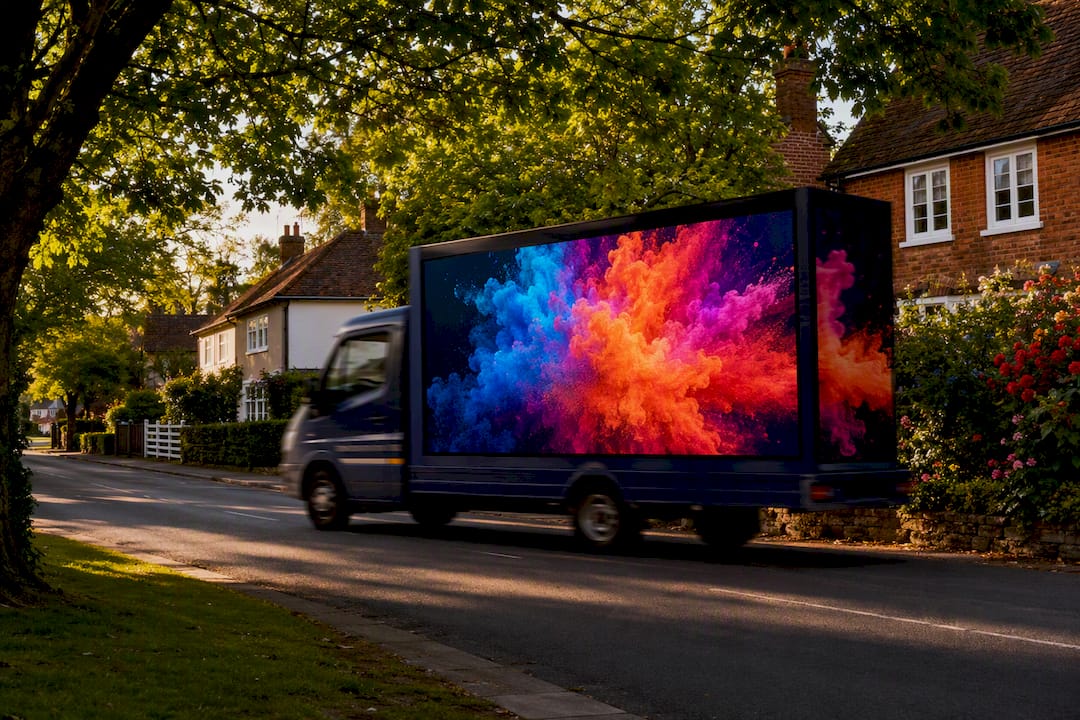
Out-of-home ad effectiveness is the measurable lift in audience engagement, brand recall, and sales that outdoor advertising generates across physical and digital channels. OOH consistently outperforms broadcast and connected TV in key performance metrics, making it one of the most underrated channels in a marketer’s media mix. A recent OAAA and Kochava study found that OOH delivers a median lift of 20% for in-person outcomes and 14% for digital outcomes, compared to roughly 10% for broadcast and connected TV. That gap is not marginal. It signals that understanding what is out-of-home ad effectiveness, and how to measure it correctly, is now a competitive advantage for any marketing team allocating serious budget.
What is out-of-home ad effectiveness, and why does it matter?
Out-of-home ad effectiveness is defined as the degree to which an OOH campaign moves a measurable audience metric, whether that is foot traffic, brand recall, search volume, or revenue. The industry term for this discipline is OOH measurement, and it sits at the intersection of media planning, behavioral science, and attribution modeling.
The stakes are high. Adding OOH to a digital campaign increases median iROAS from $1.11 to $2.00, an 80% efficiency gain. That means every dollar spent on digital advertising works harder when OOH runs alongside it. Marketers who ignore this synergy are leaving measurable revenue on the table.

OOH also reaches audiences that digital channels miss. Consumers cannot install an ad blocker on a billboard. Outdoor formats deliver continuous, unavoidable exposure in high-traffic environments, which creates brand familiarity that compounds over time. That compounding effect is what makes outdoor advertising ROI difficult to capture with simple last-click models.
What metrics and layers define out-of-home ad effectiveness?
OOH effectiveness must be measured with layered metrics because impressions and reach alone produce misleading conclusions. The three core layers are attention, recall, and action. Each layer answers a different question about campaign performance.
Attention metrics
Attention metrics measure whether the ad was actually seen. Key indicators include viewability (the percentage of the audience with a clear line of sight to the format), dwell time (how long a person remains in view of the ad), and frequency of exposure. Frequency is particularly powerful: conversion rates increase 5.3x from one to ten ad exposures, with the industry-recommended optimal range sitting at 3–5 exposures. That finding means a single billboard placement with low traffic frequency is almost certainly underperforming its potential.
Recall and brand lift
Recall metrics measure what the audience remembers after exposure. Brand lift studies comparing exposed and control groups measure awareness, recall, favorability, and purchase intent. The control group design is non-negotiable for valid results. Without a genuine unexposed comparison group, any recall improvement could reflect seasonal trends or competitor activity rather than your campaign.

Action and attribution metrics
Action metrics connect exposure to behavior. Footfall attribution tracks whether exposed consumers visited a physical location. Search lift measures whether branded queries increased in exposed markets. Conversion tracking links OOH exposure to online or in-store purchases. These metrics are the most commercially meaningful, but they are also the most technically demanding to measure correctly.
- Viewability and dwell time (attention layer)
- Brand awareness and recall lift (recall layer)
- Foot traffic, search lift, and conversions (action layer)
- Frequency of exposure across the campaign window
- Incremental revenue contribution within a marketing mix model
Pro Tip: Never evaluate an OOH campaign on impressions alone. Impressions tell you how many people could have seen the ad. Layered metrics tell you how many people actually responded to it.
How is out-of-home ad effectiveness measured with experimental and modeling approaches?
Rigorous measurement of OOH effectiveness requires going beyond correlation. Most billboard attribution is correlation, not causation. Valid attribution requires regression analysis that accounts for external factors like weather, local events, and seasonal demand, plus placebo checks to confirm that observed lifts are not false positives.
The most credible method is experimental randomization. An experimental design randomizing ads across metro lines allows causal measurement by comparing high-exposure neighborhoods against low-exposure ones and surveying residents in both groups. This approach produces causal evidence rather than observed correlation, which is the gold standard for justifying budget allocation.
A practical measurement framework
- Define your measurement layer before launch. Decide whether you are measuring attention, recall, or action. Each layer requires a different methodology and data source.
- Build a real control group. Select comparable markets or audience segments that will not see the campaign. Without this, you cannot isolate OOH’s contribution.
- Run regression analysis on outcome data. Control for confounders including weather, competitor spend, and local events. Add a placebo check using a period before the campaign to validate your model.
- Integrate findings into a marketing mix model (MMM). Marketing mix modeling quantifies OOH’s halo effect and attributes incremental revenue even without click data. This is the only method that captures OOH’s full contribution to a multi-channel campaign.
- Extend your measurement window. OOH campaigns often require longer windows beyond two weeks to capture delayed consumer behavioral effects. A consumer who sees a billboard on monday may not visit the store until the following weekend.
Pro Tip: Combine survey data, mobile location signals, and sales data in your MMM. Each source fills a gap the others leave. Surveys capture recall. Location data captures foot traffic. Sales data captures revenue. Together, they produce a complete picture.
| Measurement method | What it captures | Key limitation |
|---|---|---|
| Impression tracking | Potential audience size | Does not confirm actual exposure |
| Brand lift study | Recall and favorability change | Requires proper control group design |
| Footfall attribution | Physical store visits post-exposure | Correlation risk without regression controls |
| Marketing mix modeling | Incremental revenue contribution | Requires sufficient historical data |
| Experimental randomization | Causal impact with high confidence | Complex and resource-intensive to execute |
What benefits do out-of-home ads provide, and how does effectiveness vary by campaign type?
OOH advertising delivers three structural advantages that most digital channels cannot replicate: continuous exposure, mass reach without audience fragmentation, and high consumer receptiveness. Consumers cannot skip, mute, or block outdoor ads. That forced attention creates brand familiarity at scale, which is why OOH consistently outperforms broadcast TV in effectiveness studies.
Retail-focused OOH campaigns achieve ROAS between 3:1 and 7:1 when using proper footfall attribution models. That range reflects the channel’s ability to drive physical store visits when placements are geographically targeted near retail locations. Understanding return on ad spend in this context means accounting for both the direct footfall lift and the brand awareness that drives repeat visits over time.
Digital out-of-home (DOOH) formats extend these benefits further. Dynamic creative that changes by time of day, weather, or audience segment produces higher engagement than static formats. Integrating DOOH with mobile retargeting, for example through geofencing exposed audiences and serving them a follow-up digital ad, compounds the effectiveness of both channels. Marketers using data-driven OOH strategies report stronger attribution results because the digital layer creates trackable signals that the physical format alone cannot generate.
The benefits of OOH advertising that consistently appear across effectiveness studies include:
- Wide reach across demographic segments without reliance on logged-in user data
- Cost-effective CPM compared to premium digital placements in saturated markets
- High consumer favorability and lower ad avoidance rates than digital formats
- Strong brand recall driven by repeated physical exposure in daily commute patterns
- Cross-channel amplification when combined with search, social, or connected TV
What practical steps can marketers take to maximize outdoor campaign performance?
Maximizing OOH campaign performance starts with setting measurement KPIs before the campaign launches, not after. Marketers who define success metrics at the planning stage build campaigns that generate usable data. Those who define metrics after launch are rationalizing results rather than measuring them.
Measuring OOH effectiveness requires choosing which layer, attention, recall, or action, is relevant to the campaign objective and matching the measurement method to that layer. A brand awareness campaign should prioritize recall lift studies. A retail traffic campaign should prioritize footfall attribution with regression controls. Mixing these up produces data that looks credible but answers the wrong question.
Attribution models also matter. Marketing attribution models that rely on last-click logic systematically undervalue OOH because the channel generates no clicks. Integrating OOH data into a multi-touch or MMM framework corrects this bias and produces a more accurate picture of the channel’s contribution to revenue. Marketers who skip this step routinely underreport OOH performance and underfund it in subsequent planning cycles.
- Set KPIs aligned to attention, recall, or action before launch
- Build control groups into campaign geography or audience segmentation
- Use regression analysis and placebo checks for footfall attribution
- Extend measurement windows to capture delayed behavioral effects
- Integrate OOH signals into MMM to capture halo effects and cross-channel lift
- Use geofencing and mobile retargeting to create trackable digital signals from physical placements
Pro Tip: Plan your measurement window to include a “tail” period after the campaign ends. Consumer behavior triggered by OOH exposure often converts days or weeks after the last impression. Cutting measurement at campaign end understates true performance.
Key Takeaways
OOH ad effectiveness is best measured through layered metrics combining attention, recall, and behavioral outcomes within a marketing mix model that accounts for delayed consumer response and cross-channel halo effects.
| Point | Details |
|---|---|
| OOH outperforms broadcast TV | OOH delivers a median 20% lift for in-person outcomes vs. roughly 10% for broadcast and connected TV. |
| Frequency drives conversions | Conversion rates increase 5.3x from one to ten exposures; target 3–5 exposures per audience member. |
| Layered metrics are required | Impressions alone mislead; combine attention, recall, and action metrics for valid conclusions. |
| MMM captures the full picture | Marketing mix modeling attributes OOH’s halo effect and incremental revenue despite the absence of click data. |
| Measurement windows must extend | Campaigns need measurement beyond two weeks to capture delayed consumer behavioral responses. |
Why I think most marketers are measuring OOH wrong
The most common mistake I see is treating OOH like a digital channel and expecting click-level attribution. That expectation sets the channel up to fail. OOH works through repetition, physical presence, and brand familiarity. None of those mechanisms produce a click. Measuring them with last-click logic is like judging a marathon runner by their sprint speed.
The second mistake is trusting footfall attribution reports that have not been validated with regression controls or placebo checks. A lot of vendors will show you a lift number that looks compelling. What they will not show you is whether that lift would have happened anyway due to a local event, a competitor closing nearby, or a seasonal shopping pattern. Rigorous attribution is uncomfortable because it sometimes shows smaller lifts. But a smaller, validated number is worth more than a large, fabricated one.
My practical advice: invest in a proper MMM before you scale OOH spend. The model will show you where OOH is genuinely contributing and where it is riding the coattails of other channels. That information is what separates marketers who grow OOH budgets confidently from those who cut them at the first sign of pressure. Combine that with real control groups, extended measurement windows, and data-driven targeting to build a measurement practice that actually reflects what OOH does.
— Scott
How Beacon-ads helps marketers measure and maximize OOH performance
Beacon-ads combines LED mobile billboards and wrapped rideshare vehicles across all 50 states with attribution analytics, geofencing, and real-time retargeting built into the same platform.

Every campaign includes proof-of-posting documentation and funnel metrics that feed directly into performance reporting. Smart QR codes capture audience engagement data at the point of exposure, creating the trackable digital signals that make OOH attribution credible. For marketers ready to move beyond static placements, Beacon-ads offers route customization and affinity targeting to reach specific demographic segments in high-traffic areas. Explore the full range of OOH ad formats and see how each format maps to measurable campaign outcomes.
FAQ
What is out-of-home ad effectiveness?
Out-of-home ad effectiveness is the measurable lift in brand recall, foot traffic, search behavior, or sales that an outdoor advertising campaign generates. It is assessed through layered metrics covering attention, recall, and behavioral outcomes.
How effective are outdoor ads compared to TV?
OOH delivers a median 20% lift for in-person outcomes and 14% for digital outcomes, compared to roughly 10% for broadcast and connected TV, according to OAAA and Kochava research.
What is the best way to measure OOH advertising ROI?
Marketing mix modeling combined with footfall attribution and brand lift studies provides the most complete picture. Retail-focused OOH campaigns achieve ROAS between 3:1 and 7:1 when proper attribution models are applied.
Why does frequency matter for OOH campaign success?
Frequency is a primary driver of OOH effectiveness. Conversion rates increase 5.3x from one to ten ad exposures, with the optimal range recommended at 3–5 exposures per audience member.
How long should you measure an OOH campaign?
Measurement windows should extend beyond two weeks after the campaign ends. Consumer behaviors triggered by OOH exposure often convert days or weeks after the final impression, and cutting measurement at campaign end understates true performance.