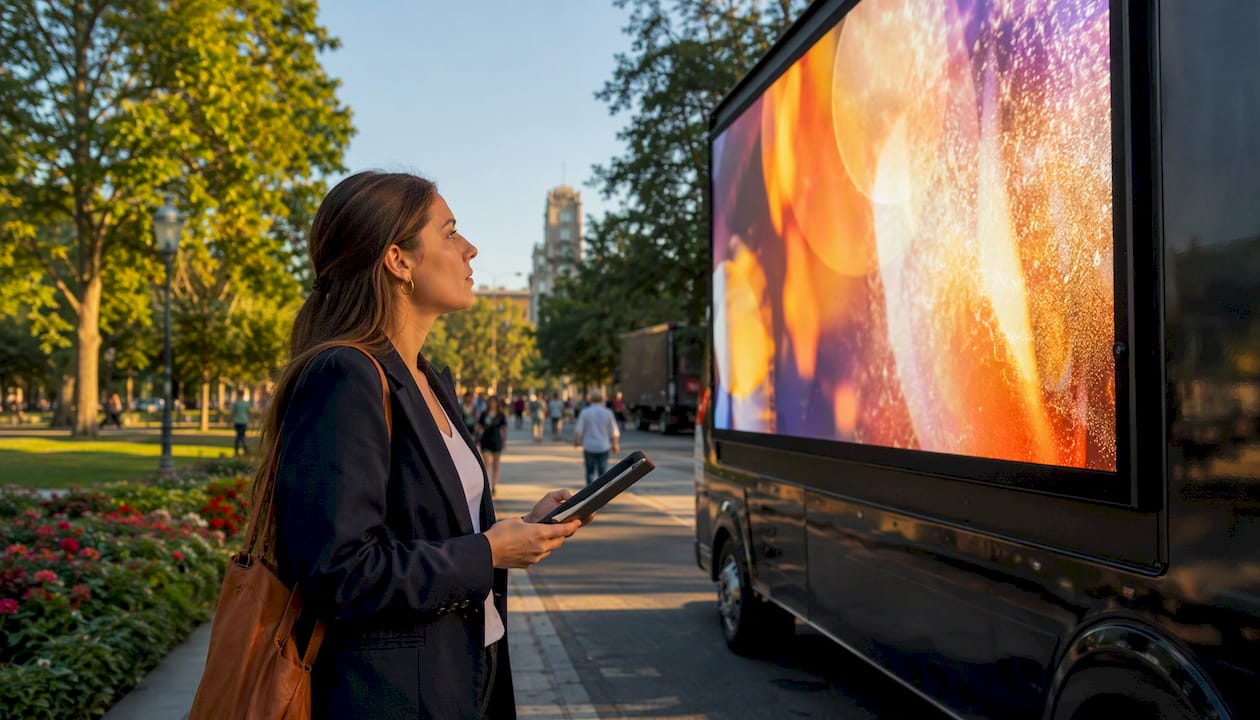
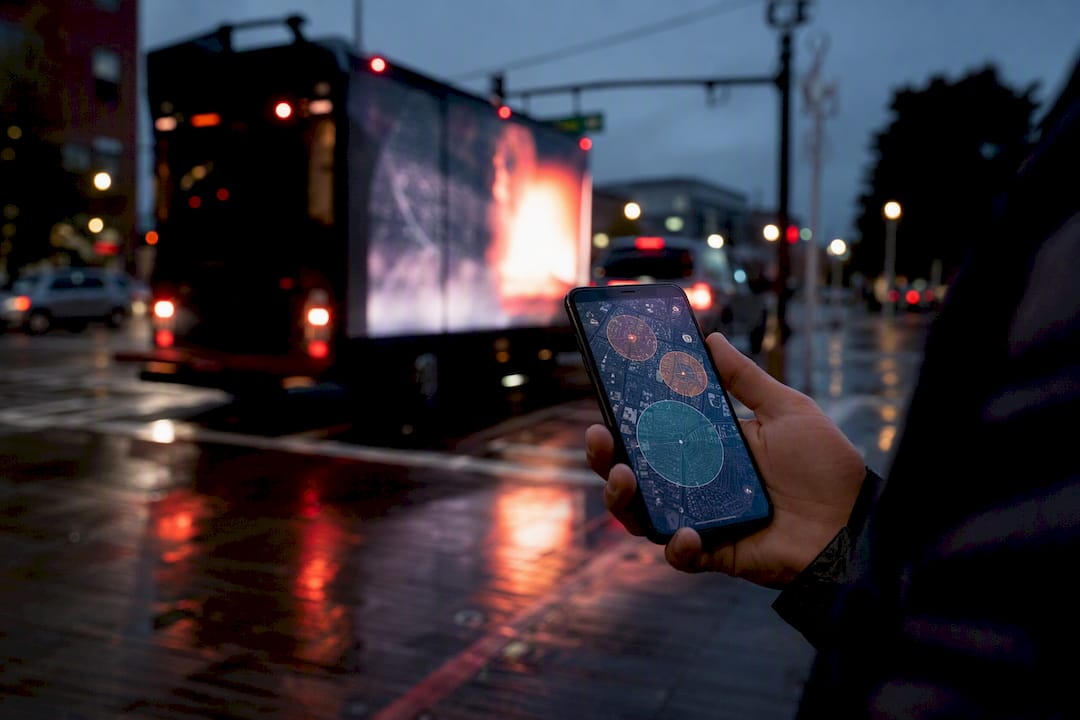
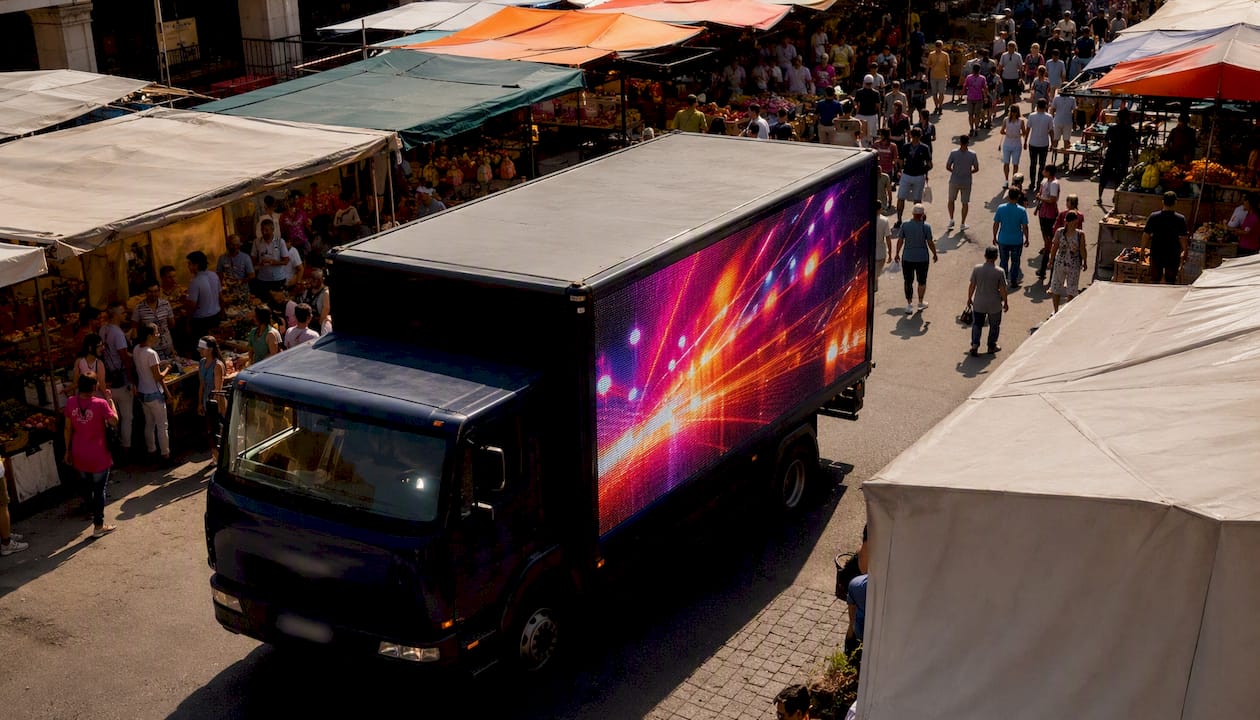
Real-time route changes mean dynamically rerouting mobile billboard trucks and wrapped rideshare vehicles mid-campaign to reach audiences where they actually gather, not just where a static route plan assumed they would be. The direct payoff is higher-quality impressions inside the windows that matter, plus a clearer line between the truck on the street and the digital action that follows it.
TL;DR:
- Real-time rerouting allows mobile billboards to follow live crowds, improving impression quality during events, surges, or sudden traffic shifts.
- A tech stack combining live data feeds, dynamic creative delivery, edge compute, and operational governance is required for effective instant rerouting.
- Triggering reroutes should rely on verified crowd spikes, underperforming routes, retail windows, or weather-driven demand, with clear thresholds and approval processes.
- Proof of rerouting success depends on GPS logs, timestamped photos, and linking digital actions to the specific route and time window.
- Vendors should provide API access, support for dynamic creative, SLA on execution, privacy compliance, and transparent pricing for mid-campaign changes.
Table of Contents
- What Real-Time Route Changes Look Like in an Active Campaign
- The Tech Stack Behind Live Route Changes
- When Should You Actually Trigger a Reroute?
- How Do You Measure and Attribute a Route That Changed Mid-Campaign?
- What Should You Ask a Vendor Before Buying Real-Time Routing?
- How Beacon Mobile Media Puts This Into Practice
- Why Responsiveness Is the Real Differentiator in Mobile OOH
- Ready to Run a Live-Route Campaign?
- Sources
What Real-Time Route Changes Look Like in an Active Campaign
Picture a truck scheduled to circle a downtown core all afternoon. A stadium event lets out early, a protest reroutes traffic, or a pop-up retail activation draws a crowd three blocks away. A static route plan misses all three. A dynamic one catches them.
The event-driven cases get the most attention because they’re dramatic: sports finals, festivals, concert exits, even large-scale protests where thousands of people suddenly funnel onto the same three streets. One World Cup activation used audience-led routing across three markets to chase live crowds, generating a significant number of impressions over multiple activation days by staying with the energy instead of a fixed loop.
But the everyday cases matter just as much. Commuter surges near transit hubs, a lunch rush around office parks, a weekend flurry at a shopping corridor. None of that requires a marquee event, just a route that adjusts to where people are right now.
What changes for the marketer:
- A campaign stops being a fixed media buy and becomes a tactical channel you can steer mid-flight.
- Impressions concentrate in the windows when your audience is actually present, not just when the truck happens to pass by.
- Contextual relevance goes up, because the vehicle shows up near the thing your audience is already doing.
- Downstream engagement signals, like QR scans and retargeted clicks, tend to track more closely with adjusted routes than with routes locked weeks in advance.
The Tech Stack Behind Live Route Changes
Rerouting a truck sounds simple until you look at what has to happen in the background. Marketers evaluating a vendor should understand the stack well enough to ask sharp questions, not just accept a claim of “real-time capability” at face value.
Four categories of infrastructure need to work together:
- Live data feeds. GPS telemetry from the fleet, passive audience sensors, event and permit feeds, weather APIs, and signals pulled from DSPs and SSPs all need to land in one place before a routing decision makes sense.
- Dynamic creative delivery. DCO templates paired with API-driven asset swaps let a screen change its message based on weather, time of day, or nearby foot traffic, without anyone physically touching the vehicle. Dynamic digital billboards built on this model can update creative from a live data stream instead of a fixed asset library, and a fail-safe default needs to sit behind every rule in case a feed drops.
- Edge compute. Processing that happens on or near the truck, rather than in a distant data center, is what makes sub-10-minute reactions possible. Edge computing cuts the latency between “crowd forms” and “truck arrives” enough that the vehicle can still be useful once it gets there, rather than showing up after the crowd has dispersed.
- Operational governance. Someone still has to dispatch the change, get it approved, and relay clear instructions to the driver, with compliance checks that keep the vehicle out of restricted zones or unsafe maneuvers.
Pro Tip: Ask any vendor for their average time from “trigger detected” to “truck moving on new route.” If they can’t give you a number, they’re likely coordinating reroutes by phone calls and guesswork rather than a governed workflow.
When Should You Actually Trigger a Reroute?
Not every dip in foot traffic justifies a change. Route changes cost coordination time and sometimes creative production time, so the trigger has to clear a real bar.
Four trigger types come up most often in live campaigns:
- Verified crowd spikes. A confirmed event letting out, a stadium exit, a festival gate opening. This is the highest-confidence trigger because the audience count is known, not estimated.
- Underperforming corridors. A scheduled route is quietly delivering fewer passes or lower dwell than projected, and the data shows it early enough to correct course.
- Nearby retail or activation windows. A partner brand’s pop-up, a mall promotion, a limited hours sale, anything with a defined start and end time that a truck can align with.
- Weather-driven demand shifts. Rain pushes foot traffic indoors and onto covered walkways; heat pushes it toward parks and waterfronts in the evening.
Before pulling the trigger, run it against a few thresholds: does the projected audience count justify the move, does the cost of rerouting fit inside the campaign’s contingency budget, is a creative variant already approved and ready to deploy, and does the client’s sign-off process allow for same-day changes without a delay that kills the opportunity?
A simple event-day playbook: confirm the trigger with a live data source, check creative readiness against the new context, get the fastest available approval (pre-authorized thresholds help here), then dispatch and log the change for reporting.
How Do You Measure and Attribute a Route That Changed Mid-Campaign?
This is where a lot of dynamic OOH campaigns fall apart, not because the routing failed but because nobody can prove what happened afterward. Proof-of-posting is the foundation: GPS traces showing exactly where the vehicle traveled, time-stamped photos confirming the creative that was displayed, and route logs tying both to specific hours.
Impression estimates come next, usually built from a mix of traffic counts, dwell-time modeling, and sensor data along the route. These are estimates, not census counts, and any vendor who presents them as exact figures is overselling their own methodology. Multi-source models that blend mobile location data with vehicle GPS and land-use data have shown real gains here.
- One case study found that combining these sources for route selection produced a substantial improvement in coverage compared to a simple passenger-count heuristic, with deep-coverage models pushing exposure intensity nearly four times higher in tested scenarios.
That kind of lift matters because it shows what separates a genuinely data-driven reroute from a truck that just drives somewhere different.
The other half of measurement is tying offline delivery to a digital action. Smart QR codes on the vehicle capture a scan the moment someone engages, deterministic retargeting picks that person up in later ad exposures, and DSP signals feed into funnel metrics that show the path from impression to click to conversion. Recommended KPIs for a dynamic campaign include on-target impression share, QR scan rate by route segment, cost per verified impression, and week-over-week shifts in retargeted engagement. Weekly reporting works for most campaigns; event-driven activations benefit from same-day dashboards.
What Should You Ask a Vendor Before Buying Real-Time Routing?
A good procurement conversation goes well beyond “can you move the truck.” It should cover the contract terms that determine whether live routing actually works when you need it to.
- API and data access. Does the vendor expose a live API for routing status and creative control, or is everything manual on their end?
- DCO support. Can creative swap automatically based on triggers, or does every change require a new file upload and manual approval?
- SLA on execution time. What’s the guaranteed window from trigger to truck movement, and what’s the guaranteed window for proof-of-posting delivery afterward?
- Privacy and compliance. Is audience data anonymized, is facial recognition explicitly excluded unless separately disclosed, and what’s the data retention policy?
- Pricing structure for mid-campaign changes. Are reroutes priced per change, bundled into a contingency allowance, or billed as a flat surcharge?
Pro Tip: Build a contingency buffer of 10 to 15% of your budget specifically for mid-campaign reroutes. Campaigns that skip this step tend to either miss real opportunities or blow through budget justifying each change individually.
How Beacon Mobile Media Puts This Into Practice
Beacon-ads runs LED mobile billboard trucks and wrapped rideshare vehicles, including Uber and Lyft, across all 50 states, which gives it the fleet flexibility that live rerouting actually depends on. Route customization and geofencing are built into the platform, so a campaign can pivot toward a verified crowd signal without waiting on a separate systems integration.
What backs that up in practice:
- Proof-of-posting through GPS tracking and time-stamped photo logs, so every reroute is documented rather than taken on faith.
- Attribution dashboards and funnel metrics that connect smart QR code scans and real-time retargeting to the specific route and time window that generated them.
- Reporting built for agencies, giving marketing teams the kind of documentation a client review actually requires.
Event activations, retail pop-ups, and multi-market brand launches all map well to this setup, because each depends on the same thing: a fleet that can move toward a live signal and a reporting layer that proves it happened.
Why Responsiveness Is the Real Differentiator in Mobile OOH

Most of the OOH industry still buys media the way it did a decade ago: lock a route, run it for weeks, hope the crowd shows up where the plan assumed it would. That assumption is the weak link, not the medium itself. A truck is inherently mobile. Treating it like a static billboard wastes the one advantage it has over every fixed panel in a city.
The mistake I see most often isn’t underinvesting in flexibility. It’s chasing flexibility without the reporting discipline to prove it worked, which is exactly what industry analysis of audience-led routing points to. Test the approach on one activation, measure it against a static control route, and only scale the playbook once the data backs it up.
— Scott
Ready to Run a Live-Route Campaign?
Beacon-ads is built for exactly the scenario this article walks through: a fleet that can chase verified audience signals instead of sitting on a fixed loop, with proof-of-posting and attribution reporting that let you show a client precisely what happened and when. That combination of mobility and documentation is hard to replicate with a static booking or a vendor without live routing infrastructure.

If your next campaign needs to move with an event, a retail window, or a crowd that doesn’t follow a predictable schedule, start by reviewing the types of out-of-home advertising Beacon-ads runs nationwide, then request a campaign brief built around your target windows and markets. Ask for a sample attribution report while you’re at it. Seeing the GPS logs, photo timestamps, and funnel data on a past campaign is the fastest way to know whether live routing will actually earn its keep on yours.
Sources
- Chasing the Crowd — What electroliTs FIFA campaign proved about mobile OOH
- Targeted bus exterior advertising using trajectory data (Frontiers in Environmental Science)
- The digital twin of the street: why AI and edge computing are quietly changing mobile billboard ROI