Dwell time is the length of time a person spends inside an ad’s display exposure zone, and it decides whether that exposure counts as a viewable impression. The Media Rating Council and the IAB both treat it as the foundation of out-of-home and digital out-of-home measurement, and vendors like Beacon-ads build reporting around it. Get the definition and the counting rules right, and everything else, creative length, placement, KPIs, follows.
TL;DR:
- Dwell time varies significantly by format, with indoor environments producing the longest durations often suitable for multi-scene creative, while roadside static boards generate the shortest exposure periods.
- Ad impressions count only if the ad plays at least once during the measured dwell window, requiring vendors to disclose measurement accuracy and fractionalization methods.
- Moving formats like mobile billboards and rideshares define exposure through route telemetry, GPS tracking, and signals, which differ from fixed-zone measurement strategies.
- Dwell data can be biased due to sampling limits, obstructions, or non-ad content, making auditability and disclosed error rates essential for reliable measurement.
- Shorter median dwell times imply that campaigns should tailor creative length, use multiple shorter spots in low-dwell venues, and prioritize dwell-adjusted impressions over raw reach or foot traffic.
Table of Contents
- What dwell time means in OOH and DOOH
- Industry standards and counting rules for dwell time
- DOOH vs static OOH vs digital: dwell ranges and creative fit
- Turning dwell data into planning and buying decisions
- Where dwell-time measurement breaks down
- Applying dwell-time measurement to mobile and rideshare OOH
- Balancing dwell time against reach and frequency
- A measurable alternative built around mobile OOH
- FAQ
- Sources
What dwell time means in OOH and DOOH
Dwell time is an operational measure: the number of seconds or minutes a person spends within a defined display exposure zone, whether that is a transit platform, a store aisle, or the sidewalk near a digital billboard. The MRC’s combined OOH standards define it as the time an individual or audience spends within range of the display, and that window determines whether an ad impression can be counted at all.
A few related terms get used interchangeably but mean slightly different things:
- Screen zone dwell time refers specifically to proximity to a digital screen, often captured by cameras or beacons.
- Venue visit time covers the full duration someone spends in a location, which can exceed actual ad exposure.
- Ad exposure time is the subset of dwell time when the ad unit is actually playing or visible.
A commuter waiting eight seconds at a crosswalk has a very different dwell profile than a traveler spending four minutes at a gate in an airport terminal, and that gap shapes everything from creative pacing to pricing.
Industry standards and counting rules for dwell time
Standardized counting rules exist so a dwell-time claim from one vendor means the same thing as a claim from another. The MRC’s OOH standards lay out the baseline requirements advertisers should expect in any audited report.
- An ad must play at least once during the measured dwell interval to count as a viewable impression; partial or missed plays should be fractionalized rather than counted in full.
- Measurement providers must disclose sampling frequency, tool accuracy, and the method used to fractionalize impressions when loop timing does not align with dwell windows.
- Periodic accuracy testing and independent audits are expected, not optional, for any provider claiming MRC-aligned measurement.
- OAAA and Geopath treat dwell time as a direct input to impression multipliers, converting raw presence into standardized audience and DMA-level ratings used across the planning industry.
These rules exist precisely so a media planner can compare a transit screen in one market against a digital billboard in another using a shared definition, rather than each vendor’s house methodology.
DOOH vs static OOH vs digital: dwell ranges and creative fit
Dwell time varies sharply by format, and that variance should drive creative length more than brand preference does.
- Indoor transit and retail environments typically produce the longest dwell, often ranging from tens of seconds to several minutes as people wait or shop.
- Outdoor place-based digital screens, like those in plazas or building lobbies, sit in the middle, usually single-digit to low double-digit seconds.
- Roadside moving formats, including mobile billboards and traditional static boards, generally produce the shortest dwell since the audience itself is often in motion.
Longer dwell environments support richer, multi-scene or interactive creative, while short-dwell formats need a single clear message delivered fast. The MRC’s Phase 1 standards frame venue median dwell as a practical creative ceiling: if the median is 18 seconds, a 30-second spot wastes delivery potential for most of the audience who never see the back half.
Turning dwell data into planning and buying decisions
Dwell time only pays off when it changes a real decision, not when it sits in a report nobody acts on.
- Set creative length to match venue median dwell rather than a fixed industry default.
- In low-dwell environments, run multiple shorter spots instead of one long one to raise frequency without wasting unseen seconds.
- Rank venues and dayparts by dwell-adjusted impressions and noticed rate, not raw foot traffic alone.
- Build dwell-based audience segments for retargeting, feeding people who lingered near a placement into cross-channel follow-up.
A workable reporting checklist includes dwell-adjusted impressions, noticed rate, creative completion rate for the median dwell window, and a disclosed margin of error from the vendor, aligning with best practices for measuring digital marketing effectiveness. Readers comparing this against static versus digital OOH testing approaches will find the same logic applies: measure first, then commit budget.
Pro Tip: Treat dwell-adjusted impressions as your primary planning metric for awareness campaigns, and raw reach as your secondary check, not the other way around.

Where dwell-time measurement breaks down
Dwell numbers look precise, but several common biases can quietly distort them.
- Sampling windows that cover only certain hours or days can misrepresent true audience dwell across a full campaign.
- Physical obstructions, poles, signage, crowds, interfere with camera and sensor accuracy without anyone noticing.
- Non-ad content mixed into the same loop as paid creative can inflate dwell counts attributed to the advertiser.
- Moving formats introduce variability that static-screen methodologies were never built to handle.
Because of this, auditability matters more than the headline number. Ask for disclosed error rates, request periodic re-testing results, and cross-check vendor estimates with on-site observation or a simple A/B placement experiment before scaling a campaign on the strength of one dwell figure.
Applying dwell-time measurement to mobile and rideshare OOH
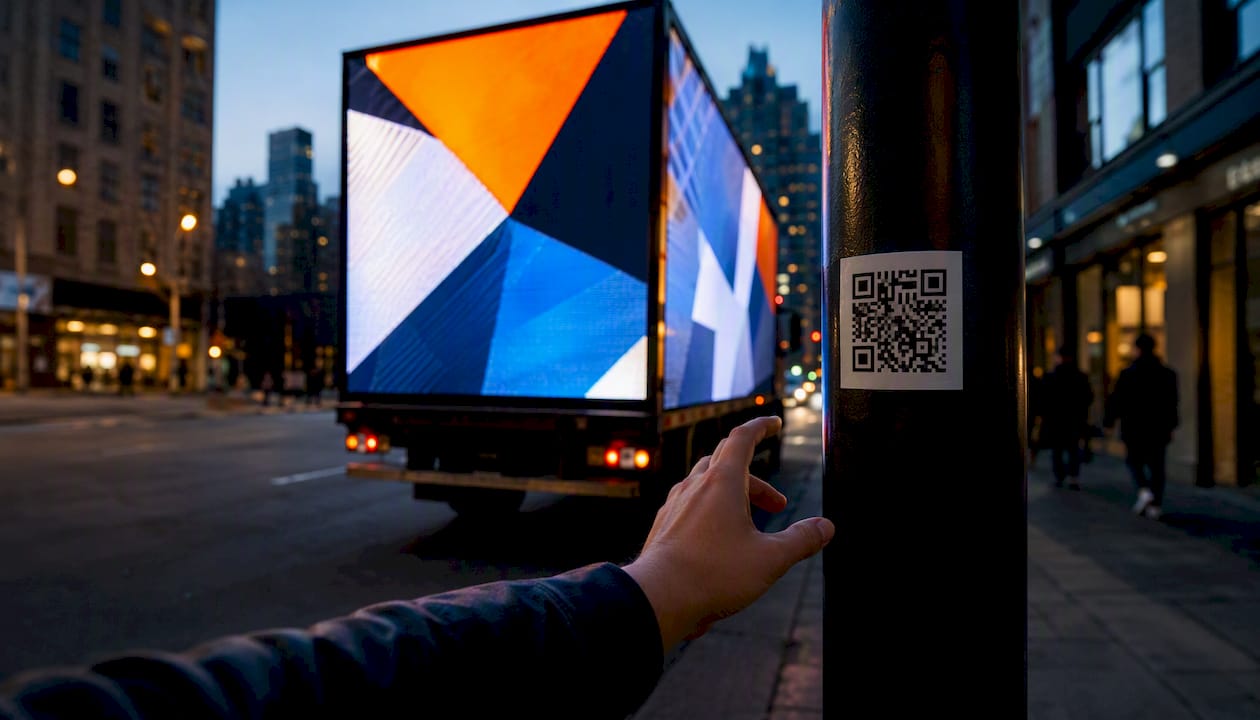
Moving formats need a different exposure model than fixed screens. For LED mobile billboards and wrapped rideshare vehicles, GPS route telemetry defines the exposure window as the vehicle moves through traffic and foot-traffic corridors, replacing the fixed-zone camera setup used in lobbies or transit stations.
- Route traces establish when and where the vehicle was within range of pedestrians or drivers, forming the exposure baseline.
- Non-PII device signals, QR scan events, and proof-of-posting documentation combine to validate that an impression actually occurred, following the pattern the IAB describes for pairing deterministic events with modeled exposure.
- Those same signals feed retargeting lists, so a scan near a route becomes a follow-up ad rather than a one-off exposure.
We apply this model across mobile billboard and rideshare campaigns, pairing route data with attribution reporting clients can audit.
Balancing dwell time against reach and frequency
Dwell time earns priority when creative needs time to land, brand launches, product demos, complex offers. For pure awareness plays, reach and frequency still carry more weight. Test both, and demand audited numbers before trusting either.
— Scott
A measurable alternative built around mobile OOH
Static placements and fixed digital screens aren’t the only way to apply dwell-aware thinking. We run LED mobile billboards and wrapped rideshare vehicles, pairing physical movement through high-traffic corridors with the same measurement discipline this article describes.

- Route telemetry defines exposure windows the way GPS tracking does for any moving format, giving planners a defensible dwell baseline.
- Smart QR codes capture scan events on the spot, turning a passing glance into a lead and a retargeting opportunity.
- Proof-of-posting documentation and attribution reports let clients audit delivery instead of taking impression counts on faith.
Geofencing and affinity targeting layer on top, so a campaign built around dwell-aware creative can also narrow in on the right neighborhoods, events, or demographic segments. Visit Beacon-ads to talk through a measurement pilot for your next campaign, or look at how mobile billboards work at conferences and trade shows for a concrete starting point.
FAQ
Is OOH still relevant for advertisers today?
Yes. Out-of-home remains a core channel because it reaches people in physical, high-traffic environments that digital-only strategies cannot replicate, and modern measurement tools now let advertisers validate exposure with the same rigor used in digital reporting.
What does dwell time mean in advertising?
Dwell time is the length of time a person spends within an ad’s display exposure zone. The MRC’s OOH standards use it to determine whether an exposure qualifies as a countable ad impression.
Is OOH considered BTL or ATL advertising?
OOH traditionally sits in the above-the-line (ATL) category because it targets broad audiences for brand awareness rather than direct response, though modern DOOH campaigns with retargeting and attribution increasingly blur that line.
What is the difference between OOH and POS advertising?
OOH refers to advertising placed in public environments like billboards, transit, and street furniture, while POS (point of sale) refers to promotional materials placed where a purchase decision actually happens, such as in-store displays. They often work together in a single campaign but measure different moments in the customer path.
Sources
Vendors estimate dwell time through a mix of passive and active signals, and the method behind a number matters as much as the number itself.
- MRC Out-of-Home Measurement Standards (combined)
- IAB | Digital Out-Of-Home (DOOH) Measurement Guide
- OAAA — OOH measurement resources
The IAB’s DOOH Measurement Guide documents these approaches and notes that combining signals, cameras plus Wi-Fi plus mobile location, paired with panel validation, produces more credible dwell estimates than any single source alone. Loop size matters here too: if a digital screen runs a 60-second loop but median dwell in that zone is 20 seconds, most viewers only see a fraction of the rotation, which changes how impressions get counted or fractionalized.
Pro Tip: Ask any OOH vendor for their stated margin of error on dwell estimates before you buy; a number without a disclosed accuracy range is a guess, not a measurement.