Convention center targeting means putting your message in front of the people attending a show, in the streets, hotels and transit routes around the venue, and then following up with the ones who saw it. The most reliable mix combines a physically mobile format, such as an LED billboard truck or a wrapped rideshare car, with a digital layer: a geofence around the venue, a smart QR code for lead capture and a report that proves where your ads ran.
This guide is for marketing teams, agencies and exhibitors who want to be seen at a conference without relying on a booth alone. It covers where attendees actually move, how to build the targeting, how to measure it and what to ask before you sign.
TL;DR
- Attendees spend most of a show day moving between the hall, nearby hotels, restaurants and transit. Mobile out-of-home reaches them on those paths, not just at the door.
- Pair the physical media with a geofence around the venue and hotel cluster, so people who saw the truck can be retargeted afterward.
- Smart QR codes turn a glance into a lead you can attribute. Proof-of-posting with GPS and photos shows the ads ran where and when you paid for.
- Plan routes and creative around the show schedule: arrival day, opening day, evening events and departure.
- Judge any vendor on reporting and lead time, not on impressions claims alone.
Table of Contents
- Why the area around the venue matters
- Where attendees actually are
- The three layers of convention center targeting
- What the results can look like
- How to plan a convention center campaign
- Creative that works at street speed
- Measuring what happened
- Mistakes we see around venues
- Our perspective
- Working with us on your next show
- FAQ
- Sources
Why the area around the venue matters
A convention center is a fixed building, but its audience is a moving one. A trade show draws a defined group of buyers, partners and competitors into one district for a few days. They arrive by airport shuttle and rideshare, walk between hotels and the hall, and eat in the same few blocks.
The business case for reaching them is solid. The IAEE’s 2025 CEIR Index Dashboard analyzes the 2024 performance of the U.S. B2B exhibition industry and includes forecasts, which is a useful benchmark for how much of your category’s pipeline runs through live events. Regional demand is strong too: in ConventionSouth’s 2025 industry report, planners said they were on track to host an average of four events in Southern destinations over the next 12 months, and 16.7% planned 11 or more.
More events in a market means more competition for attention inside the hall. Exhibit floors are crowded and noisy, and the best-placed booths still only reach people who walk in. The surrounding streets are where you can reach everyone else, including the decision-makers who never make it to your aisle.
Where attendees actually are
Before you pick a format, map the day. Most shows follow a predictable rhythm, and your targeting should follow it.
| Moment | Where attendees are | What works |
|---|---|---|
| Arrival day | Airport, rideshare pickup, hotel check-in | Wrapped rideshare cars, hotel-corridor truck routes |
| Morning rush | Hotel to hall, transit stops, entrance plazas | LED truck loops on approach streets |
| Midday | Restaurants, coffee shops, nearby streets | Short, timed routes through the dining district |
| Evening | Receptions, dinners, bars, off-site parties | Truck presence at event venues, geofenced mobile follow-up |
| Departure | Hotels, airport, rideshare | Rideshare wraps, retargeting reminders |
The point of the table is that a single static placement misses most of this. Out-of-home that moves can match each phase.
The three layers of convention center targeting
Think of the campaign as three layers that work together. Skipping one leaves a gap.
Layer 1: physical presence
Two formats do most of the work around a venue.
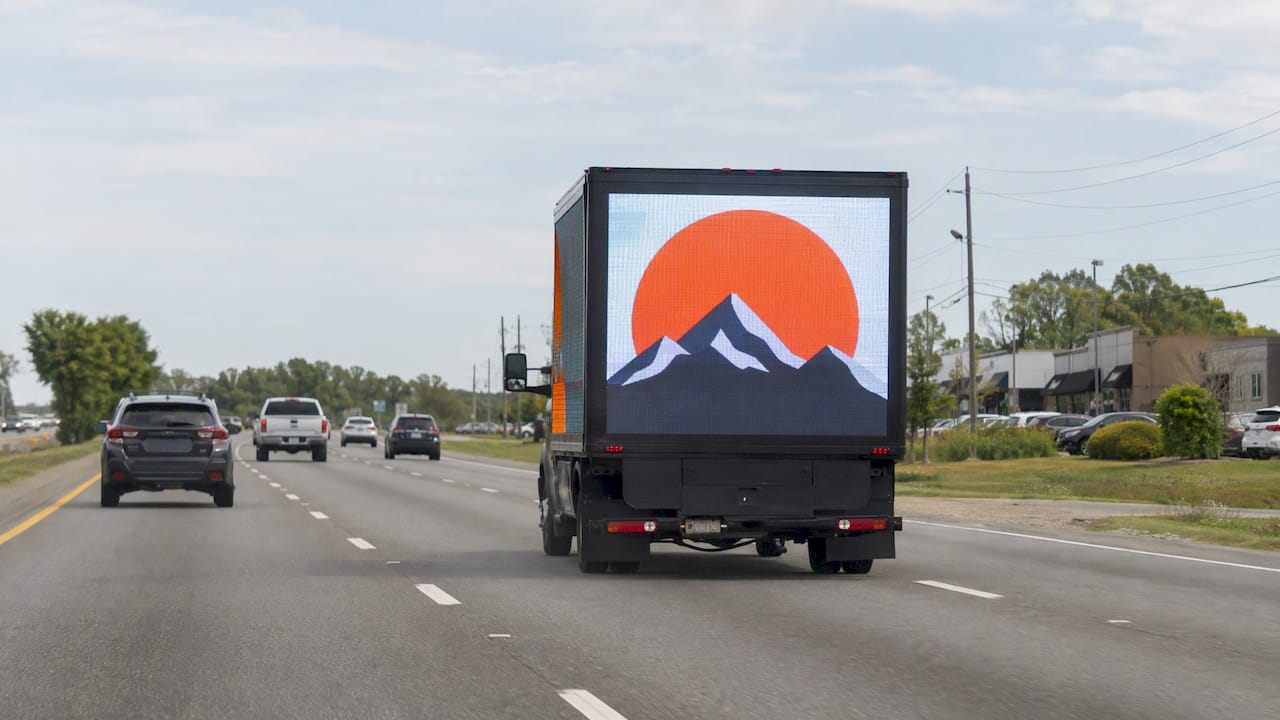
LED mobile billboards. A truck with a large LED display loops a planned route through the streets near the hall and hotels. Because it is digital, you can change creative by day, by show session or by time. A morning message can be about your keynote, an evening message about your reception. Our LED ad truck guide walks through how these campaigns are built and what makes the reach measurable.
Wrapped rideshare cars. Cars wrapped for Uber and Lyft cover the arrival and departure flows that a truck cannot, and they travel to the places attendees go after hours. They also reach people in the vehicle, which matters for riders heading to and from the show. See examples of rideshare advertising for how brands have used them, and check the rideshare advertising policies U.S. marketers should confirm before you commit to creative.
Used together, the two formats give you density at the venue and coverage across the wider district.
Layer 2: the digital geofence
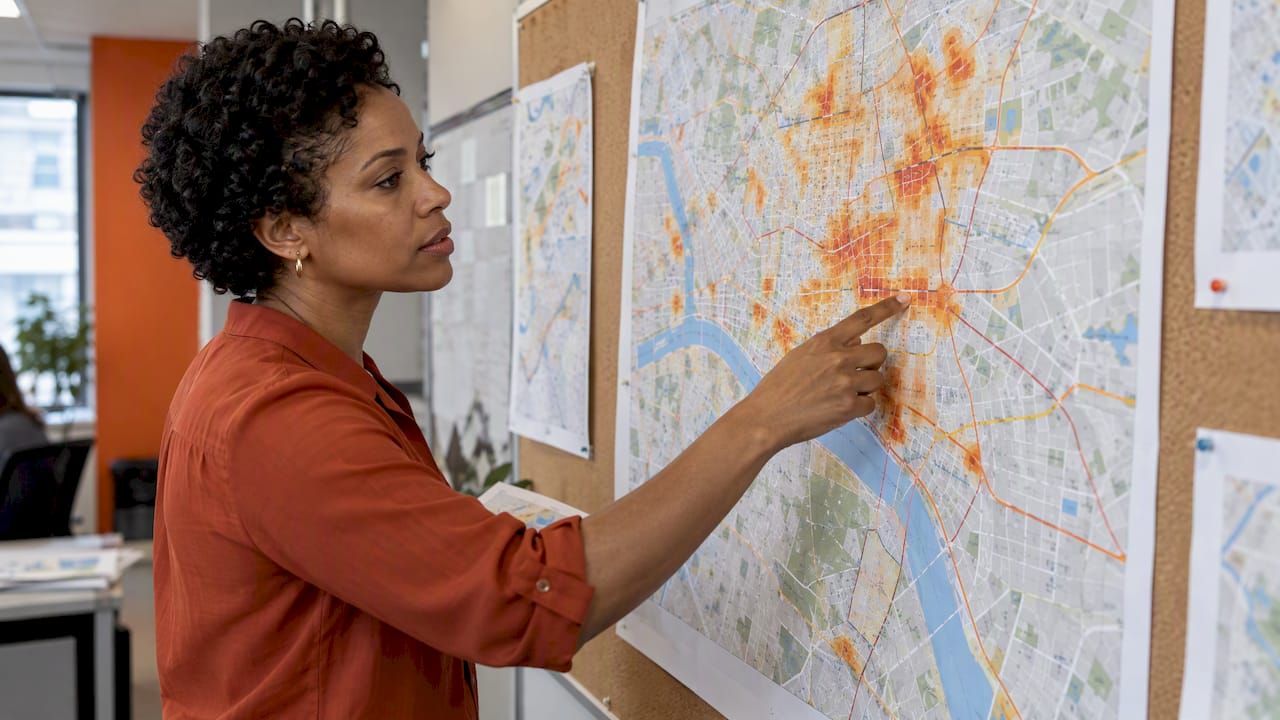
A geofence is a virtual boundary around a location. Devices that enter it can be added to an audience, and that audience can see follow-up ads on their phones. For a convention, you typically draw fences around the hall itself, the main host hotels and the major evening venues.
The value is retargeting. Someone who saw your truck on Tuesday and was inside the fence is the same person you can reach on Thursday on their phone, and again after they fly home. Our guides on retargeting in trade show promotion and geofencing campaign ideas paired with mobile OOH go deeper on audience windows and sequencing.
Privacy deserves a deliberate plan, not an afterthought. Use aggregated audiences, avoid sensitive categories and be clear with your legal team about what you collect. Our piece on event proximity targeting covers how to prove visit lift while protecting privacy.
Layer 3: capture and attribution
A billboard seen at 20 mph cannot carry much copy. It needs a single action. A smart QR code does that job: one scan, one landing page, one captured contact. Because the code is unique to the campaign, the scan data tells you which creative, route and day produced the lead.
This connects the street to your CRM. A person scans on the way to a session, books a meeting for the next morning and shows up at your booth already warm. If you also run lead capture inside the booth, the two data sets can be compared. For ideas on the booth side, this trade show lead capture guide is a helpful read on extending engagement before, during and after an event.
What the results can look like
Published case studies show how much event geofencing can move numbers, though you should treat any single result as an example, not a promise.
One case study on Amplitude at Adobe Summit in Las Vegas describes a hyperlocal out-of-home geofencing campaign aimed at enterprise marketers and analytics professionals, with the goal of positioning the company against legacy platforms and keeping the conversation going after the conference. The headline result was a 635% improvement in event campaign performance.
Another, on GE Vernova, involved a compressed timeline and limited tracking. A hyper-targeted event geofencing approach produced more than 700,000 impressions, and it was framed as a cost-effective B2B option when a full digital campaign was not feasible.

What these share is not the number. It is the structure: a defined audience, a tight location, a short window and a measurable outcome. That is the structure to copy.
How to plan a convention center campaign
- Define the one outcome. Meetings booked, badge scans, demo requests or brand recall. Pick one primary metric before you design anything.
- Get the show facts. Dates, hours, the host hotels, the evening events and the peak entrance times. The exhibitor kit and the organizer’s site usually have these.
- Map the district. Walk or review the streets between hall, hotels and dining. Identify approach roads where traffic and foot traffic are heavy.
- Set your fences. Draw geofences around the hall, hotels and key venues. Decide the retargeting window, for example the show days plus a follow-up period.
- Build the creative in tiers. One message for arrival, one for show hours, one for evening. Keep each to a headline, a visual and a QR code.
- Confirm local rules. Venues, cities and organizers can restrict vehicle advertising near the hall. Ask the organizer and the city before you finalize routes, and have your vendor confirm the plan.
- Lock in proof-of-posting. Agree on how GPS tracking and photo documentation will be delivered.
- Launch early enough to test. Run the creative and the QR landing page before the show opens, not on opening morning.
Our localized marketing strategy workflow turns this into a longer playbook if you run campaigns in many markets.
Creative that works at street speed
People see a moving truck for a few seconds. Write for that.
- One idea per frame. A billboard that tries to explain your whole platform explains nothing.
- Make it about the show. Referencing the event, your booth number or a session time tells attendees the message is for them.
- Contrast and size. LED displays can wash out in daylight, so use high-contrast colors and large type.
- Give a reason to scan. “Scan to book a 15-minute demo at booth 1420” beats a logo and a QR code with no promise.
- Rotate by phase. Change the message by day. Attendees who see the same frame three times by Wednesday stop noticing it.
Measuring what happened
Out-of-home has a reputation for being hard to measure. Convention work is one of the cases where it does not have to be.
- Proof-of-posting. GPS-tracked routes and photos confirm the truck or car was where the plan said, at the times it said.
- Scan data. Counts by day, by route and by creative.
- Visit lift. Compare footfall to your booth or location among the exposed audience against a baseline. Our guide to proving visit lift with mobile OOH covers the method.
- Funnel metrics. Follow retargeted audiences from impression to click to form fill to meeting.
- Cost per qualified lead. Divide spend by leads that match your target profile, not by raw scans.
If you want a fast read on whether mobile billboards are worth it for your team, see how to prove mobile billboard effectiveness in two weeks.
Mistakes we see around venues
Treating the venue as the only target. The building is one point. The journey around it is where most exposure happens.
Fencing too widely. A geofence covering half the city mixes attendees with residents and commuters and weakens your audience. Keep it tight and aligned to where the show actually happens.
Ignoring the multi-location picture. If you run the same message at several shows in a season, consistency and local adaptation both matter. This overview of digital advertising for multi-location businesses is a useful companion for coordinating nearby digital and physical media.
No follow-up plan. The scan is the start. Decide who calls, what they say and within how many hours, before the show begins.
Late booking. Popular dates and routes tighten around large shows. Ask about lead times early.
Our perspective
We run mobile out-of-home for a living, so we have a bias, but it comes from watching what separates a campaign that gets noticed from one that gets measured. The first is easy. A big LED truck near a busy hall will draw eyes. The second is the part that earns the next budget.
Our view is that a convention campaign should be built backward from the lead. Start with what the sales team needs after the show, then design the QR landing page, the geofence and the route so each piece produces data that can be matched to that outcome. Physical media creates the moment of attention. The digital layer, meaning geofencing, real-time retargeting, audience filtering and attribution, makes that moment countable.

We also think route customization is underrated. Two trucks with the same creative perform differently depending on whether they loop the approach streets at the right hours, so we plan routes around the show schedule instead of defaulting to a fixed circuit. And we put reporting at the center: proof-of-posting with GPS and photos, plus attribution analytics, so you and your agency can see what ran and what it did.
Short lead times matter as well. Exhibitors often decide late, after a competitor announces or a sponsorship falls through, and a national footprint across all 50 states means that a decision made two weeks out can still be executed.
— Scott
Working with us on your next show
Beacon Mobile Media runs LED mobile billboards, wrapped rideshare cars and localized mixed media campaigns nationwide, with geofencing, real-time retargeting, smart QR code lead capture and full reporting. If you have a show on the calendar, start with our guide on how to target conferences and trade shows with LED mobile billboards, or contact us through our site with the show name, dates and your goal, and we will propose routes, targeting and reporting for that venue. Pricing depends on the markets, dates and format, so we scope it per campaign. For a sense of how rideshare quotes are built, read our note on rideshare wrap cost.
For a broader look at event programs, see our out-of-home advertising for industry events guide.
FAQ
Can I advertise on the streets around a convention center?
Often yes, but rules vary by city, venue and show organizer. Some venues control their own property and signage, while public streets fall under city rules. Check with the organizer and local authorities, and ask your vendor to confirm the planned routes.
How early should I book mobile billboards for a trade show?
As early as your plan allows, because popular dates in major convention cities fill up. Short lead times are possible, but you give up options on routes and creative testing. Booking several weeks ahead gives you time to test the QR landing page and geofence.
Does geofencing a convention center work for B2B?
It can. The audience at a trade show is concentrated and professional, which suits B2B. Published examples, such as the Adobe Summit and GE Vernova campaigns above, used geofencing to reach event attendees and extend the conversation. Results depend on the creative, the fence and the follow-up.
How do I know my billboard truck actually ran?
Ask for proof-of-posting: GPS route records and timestamped photos of the vehicle in position. Combine that with QR scan data and geofenced audience reporting, so you can see both delivery and response.
Is convention center targeting only for exhibitors?
No. Agencies running localized campaigns, event organizers promoting side events and brands that are not exhibiting but want to reach the audience can all use it. The same layers apply: physical presence, a geofence and measurable capture.
Sources
- IAEE: 2025 CEIR Index Dashboard release
- ConventionSouth: 2025 State of the Industry Report
- CaseStudies.com: Amplitude event campaign case study
- CaseStudies.com: GE Vernova event geofencing case study