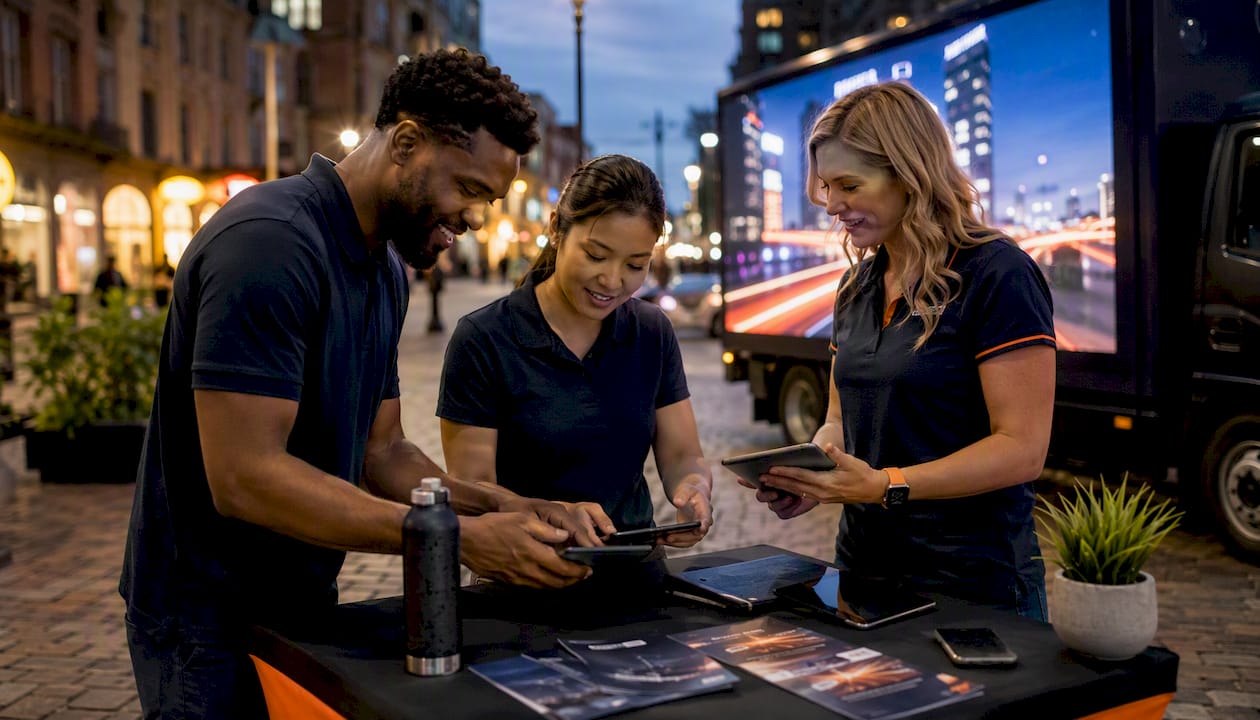
The most effective lead generation ideas for events share one trait: they treat every attendee interaction as a data point, not just a handshake. The teams consistently building pipeline from events run a three-phase motion covering pre-event outreach, on-site capture with real-time qualification, and fast, personalized follow-up. Here is what that looks like in practice:
- Pre-event: Enrich your target account list, book meetings before doors open, and warm prospects with lead magnets and personalized outreach
- On-site: Capture leads with context using badge scanning, QR codes, and experiential activations, then qualify in under 90 seconds
- Post-event: Segment leads as hot, warm, or cold, trigger personalized follow-up within 24–48 hours, and sync everything to your CRM immediately
- Technology layer: Smart QR codes, mobile capture apps, geofencing, and behavioral triggers replace manual data entry and calendar-based follow-up sequences
- Pipeline focus: Pipeline generation requires behavioral context and qualification data, not just contact info. A name and email is a lead. A name, pain point, timeline, and next step is a pipeline opportunity.
Table of Contents
- What pre-event strategies actually fill your pipeline before the event starts
- How to capture better leads on-site without slowing down conversations
- How to convert event leads into pipeline revenue after the show ends
- How Beacon-ads integrates mobile advertising into your event lead generation workflow
- Beacon-ads puts your brand in front of event attendees before they choose a booth
- Key Takeaways
What pre-event strategies actually fill your pipeline before the event starts
76% of trade show attendees arrive with a pre-planned list of booths to visit. If your brand is not on that list before they board their flight, you are competing for leftover attention on the floor.
Start by requesting the attendee list from the organizer as early as registration opens. Enrich it with job titles, company size, and tech stack using a list enrichment tool, then cross-reference against your CRM to identify your top 25–50 target accounts. Assign owners so every rep knows exactly which conversations they are trying to land before day one.
Two to three weeks out, send personalized outreach to those targets. A short note from the rep who will be at the booth, with a clear ask for a 15-minute meeting, outperforms any templated mass email. Layer in LinkedIn posts from your company page and individual reps, calling out your booth number and a reason to stop by. Spin up a simple event landing page with a meeting-booking link, add UTM parameters to track conversions, and you have a pre-event demand engine.
- Lead magnets: Whitepapers and guides targeting your prospects’ specific challenges generate 50% more sales-ready leads at lower cost than generic outreach. Gate them behind campaign-specific QR codes on your social posts and emails.
- Co-marketing: Partner with complementary brands or event sponsors to expand reach. Shared landing pages, co-branded content, and joint social posts let you tap audiences you would not reach alone.
- Team briefing: Team briefings covering target accounts, qualification criteria, and shared definitions of hot, warm, and cold leads dramatically improve capture quality. Without that alignment, your post-event report becomes guesswork.
Pro Tip: Pre-book as many meetings as possible. A rep walking in with a calendar full of meetings generates more pipeline than one relying entirely on floor traffic.
How to capture better leads on-site without slowing down conversations
Modern attendees expect value, not a sales pitch. The shift from transactional badge scanning to experiential activations is not a trend. It is the difference between a contact list and a qualified lead record.

AI photo booths, interactive product demos, and ROMI calculators all work on the same principle: offer something worth having in exchange for contact details and a qualifying question or two. The attendee gets a shareable piece of content or an instant insight. You get an opted-in lead with context attached.
Qualification forms completed in under 90 seconds produce data that is both fast to log and immediately scorable. Anything longer and reps start skipping fields. Keep your on-site flow to five structured questions: current state, trigger for looking, timeline, decision structure, and agreed next step. That is enough to score a lead and write a follow-up that does not sound generic.
- Badge scanning with context: Scan the badge, then add three to four words of context immediately. “Evaluating competitors, 500-person company, wants demo” transforms a bare contact record into something a sales rep can actually use.
- Gamification: Spin-to-win contests, trivia games, and live polls require a badge scan to enter. They drive booth traffic and create natural data-capture moments without feeling transactional.
- Real-time lead scoring: Score each lead as it is captured based on ICP fit, conversation context, and engagement depth. A Fortune 500 buyer who scanned at 10:14 AM should be routed to the right account executive by 10:20, not at end of day.
- QR code forms: A short five-to-seven-field form displayed at your booth shifts some data entry to the prospect. Mobile-friendly and brief, it works especially well for prospects who prefer self-service.
Pro Tip: Write two sentences of notes immediately after every conversation. Capturing a competitor mention or a stated pain point is more valuable than the raw lead record. That context is what makes your follow-up feel personal rather than automated.
For a deeper look at how outdoor advertising complements on-site capture, the same qualification and attribution principles apply across channels.
How to convert event leads into pipeline revenue after the show ends
Leads not synced to your CRM within 48 hours tend to go cold. Same-day sync is not a best practice. It is the baseline.
Segment every lead immediately into three buckets. Hot leads have budget, authority, and a near-term timeline. They get a personalized email from the rep who had the conversation, referencing something specific, within 24 hours. Warm leads are exploring solutions without an immediate purchase date. They get education: case studies, ROI calculators, or comparison guides that help them build an internal business case. Cold leads enter a nurture sequence tagged with the event source so attribution stays clean months later.
Behavioral triggers outperform calendar-based follow-up sequences. A lead who revisits your pricing page twice and downloads a case study three days after the event is at a different stage than one who opened your email and went quiet. Signal-driven routing puts that lead in front of the right rep with a brief on what they engaged with, rather than waiting for a scheduled day-seven email to fire.
- LinkedIn touchpoints: Every rep should send a connection request referencing something specific from the conversation. It is the lowest-effort, highest-return touch available.
- CRM workflow setup: Assign every lead to the correct rep with the correct campaign tag. Territory rules, account ownership, and event source should flow automatically so reps spend Monday in conversations, not spreadsheets.
- KPIs to track: Cost per lead, meetings booked, pipeline generated, and pipeline-to-spend ratio. These are the numbers that earn next year’s budget.
- Post-event debrief: Within 72 hours, document what worked, what to cut, and what to double down on. That institutional knowledge is what makes each event cycle better than the last.
For tracking which channels and tactics actually drive pipeline, measuring campaign results with proper attribution is the step most teams skip until it is too late.
How Beacon-ads integrates mobile advertising into your event lead generation workflow
Beacon Mobile Media takes a different angle on event lead generation. While most tactics focus on what happens inside the venue, Beacon-ads addresses the awareness gap before attendees ever walk through the door.
Their LED mobile billboards and wrapped rideshare vehicles circulate around conference venues, hotels, and high-traffic areas surrounding events across all 50 states. Combined with geofencing and audience-specific digital targeting, this creates a pre-event awareness layer that puts your brand in front of attendees before the first badge is scanned.
Smart QR codes integrated into Beacon-ads campaigns capture customer data directly from scans, feeding leads into your workflow with attribution tied to the physical ad exposure. Real-time retargeting then follows those prospects digitally, reinforcing your message across channels.
| Workflow stage | Beacon-ads capability | Outcome |
|---|---|---|
| Pre-event awareness | LED mobile billboards near venue, geofencing | Brand recognition before doors open |
| Attendee targeting | Affinity targeting, route customization | Reach specific demographic segments |
| Lead capture | Smart QR codes on mobile ads | Contact data with campaign attribution |
| Attribution | Proof-of-posting documentation, analytics | Measurable connection between ad exposure and leads |
| Retargeting | Real-time digital retargeting post-scan | Continued engagement after initial contact |
The result is a data-driven campaign that connects physical presence around the event to measurable digital outcomes, filling the awareness gap that purely on-site tactics miss entirely.
Beacon-ads puts your brand in front of event attendees before they choose a booth
Event planners running trade shows, conferences, or product launches in the US have a specific problem: most attendees decide which booths to visit before they arrive. Beacon-ads solves the pre-decision window by placing your brand physically around the event, in the streets, rideshares, and parking areas where your prospects are moving before they walk in.

Unlike digital-only retargeting, Beacon Mobile Media’s LED mobile billboards and wrapped Uber and Lyft vehicles create unavoidable physical impressions in the exact geography your attendees occupy. Smart QR codes on those ads capture leads directly, with real-time attribution connecting each scan to campaign performance. You get proof of posting, audience-specific filtering, and funnel metrics that show exactly what your event advertising spend produced.
If you are planning an event campaign and want your brand seen before the first badge scan, explore Beacon-ads’ conference targeting options and request a campaign quote for your next event.
Key Takeaways
The most effective event lead generation combines pre-event outreach, real-time on-site qualification, and signal-driven post-event follow-up to build pipeline, not just contact lists.
| Point | Details |
|---|---|
| Pre-event outreach is critical | 76% of attendees arrive with pre-planned booth lists, making early outreach and meeting-booking essential. |
| Qualify in under 90 seconds | Structured qualification fields completed within 90 seconds produce scorable, actionable lead data your sales team can use immediately. |
| Sync leads quickly after the event. Leads not integrated into your CRM promptly tend to go cold; same-day sync and immediate follow-up protect conversion rates. | |
| Behavioral triggers beat calendars | Signal-driven routing based on post-event engagement actions accelerates pipeline velocity over fixed-schedule follow-up sequences. |
| Beacon-ads fills the pre-event gap | Beacon Mobile Media’s LED mobile billboards and smart QR codes around event venues capture leads before attendees choose which booths to visit. |