For years, out-of-home advertising operated on faith. You bought a billboard, ran a flight, and hoped the impressions translated into something real. That era is over. Geolocation data transforms DOOH by relating exposure at specific OOH locations to downstream behaviors like store visits and app engagements, giving marketing executives the performance clarity they’ve long demanded. This guide covers how the mechanics work, where measurement is heading, what accuracy limitations you must design around, and how to build campaign frameworks that produce defensible, real-world results.
Table of Contents
- Why geolocation matters in out-of-home advertising
- Core mechanics: Geofencing and POI-based targeting
- Measurement evolution: From user-level certainty to probabilistic methods
- Challenges: Accuracy limitations and regulatory constraints
- Brand lift and real-world outcomes: What benchmarks show
- The uncomfortable truth: Why precision always comes with tradeoffs
- Maximize your next campaign: Advanced tools for geolocation-driven advertising
- Frequently asked questions
Key Takeaways
| Point | Details |
|---|---|
| Precision measurement | Geolocation connects OOH ad exposure to real-world outcomes, enabling more accurate campaign tracking. |
| Geofencing advantages | Virtual perimeters and POI targeting power localized messaging and footfall attribution. |
| Attribution best practices | Cohort-level probabilistic methods safeguard measurement accuracy amidst privacy constraints. |
| Compliance considerations | Regulatory and privacy laws shape what geolocation data can be used and require careful framework design. |
| Validated outcomes | Brand lift and arrival studies offer empirical benchmarks for geolocation-driven campaign effectiveness. |
Why geolocation matters in out-of-home advertising
Traditional OOH measurement relied on traffic counts and demographic estimates. Reach was approximated. Frequency was guessed. Attribution was basically impossible. Geolocation changed all of that by introducing device movement data as the connective tissue between an ad exposure and a real-world action.
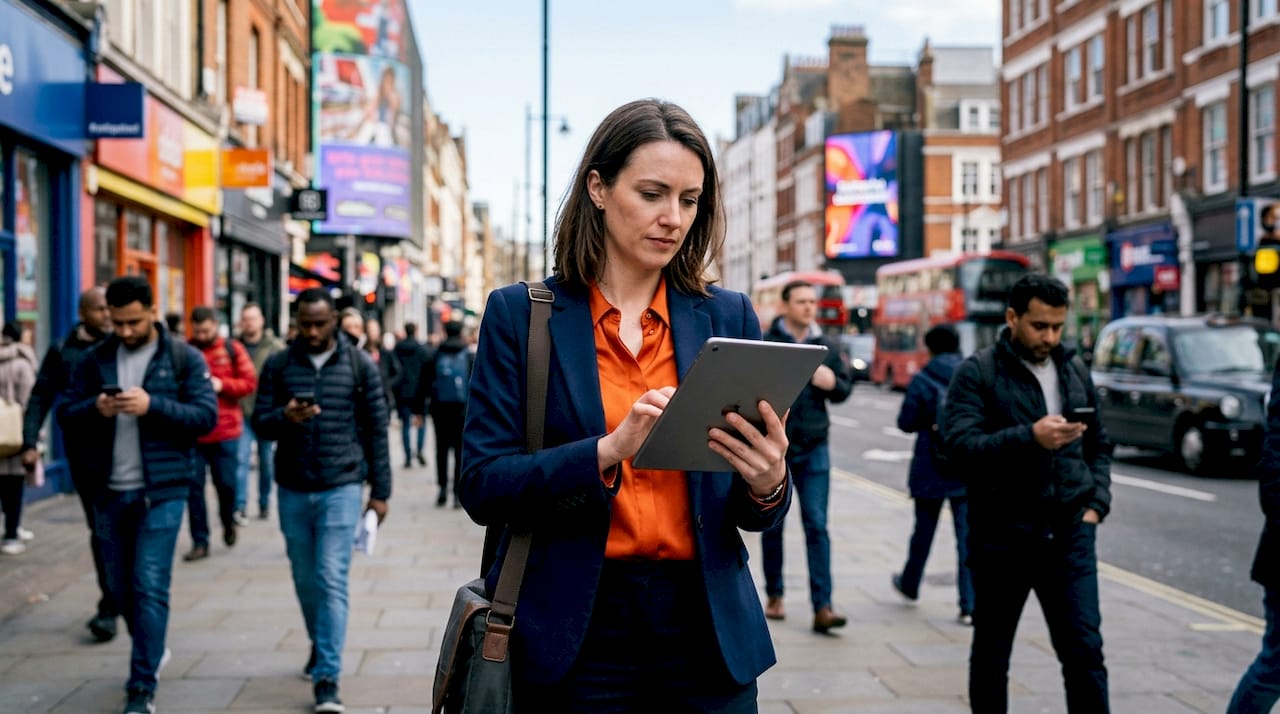
Here’s how it works at a high level. When a consumer passes an OOH asset, their mobile device logs a location signal. That signal is anonymized and cross-referenced with a network of known points of interest. If the same device later appears at a retail location or interacts with a brand’s app, the connection between exposure and outcome becomes traceable. This is the core of what makes modern DOOH strategies and impact so measurable compared to static placements from a decade ago.
The industry has moved aggressively toward device-based data measurement. Panel surveys and audience intercepts still exist, but they are slow and expensive at scale. Device movement data operates in near real time, allowing optimization mid-flight rather than waiting for post-campaign analysis.
“Geolocation enables more precise measurement in digital out-of-home (DOOH) by relating exposure at specific OOH locations to downstream behaviors like store visits and other engagements.” This shift from estimated audiences to observed behavior is the single biggest structural change in OOH measurement in 20 years.
The table below maps the workflow from asset placement to measurable outcome:
| Stage | Activity | Output |
|---|---|---|
| OOH asset location | Billboard or vehicle passes target area | Geo-tagged impression |
| Device movement | Anonymous device detected near asset | Exposure record created |
| Store visit / app engagement | Device appears at retail location or opens app | Footfall or digital signal |
| Brand lift | Exposed cohort vs. control group compared | Lift in awareness, intent, or purchase |
This four-stage workflow is not theoretical. It is the operational backbone of how serious OOH campaigns are measured today, and every stage can be optimized independently to improve overall attribution quality.
Core mechanics: Geofencing and POI-based targeting
Geofencing is the foundational technology for translating physical geography into a targetable audience segment. A virtual perimeter is drawn around a location using GPS coordinates, Wi-Fi signal data, cellular network information, or Bluetooth beacons. When a device enters or exits that boundary, an event is logged. That event can trigger an ad, enter a retargeting queue, or feed into measurement dashboards.

Geo-fencing and POI-based methodologies are the central mechanics driving geolocation campaigns for retail, auto, and local service brands. They allow you to target not just geography, but behavioral context tied to specific places.
Geofencing vs. POI-based targeting: What’s the difference?

| Feature | Geofencing | POI-based targeting |
|---|---|---|
| Definition | Virtual boundary around a custom-drawn area | Targeting based on a categorized place database |
| Flexibility | High: draw any shape, any size | Moderate: limited to known, cataloged locations |
| Use case | Event perimeters, competitor stores, custom zones | Retail chains, restaurants, stadiums, airports |
| Signal sources | GPS, Wi-Fi, cellular, Bluetooth | GPS, device visit history, dwell-time data |
| Measurement output | Fence crossings, dwell time, re-entry rates | Category visit lift, chain-level foot traffic |
Both methods have a place in a sophisticated campaign. Geofencing gives you surgical control over custom geography, while POI-based targeting benefits from pre-built audience intelligence linked to place categories. Many campaigns use both together.
Setting up a virtual perimeter correctly is not as simple as drawing a circle on a map. Here’s the standard setup process for OOH-linked campaigns:
- Define the OOH asset location with precise lat/long coordinates
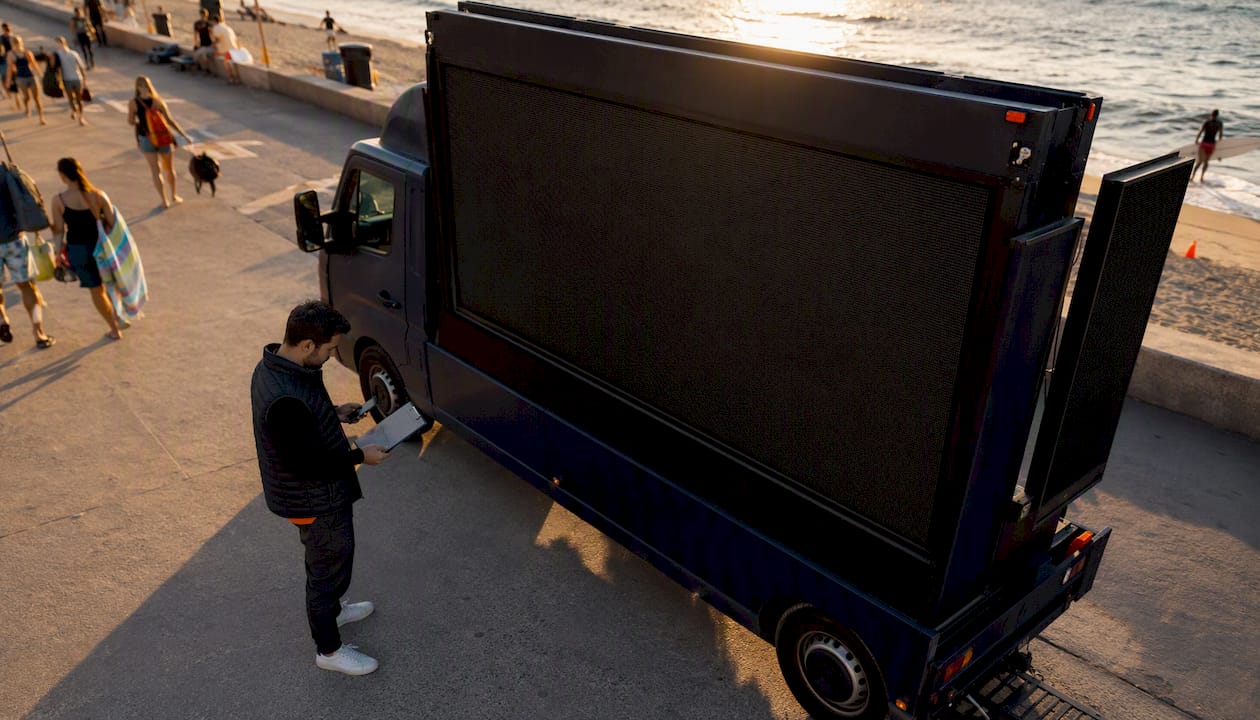
- Determine the appropriate radius based on asset type and consumer dwell patterns (mobile billboards require dynamic boundaries that update with vehicle position)
- Configure entry, exit, or dwell triggers based on campaign objectives
- Monitor boundary crossings during the flight for signal quality
- Adjust radius or signal weight if false positives or drops in signal density are detected
Pro Tip: Always calibrate your fence geometry for real-world signal variation. Urban canyons and dense indoor environments cause GPS drift that can pull signals 50 to 200 meters off actual position. A fence that looks right on a map may perform poorly in a high-rise downtown corridor. Test with a small audience segment first, verify signal quality, then scale.
For geotargeting in local campaigns, the radius calibration step alone can account for a 15 to 25 percent swing in match rates. Getting it right before scaling spend matters. A targeted out-of-home guide can help you understand how these mechanics slot into a broader OOH strategy.
Measurement evolution: From user-level certainty to probabilistic methods
Privacy changes have fundamentally restructured how DOOH measurement works. The era of persistent device IDs and cross-app tracking is narrowing. Footfall attribution has shifted from user-level certainty to cohort-level inference and probabilistic methods because consent and identifier changes have made deterministic matching far less available at scale.
This isn’t a weakness in the industry. It’s an adaptation that, when done right, produces more defensible and scalable measurement than point-in-time deterministic methods ever could. Here’s how probabilistic cohort measurement works in practice:
- Define the exposed cohort. Identify the pool of devices that received a verifiable impression near an OOH asset during the campaign flight.
- Create a matched control group. Build a statistically similar cohort of devices with equivalent behavioral and demographic profiles that were not exposed to the campaign.
- Observe downstream behavior. Track both groups for store visits, app installs, search queries, or purchase signals over a defined attribution window.
- Calculate lift. Subtract the control group’s baseline behavior rate from the exposed group’s rate. The delta represents campaign-driven lift.
- Apply statistical weighting. Account for signal completeness, panel representation, and temporal factors to produce a confidence-adjusted lift estimate.
“IAB’s DOOH measurement guidance emphasizes standardized definitions, audience metrics, viewability standards, and attribution models such as synthetic control groups and matched market testing.” These standards are becoming the baseline expectation for any serious OOH buy.
The shift toward cohort-level measurement also benefits brands because it reduces single-device over-indexing. One enthusiastic early adopter showing up at a store five times doesn’t inflate your lift number the same way it would in a deterministic model. The statistical discipline is actually an improvement.
Pro Tip: Design synthetic control groups before your campaign launches, not after. A pre-defined control methodology removes the temptation to cherry-pick comparison groups post-flight. It also satisfies procurement and analytics teams who will push back on any measurement that looks reverse-engineered to show favorable results.
For deeper context on applying these methods to real campaigns, explore data-driven OOH advertising tips that integrate cohort measurement into the creative and planning process.
Challenges: Accuracy limitations and regulatory constraints
No discussion of geolocation strategy is complete without an honest accounting of where it fails. Location signals can be unstable or distorted by indoor/outdoor differences, network routing, and behaviors like VPN use, all of which directly impact geotargeting precision.
The most common sources of signal error include:
- GPS drift: Device GPS chips lose accuracy indoors or near tall structures, causing reported positions to wander by 50 to 300 meters
- Wi-Fi triangulation instability: Wi-Fi based positioning depends on router density and can be unreliable in low-density suburban or rural environments
- VPN distortion: Consumers using VPNs may appear to be in entirely different cities or regions, creating false attribution matches
- Indoor/outdoor mismatch: A device inside a mall may appear to be on the street outside due to signal leakage through building materials
- Temporal lag: Batch-processed location data can be delayed by hours, making real-time attribution windows inaccurate for fast-moving campaign decisions
Beyond signal accuracy, regulatory pressure is reshaping what brands can legally do with precise location data. Virginia became the third state to ban the sale of consumers’ precise geolocation data, joining a growing list of states tightening controls on how location information is collected, shared, and monetized.
Regulatory pressure points that every marketing exec must track include:
- State-level bans on selling precise geolocation data without explicit consent (Virginia, and expanding)
- Federal frameworks requiring opt-in consent for sensitive location data tied to health, religion, and political affiliation
- Contractual consent requirements flowing down through the ad ecosystem from DSPs to data vendors
- Browser and OS-level permission changes that reduce passive location data availability
- IAB transparency requirements for location data disclosures in programmatic supply chains
The practical response is not to avoid geolocation. It’s to build campaigns on localized ad targeting frameworks that treat signal accuracy tolerance and consent compliance as core design parameters, not afterthoughts.
Brand lift and real-world outcomes: What benchmarks show
Despite all the complexity in measurement methodology and signal quality, the outcomes data for DOOH geolocation campaigns is genuinely strong. Over 1,050 DOOH brand lift studies across 27 countries since 2022 validate that programmatic DOOH consistently produces measurable improvements in awareness, purchase intent, and brand favorability.
The table below summarizes the types of outcomes typically measured and what strong campaign benchmarks look like:
| Outcome metric | Measurement method | Strong benchmark |
|---|---|---|
| Awareness lift | Exposed vs. control survey | 8 to 15 percentage points |
| Purchase intent lift | Cohort survey comparison | 4 to 10 percentage points |
| Footfall lift | Device visit match rate | 10 to 30 percent above baseline |
| App engagement | Post-exposure app open rate | 2x control group open rate |
| Arrival lift | GPS-confirmed visit attribution | 20 to 35 percent increase |
These benchmarks are not aspirational. They’re drawn from real campaign data. A strong example: Visit Arizona’s programmatic DOOH campaign used arrival lift measurement and reported a 30 percent increase in arrivals, exceeding the national average benchmark for similar tourism campaigns. That result wasn’t delivered by broad awareness buys alone. It was driven by precise geolocation targeting that matched traveler behavior patterns to relevant creative, then tracked physical outcomes.
Measurable outcomes from well-designed geolocation campaigns include:
- Brand awareness: Exposed consumers recognize and recall the brand at higher rates than unexposed control groups
- Footfall and store visits: Device-verified visits to retail locations, tracked within defined attribution windows
- Arrival and destination lift: Consumers traveling to specific venues or regions as a direct result of DOOH exposure
- App engagement signals: Post-exposure app opens, search queries, and micro-conversions
- Purchase behavior shifts: Basket size changes, category trial rates, and repeat visit frequency
Understanding the real benefits of localized ad campaigns is essential for building the business case internally and setting realistic outcome expectations with clients and stakeholders.
The uncomfortable truth: Why precision always comes with tradeoffs
Here’s a perspective most OOH vendors won’t say out loud: demanding perfect precision from geolocation data will always cost you more than it returns. The industry’s obsession with deterministic matching, exact device-level attribution, and pinpoint accuracy is actually a strategic liability for most campaigns.
We’ve seen brands reject perfectly usable cohort-level attribution because it didn’t look like the crisp, individual-level data they were used to from digital display. That’s the wrong frame. Cohort inference isn’t a consolation prize. It’s a statistically more honest representation of how mass-market OOH actually works. A billboard on a highway doesn’t speak to one person. It speaks to 50,000 people in a month, and the measurement should reflect that reality, not pretend it’s a click-based campaign.
Privacy and signal distortion should not be treated as obstacles to push through. They are design constraints that force better campaign thinking. When you can’t track every individual, you build better audiences. When you can’t rely on GPS alone, you build multi-signal measurement architectures that are more resilient. The brands winning in geolocation-driven OOH are the ones who stopped chasing impossible precision and started building measurement frameworks with OOH media strategies designed for real-world tolerance.
The goal isn’t a number with six decimal places. The goal is a confident, defensible estimate of campaign impact that holds up under scrutiny. Build for that, not for the illusion of perfect data.
Pro Tip: Set explicit uncertainty thresholds before the campaign launches. Agree internally on what confidence interval is acceptable for each outcome metric. This prevents post-campaign debates from devolving into methodology arguments and keeps optimization focused on performance rather than data perfection.
Maximize your next campaign: Advanced tools for geolocation-driven advertising
The strategies and measurement frameworks in this guide don’t stay theoretical when you partner with a team that has built infrastructure specifically for geolocation-powered OOH. Beacon Mobile Media brings together mobile LED billboards, wrapped rideshare vehicles across all 50 states, real-time retargeting, and geofencing into a single campaign architecture that measures what actually matters.

Whether you’re building data-driven OOH strategies from scratch or optimizing an existing program, Beacon’s platform connects physical ad exposure to digital retargeting audiences, captures engagement data through smart QR codes, and delivers attribution analytics with proof-of-posting documentation. From boosting campaign effectiveness through localized targeting to executing full-funnel digital OOH strategies, the tools are designed for marketing executives who demand real performance data, not estimated impressions. Reach out to explore a customized campaign built on the geolocation principles covered in this guide.
Frequently asked questions
How does geolocation improve out-of-home ad measurement?
Geolocation links exposure at specific locations to store visits and downstream engagements, replacing estimated audience counts with observed behavioral outcomes that marketing teams can act on directly.
What is the impact of privacy regulations on geolocation-enabled ads?
Privacy laws increasingly restrict how precise location data is collected and shared. Virginia’s ban on selling consumers’ precise geolocation data is one of several state-level actions requiring brands to build compliant, consent-based measurement frameworks.
What are the most common sources of geolocation signal error?
Location signals are frequently distorted by GPS drift near tall buildings, Wi-Fi instability, indoor/outdoor positioning mismatches, and VPN use, all of which require accuracy calibration before scaling campaign spend.
How can brands validate real-world campaign impact using geolocation data?
Brand lift studies and arrival lift metrics compare exposed and control cohorts to quantify campaign-driven changes in awareness, footfall, and purchase behavior, providing statistically defensible proof of campaign value.