Most event organizers assume mobile billboards are just awareness tools — a flashy way to get eyes on a logo before the doors open. That assumption is costing you measurable revenue. Mobile billboards, when properly integrated with digital tracking tools, can drive ticket scans, app downloads, lead form completions, and post-event retargeting just as effectively as any paid digital channel. This guide breaks down exactly how event marketers and venue teams can use mobile billboard campaigns to generate outcomes you can actually report on, optimize in real time, and scale from event to event.
Table of Contents
- What makes mobile billboards uniquely powerful for event venues?
- From awareness to action: Measurable results with integrated campaigns
- Case study snapshots: Real campaigns and what they reveal
- Best practices for maximizing impact at your event
- Fresh perspective: What most event marketers get wrong about mobile billboards
- Make every event campaign measurable with expert-led mobile billboard solutions
- Frequently asked questions
Key Takeaways
| Point | Details |
|---|---|
| Trackable engagement | Mobile billboards combined with digital features let you measure how audiences interact and respond at events. |
| Massive reach | Strategic routing around venue hotspots delivers millions of impressions and strong brand recall. |
| ROI-focused activation | Integrating calls-to-action like QR codes transforms billboards into direct-response channels that boost event ROI. |
| Real-world success | Case studies show measurable jumps in impressions, engagement, and sales tied to mobile billboard event activations. |
What makes mobile billboards uniquely powerful for event venues?
Static billboards sit in one place. A mobile billboard follows your audience. That distinction sounds simple, but it changes everything about how event marketers can use outdoor advertising.
When you route an LED billboard truck around a stadium two hours before kickoff, you’re not just building brand awareness — you’re reaching exactly the right people at exactly the right moment. The same applies to trade shows, music festivals, and corporate conferences. Mobile billboard strategies for conferences follow a similar logic: place your message where your attendees are gathering, moving, or waiting, and you dramatically increase the chance of a conversion action.
Here’s what makes mobile billboards stand out in event venue contexts:
- Strategic routing lets you cover hotel corridors, parking lots, transit hubs, and venue perimeters before, during, and after the event.
- High pixel-density LED displays are visible in daylight and at night, ensuring your creative lands regardless of conditions.
- Flexibility means you can update messaging between the morning session and the afternoon keynote without reprinting anything.
- Physical presence creates a sense of scale and legitimacy that digital ads rarely replicate.
- Creative activations such as live countdowns, social media handles, and event hashtags turn a passing truck into a shareable moment.
Audience engagement strategies consistently show that multi-touchpoint exposure — seeing an ad on your phone and then on a truck outside the venue — significantly increases recall and action rates compared to single-channel exposure.
“Seeing a brand message in the physical world moments before entering an event creates a psychological bridge between the ad and the experience. It makes the message feel earned and relevant, not intrusive.”
Mobile billboards generate large impression volumes and measurable brand lift and sales impact when properly deployed around venues. But the real multiplier effect kicks in when you combine physical reach with digital response tools.
Pro Tip: Schedule your billboard trucks to circulate during peak ingress (90 to 30 minutes before the event) and peak egress (immediately after). These windows deliver the highest concentration of your target audience in a compact geographic zone, which maximizes both impressions and action rates.

From awareness to action: Measurable results with integrated campaigns
With foundational strengths covered, let’s see how mobile billboards unlock actionable, measurable results at event venues.
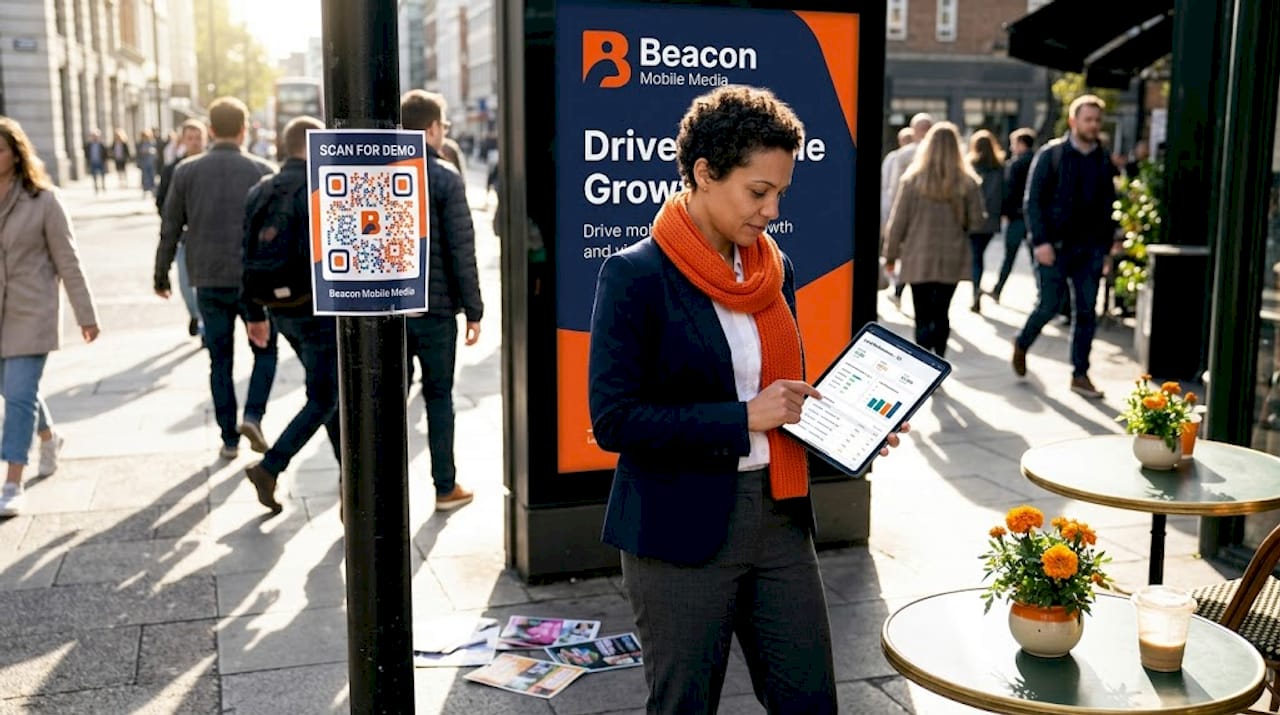
The biggest shift in outdoor advertising over the last five years is the integration of digital response elements directly into physical creative. A QR code on an LED truck is not a gimmick. When placed correctly and paired with a compelling offer, it becomes a real-time data capture tool. Using smart QR codes with mobile billboards creates a direct link between a physical impression and a measurable digital action, whether that’s a ticket redemption, an app install, or an email sign-up.
Mobile billboards can support outcomes beyond awareness with elements like QR codes, tracked user actions, and event-adjacent placement. During Super Bowl weekend, billboard trucks parked near the stadium tracked QR code hits in real time, giving the campaign team data on which routes and time windows were generating the most engagement. That kind of feedback loop is exactly what separates a modern mobile billboard campaign from a traditional one.
Here are the specific measurable objectives you can build into an event billboard campaign:
- Ticket and registration scans tied to a unique event URL
- App downloads triggered by a scannable code on the display
- Lead form completions routed through a landing page
- Social media follows linked to a displayed handle or hashtag
- Coupon or offer redemptions tracked by a promo code
- Post-event retargeting audiences built from scan data and geofencing
For a clear comparison of how mobile billboards stack up against traditional outdoor options in event contexts, see the table below:
| Feature | Mobile billboard | Traditional static OOH |
|---|---|---|
| Route flexibility | High (real-time adjustments) | None |
| QR/NFC integration | Yes, built into display | Rarely |
| Audience targeting | Geofenced and timed | Fixed location only |
| Real-time data capture | Yes | No |
| Creative update speed | Immediate | Days to weeks |
| Event-adjacent placement | Precise | Limited |
| Attribution capability | Strong | Weak |
QR code engagement tips point to one consistent finding: the simpler the call to action, the higher the scan rate. “Scan for 20% off your next ticket” outperforms “Learn more” every time. Keep your effective CTAs tight, event-specific, and tied to a real incentive.
Measuring mobile ad engagement at the venue level means looking beyond raw impressions. You want scan rate by route, dwell time near the truck, and conversion rate from scan to completed action. Build these metrics into your campaign brief before the event starts.

Case study snapshots: Real campaigns and what they reveal
To prove these strategies work in practice, let’s look at what happened when top organizers leveraged mobile billboards at scale.
Two campaigns stand out as particularly instructive for event marketers thinking about ROI and scale.
The first is a New York City guerrilla campaign that deployed LED billboard trucks around a major event venue over a concentrated multi-day window. The result: over 3 million impressions reported via the NYC LED campaign, confirming the reach and action potential of event-adjacent mobile billboard placement. What made this campaign notable was not just the volume but the density. The trucks circulated within a tight geographic radius, which meant each individual attendee was likely exposed to the message multiple times across different approach routes.
The second is an event activation case where a brand used mobile billboards stationed near a venue during a major sporting weekend to drive product purchases. The campaign combined physical visibility with a unique offer displayed on the screen, and tracked redemptions through a dedicated landing page.
| Campaign | Duration | Impressions | Engagement actions | Result |
|---|---|---|---|---|
| NYC event venue activation | 3 days | 3,000,000+ | QR scans, social follows | Record-setting weekend reach |
| Sporting event product campaign | 4 days | 1,200,000+ | URL visits, coupon redemptions | Measurable sales lift |
“Mobile billboards helped us break our sales record for the weekend. The combination of physical presence at the venue and a trackable offer gave us data we’d never had from outdoor before.”
These aren’t outlier results. They reflect what happens when you pair strong creative, precise routing, and digital response integration. Data-driven OOH advertising tips consistently reinforce that campaigns with clear conversion mechanisms and event-specific timing outperform generic awareness plays by a wide margin.
The key takeaway from both campaigns is this: the event itself is the targeting mechanism. You don’t need a complex algorithm when 60,000 people are converging on one location at one time. You need to be there, with a clear message and a way to track the response.
Best practices for maximizing impact at your event
Inspired by these successes, how can you put mobile billboards to work for your next event? Here’s how to maximize your ROI.
Getting results from a mobile billboard campaign at an event venue is not about luck. It’s about planning, timing, and building in the right response mechanisms from the start. Here’s a proven step-by-step process:
- Define your campaign objective first. Is this about driving ticket upgrades, app installs, or post-event retargeting? Every other decision flows from this.
- Map your attendee routes. Identify where your audience parks, eats, stays, and gathers before and after the event. These are your prime circulation zones.
- Design creative for mobile viewing. People see billboard trucks from moving vehicles and sidewalks. Keep text under six words, use high-contrast colors, and make the QR code large enough to scan from 15 feet.
- Integrate a tracked response element. A unique URL, QR code, or promo code turns every impression into a potential data point.
- Schedule routes around peak windows. Pre-event ingress, halftime or intermission zones, and post-event egress are your highest-value time slots.
- Monitor scan rates and adjust in real time. If one route is underperforming, redirect the truck. Digital displays update instantly.
- Use post-event data to retarget. Anyone who scanned your code or visited your URL during the event is a warm lead. Follow up with a digital ad within 24 hours.
Optimized campaign route planning is one of the highest-leverage decisions in the entire process. A billboard truck circling a dead zone generates impressions but not actions. A truck on the main pedestrian corridor between the venue and the nearest transit hub generates both.
Planning digital campaigns alongside your physical activation creates a synergy that neither channel achieves alone. When someone sees your billboard outside the venue and then gets a retargeted ad on their phone that evening, your conversion rate climbs sharply.
The most common pitfall we see? Event marketers put all their energy into the creative and forget to specify a clear, event-specific call to action. A beautiful truck with “Experience the difference” on the side is a branding play, not a conversion tool. Tell people exactly what to do next.
Pro Tip: Pair your mobile billboard campaign with a real-time social tie-in. Display a live Twitter or Instagram hashtag on the screen, and ask attendees to post for a chance to win something. This turns a passive impression into an active, trackable social signal that extends your campaign reach far beyond the physical route.
Event-adjacent routing and high-visibility placements are shown to generate tangible outcomes, but only when the campaign is designed to capture a response, not just an eyeball.
Fresh perspective: What most event marketers get wrong about mobile billboards
Most event marketers who come to us have already run at least one mobile billboard campaign. And most of them are disappointed by the results. When we dig into why, the answer is almost always the same: they treated the truck like a banner ad.
A banner ad is passive. You put it up, it gets seen, and you hope something happens. A mobile billboard, properly deployed, is an active data collection and conversion asset. The physical creative is just the front end of a campaign that should include geofence tracking, QR scan analytics, post-event retargeting, and attribution reporting. If you skip those layers, you’re leaving the best returns on the table.
The lesson we’ve learned from running campaigns across dozens of event venues is that the marketers who get the most out of mobile billboards are the ones who treat each event as a test and a data source. They run a campaign, capture the scan data, retarget the warm leads, and use those results to sharpen the next campaign. Over three or four events, they build a feedback loop that makes each campaign more efficient than the last.
The mistake is treating outdoor as a one-way channel. QR code data for billboards makes outdoor two-way. Every scan is a signal. Every signal is an insight. And every insight compounds into better targeting, better creative, and better ROI.
If you only measure impressions, you’re measuring the least interesting part of what mobile billboards can do for you. Build them into your measurable event funnel — not just your branding plan — and the results will look very different.
Make every event campaign measurable with expert-led mobile billboard solutions
If you’re ready to stop guessing and start tracking your event marketing impact, here’s how to take the next step.
At Beacon Mobile Media, we’ve built our entire platform around the idea that outdoor advertising should be as measurable as digital. Our LED mobile billboard and wrapped rideshare campaigns come standard with data-driven campaign strategies, geofencing, real-time route optimization, and proof-of-posting documentation that lets you report results with confidence.

Whether you’re promoting a conference, a stadium event, or a multi-day festival, we design campaigns that fit your attendee flow, your conversion goals, and your budget. Our advanced QR code engagement tools capture lead data directly from billboard scans, feeding your retargeting pipeline from the moment the truck hits the road. Reach out to our team to get a strategy session tailored to your next event, and turn your outdoor spend into a fully tracked, fully attributed campaign.
Frequently asked questions
How do mobile billboards drive measurable results for events?
Mobile billboards support measurable outcomes beyond awareness when paired with QR codes, unique URLs, and direct-response elements that track attendee actions tied to the campaign in real time.
What kinds of events benefit most from mobile billboard campaigns?
High-traffic events such as trade shows, concerts, sporting events, and city festivals see the greatest impact, with large impression volumes and brand lift tied directly to venue activation approaches.
How do I make mobile billboard campaigns interactive?
Incorporate scannable QR codes, NFC tags, or interactive calls-to-action on the display so attendees can respond immediately, generating measurable engagement data from each exposure.
Can I adjust my mobile billboard campaign during the event?
Yes, event-adjacent routing and placements can be updated in real time, allowing your team to redirect trucks and swap creative based on live attendance patterns and scan data.
What budget range should I expect for a mobile billboard campaign at an event?
Budgets vary based on market size, campaign duration, and the number of trucks deployed, but campaigns can be designed with enough flexibility to maximize both reach and measurable engagement within your specific spend level.