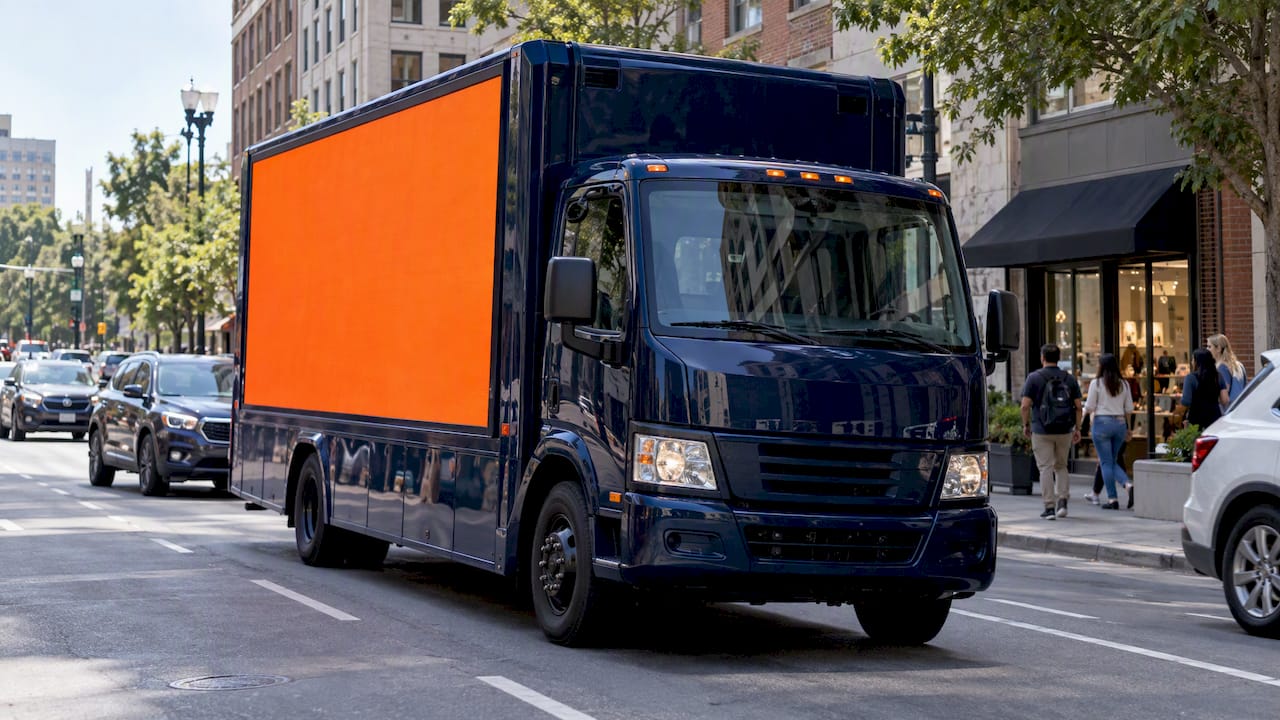
DOOH advertising is the delivery of marketing messages on internet-connected digital screens placed in public spaces, from airport terminals and subway stations to retail corridors and highway corridors. Unlike a printed billboard that stays fixed for weeks, a DOOH screen can serve a different ad every 8 to 15 seconds and update its content within 24 hours of a campaign launch. The U.S. market is on track to reach $3 billion in programmatic DOOH spend in 2025 alone, which signals how fast brands are reallocating budgets toward this channel. For marketing professionals weighing where digital out-of-home advertising fits in their mix, the fundamentals matter before the tactics do.
What is DOOH advertising and how does it differ from traditional OOH?
DOOH advertising and traditional out-of-home (OOH) advertising share the same physical world, but they operate on entirely different logic. Traditional OOH relies on printed or painted static creative locked into a fixed location for the duration of a buy. DOOH uses internet-connected digital screens with changeable content, verified play logs, and impression-based measurement. That distinction reshapes every part of the campaign process, from planning to reporting.

The comparison below shows where the two formats diverge most sharply:
| Dimension | Traditional OOH | DOOH |
|---|---|---|
| Creative format | Static print or vinyl | Digital video, animation, or static image |
| Content changes | Requires physical reprinting | Updated remotely in near real time |
| Buying model | Fixed placement, CPM estimated by traffic count | Programmatic or direct, measured by verified impressions |
| Speed to market | Weeks for production and installation | As fast as 24 hours from brief to live |
| Measurement | Estimated reach from traffic data | Play logs, brand lift studies, footfall attribution |
DOOH also differs meaningfully from online display advertising. Online ads target individual users on personal devices using cookies or device IDs. DOOH targets shared public screens, reaching audiences by location, time of day, and contextual conditions rather than by personal identifiers. That shift from individual tracking to cohort and location targeting makes DOOH one of the more privacy-compliant channels available to marketers today.
For a broader view of where DOOH sits among outdoor ad formats, the category includes everything from large-format roadside LED boards to place-based screens inside gyms, gas stations, and office building lobbies.
What is programmatic DOOH and how does it work?
Programmatic DOOH is the automated buying and selling of digital out-of-home inventory through real-time bidding platforms or private marketplace deals. Instead of negotiating a fixed placement with a media owner weeks in advance, a marketer sets targeting parameters and the system executes buys across qualifying screens as conditions are met. The U.S. programmatic DOOH market is expected to reach $3 billion in 2025, reflecting rapid adoption across retail, transit, and roadside environments.
The targeting triggers available in programmatic DOOH go well beyond geography:
- Time of day: Serve breakfast promotions during morning commutes and dinner offers in the evening.
- Weather conditions: A cold-weather apparel brand can activate ads automatically when temperatures drop below a set threshold.
- Local events: A sports brand can push creative near a stadium on game days without manual intervention.
- Audience movement patterns: Location-based targeting allows buys near venues where a brand’s core demographic concentrates.
One underappreciated aspect of programmatic DOOH is creative rotation. Unlike web display ads, creative changes in DOOH propagate through screen cycles with some delay rather than updating instantly. Setting up multiple creative variations from the start of a campaign allows the platform to identify best-performing assets mid-flight without requiring manual creative swaps. Marketers who load a single static asset and expect web-like optimization are consistently disappointed.
Creative tailoring by environment also matters more than most briefs acknowledge. Motion video in transit hubs outperforms simpler static formats because dwell time is longer and audiences are receptive. Roadside billboards, where viewing windows are measured in seconds, favor bold visuals and minimal copy. Vetting screen inventory for environment type before launch is not optional. It is the difference between a campaign that performs and one that burns budget.

Pro Tip: Build at least three creative variations per environment type before launch. This gives the platform enough assets to rotate and surface performance signals within the first week, rather than waiting until the campaign ends to learn what worked.
How do marketers measure DOOH advertising effectiveness?
DOOH measurement is built on aggregate exposure metrics rather than individual user actions. Impression counts and dwell time replace click-through rates as the primary performance signals. This is not a limitation unique to DOOH. It reflects the shared-screen nature of the channel, where one ad play reaches multiple people simultaneously and no individual user action is trackable.
The core KPIs used in DOOH campaigns break into three tiers:
| KPI Tier | Metric | What it measures |
|---|---|---|
| Exposure | Verified impressions, play logs | Proof that the ad ran as planned |
| Engagement | Brand lift, recall surveys | Shift in awareness or purchase intent |
| Behavioral | Footfall attribution, web visits, app downloads | Downstream actions linked to exposure |
Third-party verification providers confirm that ads played at the scheduled times and locations, giving marketers the equivalent of a proof-of-posting document. Brand lift studies, run through panel-based surveys, measure whether exposed audiences show higher awareness or intent than a control group. Footfall attribution matches anonymized device movement data to screen locations, estimating how many people who saw the ad later visited a physical store.
The critical expectation-setting point: DOOH brand lift and footfall studies require sufficient impression volume to reach statistical significance. A campaign running on five screens for two weeks will not generate reliable lift data. Marketers who set realistic scale thresholds before launch avoid the frustration of inconclusive results.
Pro Tip: Pair DOOH with a UTM-tagged landing page or a unique QR code on the creative. Even without individual tracking, you can observe correlated spikes in direct traffic or QR scans that align with campaign flight periods and screen locations.
What are the benefits of DOOH advertising for marketing professionals?
The most direct benefit of DOOH advertising is that it is unskippable. A person walking through a transit hub or waiting at a gas station pump cannot close the ad, mute it, or scroll past it. Full-motion video in DOOH consistently drives higher attention and recall than static creative, making it one of the most effective formats for brand awareness at scale.
Beyond attention, DOOH offers several strategic advantages worth building into a dooh marketing strategy:
- Context-aware creative: A pharmacy chain can serve flu season messaging when pollen counts spike. A quick-service restaurant can push limited-time offers during lunch hours within a half-mile radius of its locations.
- Privacy compliance: Because DOOH targets locations and cohorts rather than individuals, it sidesteps the consent and cookie deprecation issues that complicate online display campaigns.
- Omnichannel amplification: DOOH as an omnichannel complement reinforces messaging delivered through connected TV, paid social, and search, extending reach to audiences who are light users of digital media.
- QR code integration: Smart QR codes on DOOH screens create a direct bridge between physical exposure and online conversion, capturing scan data that feeds back into retargeting pools.
Practical use cases span industries. Retail brands use DOOH near competitor locations to intercept shoppers before a purchase decision. B2B marketers place ads in office building lobbies and business district transit hubs to reach decision-makers during commute hours. Event marketers use programmatic triggers to activate creative in the 48 hours before a conference, targeting screens within walking distance of the venue.
For marketers building data-driven outdoor campaigns, the combination of location intelligence and programmatic buying turns DOOH from a broad awareness play into a precision targeting tool. The channel works across the full funnel when the strategy is built that way from the start.
Integrating DOOH with omnichannel campaign frameworks also reduces the risk of message fatigue. When a consumer sees a brand on a DOOH screen in the morning, then encounters a retargeted social ad in the afternoon, the cumulative effect on recall is greater than either touchpoint alone.
Key takeaways
DOOH advertising delivers measurable brand impact through context-aware, unskippable digital screens in public spaces, and performs best when integrated into a broader omnichannel strategy with multiple creative variations and clear measurement benchmarks set before launch.
| Point | Details |
|---|---|
| DOOH defined | Internet-connected public screens that update content dynamically, unlike static printed OOH. |
| Programmatic buying | Automates inventory purchasing by time, weather, and location triggers with campaigns live in 24 hours. |
| Measurement model | Relies on verified impressions, brand lift, and footfall attribution rather than click-through rates. |
| Privacy advantage | Targets cohorts and locations instead of individuals, avoiding cookie and consent complications. |
| Omnichannel role | Amplifies CTV, paid social, and search campaigns by adding a physical-world touchpoint. |
Why most DOOH campaigns underperform (and how to fix that)
After working across dozens of out-of-home campaigns, the pattern I see most often is not a media buying problem. It is a creative and expectation problem. Marketers allocate budget to DOOH, load a single static asset adapted from a social ad, and then measure the campaign against click-based benchmarks it was never designed to hit. The result is a channel that looks like it failed when the strategy was the actual failure.
DOOH is not a standalone channel. It is a force multiplier. When I see it work at its best, it is always running alongside a retargeting campaign, a CTV flight, or a paid search push. The DOOH exposure primes the audience. The digital touchpoints close the loop. Treating it as a replacement for any of those channels misses the point entirely.
Screen inventory quality is the other variable that rarely gets enough attention in pre-campaign planning. Not all DOOH inventory is equal. A screen in a high-traffic transit hub with verified dwell time data is a fundamentally different buy than a screen in a low-footfall retail corridor with estimated traffic counts. Vetting inventory before committing budget is not a nice-to-have. It determines whether your creative reaches the audience you paid for.
The marketers I have seen get the most from DOOH are the ones who treat it like a testing channel from day one. They build multiple creative variations, set clear measurement benchmarks tied to brand lift or footfall rather than clicks, and review performance data weekly rather than waiting for a post-campaign report. That cadence turns DOOH from a black box into a channel with real feedback loops.
— Scott
How Beacon-ads powers smarter DOOH campaigns

Beacon-ads combines the physical reach of mobile LED billboards and wrapped rideshare vehicles with the targeting precision of programmatic digital advertising, covering all 50 states. For marketing professionals who want DOOH results that are actually measurable, Beacon-ads provides geofencing, real-time retargeting, smart QR code integration, and attribution analytics that connect exposure to outcomes. Whether you are building a local activation or a national brand awareness push, the platform gives you the reporting and proof-of-posting documentation to justify every dollar of spend. Explore DOOH campaign strategies to see how data-driven out-of-home advertising can fit your next campaign.
FAQ
What does DOOH stand for in advertising?
DOOH stands for digital out-of-home advertising. It refers to marketing content delivered on internet-connected digital screens in public or semi-public spaces such as transit hubs, retail venues, and roadside locations.
How is DOOH different from traditional billboard advertising?
Traditional billboards use static printed creative that requires physical replacement to update. DOOH screens update content remotely in near real time, are bought by verified impression rather than estimated traffic count, and support dynamic targeting by time, weather, and location.
Can DOOH advertising be targeted to specific audiences?
DOOH targets audiences by location, time of day, contextual conditions, and audience movement patterns rather than individual identifiers. This makes it more privacy-compliant than cookie-based online advertising while still enabling precise demographic and behavioral targeting.
How do you measure the ROI of a DOOH campaign?
DOOH ROI is measured through verified play logs, brand lift studies, footfall attribution, and correlated web or app activity rather than click-through rates. Campaigns require sufficient impression volume to generate statistically reliable lift data.
What is the difference between programmatic DOOH and direct DOOH buying?
Direct DOOH buying involves negotiating fixed placements with media owners in advance. Programmatic DOOH uses automated real-time bidding platforms to purchase inventory dynamically based on targeting conditions, offering greater flexibility and faster campaign execution.