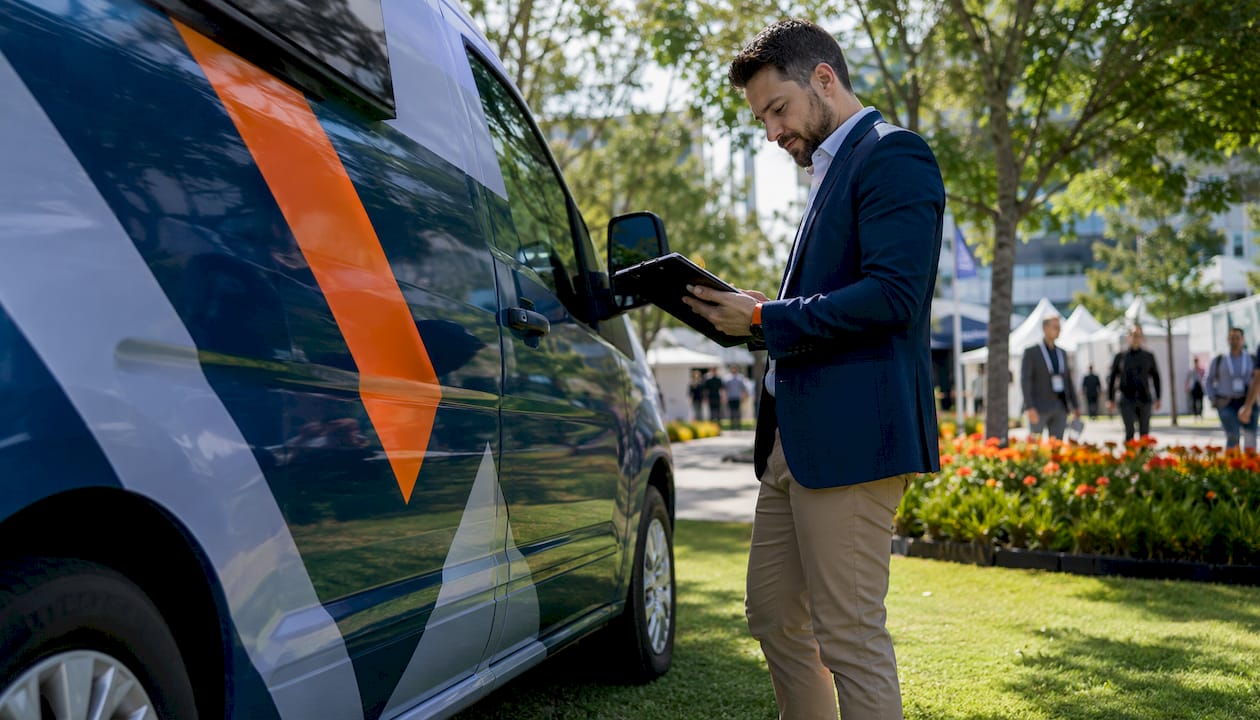
Out-of-home advertising is any paid marketing delivered through physical or digital displays in public spaces outside the home, capturing consumer attention during daily movement. Known in the industry as OOH, this channel spans everything from highway billboards and transit wraps to digital kiosks and LED mobile billboards. Platforms like StackAdapt and Broadsign have helped push OOH into the programmatic era, where data-driven campaigns now run alongside traditional print formats. Standard campaign flights typically run 2 to 4 weeks, giving brands sustained exposure across high-traffic locations. For marketers, business owners, and students alike, understanding how OOH works is the foundation for deploying it effectively.
What is OOH advertising and how does it work?
OOH advertising works by placing brand messages in physical environments where consumers naturally spend time, from commuting and shopping to waiting and walking. Unlike television or social media, OOH does not require the audience to opt in. The exposure happens as part of daily life, which is precisely what makes it so durable as a channel.
The mechanics are straightforward. An advertiser selects a format, a location, and a flight period. Creative assets are produced, installed or uploaded, and the campaign runs for the agreed duration. OOH includes both traditional printed and digital display formats, so the production process varies significantly depending on which type you choose. Digital formats can go live within hours; printed billboards require physical logistics that demand advance planning.

Modern OOH campaigns increasingly integrate with digital marketing ecosystems. Geofencing, mobile retargeting, and QR code tracking allow brands to connect an outdoor impression to a measurable consumer action. This integration is what separates a contemporary OOH strategy from simply renting a billboard and hoping for the best.
What are the main types of outdoor advertising?
OOH formats divide into four broad categories: traditional static, digital out-of-home (DOOH), place-based, and transit advertising. Each serves a different strategic purpose and reaches audiences in distinct contexts.
| Format | Description | Best use case |
|---|---|---|
| Static billboards | Large printed displays on roadsides or buildings | Mass awareness, brand recall |
| Digital billboards (DOOH) | LED screens rotating multiple ads dynamically | Time-sensitive offers, real-time triggers |
| Transit advertising | Wraps on buses, trains, rideshare vehicles | Urban reach, commuter targeting |
| Street furniture | Bus shelters, benches, kiosks | Neighborhood-level targeting |
| Place-based screens | Displays in malls, offices, gyms, airports | Captive audience engagement |
Static OOH remains the workhorse of the channel. Roadside billboards, posters, and transit wraps deliver consistent impressions at scale. Their limitation is inflexibility: once printed and installed, the creative cannot change until the flight ends.
DOOH solves that problem directly. Digital OOH can rotate multiple ads on the same screen and supports video and motion graphics, giving advertisers creative options that static formats simply cannot match. A single digital billboard in Times Square might cycle through a dozen brands in one minute.
Transit advertising deserves special attention for urban campaigns. Vehicle wraps on buses, subway cars, and rideshare vehicles like Uber and Lyft turn everyday commutes into moving impressions. The format reaches consumers across neighborhoods and income brackets in a way that fixed-location displays cannot replicate.

Place-based advertising targets consumers in specific environments: airport lounges, gym locker rooms, office building lobbies. The audience is captive and often in a receptive mindset, which increases the likelihood of message retention.
What are the key benefits of OOH advertising?
OOH advertising cuts through digital noise by delivering unmissable, contextually relevant exposure during daily routines. That unskippable quality is the channel’s most cited advantage, but it is far from the only one.
The core benefits break down as follows:
- Geographic precision. OOH delivers location-based exposure ideal for targeting shoppers near retail locations, commuters on specific routes, or residents in defined zip codes.
- High-frequency reach. Consumers who pass the same billboard twice a day for two weeks accumulate significant brand impressions without any active media consumption on their part.
- No ad fatigue. Unlike pre-roll video or display banners, OOH cannot be blocked, muted, or scrolled past. The impression is guaranteed.
- Synergy with digital channels. OOH campaigns that incorporate QR codes or geofenced mobile retargeting create a measurable link between physical exposure and digital behavior.
- Captive audience dwell time. Commuters waiting at transit hubs have longer dwell time than drivers passing a highway billboard, enabling more complex messaging and interactive elements like QR codes.
The dwell time point is worth expanding. A bus shelter ad in a dense urban area might hold a commuter’s attention for three to five minutes. That window is long enough to communicate a promotion, a URL, or a call to action. A highway billboard gets roughly three seconds. The format you choose should match the complexity of your message.
Pro Tip: Match message complexity to dwell time. Reserve detailed offers and QR codes for transit and place-based formats. Keep highway billboards to seven words or fewer.
How has programmatic buying transformed digital OOH?
Programmatic DOOH is the practice of buying digital out-of-home inventory through automated platforms that use data signals to trigger the right ad at the right moment. Programmatic DOOH allows real-time triggering of ads based on inputs like weather conditions, traffic patterns, time of day, and local events. A coffee brand can serve a hot drink ad when temperatures drop below 40°F and switch to an iced beverage creative when they climb above 80°F, automatically.
This capability represents a genuine shift in how OOH fits within a broader media plan. Traditionally, OOH was a brand-building channel with limited performance measurement. Programmatic DOOH bridges traditional brand-building with data-driven performance marketing, enabling marketers to scale campaigns dynamically and optimize based on real outcomes. That shift puts OOH in direct conversation with paid search and social media in terms of accountability.
The operational difference between static and programmatic DOOH is significant. Static OOH requires considerable lead time for printing and installation, while DOOH assets update instantly via software. A brand launching a flash sale on a Friday afternoon can push new creative to a DOOH network within the hour. The same update on a printed billboard would require days of production and physical installation.
That speed advantage comes with a planning caveat. Marketers who are new to DOOH sometimes underestimate how much creative variation a dynamic campaign requires. If your programmatic triggers fire across five different weather conditions and three dayparts, you need fifteen distinct creative assets ready before launch. Building that library takes time, even if the deployment does not.
Pro Tip: When running a mixed OOH campaign, lock in your static placements first. Static formats require the longest lead time and the least flexibility, so they anchor the campaign timeline. Build DOOH creative around them.
How to plan and execute an effective OOH campaign
A well-executed OOH campaign follows a clear sequence. Skipping steps, particularly early ones, is the most common reason campaigns underdeliver.
- Define your objective. Brand awareness, foot traffic, event promotion, and direct response each require different formats and locations. Clarity here determines every downstream decision.
- Select your formats. Match format to objective. Transit wraps build urban frequency. Place-based screens reach captive audiences. DOOH enables real-time relevance. Static billboards deliver mass reach.
- Choose locations strategically. Prioritize high-traffic corridors, transit hubs, and areas with strong demographic alignment. Geographic precision is one of OOH’s core strengths, so use it deliberately rather than defaulting to the cheapest available inventory.
- Set your flight length. Standard flights run 2 to 4 weeks to balance exposure frequency against budget. Shorter flights work for event-driven campaigns; longer flights build sustained brand recall.
- Develop format-appropriate creative. A billboard headline needs to land in three seconds. A transit shelter ad can carry a QR code and a secondary message. Treat each format as a distinct creative brief.
- Integrate measurement tools. Smart QR codes, geofenced mobile audiences, and foot traffic attribution tools connect OOH impressions to measurable outcomes. Without these, you are flying blind on performance.
- Review and optimize. For DOOH campaigns, monitor performance data mid-flight and adjust creative or targeting as needed. For static campaigns, document learnings for the next cycle.
Pro Tip: Add a unique QR code to every OOH placement. Even if scan rates are low, the data you collect on which locations drive engagement is worth more than the cost of implementation.
Multichannel integration is where OOH campaigns compound their value. An OOH impression followed by a targeted digital retargeting ad to the same consumer creates a frequency effect that neither channel achieves alone. The physical impression builds recognition; the digital follow-up drives conversion.
Key takeaways
OOH advertising delivers measurable brand impact when format selection, location strategy, and creative execution align with a clearly defined campaign objective.
| Point | Details |
|---|---|
| OOH definition | Any paid media displayed in public spaces outside the home, spanning static and digital formats. |
| Format selection matters | Match format to objective: transit for urban reach, DOOH for real-time relevance, static for mass awareness. |
| Dwell time drives messaging | Captive audiences allow complex messages and QR codes; fast-moving placements need seven words or fewer. |
| Programmatic DOOH adds precision | Real-time data triggers let brands serve contextually relevant ads based on weather, traffic, and time of day. |
| Measurement is non-negotiable | QR codes, geofencing, and attribution tools connect OOH impressions to digital behavior and campaign ROI. |
Why OOH advertising still earns its place in a digital-first world
I have spent years watching brands chase the next digital channel while their OOH budgets sat underutilized or, worse, were allocated without any strategic thought. The conventional wisdom that OOH is a legacy medium for big-budget brand campaigns is simply wrong in 2026.
What I have found is that OOH’s greatest strength is also its most overlooked one: it is the only channel that reaches consumers in the physical world, at the moment they are moving through it. No algorithm controls the impression. No privacy update can deprecate a billboard. That reliability has real value in a media environment where digital targeting is getting harder, not easier.
The brands I see getting the most from OOH are the ones treating it as a precision tool rather than a blunt instrument. They are using DOOH strategies to serve contextually relevant creative, pairing transit placements with mobile retargeting, and building QR code data into their broader CRM pipelines. They are also planning production timelines properly, which sounds basic but is genuinely where most campaigns stumble.
My honest advice: stop treating OOH as a reach play and start treating it as an audience play. The data tools exist to make it as targeted as any digital channel. The marketers who figure that out first will have a significant advantage.
— Scott
Take your OOH campaigns further with Beacon-ads
If this article clarified what OOH advertising is and how it works, the next step is putting that knowledge into practice with the right partner.

Beacon-ads specializes in LED mobile billboards and wrapped rideshare vehicles across all 50 states, combining the physical reach of outdoor advertising with geofencing, real-time retargeting, and QR code data capture. Every campaign includes proof-of-posting documentation and attribution analytics so you can measure exactly what your spend delivers. Whether you are planning your first OOH campaign or scaling an existing one, the 2026 OOH format guide is the right place to start. It covers every major format, their strategic use cases, and how to integrate them into a data-driven media plan.
FAQ
What does OOH stand for in advertising?
OOH stands for out-of-home advertising, a paid media channel that delivers brand messages through physical or digital displays in public spaces outside the home.
What are the main types of OOH advertising formats?
The main types include static billboards, digital billboards (DOOH), transit advertising such as vehicle wraps, street furniture like bus shelters, and place-based screens in locations like malls and airports.
How long does a typical OOH advertising campaign run?
Standard OOH campaign flights run 2 to 4 weeks, balancing sufficient exposure frequency against budget constraints, though shorter flights work for event-driven promotions.
What is the difference between OOH and DOOH advertising?
OOH is the broader category covering all out-of-home formats, while DOOH refers specifically to digital displays that can rotate multiple ads, support video, and update content in real time based on data triggers like weather or traffic.
How do you measure the effectiveness of an OOH campaign?
Marketers measure OOH effectiveness through smart QR code scan rates, geofenced mobile audience tracking, foot traffic attribution tools, and direct response metrics tied to campaign-specific URLs or promotional codes.