Broad national campaigns feel like the safe bet until you look at the numbers. 98% of marketers now incorporate out-of-home advertising into purchase-driven initiatives, and 86% expect their investment to grow, citing cost-effective reach at 52% and retail traffic impact at 51%. What that data signals is a clear shift: marketers who understand localization are pulling ahead. This guide breaks down why local targeting outperforms national scale, what the measurable benefits look like, and how to build campaigns that convert at the street level.
Table of Contents
- Why localization is redefining ad campaign outcomes
- Core benefits of localized ad campaigns
- How localized OOH campaigns drive real-world results
- Best practices for maximizing your localized campaign
- Why true localization means more than geo-targeting
- Drive impact with advanced local ad solutions
- Frequently asked questions
Key Takeaways
| Point | Details |
|---|---|
| Higher ROI | Localized campaigns generate above-average returns and tangible sales lifts compared to national ads. |
| Relevance and engagement | Localized messaging increases audience attention and drives higher brand awareness and favorability. |
| Efficient spend | Smart localization maximizes the impact of each advertising dollar, especially with smaller budgets. |
| Advanced tools | Programmatic OOH and geo-targeting make campaign execution more dynamic and effective than ever. |
| Holistic success | True localization blends data, creative nuance, and agile tactics for best-in-class results. |
Why localization is redefining ad campaign outcomes
The old assumption was simple: bigger reach equals better results. Spend nationally, saturate widely, and the numbers will follow. That logic made sense when targeting was limited and measurement was rough. Today, it costs brands real money.
Local out-of-home advertising now accounts for roughly 60% of total OOH revenue, and it is growing faster than national spend. The reason is not just budget efficiency. It is relevance. A message that speaks to someone in their neighborhood, near their daily commute, or outside a store they actually visit performs differently than a generic impression served nationally.
Three forces are driving this shift in how brands allocate OOH budgets:
- Proximity effect: People are far more likely to act on an ad when they are physically close to the product, service, or location being advertised. Distance kills urgency.
- Contextual alignment: A coffee shop ad placed near a transit hub at 7 AM fits the moment. The same ad placed in a suburban residential zone at noon does not. Context makes the difference between noticed and ignored.
- Budget precision: National campaigns spread spend across audiences who will never convert. Local campaigns concentrate dollars where conversion probability is highest.
“The street-level advantage isn’t about being small. It’s about being precise. Local OOH creates a direct line between the message and the moment when a purchase decision can actually happen.”
Brands working with localized ad targeting strategies are finding that proximity-based placements reduce wasted impressions significantly while driving higher qualified engagement. The market has moved, and local is no longer the secondary option. It is the primary lever for brands that want performance over presence.

Core benefits of localized ad campaigns
Once you understand why localization works, the concrete results become even more compelling. This is where the data separates opinion from evidence.
1. Store traffic lifts that far exceed industry norms
The typical store traffic lift from an ad campaign runs between 10% and 26%. Localized OOH routinely exceeds that benchmark by a wide margin, with store traffic lifts of 50%+ in documented campaigns. That is not a marginal improvement. That is a structural advantage.
2. Sales impact that compounds
Consider the Heineken case study, which showed a 4.3x sales lift attributed directly to OOH advertising. When you localize a campaign around specific retail locations, events, or neighborhoods, you are concentrating that sales pressure where it can actually move units.
3. ROI that beats most channels
Out-of-home delivers an average return of $6 per $1 spent. That figure puts it ahead of many digital alternatives, especially when you factor in viewability, ad fatigue, and the rising cost of programmatic digital placements.
4. Brand awareness gains at scale
Localized campaigns generate brand awareness lifts of up to 47%, and Kantar research shows OOH outperforms digital and connected TV in both awareness and brand favorability by 13%. That gap matters for brands trying to build lasting recognition in specific markets.
Here is a direct comparison of how localized OOH stacks up against other common ad formats:
| Metric | Localized OOH | Connected TV | Standard Digital Display |
|---|---|---|---|
| Brand awareness lift | Up to 47% | Lower by 13% vs OOH | Moderate |
| Store traffic lift | 50%+ | Limited | Low |
| Sales lift benchmark | Up to 4.3x | Low | Low to moderate |
| ROI per $1 spent | $6.00 | Variable | $2.00 to $4.00 |
| Contextual relevance | Very high (proximity-based) | Medium | Low to medium |
| Ad avoidance risk | Low (non-skippable) | High (streaming skips) | Very high (ad blockers) |

The table reinforces something marketers who focus on OOH impact tips already know: OOH is not a supporting channel. For localized campaigns, it is often the highest-performing primary channel available.
Steps to build a results-driven localized campaign:
- Define your primary conversion zone, meaning the geographic area where your target customer lives, works, or travels daily.
- Map your placements to moments of decision, such as near retail locations, transit hubs, or event venues.
- Set baseline metrics before launch, including store visits, sales lift, and brand recall, so you can measure impact accurately.
- Plan creative variations by neighborhood or audience segment, not just by market.
- Build in a review cycle of no more than two weeks to identify what is working before the campaign ends.
Pro Tip: Never treat a city as one audience. A campaign running across Chicago, for example, should approach Lincoln Park, Pilsen, and the Loop as distinct contexts with different messaging opportunities.
How localized OOH campaigns drive real-world results
The tactical landscape for localized out-of-home advertising has expanded significantly over the past few years. Programmatic digital out-of-home, often called DOOH, has changed what is operationally possible at the local level.
Programmatic DOOH now enables geo-targeting and dynamic creative that responds to weather conditions, local events, and neighborhood rotations in real time. Private marketplace deals account for 95% of programmatic DOOH spend, which means most of this technology runs through structured, quality-controlled inventory rather than open auction chaos. That is good news for brands that care about placement quality.
Here is what that looks like in practice:
- Weather-triggered messaging: A quick service restaurant can push hot drink promotions automatically when temperatures drop below a threshold in specific zip codes.
- Event-based creative: A sports apparel brand can activate local messaging around venue traffic on game days without manual campaign updates.
- Neighborhood rotation: A regional grocery chain can rotate store-specific promotions across different city zones throughout the day, matching audience patterns to creative.
- Geofence entry triggers: When a consumer enters a defined area near a competitor’s location, a mobile retargeting message can follow them after the physical impression.
The combination of smart data capture in OOH and dynamic creative delivery creates a feedback loop that static campaigns simply cannot replicate. You are not just broadcasting a message. You are activating it at exactly the right moment for the right audience.
| Programmatic DOOH capability | Local campaign benefit |
|---|---|
| Geo-targeting by zip code or radius | Hyper-precise placement without national waste |
| Dynamic creative triggers | Real-time relevance based on weather, time, and events |
| Neighborhood rotation scheduling | Audience-matched messaging across zones |
| Retargeting integration | Extends reach from physical impression to mobile follow-up |
| Attribution reporting | Connects OOH exposure to foot traffic and conversion data |
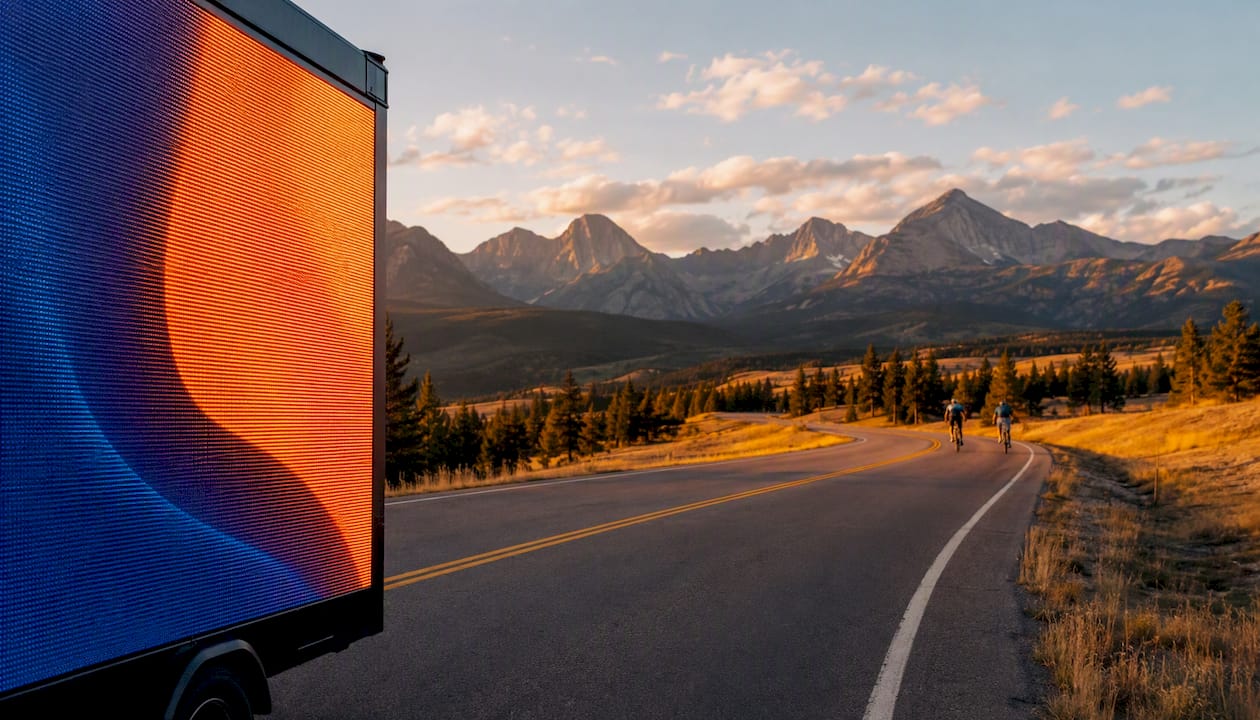
Combining physical placement with digital retargeting is where route planning for local ads becomes a genuine competitive advantage. A mobile LED billboard traveling a customized route through a target neighborhood, paired with geofenced mobile retargeting, creates a dual-channel impact that neither medium achieves alone.
Best practices for maximizing your localized campaign
Knowing the tools is one thing. Using them well is another. Here are the practices that separate high-performing local campaigns from ones that burn budget without clear return.
Follow this implementation checklist before your campaign goes live:
- Audit your audience data first. Understand where your best customers actually spend time, not where you assume they do. Use foot traffic data, purchase data, or CRM geographic data to validate your targeting zones.
- Set creative by context, not just location. A neighborhood with heavy foot traffic from young professionals needs different messaging than a suburban corridor with family-oriented commuters.
- Integrate smart QR codes into physical placements. QR scans capture first-party data and give you a direct signal connecting a physical impression to a digital action.
- Build your attribution framework before launch. Decide upfront how you will measure store visits, sales lifts, and brand recall. Post-campaign attribution is much harder to establish retroactively.
- Schedule creative rotation every 10 to 14 days. Audience fatigue with static creative is a real problem. Dynamic rotation keeps the message fresh and relevant.
- Test conference targeting methods if your audience concentrates around events. Trade shows, sporting events, and industry conferences create high-density targeting opportunities that localized OOH handles extremely well.
- Review performance data mid-campaign. Most campaigns wait until the end to analyze. Mid-flight reviews let you reallocate budget, adjust routes, or swap creative while the campaign is still running.
The most common mistakes marketers make with local campaigns include treating local markets as miniature versions of national campaigns, using identical creative across every zone, and failing to build any measurement infrastructure before launch. Each of these mistakes produces the same result: a campaign that spent money without producing clear evidence of impact.
Pro Tip: 98% of marketers now integrate OOH into purchase-driven strategies. If your local campaign lacks a direct line to a conversion metric, you are running brand activity when your competitors are running performance activity.
Why true localization means more than geo-targeting
Here is something most campaign briefs get wrong: they treat localization as a targeting parameter rather than a creative strategy. Drop the pin, define the radius, serve the ad. That is geo-targeting. That is not localization.
Real localization asks harder questions. What does this specific community care about right now? What local events, cultural references, or seasonal patterns make this message land differently here than anywhere else? What tone fits this neighborhood’s identity? Geo-targeting sets the boundary. Localized creative crosses it.
We see this clearly in how campaigns perform across similar demographic zones with different creative approaches. Two campaigns running the same radius targeting in adjacent neighborhoods can produce wildly different results when one creative acknowledges the local context and one does not. The data consistently shows that audience response improves when the message feels made for them rather than placed near them.
The agencies and brands pulling the best results from localized OOH in 2026 are doing something most of their competitors are not: they are treating creative iteration as a core part of the local strategy, not an afterthought. They are testing two or three creative angles per zone, reading the performance signals quickly, and updating before the campaign ends. That agility is what turns a good campaign into a market-leading one.
The deeper insight is this: most organizations underinvest in localized creative because they see it as operationally expensive. But the cost of producing a few neighborhood-specific creative variations is almost always lower than the cost of running a generic campaign at full budget with mediocre results. Advanced OOH tips consistently point to creative relevance as one of the strongest multipliers on placement efficiency. Geo-targeting finds your audience. Localized creative earns their attention.
Drive impact with advanced local ad solutions
The strategies in this guide work best when the platform behind them is built for precision. Beacon Mobile Media delivers exactly that: LED mobile billboards, wrapped rideshare vehicles across all 50 states, and a targeting platform that combines physical reach with programmatic capabilities.

From geofencing and real-time retargeting to smart QR code integration and effective ad targeting solutions, every tool is designed to give your local campaigns measurable lift, not just impressions. Our attribution analytics and proof-of-posting documentation connect physical placements to real results you can report. Explore data-driven OOH results and see how localized precision translates to performance, or dive into data-driven advertising tips to sharpen your next campaign from the ground up.
Frequently asked questions
What is the biggest advantage of localized ad campaigns?
Localized ad campaigns deliver higher relevance and stronger ROI by targeting audiences based on proximity and context, making every impression more likely to drive action. Local OOH now accounts for roughly 60% of total OOH revenue because it consistently outperforms broad, national approaches in converting awareness into behavior.
How does programmatic DOOH enhance local campaigns?
Programmatic DOOH enables marketers to use geo-targeting and dynamic creative, responding to local events, weather, and audience shifts in real time. With private deals accounting for 95% of programmatic DOOH spend, brands benefit from quality-controlled inventory and precise local delivery.
Can localized campaigns work with small budgets?
Yes, local campaigns make the most of limited budgets by focusing on proximity marketing and context-driven placements for high ROI. Hyperlocal OOH placements eliminate wasted spend by concentrating budget where your most convertible audiences actually are.
What results can brands expect from localized OOH ads?
Brands using localized OOH have seen store traffic lifts exceeding 50%, 4.3x sales lifts, and brand awareness gains of up to 47%, outperforming digital and connected TV alternatives in both awareness and favorability. Those benchmarks make localized OOH one of the strongest performance channels available for proximity-based marketing goals.