Out-of-home advertising, known in the industry as OOH, is the most visible and trusted channel for promoting industry events in physical environments where attendees are already moving. The case for why out-of-home advertising for industry events works is grounded in hard data: a May 2026 study by the OAAA and Kochava found that OOH drives a 20% median lift for in-person outcomes. That number doubles what connected TV and broadcast TV deliver. For event organizers and marketing professionals who need to fill rooms, drive registrations, and build brand presence before the doors open, OOH is not a supplementary channel. It is the anchor.
Why out-of-home advertising for industry events outperforms other channels
The OAAA and Kochava study analyzed hundreds of campaigns and found that OOH delivers 14% lift for digital outcomes alongside its 20% in-person lift. Connected TV and broadcast TV each deliver roughly 10% lift across both categories. That gap matters enormously when your campaign goal is physical attendance at a conference, trade show, or industry summit.
The reason OOH outperforms in event contexts is straightforward. People traveling to a convention center, arriving at an airport, or riding transit to an expo are already in motion. They are physically close to the event and mentally open to relevant messaging. A billboard or mobile LED display at that moment reaches a pre-qualified audience at the exact point of decision.

| Channel | In-person lift | Digital lift |
|---|---|---|
| Out-of-home (OOH) | 20% median | 14% median |
| Connected TV | ~10% | ~10% |
| Broadcast TV | ~10% | ~10% |

The sustained nature of OOH exposure also compounds its advantage. A digital ad disappears in seconds. A billboard near a convention center runs for the full duration of a multi-day event, delivering repeated impressions to the same attendee pool every time they pass. Frequency builds recall, and recall drives action.
Pro Tip: Schedule OOH placements to begin 7–10 days before the event opens. Pre-event exposure primes attendees before they arrive, so your brand registers before competitors get their first handshake on the show floor.
What unique advantages does OOH offer for reaching event attendees?
OOH advertising is unskippable and ad-block-proof, which gives it a structural advantage over every digital format. A person walking past a wrapped rideshare vehicle or a digital city light poster cannot install an extension to block it. That physical presence guarantees exposure in a way that no programmatic display ad can match.
Trust is the second major advantage. About 80% of consumers noticed a billboard ad in the past week. Nearly 49% find OOH more trustworthy than social media ads. For industry events where brand credibility matters, that trust differential is a real competitive edge. A trade show exhibitor who appears on a prominent OOH placement arrives at the event with authority already established.
The benefits of out-of-home advertising for event contexts also include:
- Unskippable exposure. No ad blocker, no skip button, no scroll-past. The message reaches the viewer in full.
- High trust scores. OOH consistently outperforms social media in consumer trust surveys, which matters when promoting professional events where reputation is currency.
- Contextual relevance. Placements near airports, transit hubs, and convention centers put the message in front of people who are already event-adjacent.
- Privacy-safe targeting. OOH reaches audiences by location and context, not by harvesting personal data. This aligns with growing consumer concern about digital surveillance.
OOH is privacy-safe because it uses geography and environment to define the audience, not individual behavioral profiles. As privacy regulations tighten and third-party cookies disappear, that distinction becomes a genuine strategic advantage for marketers who want reach without compliance risk.
Pro Tip: Pair OOH placements near event venues with branded event signage inside the venue. The two touchpoints reinforce each other and create a consistent brand experience from the street to the show floor.
How can marketers integrate OOH with digital strategies for event success?
OOH and digital advertising are stronger together than either is alone. Adding OOH to digital campaigns can boost audience reach by 100% or more, according to research from MRI-Simmons and the OAAA. That reach multiplier is the core argument for treating OOH as a complement to your social media and mobile ad spend, not a replacement.
The integration works in four practical steps:
- Launch OOH placements first. Start outdoor advertising 7–10 days before the event to build brand awareness in the physical environment. This primes the audience before digital retargeting begins.
- Use QR codes on OOH units. Smart QR codes on mobile billboards and digital displays capture scan data, turning a passive impression into a measurable lead. Attendees who scan can be retargeted digitally with event registration offers.
- Activate programmatic digital OOH. Programmatic digital OOH (pDOOH) enables real-time contextual targeting using triggers like weather, time of day, or live event schedules. A display near a convention center can automatically switch creative when the morning keynote ends and foot traffic peaks.
- Retarget OOH-exposed audiences digitally. Use geofencing around OOH placements to identify mobile devices that passed the billboard. Serve those users follow-up ads on social media and mobile apps to move them from awareness to registration.
The measurement story for OOH has also improved significantly. Attribution tools now connect physical ad exposure to digital behavior and in-person attendance, giving marketers the data-driven campaign insights they need to justify spend and refine future placements.
What practical placements make outdoor advertising for trade shows work?
Location is the most important variable in outdoor advertising for trade shows. The ISE trade show in Barcelona demonstrated this clearly: OOH campaigns placed in airport arrivals and baggage claim areas captured brand attention before attendees even left the terminal. That pre-event exposure created brand presence before a single competitor could shake a hand on the show floor.
The highest-performing placements for industry events follow a clear pattern. Airports deliver the first impression for traveling attendees. Transit hubs, metro stations, and bus routes connecting hotels to convention centers deliver repeated impressions during the event itself. The area immediately surrounding the venue delivers the final push at the moment of highest intent.
| Placement type | Best use case | Format recommendation |
|---|---|---|
| Airport arrivals and baggage claim | Pre-event brand awareness for traveling attendees | Digital city light posters, large format displays |
| Transit routes to venue | Repeated impressions during event days | Mobile LED billboards, wrapped vehicles |
| Convention center perimeter | High-intent audience at point of arrival | Mobile billboards, digital OOH screens |
| Hotel districts near event | Capture attendees during off-hours | Wrapped rideshare vehicles, static billboards |
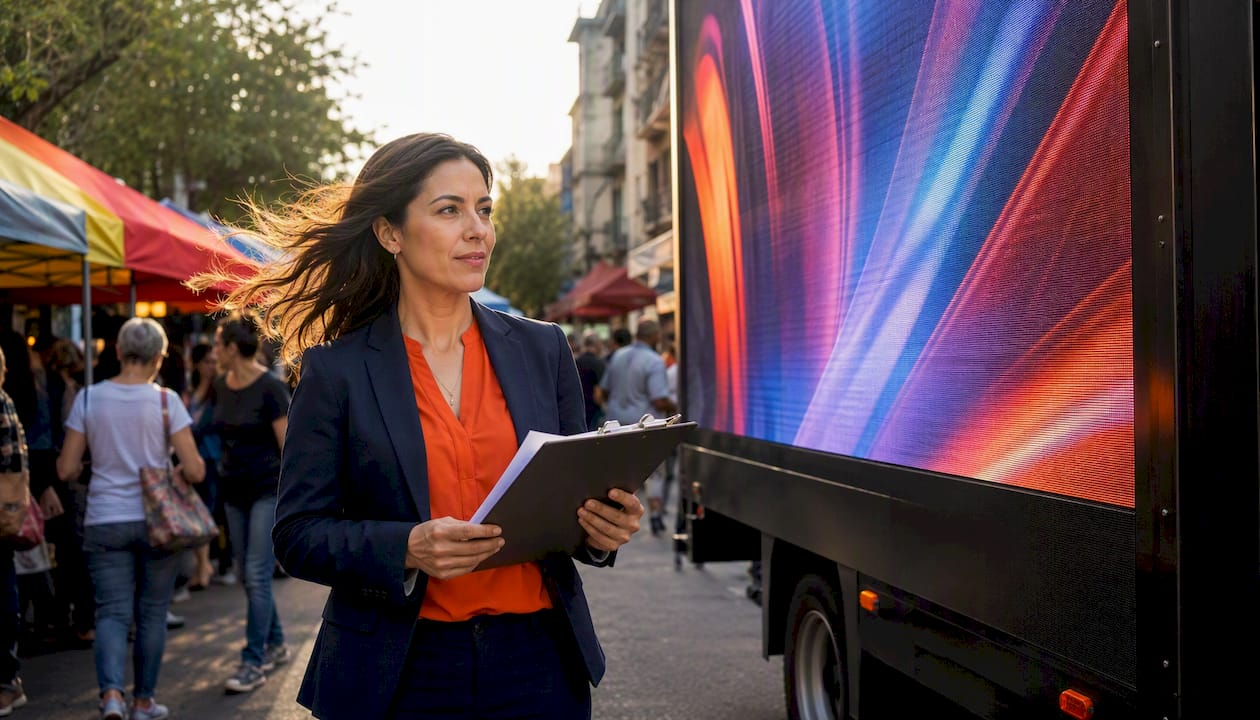
Mobile LED billboards deserve specific attention for event contexts. They follow the audience rather than waiting for the audience to pass a fixed location. A mobile billboard targeting conferences can route through hotel pickup zones in the morning, circle the convention center during peak hours, and shift to restaurant districts in the evening when attendees network. That flexibility is impossible with static placements.
Creative alignment with audience mindset also drives results. Industry event attendees are professionals in a focused, goal-oriented state. Creative that speaks directly to business outcomes, product launches, or session highlights outperforms generic brand awareness messaging. Keep copy short, the visual hierarchy clear, and the call to action specific.
Sponsored event signage inside and around the venue reinforces OOH placements and extends the campaign’s reach into the event itself. The combination of exterior OOH and interior branded signage creates a full-funnel presence from first awareness to on-site engagement.
Key takeaways
Out-of-home advertising is the highest-performing channel for driving in-person event attendance, delivering twice the lift of connected TV and broadcast TV according to OAAA and Kochava research.
| Point | Details |
|---|---|
| OOH outperforms TV for events | OOH delivers 20% in-person lift vs. roughly 10% for connected TV and broadcast TV. |
| Trust drives OOH effectiveness | Nearly 49% of consumers trust OOH more than social media ads, giving event brands a credibility edge. |
| Location targeting is the key tactic | Airports, transit hubs, and venue perimeters reach attendees at the highest-intent moments. |
| Digital integration multiplies reach | Adding OOH to digital campaigns can double audience reach, per MRI-Simmons and OAAA research. |
| Measurement has caught up | Geofencing, QR codes, and attribution tools now connect OOH exposure to registrations and attendance. |
What I’ve learned about OOH timing that most event marketers get wrong
Most event marketers treat OOH as a last-minute awareness play. They book placements for the week of the event and wonder why the results feel thin. The campaigns that actually move registration numbers start earlier and think harder about sequence.
The ISE Barcelona example is instructive precisely because the airport placements ran before attendees reached the venue. That sequence matters. When someone sees your brand at baggage claim, then again on the metro, then again outside the convention center, the third impression lands differently than the first. It feels like presence, not advertising. That distinction is what builds the trust that converts.
The measurement improvements in OOH have also changed what is possible for event campaigns. Geofencing around billboard locations, QR scan data, and digital OOH attribution now give marketers a real picture of what the spend produced. The excuse that OOH cannot be measured no longer holds. What I see consistently is that marketers who combine strong creative with data-driven placement decisions get results that justify the investment clearly. The ones who skip the data layer are the ones who cannot explain the ROI to their leadership.
The future of OOH for events is programmatic and mobile. pDOOH that responds to live event triggers and mobile units that follow attendee movement patterns will define the next generation of event campaigns. Marketers who build those capabilities now will have a structural advantage over competitors still buying static placements.
— Scott
How Beacon-ads helps event marketers run OOH campaigns that perform
Beacon-ads operates LED mobile billboards and wrapped rideshare vehicles across all 50 states, with targeting capabilities built specifically for event contexts. The platform combines route customization, geofencing, and real-time retargeting so your campaign follows the attendee from airport arrival to convention center exit.

For marketers planning their next trade show or industry conference campaign, the 2026 OOH format guide from Beacon-ads covers every format option with placement recommendations matched to event scenarios. Smart QR code integration, proof-of-posting documentation, and attribution analytics are included, so you can show leadership exactly what the campaign delivered. Beacon-ads also offers a dedicated resource on targeting conferences with LED billboards for teams ready to move from planning to execution.
FAQ
What is out-of-home advertising in the context of events?
Out-of-home advertising refers to any ad format that reaches people in public spaces, including billboards, mobile LED trucks, transit ads, and wrapped vehicles. For industry events, OOH targets attendees at airports, transit routes, and venue perimeters before and during the event.
How does OOH advertising compare to digital ads for event promotion?
OOH delivers a 20% median lift for in-person outcomes, compared to roughly 10% for connected TV and broadcast TV, according to the OAAA and Kochava. OOH also cannot be blocked or skipped, giving it a guaranteed exposure advantage over digital formats.
What OOH formats work best for trade shows and conferences?
Mobile LED billboards, digital city light posters, and wrapped rideshare vehicles perform best for trade show promotion. Mobile formats are especially effective because they can route through airports, hotel districts, and convention center perimeters to follow attendee movement throughout the event.
Can OOH advertising be measured for event campaigns?
OOH campaigns are measurable through geofencing, QR code scan data, and attribution analytics that connect physical ad exposure to digital behavior and in-person attendance. These tools give marketers clear data on impressions, engagement, and conversion.
Is OOH advertising privacy-safe for event targeting?
OOH targets audiences by location and context rather than personal data, making it fully privacy-safe. This approach aligns with tightening privacy regulations and growing consumer concern about data collection, while still delivering precise audience reach at event-relevant locations.