Digital billboard targeting is defined as the practice of delivering dynamic, data-driven ad messages to specific audiences based on location, time, behavior, and demographic signals. Unlike static outdoor advertising, targeted digital billboards update in real time and respond to audience data. 65% of US marketers say digital billboards best support connected-commerce goals, ranking them as the top out-of-home format for driving activation. That number signals a clear shift: digital billboards are no longer just awareness tools. The benefits of digital billboard targeting now extend to measurable purchase intent, retail traffic, and attribution, making them a serious performance channel for marketing professionals.
1. What are the primary benefits of digital billboards over static formats?
Digital billboards outperform static formats on one fundamental dimension: flexibility. A single digital screen can rotate multiple creatives throughout the day, reaching different audiences with different messages without printing a single sheet of vinyl.
Key advantages over traditional static billboards include:
- Dynamic content rotation: One screen can carry multiple campaigns, reducing cost per message and increasing relevance across dayparts.
- Motion graphics: Animated visuals capture attention more effectively than flat images, especially in high-traffic urban environments.
- Instant updates: Creatives update instantly based on time of day, weather conditions, or local events, keeping messaging relevant without production delays.
- Remote management: Campaign managers can push new content from any location, eliminating the logistics of physical installation.
- Scheduling control: Advertisers can run a breakfast promotion at 7 a.m. and a dinner offer at 5 p.m. on the same screen, same day.
Static billboards lock you into one message for weeks. Digital formats give you the ability to react to what is happening right now, whether that is a weather shift, a competitor promotion, or a local sports event.
Pro Tip: Schedule your highest-converting creative for the 90-minute window before your target audience reaches a purchase decision point, such as the commute home before dinner or the morning drive before a retail district.

2. How does location-based targeting sharpen digital billboard effectiveness?
Location-based targeting, also called geofencing or addressable out-of-home (OOH), is the engine behind the most effective billboard marketing strategies in 2026. It connects physical ad placement to real audience behavior data, so your message reaches the right people at the right place.
Geofencing works by drawing a virtual boundary around a location. When a device enters that boundary, it gets tagged for audience analysis or retargeting. Platforms like King Sixteen’s geoframing take this further by using historical location data to build audience segments from past visitors to specific venues.
Practical targeting inputs that improve campaign relevance:
- Traffic flow data: Identifies peak hours at specific intersections or retail corridors.
- Behavioral patterns: Segments audiences by past visits to competitor locations, gyms, or grocery stores.
- Time-of-day targeting: Serves commuter-focused messages during rush hour and leisure-focused messages on weekends.
- Affinity data: Matches billboard placement to neighborhoods where your core customer profile is most concentrated.
Privacy compliance is not optional in this space. The FTC treats location data more precise than roughly 0.35 miles as sensitive, which means geofences must be carefully designed to exclude healthcare facilities, religious venues, and other protected locations. Marketers who skip this step face regulatory exposure.
Pro Tip: Maintain a versioned polygon library for every geofence you run. Document each boundary, its creation date, and any exclusion zones applied. This creates an audit trail that protects you if compliance questions arise.
3. What measurable impacts can marketers expect from targeted digital billboard campaigns?
The impact of digital targeting on out-of-home advertising is now backed by hard numbers. Programmatic digital billboard campaigns increase purchase intent by 9.8% and brand favorability by 7.8%. Programmatic buys specifically deliver a 300% increase in purchase intent compared to classic OOH purchases. That gap between programmatic and traditional buying is the single most important data point for any marketer still running static placements.
| Metric | Digital Billboard Targeting | Classic OOH |
|---|---|---|
| Purchase intent lift | +9.8% | Baseline |
| Brand favorability lift | +7.8% | Baseline |
| Programmatic purchase intent vs. classic OOH | +300% | Baseline |
| Top commerce role | Cost-effective reach and retail traffic | Awareness only |
OOH outperforms digital and CTV on tested brand metrics according to Clear Channel Outdoor and Kantar research. That finding challenges the assumption that digital channels own the performance space. Physical presence, combined with data-driven placement, produces results that screen-based formats struggle to match.
“Digital billboards are not only about reach. They are uniquely capable of delivering measurable purchase-driven outcomes compared to other out-of-home formats.” — eMarketer, 2026
Attribution in this channel has matured significantly. Measuring incremental lift with confidence intervals and cohort sizes gives marketers a statistically sound picture of what the campaign actually caused, not just what happened nearby. This is the difference between a vanity metric and a budget decision.
4. How does programmatic buying improve digital billboard targeting strategies?
Programmatic digital out-of-home (DOOH) buying automates the purchase of billboard inventory using real-time data signals. It replaces manual insertion orders with auction-based buying that responds to audience conditions as they change. For marketing professionals managing multi-market campaigns, this shift changes everything about how budgets get allocated.
Core advantages of programmatic DOOH over traditional OOH buying:
- Real-time content triggers: Campaigns respond automatically to weather, sports scores, or stock levels without manual intervention.
- Granular budget control: Spend is allocated to specific screens, times, and audience conditions rather than broad market packages.
- Faster campaign launches: Programmatic platforms reduce setup time from weeks to hours.
- Cross-channel data integration: Audience data from mobile, CRM, and web platforms can inform which screens to activate and when.
| Feature | Programmatic DOOH | Classic OOH Purchase |
|---|---|---|
| Buying speed | Hours | Weeks |
| Audience targeting | Data-driven, real-time | Demographic estimates |
| Creative flexibility | Dynamic, instant updates | Fixed for contract term |
| Attribution | Incremental lift, cohort analysis | Impression estimates |
| Budget control | Screen and time-level | Market-level packages |
Programmatic DOOH buyers expect venue-level audience data in attribution reports, not just roadside traffic models. This expectation is reshaping how vendors report campaign performance. If your current OOH partner cannot provide venue-level exposure data, your attribution is built on assumptions.
For marketers building data-driven OOH advertising strategies, programmatic buying is the entry point to campaigns that can be measured, adjusted, and defended to a CFO.
5. How do digital billboards support cost-effective reach and retail traffic?
Cost-effective reach is one of the top commerce roles for OOH, alongside driving retail traffic and reinforcing consistent brand messaging. Digital billboards lead format deployment at 65% among US marketers. That deployment rate reflects a practical reality: digital formats deliver more messages per dollar than static placements when campaigns are managed well.
Retail traffic lift is a direct, measurable outcome of well-placed digital billboard campaigns. When a billboard sits within a half-mile of a store and runs a time-sensitive offer, foot traffic data shows a measurable response. This is not a theoretical benefit. Platforms that combine geofencing with real-time advertising attribution can connect billboard exposure to in-store visits with statistical confidence.
The cost efficiency argument also holds at the creative level. One digital screen replaces multiple static installations for brands running seasonal or promotional campaigns. Printing, installation, and removal costs disappear. The savings compound across a multi-location campaign.
6. What practical tips maximize ROI from targeted digital billboard campaigns?
Execution separates campaigns that perform from campaigns that just run. The advantages of targeted billboards only materialize when the setup is deliberate and the measurement is rigorous.
- Choose locations for audience density, not just traffic volume. A screen near a competitor’s store or a complementary retail cluster delivers more relevant impressions than a high-volume freeway placement with no audience context.
- Run multi-message rotations with a clear funnel logic. Awareness messages early in the day, offer-driven messages closer to purchase windows.
- Measure incremental lift, not raw impressions. Attribution must link impressions to incremental visitor behavior with confidence intervals. Raw impression counts tell you how many people could have seen your ad. Incremental lift tells you how many changed their behavior because of it.
- Audit geofences before every campaign launch. Geofences must be versioned and regularly audited to avoid intersecting sensitive locations. A single compliance failure can cost more than the entire campaign budget.
- Budget for attribution infrastructure. Programmatic DOOH attribution requires exposure opportunity inputs anchored to real venue traffic data. This is not a free add-on. Build it into the campaign budget from the start.
Pro Tip: When planning a localized campaign, pull foot traffic data for your target locations two weeks before launch. Patterns shift by season, local events, and even construction. Stale data produces misaligned placements.
Key Takeaways
Digital billboard targeting delivers measurable purchase intent lifts, retail traffic increases, and attribution clarity that static OOH formats cannot match, making it the highest-performing format for marketers focused on connected commerce outcomes.
| Point | Details |
|---|---|
| Purchase intent lift | Programmatic DOOH increases purchase intent by 9.8% and delivers 300% more lift than classic OOH. |
| Location-based precision | Geofencing and affinity data connect billboard placement to real audience behavior and purchase patterns. |
| Privacy compliance | FTC treats location data more precise than 0.35 miles as sensitive; geofences require versioning and auditing. |
| Programmatic advantage | Programmatic buying enables real-time creative updates, granular budget control, and venue-level attribution. |
| Incremental lift measurement | Attribution must report lift with confidence intervals and cohort sizes, not raw impression counts. |
Why measurement is the real differentiator in digital billboard targeting
Most marketers I talk to are still optimizing for impressions. That is the wrong metric, and the data makes it clear. When I look at campaigns that actually moved the needle on retail traffic or purchase intent, the common thread is not the screen size or the location. It is the attribution framework behind the buy.
The shift to incremental lift measurement is uncomfortable for teams used to reporting reach and frequency. Incremental lift requires a control group, a confidence interval, and a cohort large enough to be statistically meaningful. That is more work. But it is the only number that tells you whether the campaign caused a behavior change or just coincided with one.
Privacy compliance is the other area where I see marketers underestimate the risk. Geofences that look clean on a map can still intersect a healthcare clinic or a place of worship at the boundary edge. The FTC’s 0.35-mile threshold for sensitive location data is not a guideline. It is a line that, once crossed, creates documented liability. Versioning your polygon library is not bureaucratic overhead. It is your legal defense.
The opportunity in 2026 is real. Digital billboard targeting, when executed with proper attribution and privacy controls, outperforms most digital channels on brand metrics. The marketers who will win are the ones who treat measurement as a core competency, not an afterthought.
— Scott
How Beacon-ads brings targeted digital billboard campaigns to life
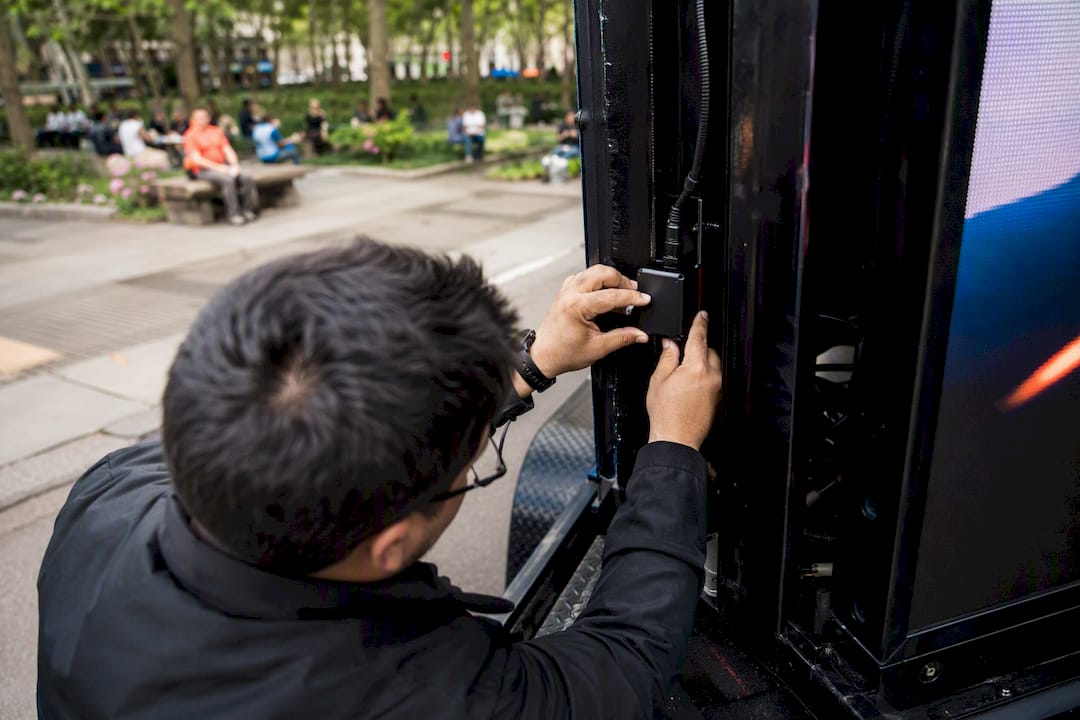
Beacon-ads combines LED mobile billboards, wrapped rideshare vehicles, and advanced digital targeting into campaigns that are built to be measured from day one.

For marketing professionals who need more than reach, Beacon-ads provides geofencing, real-time retargeting, and smart QR code integration that captures lead data directly from billboard exposure. Every campaign includes proof-of-posting documentation and attribution analytics tied to real audience behavior. Whether you are running a localized retail push or a national brand campaign, the digital out-of-home advertising strategies Beacon-ads deploys are built around incremental lift, not vanity metrics. If you are ready to see what targeted OOH looks like with real measurement behind it, Beacon-ads is the place to start.
FAQ
What is digital billboard targeting?
Digital billboard targeting is the practice of using location data, audience behavior, and real-time signals to deliver specific ad messages on digital out-of-home screens. It combines physical billboard placement with data-driven audience selection.
How much does digital billboard targeting improve purchase intent?
Programmatic digital billboard campaigns increase purchase intent by 9.8% and deliver 300% more purchase intent lift than classic OOH buys.
What is incremental lift in DOOH attribution?
Incremental lift measures the behavior change caused by a campaign, compared to a control group that was not exposed. It is reported with confidence intervals and cohort sizes to confirm statistical validity.
Are there privacy rules for geofencing in digital billboard campaigns?
The FTC treats location data more precise than approximately 0.35 miles as sensitive. Geofences must exclude healthcare facilities, religious venues, and other protected locations, and must be versioned and audited regularly.
Why do marketers prefer programmatic DOOH over traditional OOH buying?
Programmatic DOOH enables real-time creative updates, data-driven audience targeting, and venue-level attribution. Traditional OOH purchases rely on demographic estimates and fixed creative for the full contract term.