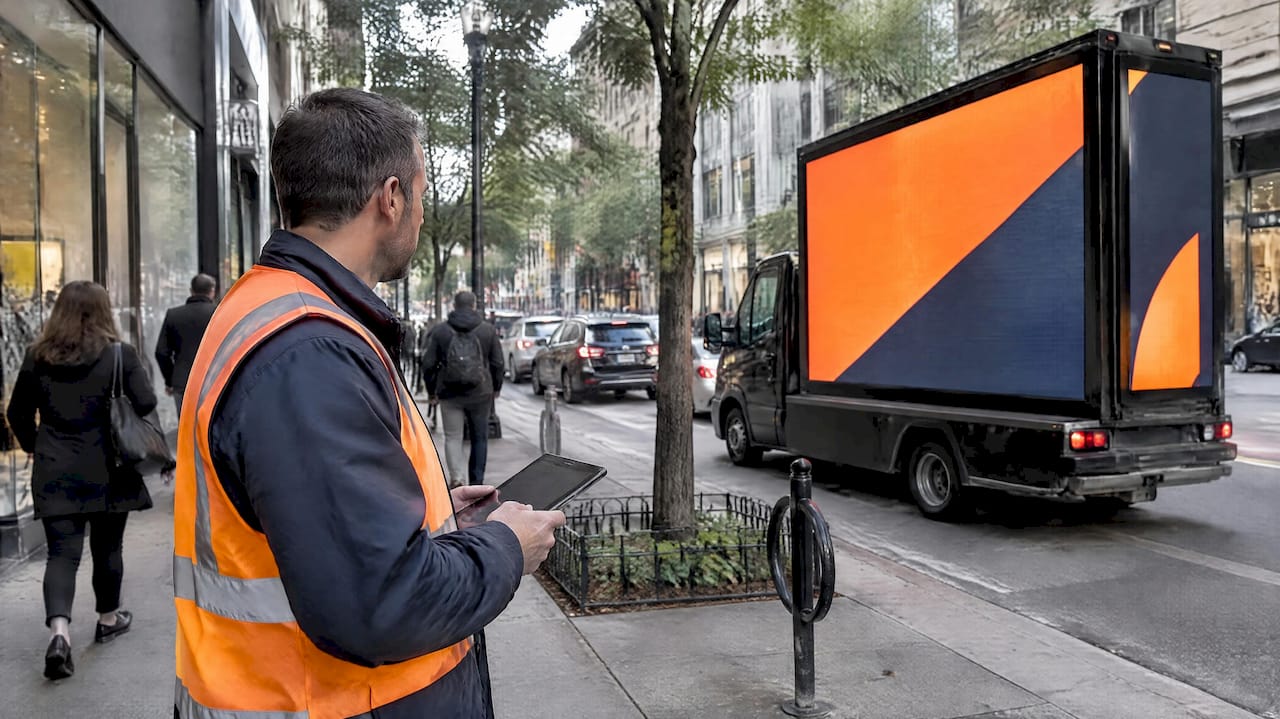
Yes. Mobile billboards reliably drive measurable brand lift and in-person outcomes when campaigns are planned with clear targets and measured properly. A joint OAAA and Kochava study found a median lift for in-person outcomes, and pairing moving billboards with stationary formats can amplify that further. The sections below unpack the evidence, the measurement methods, and the costs behind those numbers.
TL;DR:
- Mobile billboards deliver a median 20% increase in in-person outcomes and outperform TV in similar metrics, with pairing formats boosting lift 50% to 100%.
- Combining moving and stationary out-of-home formats significantly enhances engagement, with audiences up to 2.5 times more likely to take action.
- Effective measurement relies on geo-fenced visit tracking, device panel matching, and unique QR codes, with a two to four-week pilot recommended before larger campaigns.
- Cost varies by market and fleet, with static wraps suited for long-term, single-message campaigns, while digital LED trucks excel in flexible, time-sensitive messaging.
- Proven ROI depends on controlled pilots, accurate attribution, and matching creative to route conditions, not just campaign exposure.
Table of Contents
- What the research says about mobile billboard effectiveness
- Static wraps versus digital LED trucks: which should you book?
- How to measure mobile billboard ROI with confidence
- Creative rules that make moving ads actually work
- What mobile billboards cost and how to budget a test flight
- Where mobile billboards consistently move the needle
- How Beacon Mobile Media turns mobile billboard data into results
- When mobile billboards deserve priority in your media mix
- Run a measurable mobile billboard campaign with Beacon Mobile Media
- Sources
- FAQ
What the research says about mobile billboard effectiveness
The clearest data point for marketers evaluating mobile billboard effectiveness comes from the OAAA and Kochava study, which measured out-of-home campaigns against connected TV and broadcast using device-level data and matched controls rather than simple before-and-after comparisons.
- Out-of-home campaigns produced a median lift in in-person outcomes and a lift in digital outcomes.
- Retail campaigns saw the strongest category lift, with automotive and quick-service restaurants showing notable rises.
- Out-of-home outperformed television on both lift measures in the same study.
Combining formats pushes those numbers higher. Reveal and Firefly’s testing found that campaigns pairing moving OOH with stationary placements generated 50% to 100% higher lift, with exposed audiences up to 2.5 times more likely to take action, validated against matched control groups.
A peer-reviewed field experiment found mobile banner advertising produced roughly a 2% uplift in offline sales with no significant effect online. That modest figure matters because it shows mobile-adjacent advertising can move real purchase behavior even when digital metrics show nothing, which is exactly the blind spot mobile billboards are built to cover. Frequency matters too: steeper exposure curves tend to precede increases in search and social engagement, which is why single-exposure flights rarely show the lift that sustained campaigns do.
Static wraps versus digital LED trucks: which should you book?
Printed vehicle wraps and digital LED trucks solve different problems, and the choice shapes both cost and creative flexibility.
- Static wraps cost less to produce, require no rotation logic, and work well for single-message campaigns running several weeks or longer.
- Digital LED trucks allow multiple creative rotations per route, support dayparting, and let you swap messages between a morning commute audience and an evening event crowd without reprinting anything.
- Wraps need longer lead times for design and installation, while LED units can update creative within hours of a route change.
- Fleet size matters more for wraps, since rotating creative across a large static fleet means physically re-wrapping vehicles.
Static wraps tend to outperform on cost efficiency for long-running awareness campaigns in a single market. Digital LED trucks tend to outperform when a campaign needs multiple messages, time-sensitive offers, or rapid testing across routes, which is increasingly the default for retail and event marketers chasing the lift numbers above.
How to measure mobile billboard ROI with confidence
Measuring mobile OOH requires methods built for a medium that moves, which rules out simple foot-traffic counts alone.
- Use device-panel matching to compare exposed and unexposed groups drawn from the same geographic pool.
- Run geo-fenced visit-lift studies that track whether people near a billboard’s route later visited a client location.
- Set up matched-control experiments, holding one market or time window as a baseline against an active flight.
- Add QR codes or unique URLs on the creative to capture direct response data tied to a specific route or day.
Before launching, set a baseline for each KPI (foot traffic, website visits, QR scans) using at least two weeks of pre-campaign data. A basic ROI formula looks like this: take the lift percentage, apply it to your baseline conversion volume, multiply by average order value, then subtract campaign cost.
Pro Tip: Run your test in a single market for two to four weeks before committing to a multi-market flight, so you have a clean lift number to justify scaling.
The most common pitfall is attributing lift to the billboard alone when a digital campaign ran at the same time. Stagger your flight dates or hold out a control market to isolate the effect.

Creative rules that make moving ads actually work
Moving billboards give viewers a few seconds of attention, so the creative has to work instantly.
- Keep copy to 3 to 7 words, with a brand cue and the offer visible without reading a full sentence.
- Use high-contrast colors and large type that read clearly at highway speed or from across a street.
- Assign a unique QR code or short URL per route or market so scans can be tied back to specific placements.
- Design static creative as flat, print-ready files, and design LED creative with simple animation that does not rely on fast-moving transitions a viewer only sees for a second.
Pro Tip: Test two creative variations across different routes in the same city to see which message drives more QR scans before locking creative for a full flight.
What mobile billboards cost and how to budget a test flight
Pricing in mobile out-of-home typically runs on a per-truck, per-day basis, with premiums for event days, exclusive routes, or rush production.
- Estimate cost per thousand impressions (CPM) by dividing total campaign cost by estimated impressions, then compare that figure against your other channels using a CPM calculator.
- Convert the lift percentage from your pilot into incremental revenue using the ROI formula above, and compare that against the flight’s total cost.
- Budget for a minimum two-week test in one market before expanding, since shorter windows rarely produce enough data to detect a reliable lift.
Full pricing and package details are available directly from a provider, since rates vary by market, fleet size, and campaign length. Beacon Mobile Media’s ROI framework walks through a similar calculation for mobile billboard flights.
Where mobile billboards consistently move the needle
Certain use cases show up again and again in campaign data because the format matches the buying moment.
- Event and trade-show activations use mobile billboards to circle venues and parking lots, reinforcing booth visibility and driving foot traffic during the exact hours attendees are present.
- Retail and QSR brands run geo-targeted daypart campaigns, routing trucks near competitor locations or high-traffic intersections during lunch and dinner windows to drive same-day visits.
- Real estate and local service businesses use mobile billboards for hyperlocal awareness and lead capture, often pairing a route with a QR code for instant contact.
- Pairing any of these with digital retargeting extends the campaign’s reach by serving ads to people whose devices were detected near the route, turning a single exposure into a multi-touch conversion path.
How Beacon Mobile Media turns mobile billboard data into results
Some providers run LED mobile billboards and wrapped rideshare vehicles nationwide, built around measurement principles outlined above.
- Geofencing and real-time retargeting extend each route’s reach into digital channels after initial exposure.
- Smart QR codes capture customer data directly from scans, creating a direct-response layer on top of brand awareness.
- Proof-of-posting documentation, including GPS and photo tracking, confirms where and when creative actually ran.
- Attribution analytics and funnel metrics tie route-level exposure back to downstream conversions, mirroring the device-panel and geo-fenced methods described earlier.
Marketers weighing a pilot can apply the same ROI formula to a small, controlled flight before scaling to a full campaign.
When mobile billboards deserve priority in your media mix
Mobile billboards earn their place when a campaign needs visible, localized presence tied to a specific window of time, an event, a store opening, a competitive push, rather than broad, slow-building awareness. The trade-off is real: static formats are cheap and durable, digital formats are flexible and testable, and neither replaces a properly isolated measurement plan. Run a small, controlled test before committing budget, and treat mobile OOH as one channel in a mix rather than a standalone bet.
— Scott
Run a measurable mobile billboard campaign with Beacon Mobile Media
Most advertisers lose the thread between a mobile billboard route and what it actually produced, because proof-of-posting and attribution get bolted on after the fact instead of built into the plan. Beacon Mobile Media runs LED mobile billboards and wrapped rideshare vehicles nationwide with geofencing, real-time retargeting, and smart QR capture built into every flight, so the data needed to prove lift exists from day one.

- Route customization and affinity targeting match your audience to the right streets and dayparts.
- Proof-of-posting and funnel metrics give you the reporting needed to defend the budget on the next renewal.
- A short pilot flight can be scoped and measured before committing to a multi-market campaign.
Get a quote for your next mobile billboard campaign and see how a measurable pilot fits your budget.
Sources
The OAAA and Kochava study quantifies OOH lift against TV. Reveal and Firefly’s research covers format amplification. The offline sales field experiment tests mobile advertising’s effect on purchases. A brand-lift measurement guide explains how to run your own study.
- OOH Delivers 2x the Performance Lift of TV, New OAAA and Kochava Study Finds
- Study confirms combining moving and stationary out-of-home media boosts campaign lift
- Do mobile banner ads increase sales? Yes, in the offline channel
FAQ
How effective are mobile billboards compared to other ad formats?
Mobile billboards produced a median 20% lift in in-person outcomes and a 14% lift in digital outcomes, outperforming television in the same OAAA and Kochava study. Pairing mobile billboards with stationary OOH formats pushed lift 50% to 100% higher in a separate Reveal and Firefly analysis.
What are the disadvantages of mobile advertising?
Mobile billboards require longer lead times for wrap production, can be harder to scale quickly across multiple markets, and need proper attribution tools to isolate their effect from other channels running at the same time. Without geo-fenced measurement or matched controls, it is easy to misattribute lift to the wrong source.
What does a mobile billboard cost?
Pricing typically runs on a per-truck, per-day basis, with premiums for event days or exclusive routes, and exact rates vary by market, fleet size, and campaign length. Providers such as Beacon Mobile Media quote pricing directly based on the specifics of a campaign, since no single flat rate applies across markets.
How do I prove mobile billboard ROI before scaling a campaign?
Run a two to four week pilot in one market using geo-fenced visit-lift tracking, a matched control area, and unique QR codes tied to the campaign. Apply the lift percentage to your baseline conversion volume and average order value to calculate incremental revenue against the campaign’s cost.
Do digital LED trucks perform better than static wrapped vehicles?
Digital LED trucks tend to perform better for campaigns needing multiple messages, time-sensitive offers, or dayparting, since creative can rotate without reprinting. Static wraps remain cost-efficient for single-message awareness campaigns running over a longer flight in one market.