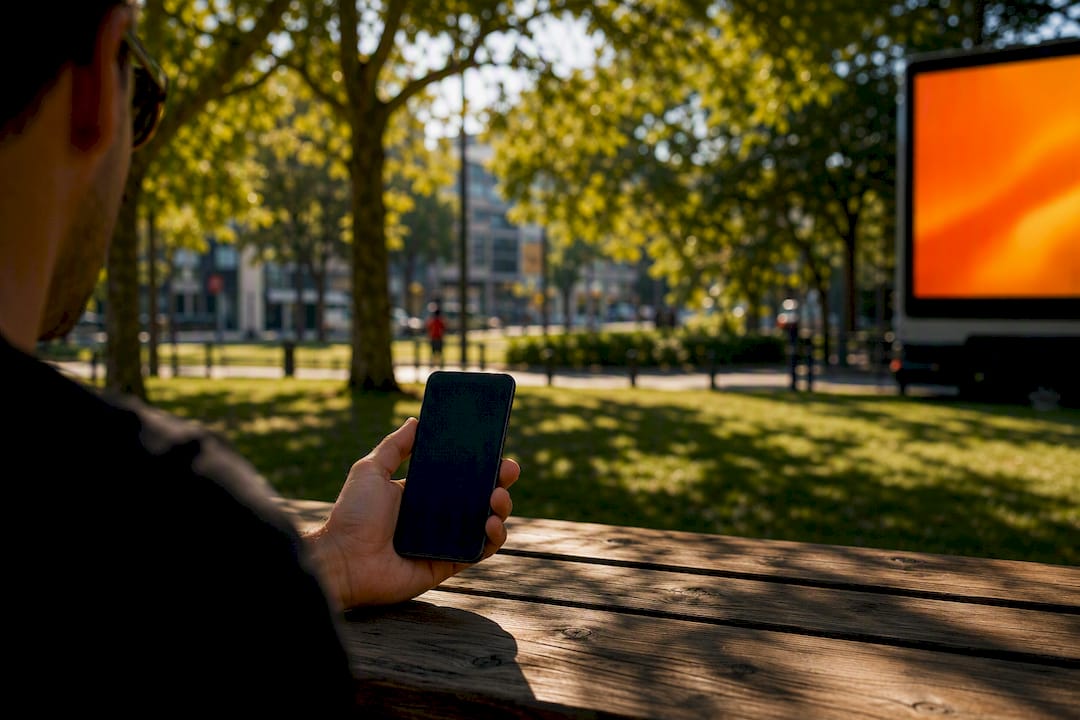
Advertising trends in 2026 are defined by three structural forces: AI-driven automation as the operational baseline, privacy-first targeting as a compliance necessity, and omnichannel measurement as the standard for proving ROI. Global media ad spending is projected to reach $1.17 trillion in 2026, with digital formats, particularly display, Connected TV, and retail media, capturing the largest share of that growth. Platforms like Meta, Google, and Amazon are reshaping how budgets are allocated, while out-of-home advertising is evolving from a brand awareness play into a precision, data-led channel. Marketers who understand these shifts now will be positioned to outperform competitors still operating on 2023 assumptions.
1. AI is now the default engine of advertising workflows
AI is no longer a competitive advantage in paid media. It is the assumed baseline. JumpFly reported that AI adoption across paid media platforms has compressed rapidly, with automation now handling bidding, targeting, creative assembly, and placement across Google, Meta, and most major DSPs. That shift means manual campaign management is largely obsolete for routine tasks.

The practical result for marketers is a role change, not a job loss. As AI automation becomes standard, the competitive edge moves toward creative strategy, audience insight, and experimentation rather than execution. Google Gemini now powers a significant portion of responsive search ad generation, and ByteDance’s Seedance 2.0 produces studio-quality video ads at a fraction of traditional production costs. Brands that treat AI as a creative collaborator rather than a replacement will produce more volume with higher relevance.
Key shifts AI is driving in 2026 advertising workflows:
- Automated bidding and budget allocation across Google Performance Max and Meta Advantage+ campaigns, reducing manual optimization cycles
- AI-generated creative assets, including copy, imagery, and short-form video, scaled across audience segments
- Predictive audience modeling that identifies high-intent users before they signal purchase intent explicitly
- Real-time placement decisions across programmatic networks, reducing wasted impressions on low-probability audiences
Pro Tip: Don’t fight AI automation. Instead, invest your team’s time in building better creative briefs and audience personas. The brands winning in 2026 are the ones feeding AI systems with sharper inputs, not the ones trying to override them.
2. Privacy-first advertising is a structural shift, not a trend
Privacy-first advertising is the practice of building campaigns around consented, first-party data signals rather than third-party cookies or inferred behavioral tracking. 69% of US consumers have abandoned a transaction due to privacy concerns, a figure that illustrates how directly consumer trust affects conversion rates. Ignoring privacy is no longer just a compliance risk. It is a revenue risk.
The deprecation of third-party cookies, combined with stricter enforcement of GDPR, CCPA, and emerging state-level regulations, has forced a structural rethink of addressability. Marketers who built targeting strategies on cookie pools are now rebuilding on first-party data collected through owned channels: email lists, loyalty programs, CRM integrations, and on-site behavioral signals. These consented signals feed more stable optimization loops inside ad platforms.
“Privacy-first addressability changes are structural rather than temporary. The most stable optimization comes from improving consented first-party signals integrated into ad-system measurement.” — eMarketer Digital Privacy Trends 2026
Core privacy-first tactics marketers are deploying in 2026:
- First-party data activation through CRM uploads to Meta Custom Audiences and Google Customer Match
- Contextual targeting as a cookie-free alternative that aligns ad placement with content relevance rather than user history
- Consent management platforms like OneTrust and TrustArc to maintain compliant data collection at scale
- Clean room partnerships between brands and publishers to analyze overlapping audiences without exposing raw user data
The brands that invested early in first-party data infrastructure are now running more accurate lookalike models, better retargeting sequences, and cleaner attribution. The ones that delayed are scrambling to rebuild audience reach from scratch.
3. Shoppable Connected TV is rewriting the awareness-to-purchase funnel
Shoppable Connected TV (CTV) is an ad format that allows viewers to interact directly with a streaming ad, scanning a QR code, adding a product to a cart, or visiting a landing page, without leaving their viewing experience. Shoppable CTV ads directly link exposure to measurable purchase-path behaviors such as QR scans and add-to-cart actions, collapsing the traditional gap between brand awareness and direct response. For e-commerce brands, this format changes the economics of TV advertising entirely.
The measurement challenge with CTV is real. Teams relying solely on last-click attribution risk underestimating CTV’s incremental effect on the sales funnel, because most viewers interact with a brand across multiple touchpoints before converting. ALM Corp recommends layered measurement frameworks that capture direct ad interactions, post-exposure site behavior, and assisted conversion data together.
| CTV measurement method | What it captures | Best used for |
|---|---|---|
| Direct QR scan tracking | Immediate ad interaction | Short-term conversion attribution |
| Post-exposure site lift | Behavior after ad viewing | Incremental reach measurement |
| Assisted conversion data | Multi-touch purchase paths | Full-funnel ROI justification |
| Brand search lift | Organic search increase post-campaign | Awareness and consideration impact |
Pro Tip: Run shoppable CTV alongside retargeting campaigns on Meta or Google. Viewers who scan a QR code but don’t convert immediately are high-intent prospects. Retargeting them within 24 to 48 hours captures the conversion that CTV initiated.
4. Out-of-home advertising is becoming a precision channel
Out-of-home (OOH) advertising in 2026 is no longer a static, awareness-only medium. Data-led OOH planning transforms transit and venue-based placements into impactful, repeated exposures that complement digital channels with measurable downstream behavior. Smart digital screens now update in real time based on weather, time of day, local events, and audience composition data. That level of contextual precision was unavailable in traditional billboard formats.
The most effective 2026 OOH campaigns treat out-of-home as a node in the omnichannel customer journey, not a standalone awareness tactic. A consumer who sees a mobile LED billboard in a high-traffic area, then receives a retargeted social ad two hours later, experiences a compounding brand signal that neither channel achieves alone. Beacon-ads specializes in exactly this integration, combining OOH data-driven targeting with geofencing and real-time retargeting to close the loop between physical exposure and digital conversion.
Digital OOH formats gaining traction in 2026 include LED mobile billboards on high-traffic routes, wrapped rideshare vehicles on Uber and Lyft networks, smart transit screens with dynamic content updates, and venue-based digital displays in retail and entertainment districts. Each format generates exposure data that feeds back into campaign optimization. For marketers running omnichannel 2026 strategies, OOH is now a measurable contributor to pipeline, not just a brand impression metric.
5. Meta leads digital ad revenues for the first time
Meta has surpassed Google to become the #1 platform for net digital ad revenues in 2026. This is a significant structural shift in where digital budgets flow, driven by Meta Advantage+ automation, Reels ad inventory expansion, and improved conversion tracking through the Meta Conversions API. For marketers, it signals that social video and feed-based formats are delivering measurable returns that justify increased allocation.
Retail media is the second major growth story in digital advertising. Retail media ad spending continues its fast growth in 2026, though larger players like Amazon capture the dominant share while smaller retail media networks struggle to scale. Off-site retail media, where brands serve ads outside the retailer’s own properties using retailer first-party data, is gaining traction as a way for non-Amazon advertisers to compete.
Key digital advertising platforms and formats by growth trajectory in 2026:
- Meta Advantage+: Automated campaign management with AI-driven creative testing across Facebook and Instagram
- Google Performance Max: Cross-channel automation spanning Search, Display, YouTube, and Gmail
- Amazon DSP: Retail media targeting using purchase intent data unavailable on other platforms
- YouTube and CTV inventory: Video ad spend accelerating as streaming audiences grow and linear TV declines
- TikTok and Reels: Short-form video formats driving high engagement rates among 18 to 34 demographics
Algorithm-based precision advertising is expected to account for 75% of total ad spend by 2028. Marketers who are not building fluency with automated campaign structures now will face a significant capability gap within two years.
6. Omnichannel measurement is the defining operational challenge
Measuring advertising performance across AI-automated platforms, shoppable CTV, OOH, and social simultaneously is the hardest operational problem in marketing right now. Properly integrating omnichannel measurement frameworks for CTV, OOH, and digital channels yields more accurate attribution and better campaign optimization. Without it, budget decisions are based on incomplete data, and high-performing channels get defunded because their contribution is invisible.
The practical steps for building omnichannel measurement in 2026:
- Establish a unified data layer that connects ad platform signals, CRM data, and website behavior into a single attribution model
- Implement platform-specific conversion APIs (Meta CAPI, Google Enhanced Conversions) to recover signal lost to browser privacy restrictions
- Add incrementality testing, such as geo-based holdout experiments, to measure the true lift of OOH and CTV campaigns
- Use media mix modeling (MMM) for budget allocation decisions across channels where last-click attribution is structurally blind
“Marketers should prepare for continued digital dominance and platform concentration, avoiding expectations for a return to traditional spend growth drivers.” — eMarketer Worldwide Ad Spending H1 2026
The brands that build measurement infrastructure now will make faster, more confident budget decisions in 2027 and beyond. Those that rely on platform-reported ROAS alone will consistently misallocate spend.
7. AI chatbots and recommendation engines are becoming ad surfaces
AI platforms like ChatGPT, Perplexity, and Google’s AI Overviews are splitting into ad-supported and ad-free tiers, creating a new category of advertising inventory that did not exist two years ago. Brands that appear in AI-generated recommendations gain a form of visibility that operates outside traditional paid search and display. This is not a replacement for existing channels. It is an additive surface that rewards brands with strong content authority and structured data.
Brand management inside AI systems requires a different approach than traditional SEO or paid media. The signals that influence AI recommendations include brand mentions across authoritative sources, structured product data, review volume and sentiment, and consistent entity recognition across the web. Marketers who treat AI visibility as a separate discipline, rather than an extension of existing SEO, will build a more durable presence in these emerging surfaces.
Key takeaways
The dominant advertising trends in 2026 require marketers to operate across AI automation, privacy-first data strategies, and omnichannel measurement simultaneously to maintain competitive reach and ROI.
| Point | Details |
|---|---|
| AI is the baseline, not the edge | Invest in creative strategy and audience insight, not manual campaign management. |
| Privacy-first data is non-negotiable | Build first-party data infrastructure now to maintain addressability and audience reach. |
| OOH is a measurable channel | Integrate out-of-home into omnichannel journeys with geofencing and retargeting to close the loop. |
| Meta leads digital ad revenues | Allocate budget toward Meta Advantage+ and social video formats for measurable conversion performance. |
| Measurement determines budget accuracy | Use layered attribution, incrementality testing, and MMM to avoid defunding high-performing channels. |
Why the marketers overthinking 2026 are already behind
I’ve watched marketing teams spend six months debating AI adoption frameworks while their competitors ran 200 creative variants through Google Performance Max and found their top performers in three weeks. The analysis paralysis around “how AI fits our brand” is costing real ground.
The privacy shift is the one area where I’d push back on the urgency narrative slightly. Yes, first-party data is critical. But most mid-market brands already have more first-party data than they’re using. The problem isn’t collection. It’s activation. Your CRM list is sitting there. Your loyalty program data is sitting there. The work is connecting those signals to your ad platforms, not building new data collection programs from scratch.
On OOH specifically: the biggest mistake I see is brands treating it as a brand awareness line item with no downstream measurement. When you run a mobile LED billboard campaign with geofencing and follow it with retargeted digital ads, you’re running a coordinated sequence with measurable outcomes. That’s a fundamentally different investment than a static billboard with no attribution. The 2026 OOH formats guide from Beacon-ads lays out exactly how to structure that kind of campaign.
The marketers who will win in 2026 are not the ones with the biggest budgets. They’re the ones who test faster, measure more honestly, and treat every channel as a contributor to a single customer journey.
— Scott
How Beacon-ads helps marketers execute data-driven OOH in 2026
Beacon-ads operates LED mobile billboards and wrapped rideshare vehicles across all 50 states, combining physical out-of-home reach with geofencing, real-time retargeting, and QR-based lead capture. For marketing teams building omnichannel campaigns in 2026, that means OOH exposure feeds directly into digital retargeting sequences with full attribution reporting.

If you’re building a 2026 media plan that includes measurable out-of-home, Beacon-ads provides proof-of-posting documentation, audience-specific route customization, and campaign analytics that connect physical impressions to digital conversions. Explore the OOH advertising formats guide to see which formats align with your campaign objectives, or review the data-driven OOH strategies page to understand how measurement is built into every campaign from day one.
FAQ
What are the top advertising trends in 2026?
The top advertising trends in 2026 are AI-driven campaign automation, privacy-first targeting using first-party data, shoppable Connected TV, precision out-of-home advertising, and retail media growth. These trends reflect a broader shift toward measurable, data-led advertising across all channels.
How is OOH advertising changing in 2026?
OOH advertising in 2026 uses real-time dynamic content, geofencing, and omnichannel retargeting to move beyond static awareness placements. Data-led OOH planning now integrates out-of-home exposure directly into measurable customer journey sequences.
Why is first-party data critical for digital advertising in 2026?
Third-party cookie deprecation and stricter privacy regulations have made first-party data the primary source of addressable audience targeting. 69% of US consumers have abandoned transactions over privacy concerns, making consented data collection a direct revenue factor.
How should marketers measure shoppable CTV campaigns?
Shoppable CTV requires layered measurement combining direct QR scan tracking, post-exposure site behavior, and assisted conversion data. Relying on last-click attribution alone underestimates CTV’s incremental contribution to the sales funnel.
What share of ad spend will algorithm-based advertising represent by 2028?
Algorithm-based precision advertising is projected to account for 75% of total ad spend by 2028, making fluency with automated campaign platforms a core marketing competency rather than a specialist skill.