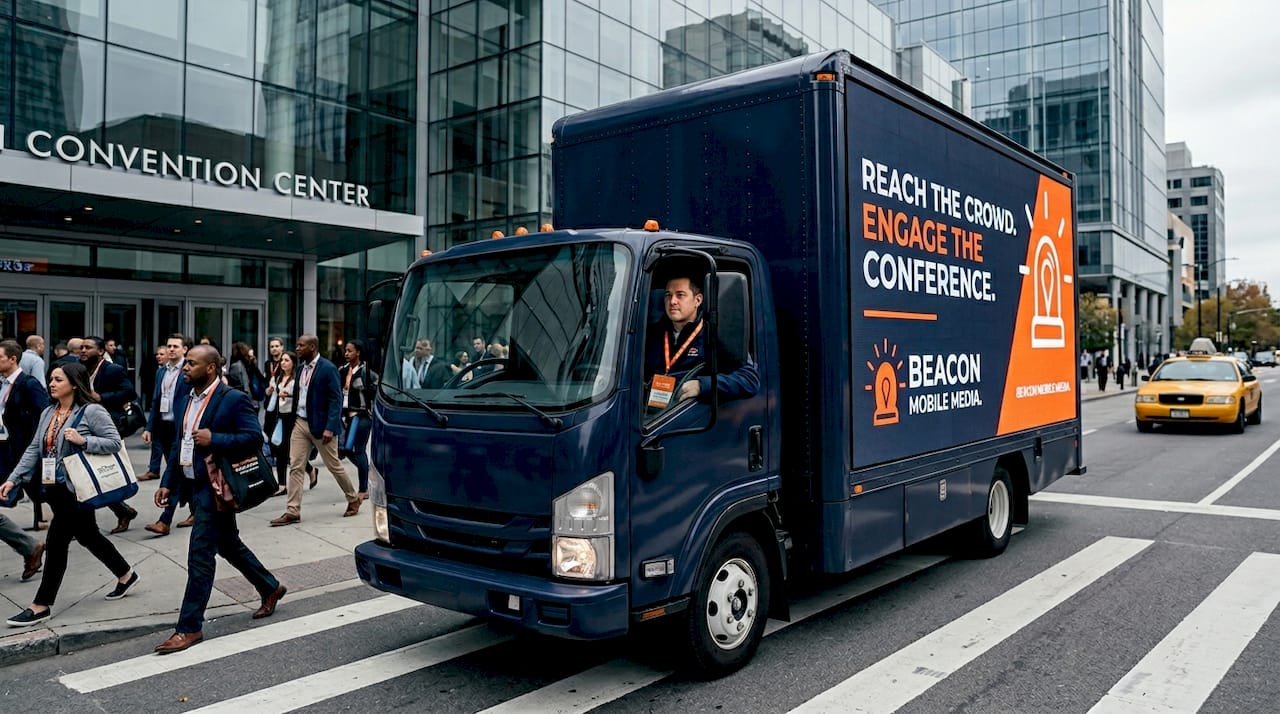
Airport geofencing is the practice of drawing virtual perimeters around terminal zones to trigger digital out-of-home ads on airport screens and mobile retargeting on traveler devices. The tactic that actually moves foot traffic is a dual-layer play: placing DOOH ads in high-intent airport zones, then retargeting the same audience on mobile once they leave the terminal. Some vendors build this exact sequence using LED mobile billboards, rideshare wraps, and geofenced mobile retargeting with proof-of-posting behind it.
TL;DR:
- Target specific airport zones like gates, duty-free, and baggage claim, tailoring creative length, messaging, and timing to passenger mindset and dwell time.
- Use tight polygons aligned with passenger walking paths to avoid audience bleed and improve targeting accuracy for high-impact zones.
- Combine fixed-screen geofencing with mobile retargeting, defining a clear attribution window and requiring proof-of-posting to measure true campaign lift.
- Prioritize proof standards such as GPS and photo proof, a control geofence, and a documented retargeting period, especially to verify mobile engagement.
- Implement initial pilot campaigns with a 48-hour test in one terminal to gauge foot traffic and refine targeting before scaling across an entire airport.
Table of Contents
- How Does Airport Geofencing Work?
- Which Airport Zones Should You Target?
- Building the Dual-Layer Campaign: DOOH Then Retargeting
- Creative and Timing Rules by Zone
- How to Measure Airport Geofencing Results
- Legal and Privacy Checklist for U.S. Campaigns
- Beacon Mobile Media’s Approach to Airport Campaigns
- What the Data Actually Supports
- Get an Airport Geofencing Campaign Built Around Your Terminal
- Sources
- FAQ
How Does Airport Geofencing Work?
Airport DOOH inventory is sold differently than most mobile geofencing. Screens sit at fixed GPS coordinates, so when a buyer draws a geofence polygon, the platform simply returns every screen whose coordinates fall inside that shape. This is how location targeting actually works for DOOH, and it does not depend on cookies, device IDs, or app permissions at all, which is why screen delivery tends to be more reliable than app-based signals alone.
Device-based geofencing works differently. It watches for a phone’s location signal crossing into a drawn boundary, then fires a mobile ad or logs a visit. Airports complicate this because GPS drifts indoors, terminals stack multiple floors, and Wi-Fi triangulation can misplace a device by dozens of yards.
That is why serious campaigns combine both layers instead of picking one:
- Fixed-screen geofences anchor the DOOH buy to specific concourses, gates, or corridors using lat/long inventory.
- Polygon and corridor shapes get matched to actual passenger walking paths, not just a circle dropped on a map.
- Programmatic triggers tied to flight schedules, dayparts, and destination data can activate specific creative at gate level automatically.
- Device-based retargeting picks up where the screen leaves off, following the same visitor after they exit the terminal.
Buyers comparing the two approaches should read up on the difference between geofencing and geotargeting before briefing an agency, since the terms get used interchangeably even though the targeting logic differs.
Which Airport Zones Should You Target?
Not every terminal zone deserves the same message. Departure halls, security lines, gates, baggage claim, and curbside pickup each carry a different passenger mindset, and programmatic DOOH platforms can target by zone and daypart to match creative to that mindset.
- Curbside and drop-off zones work best for last-mile services like rideshare offers, parking apps, or hotel shuttles.
- Security and departure halls suit broad awareness plays since dwell time is longer and attention is scattered.
- Gate areas are ideal for flight-specific or destination-specific messaging, since you know roughly where that traveler is headed.
- Duty-free and retail corridors convert best with promotional offers and QR-driven discounts.
- Baggage claim and arrivals favor local services: ground transport, dining, and hotel check-in reminders.
Keep polygons tight around actual walking paths rather than blanketing an entire terminal. Loose polygons pull in audience bleed from adjacent zones, which is one reason terminal operators often restrict how close a competing category’s geofence can sit to certain concourses.
Building the Dual-Layer Campaign: DOOH Then Retargeting
The sequence matters more than either channel alone. Combining geofenced DOOH with mobile retargeting outperforms either channel run in isolation, and programmatic buying has lowered the entry threshold enough that short pilot windows of 24 to 72 hours are now common before scaling spend.
The flow looks like this in practice:
- Run DOOH creative inside the drawn airport polygon to build initial exposure.
- Capture a device audience present inside the same POI during the flight window.
- Serve mobile retargeting ads to that audience for a defined window after they leave the terminal, usually a matter of days.
- Layer in dynamic creative so gate-side messaging can shift by flight number, destination, or time of day.
Name your segments by zone and dwell window, not just by airport, since “JFK Terminal 4 Gates B20 to B30, 6 to 9 PM” is far more useful to a media buyer than a generic “JFK travelers” label. For campaign inspiration, review geofencing campaign ideas paired with mobile OOH built specifically to prove visit lift.
Pro Tip: Start every airport pilot with a 48-hour test window on one terminal before committing budget across a whole airport. It’s cheap insurance against a polygon that turns out to have far less foot traffic than the map suggested.

Creative and Timing Rules by Zone
Creative length and message tone should shift with the zone. A gate audience has minutes to kill and reads slower; a curbside audience is moving fast and needs one glance to register the offer.
- Keep loops short (6 to 10 seconds) at curbside and baggage claim, where dwell time is brief.
- Use longer dynamic creative (15 to 20 seconds) at gates, where passengers are seated and scrolling less.
- Lead with a QR code and a one-line offer for retail and duty-free zones, since transit audiences engage at notably higher rates than typical street-level screens.
- Cap mobile retargeting frequency at two to three impressions per day post-departure to avoid burning out the audience before conversion.
- Sequence CTAs by journey stage: service bookings pre-flight, retail discounts in-terminal, and local offers after arrival.
How to Measure Airport Geofencing Results
The core numbers buyers should ask for are DOOH contact counts by screen, mobile retargeted reach, foot-traffic visit lift, and conversions tied to the retargeting window. None of that matters without proof behind it.
Require these before signing off on a campaign:
- GPS and photo proof-of-posting for every DOOH placement, timestamped against the flight or daypart it was meant to serve.
- An inventory export listing screen IDs and delivery timestamps, not just a summary slide.
- A defined attribution window for mobile visits, set before launch so post-hoc window shopping doesn’t inflate results.
- A control geofence in a comparable, unexposed zone to isolate real lift from seasonal airport traffic swings.
Foot-traffic measurement is only as good as its baseline. Review how foot-traffic attribution actually works before agreeing to a vendor’s lift claims, and ask how they handle sample bias from holiday travel spikes or weather delays.
Legal and Privacy Checklist for U.S. Campaigns
Mobile retargeting near airports still falls under general FTC consent expectations for location-based advertising, so consent basics apply the same way they do in any geofenced campaign. Favor aggregated, hashed audience segments over anything that resembles raw personally identifiable information. Ask any vendor for their data processing agreement in writing, and confirm what happens to captured device data after a campaign ends. Airport-specific permissions matter too. Terminal operators often restrict signage placement, screen brightness by time of day, and which categories can geofence near security checkpoints. Review the FTC-aligned legal gates for U.S. geofencing before your RFP goes out.
Beacon Mobile Media’s Approach to Airport Campaigns
Airport geofencing rewards buyers who plan the retargeting layer before the DOOH creative ever goes live, not after. That order gets skipped constantly because DOOH feels like the “real” deliverable and mobile retargeting gets treated as an afterthought.
Both layers can be run as one campaign. LED mobile billboards and wrapped rideshare vehicles establish physical presence near terminal zones, while geofencing captures the device audience for mobile retargeting once travelers leave the airport. Smart QR codes on the vehicle wraps and screens capture leads directly at the point of exposure, and every placement can come with GPS and photo proof-of-posting so buyers can verify delivery rather than take a vendor’s word for it.
A typical illustrative campaign idea: a rideshare-wrap fleet circling curbside pickup during peak arrival hours, paired with a retargeting window that follows captured devices for 72 hours post-departure, reported weekly with attribution analytics tied to QR scans and visit lift; for more audience examples and use cases, see which travel and retail brands use airport geofencing. Ask the provider to build a route customized to your target terminal and daypart before committing to a full-airport buy.
What the Data Actually Supports
Most airport geofencing pitches oversell the DOOH half and underexplain the retargeting half, which backwards from what actually drives measurable lift. The screen buy gets the audience’s attention for a few seconds; the mobile retargeting window is what converts that attention into a store visit, a booking, or a scan days later. Skip that second layer and you’re paying for exposure with no way to prove it did anything.

The conventional advice to “target the whole terminal for reach” is usually wrong too. Tight, zone-specific polygons matched to actual passenger objectives beat blanket coverage almost every time, because a gate audience and a curbside audience need completely different messages to respond at all.
If you’re buying an airport campaign for the first time, prioritize the proof requirements before the creative concepts. Demand GPS and photo proof-of-posting, a written attribution window, and a control geofence in the RFP itself. Vendors who resist those terms are usually the ones whose lift numbers wouldn’t survive scrutiny anyway.
— Scott
Get an Airport Geofencing Campaign Built Around Your Terminal
Some providers offer a dual-layer airport campaign instead of stitching together a DOOH vendor and a separate retargeting platform yourself. This can include LED mobile billboards, rideshare wraps, and mobile retargeting managed as one campaign, with GPS and photo proof-of-posting and attribution analytics built into the reporting from day one.

When you brief a vendor or request a proposal, ask for three things in writing: proof-of-posting on every placement, a defined mobile retargeting window, and a weekly reporting format that ties QR scans and visit lift back to specific zones. Start by reviewing the types of out-of-home advertising Beacon-ads runs nationwide, then request a campaign consult to scope a pilot around your target airport and terminal.
Sources
- Geofencing DOOH: How Location Targeting Actually Works
- DOOH advertising in airports: why transit audiences deliver CTR twice as high as street screens – Advision
- Heathrow Express — programmatic DOOH campaign using real-time flight data
FAQ
What Is Airport Geofencing in Advertising?
Airport geofencing draws a virtual boundary around a terminal zone to trigger DOOH ad delivery on screens or mobile OOH within that area, then follows the same audience with mobile retargeting after they leave.
Is Airport Geofencing Legal in the United States?
Yes, when campaigns follow FTC consent expectations for location data and rely on aggregated, hashed audiences rather than raw personal information; check vendor data processing agreements before signing.
How Long Should a Mobile Retargeting Window Run After an Airport Visit?
Most pilot campaigns run retargeting for a few days after departure, though the exact window should be defined and documented before launch, not decided after the results come in.
What Proof Should I Require From an Airport Geofencing Vendor?
Ask for GPS and photo proof-of-posting, an inventory export with screen IDs and timestamps, and a control geofence used to isolate real visit lift from normal traffic patterns.
Which Airport Zones Deliver the Best Results for Retail Offers?
Duty-free and retail corridors tend to convert best with QR-driven discounts, since transit audiences engage at higher rates than typical street-level DOOH screens.
Does Beacon Mobile Media Run Airport-Specific Geofencing Campaigns?
Beacon Mobile Media builds dual-layer campaigns combining LED mobile billboards and rideshare wraps near airport zones with mobile retargeting, smart QR lead capture, and proof-of-posting documentation for every placement.