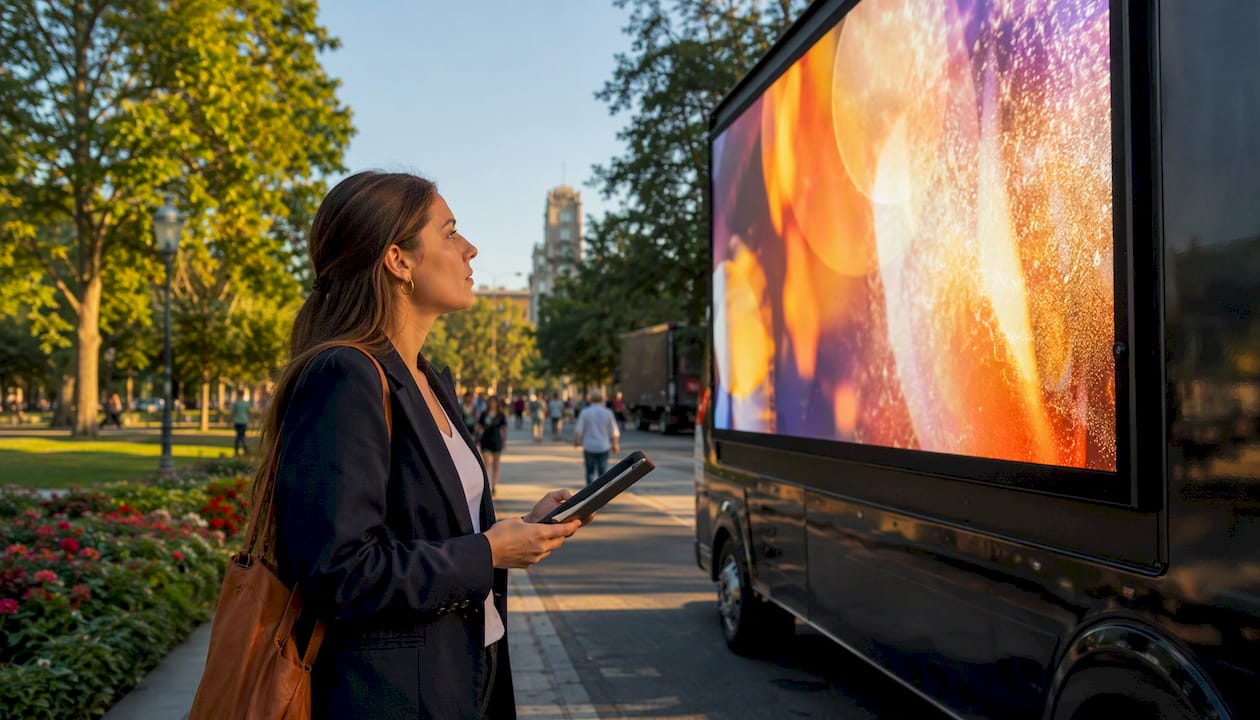
The fastest path to results in billboard advertising in Washington DC is a mix of mobile LED trucks and digital bulletins layered with geofencing and proof-of-posting, because it captures both commuter frequency and event-day density. Start by scoping your target corridor (K Street, Capitol Hill, National Mall) and contacting a mobile-OOH vendor for a route plan before locking a static bulletin.
- Reach commuters, staffers, and tourists in the same flight
- Get GPS-verified proof instead of guessing at exposure
- Deploy in days near an event, not months on a lease
Pro Tip: Book your mobile truck route around Metro rush windows (7 to 9:30 AM and 4 to 6:30 PM) to catch the highest concentration of pedestrian and vehicle traffic downtown. Keep reading for pricing, permitting, and measurement specifics.
Key Takeaways
Billboard advertising in Washington, DC works best as a mixed-format campaign built on measurable, GPS-verified placements rather than a single fixed bulletin.
| Point | Details |
|---|---|
| Mix formats for coverage | Pair mobile trucks with static or digital bulletins to combine event-day reach with steady commuter frequency. |
| Budget beyond media cost | Factor in permit fees, production, installation, and possible agency fees on top of the base rate. |
| Demand proof-of-posting | Require GPS timestamps and photo verification before paying the full invoice on any flight. |
| Match location to audience | Capitol Hill suits advocacy campaigns, Georgetown suits retail, and Metro hubs suit broad commuter reach. |
| Consider Beacon for flexibility | Beacon Mobile Media routes LED trucks and wrapped rideshare vehicles with geofencing and proof-of-posting built in. |
Table of Contents
- What Does the Washington DC Advertising Market Look Like?
- What Types of Billboards and OOH Inventory Exist in DC?
- How Much Does Billboard Advertising Cost in DC?
- How Do You Rent or Buy a Billboard in Washington DC?
- What Creative Specs Work Best for DC Billboards?
- How Do You Measure Billboard Campaign Performance in DC?
- Why Choose Beacon Mobile Media for Washington DC OOH Campaigns
- How Do Top DC Billboard Locations Compare?
- What Permits and Regulations Apply to DC Billboards?
- What Alternative and Emerging OOH Formats Exist in DC?
- What Do Successful DC Billboard Campaigns Look Like?
- How Beacon Mobile Media Can Run Your Washington DC Campaign
- Frequently Asked Questions
- Sources
What Does the Washington DC Advertising Market Look Like?
Washington’s advertising audience splits into distinct, addressable groups: federal and Capitol Hill staffers moving between office corridors and the Metro, tourists concentrated around the National Mall and Smithsonian sites, downtown office workers in the K Street and Penn Quarter corridors, and Georgetown’s retail foot traffic. Each group has different dwell times and different media that reach them best.
Downtown’s K Street and Penn Quarter blocks carry some of the heaviest weekday foot and vehicle counts in the district, which is why wallscapes and static bulletins cluster there. Metro transfer hubs like Gallery Place and Union Station generate high pedestrian density but shorter individual exposure windows, favoring formats with quick, legible messaging.
- Commuters: high-frequency, short-dwell exposure near Metro entrances and bus corridors
- Visitors: longer dwell time near the National Mall and museum row
- Staffers and lobbyists: repeat exposure along Capitol Hill and K Street routes
- Event crowds: concentrated, short-window exposure near arenas and convention venues
A useful reach benchmark comes from how large operators report market coverage to investors, which gives buyers a sense of the scale and reporting detail worth demanding from any vendor, regardless of size.
What Types of Billboards and OOH Inventory Exist in DC?
DC’s inventory spans six practical formats, and the right choice depends on whether you’re chasing broad awareness or tight geographic targeting.
- Digital bulletins: rotate multiple advertisers, ideal for short flights or daypart targeting
- Static bulletins: large, fixed panels along arterials, best for sustained brand awareness
- Wallscapes: building-mounted graphics downtown with high visual impact but longer production lead times
- Street furniture and kiosks: bus shelters and transit kiosks that reach pedestrians at close range
- Transit and Metro placements: rail cars, station domination, and bus wraps for repeat commuter exposure
- Mobile LED trucks: routed vehicles that follow events, activations, or specific ZIP codes on demand
Static and digital bulletins deliver consistent frequency but lock you into a fixed location for the flight. Mobile trucks trade some fixed-audience scale for the ability to chase foot traffic to a specific rally, conference, or product launch, then move the next day. Beacon’s own format guide breaks down when each format earns its keep.
Pro Tip: Pair a mobile truck route with a static or digital bulletin in the same corridor. The truck amplifies a specific event while the fixed unit builds baseline frequency. Running both lets you compare impression data side by side.
How Much Does Billboard Advertising Cost in DC?
Pricing in Washington varies widely by format, location, and flight length, so treat the following as approximate starting ranges rather than fixed rates. Static bulletins in high-traffic corridors typically cost more for a multi-week period, digital bulletin spots usually have a lower per-unit price due to rotating advertisers, and mobile LED truck bookings are generally priced daily, with discounts sometimes available for longer campaigns.
The variables that move price most are location and traffic count, format type (digital costs more to produce but rotates cheaper per advertiser), flight length, and any add-ons like nightly illumination or premium placement near a Metro entrance or stadium.
- Location and daily traffic counts near the panel
- Digital versus static production and rotation costs
- Flight length, with longer runs often earning per-week discounts
- Permit fees, which vary by placement type and jurisdiction
- Installation and creative production costs separate from media cost
Buyers should also budget for local permit fees, art and production costs, installation labor, and, if working through a broker, an agency fee layered on top of media cost. On the contract side, ask about flight flexibility (can you shift dates if an event is postponed), makegood clauses if a panel malfunctions or is obstructed, and discounts for extending a well-performing flight. The OAAA publishes measurement guidance that’s worth referencing when a vendor’s reach numbers seem inflated relative to their asking price.
How Do You Rent or Buy a Billboard in Washington DC?
Buying billboard space in DC follows a fairly predictable sequence, though timelines compress or stretch depending on format.
- Scope the campaign — define your target neighborhoods, audience, and flight dates
- Select inventory — compare available panels, digital rotation slots, or mobile routes against your budget
- Confirm permitting — verify the vendor holds or will secure the necessary local permits
- Produce creative — finalize artwork to the format’s exact specs
- Lock the posting date — confirm installation or truck deployment scheduling
- Collect proof-of-posting — require GPS and photo documentation once the campaign is live
Planning and inventory selection usually take one to two weeks. Permit approvals for static or wallscape placements can add another two to four weeks, while mobile truck deployment can often launch within days once creative is approved. Production lead times for large-format wallscapes run longest, sometimes three to four weeks.
Before signing anything, run through a vendor checklist:
- Can they show a coverage map or proposed route with real addresses?
- What proof-of-posting do they provide, and how often?
- For mobile units, how is the route customized to your target ZIP codes or event location?
- What audience targeting or geofencing options exist alongside the physical placement?
- What’s the cancellation policy, and do they offer makegoods for missed posting days?
Checking a vendor’s government contracting credentials is one more way to confirm legitimacy before you wire a deposit.
What Creative Specs Work Best for DC Billboards?
Static bulletins typically require high-resolution vector or large-format raster files, while digital bulletins run on standard LED pixel-pitch specs the vendor will provide before you start production. Confirm safe-area margins and exact aspect ratios for each panel size before your designer starts, since DC’s mix of wallscapes, standard bulletins, and truck-mounted LED screens each demand different file setups.
Messaging needs to work at a glance. Keep headlines under seven words, use high-contrast color pairings, and put your logo in a consistent spot so drivers and pedestrians catch it in under three seconds. Skip cluttered maps or small-print details. Commuters reading a panel from a moving car or a crowded sidewalk need one idea, not three.
- Confirm file format and resolution per panel type before production
- Keep headline copy short enough to read in a three-second glance
- Use bold contrast, not subtle gradients, for legibility at distance
- Lock a consistent brand mark position across every creative variant
QR codes work well on outdoor formats when sized large enough to scan from a stopped car or a slow-moving sidewalk, placed with strong contrast against the background, and positioned in a corner that doesn’t crowd the primary message.
Pro Tip: Test your QR code’s scan distance in the field before the flight launches. A code that scans fine on a screen can fail completely at ten feet on a wallscape.
How Do You Measure Billboard Campaign Performance in DC?
Out-of-home measurement centers on four core figures: impressions, reach, frequency, and out-of-home GRPs, which together estimate how many people saw your placement and how often. Digital bulletins add viewability proxies from adserver logs, while mobile units rely on route-based engagement tracking tied to GPS data.
Attribution has gotten more precise. GPS-based proof-of-posting with timestamps and photos confirms a truck or panel ran where and when promised. Mobile location data can tie foot traffic near a placement to downstream store visits or website activity, and RADAR-style third-party measurement adds an independent layer of verification that the OAAA recommends buyers request from any vendor.
- Impressions, reach, and frequency by placement and flight week
- Route logs with timestamps for every mobile truck deployment
- Photo-verified proof-of-posting at each posting interval
- A post-campaign attribution summary tying exposure to measurable outcomes
Buyers should never accept a vendor’s word alone on exposure. GPS timestamps, photo documentation, and a written attribution summary turn a billboard flight from a guess into a measurable line item in your marketing report.
Beacon ties its GPS and photo verification directly to the routing and audience segments each truck was assigned, so reporting reflects the actual neighborhoods covered, not a generic market average.
Why Choose Beacon Mobile Media for Washington DC OOH Campaigns
Beacon Mobile Media runs LED mobile billboard trucks and wrapped rideshare vehicles (Uber and Lyft) through DC’s densest corridors, paired with geofencing, retargeting, and smart QR codes for direct lead capture. Route customization means a truck assigned to a Capitol Hill advocacy event can pivot the next day to a downtown product launch without a new lease negotiation.
- LED truck and rideshare wrap inventory routed to specific DC neighborhoods
- Geofencing and retargeting layered onto physical placements
- Smart QR codes that capture scans directly into a lead pipeline
- GPS and photo proof-of-posting tied to attribution reporting
This model fits DC’s event calendar particularly well: advocacy rallies, conferences near the convention center, and brand launches near Metro hubs all benefit from a route that can shift with the news cycle instead of sitting fixed for a month. Reach out to Beacon for a campaign brief built around your target corridor and flight dates.
Pro Tip: If your campaign ties to a specific event date, book your mobile route at least two weeks out. DC’s event calendar fills fast, and prime staging areas near convention venues get claimed early.
How Do Top DC Billboard Locations Compare?
Location choice in Washington comes down to trading raw volume against audience specificity. Downtown’s K Street corridor and the area around Gallery Place Metro station carry dense weekday commuter and office-worker traffic, making them strong for static and digital bulletins targeting a professional, repeat-exposure audience. The National Mall and surrounding museum corridor see heavier weekend and seasonal tourist volume, better suited to formats built for longer dwell times, like street furniture near pedestrian queues.

Capitol Hill’s blocks around the Senate and House office buildings carry lower raw foot traffic than downtown but a far more concentrated audience of staffers, lobbyists, and policy professionals, which makes it valuable for advocacy and issue-based campaigns despite smaller volume. Georgetown’s M Street corridor delivers strong retail foot traffic skewed toward shoppers and younger demographics, a fit for consumer brand launches.
Union Station and other Metro transfer hubs combine high pedestrian density with a mixed audience of commuters, tourists, and residents, making them a middle ground: strong volume without the narrow specificity of Capitol Hill or the seasonal swings of the Mall. Event venues near the convention center or arena district spike hard on game days or conference weeks but sit quiet otherwise, which is exactly the pattern that favors a mobile truck over a fixed lease.
Matching format to location matters more than chasing the single highest traffic count. A static bulletin in a low-frequency corridor near your actual customer base often outperforms a busier panel that reaches the wrong crowd entirely.
What Permits and Regulations Apply to DC Billboards?
Washington, DC regulates outdoor advertising through its own zoning and permitting framework administered by the district’s Department of Buildings, and requirements differ by placement type, size, and location relative to residential zones. Static bulletins and wallscapes generally need a permit tied to structural approval and sign specifications, while mobile advertising vehicles fall under separate rules governing vehicle-based advertising and parking or staging in public rights-of-way.
Digital bulletins face additional scrutiny in some corridors due to brightness and dimming requirements meant to limit driver distraction near intersections. Any placement near a federal building, monument, or the National Mall corridor is subject to tighter restrictions given the density of federal jurisdiction overlapping with district authority in that area.
Permit timelines for new static or wallscape installations often run several weeks, since applications require structural review in addition to sign content approval. Mobile truck deployment typically avoids the structural permitting process entirely since no permanent structure is installed, though staging and parking still need to comply with district traffic and parking rules, particularly near high-security zones around Capitol Hill.
Work with a vendor who handles permitting directly, or confirm in writing who is responsible for securing approvals before your flight date. A missed permit deadline can push a wallscape launch back by weeks, while a mobile truck route can usually adjust within days if a staging location falls through.
What Alternative and Emerging OOH Formats Exist in DC?
Beyond traditional bulletins and mobile trucks, Washington’s OOH market includes several formats worth considering for specific campaign goals. Transit advertising, including Metro rail car wraps and bus exterior placements, delivers strong repeat exposure to the same commuter base day after day, making it effective for brand-building campaigns that rely on frequency rather than novelty.
Street furniture, bus shelters, and pedestrian kiosks reach people at a slower pace, often while they’re waiting rather than moving, which makes them a better fit for QR-code-driven offers or longer copy than a moving-traffic bulletin would allow. These placements also tend to sit in dense retail corridors like Georgetown or Dupont Circle, adding a layer of geographic specificity that broader Metro placements don’t offer.
Wrapped rideshare vehicles represent one of the more flexible emerging formats in the district. Because Uber and Lyft drivers cover the entire metro area rather than a single fixed route, a wrapped vehicle campaign can reach neighborhoods a static bulletin or even a scheduled mobile truck route would miss entirely, all while carrying the same visual impact as a moving billboard.
Digital place-based screens in high-traffic retail or office lobbies are also gaining ground in downtown DC, offering another layer of targeted, dwell-time exposure beyond street-level formats. For campaigns that need both broad street presence and targeted precision, combining a wrapped rideshare fleet with a Metro transit buy or a downtown bulletin often covers more ground than any single format alone.
What Do Successful DC Billboard Campaigns Look Like?
Advocacy organizations timing a mobile truck route to coincide with a congressional vote or hearing schedule illustrate one of the clearest wins for mobile OOH in DC. Rather than leasing a fixed panel for a month, a route built around Capitol Hill during a specific legislative window concentrates impressions exactly when the target audience, staffers and press covering the vote, is physically present.
Event-driven brand launches near the convention center follow a similar logic. A product launch timed to a major conference week can pair a wrapped rideshare fleet circulating attendee hotels with a digital bulletin near the venue entrance, creating overlapping impressions across the exact days attendees are in town rather than paying for a full month of exposure most of which falls outside the event window.
Retail and consumer brands targeting Georgetown’s shopping corridor have found success layering QR-code-driven street furniture placements with geofenced retargeting, capturing a scan on the street and following up with a mobile ad once that person leaves the area. This kind of layered approach, physical placement plus digital retargeting, tends to outperform a single-format buy because it captures both the initial impression and a measurable follow-up action.
The throughline across these examples is timing and format-matching, not raw spend. A well-timed, well-targeted mobile or hybrid campaign in DC often outperforms a larger, less targeted static buy simply because it puts the message in front of the right audience at the right moment.
A Campaign Manager’s Field Notes
Two things I’d tell any first-time DC buyer: schedule mobile routes around Metro rush, and keep creative to one idea readable in three seconds. The real trap is permit lead times colliding with a fast-moving event. Book mobile inventory early and keep a static or digital backup in your plan.
How Beacon Mobile Media Can Run Your Washington DC Campaign
Beacon Mobile Media builds DC campaigns around mobile LED trucks, wrapped rideshare vehicles, and digital targeting layered on top of the physical placement, so a downtown product launch and a Capitol Hill advocacy push can run from the same platform with different routes and creative.

Compared to leasing a fixed static bulletin for a month, a Beacon route gives you the flexibility to shift neighborhoods mid-flight, retarget people who scanned your QR code, and pull GPS-verified proof of every day the truck ran. That combination of mobility and measurement is hard to replicate with a traditional fixed-panel lease. Explore the full format breakdown to see how mobile, static, and digital inventory can work together for your flight dates, then request a campaign brief to get a route proposal built around your target corridor and budget.
Frequently Asked Questions
How much does billboard advertising cost in Washington, DC?
Costs vary by format and location, with static bulletins in high-traffic corridors running higher than digital bulletin slots, and mobile truck bookings typically priced by the day. Treat any quote as one variable among location, flight length, and production costs.
How do I get started with billboard advertising in DC?
Define your target neighborhoods and flight dates, then contact a vendor for available inventory and a route proposal if you’re considering mobile units. Confirm permitting responsibility and proof-of-posting terms before signing.
What’s a typical timeline for a DC billboard campaign?
Mobile truck deployment can often launch within days of creative approval. Static bulletins and wallscapes usually need several weeks for permitting and production before the posting date.
Do I need a permit for a mobile billboard truck in DC?
Mobile units generally avoid the structural permitting required for fixed signs, but staging and parking near restricted zones, particularly around Capitol Hill, still need to comply with district traffic rules.

What’s the difference between static and digital billboards in DC?
Static bulletins hold one message for the full flight, while digital bulletins rotate multiple advertisers and allow daypart-specific targeting, often at a lower per-advertiser cost.