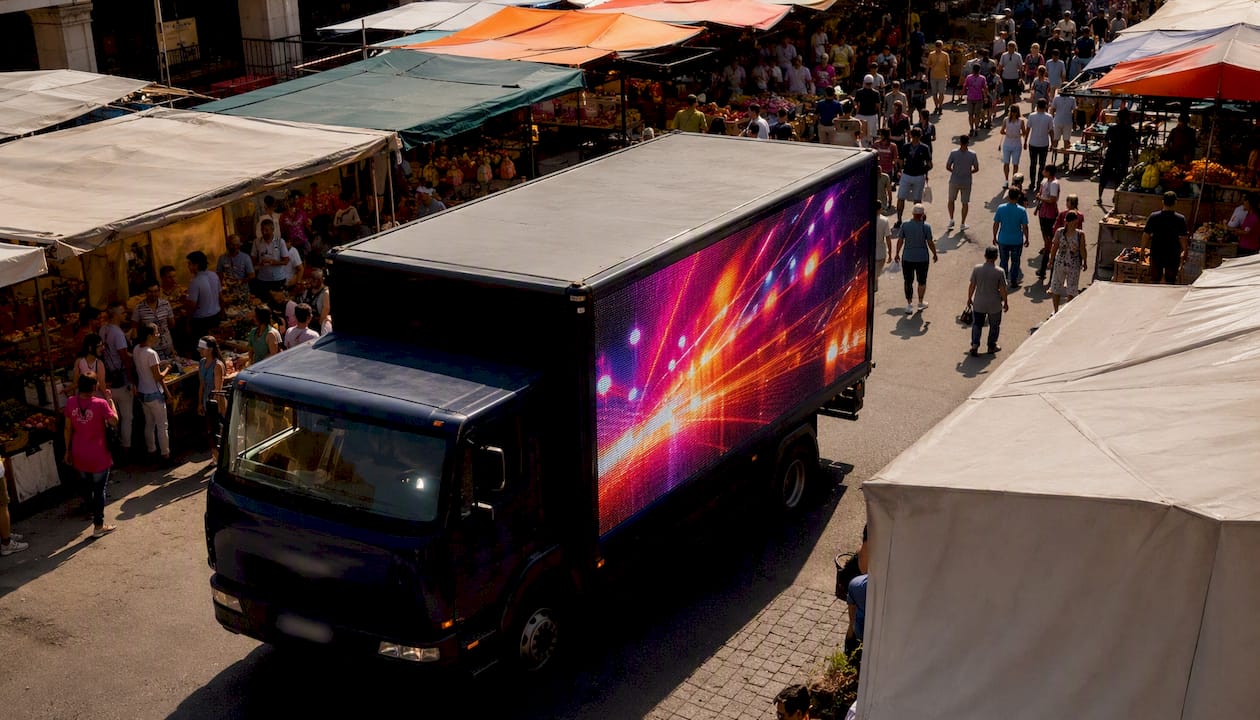
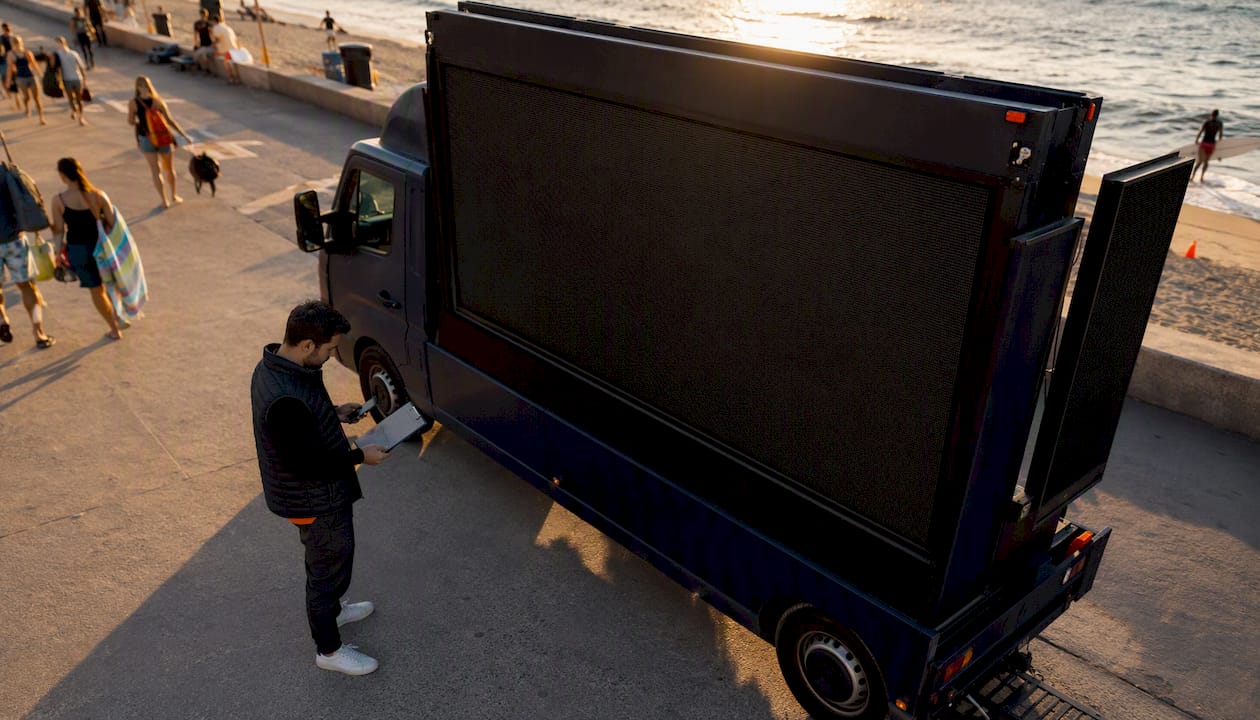
“LED on wheels” refers to mobile LED billboards and LED-equipped, rideshare-wrapped vehicles used for out-of-home advertising. If you’re buying one, the single biggest requirement to nail in your brief is specifying route, measurement methodology, and proof-of-posting before you sign anything. Vendors like Beacon Mobile Media, measurement partners such as Vistar and Broadsign, and standards bodies like the IAB and OAAA all shape what a defensible campaign actually looks like.
Key Takeaways
Auditable mobile LED campaigns require route specificity, GPS-verified proof-of-posting, and transparent impression methodology negotiated into the contract before launch.
| Point | Details |
|---|---|
| Define the format first | Match your screen size and route needs to single-sided, multi-sided, trailer, or rideshare-wrapped LED before briefing vendors. |
| Demand auditable impressions | Require ad-slot share, viewability rules, and dwell-time methodology, not just raw impression counts. |
| Require GPS and photo proof | GPS route traces and timestamped, geotagged photos are the industry standard for verification. |
| Sequence creative by context | Build shorter route-hour frames and longer parked-activation sequences rather than one loop for both. |
| Work with a measurable partner | Beacon Mobile Media builds proof-of-posting, geofencing, and attribution analytics into every mobile LED campaign by default. |
Table of Contents
- What Formats Fall Under LED On Wheels?
- When Should You Use a Mobile LED Campaign Instead of Static DOOH?
- How Do You Measure and Target an LED-On-Wheels Campaign?
- What Creative Specs Work Best on Moving LED Displays?
- What Does an LED-On-Wheels Campaign Cost?
- How Do You Plan Timing, Permits, and Logistics?
- What Should Your Vendor RFP Ask For?
- What’s the One Execution Mistake Most Mobile LED Campaigns Make?
- Get Your Next Mobile LED Campaign Off the Ground
- Where to Verify Measurement Standards and Specs
- Frequently Asked Questions
- Sources
What Formats Fall Under LED On Wheels?
Not every mobile LED asset works the same way, and your creative brief needs to match the format.
- Single-sided trucks: one screen, lower cost, good for parked activations or narrow city streets.
- Double-sided or triple-sided trucks: more screen real estate for the same route, ideal for high-traffic intersections where traffic approaches from multiple directions.
- LED trailers: towable units that free up the tow vehicle, often used for longer parked activations or venue perimeters.
- Rideshare-wrapped LED vehicles: Uber and Lyft vehicles fitted with smaller LED units, built for dense, unpredictable urban routes rather than fixed loops.
Trucks and trailers typically run cloud-based CMS platforms that support multiple creatives per day, while rideshare units trade screen size for route density and dwell time in high-footfall neighborhoods.
When Should You Use a Mobile LED Campaign Instead of Static DOOH?
Mobile LED earns its budget when a static board can’t move to where your audience actually is. Here’s where it consistently outperforms a fixed buy:
- Product launches near flagship retail or competitor storefronts.
- Trade show and conference perimeter loops to drive booth traffic during show hours.
- Store opening support, circling the new location for two to three weeks pre-launch.
- Competitor proximity campaigns, parking near a rival’s event or storefront.
- Experiential activations paired with sampling, QR capture, or pop-up staff.
- High-footfall commuter routes during dayparted windows (morning transit, evening happy hour).
- Political, advocacy, or public-safety messaging requiring precise geographic targeting.
- Event-adjacent awareness for festivals, sporting events, or concerts without paying venue sponsorship rates.
A trade show loop is the clearest example: objective is booth traffic, route is a tight perimeter around the convention center entrance during exhibit hours, and the KPI is scanned QR codes plus modeled foot-traffic lift. If your goal is broad, sustained brand awareness across a metro area over months, a static billboard portfolio is usually the more efficient buy. If your goal is a specific audience at a specific place and time, mobile LED wins. Beacon’s guide on targeting conferences and trade shows walks through route planning for exactly this scenario.
How Do You Measure and Target an LED-On-Wheels Campaign?
A modern mobile LED campaign should deliver auditable impressions, not just a truck driving around and a vendor’s word for how many people saw it. That distinction is the entire reason procurement teams need to read a measurement methodology section before signing.

Ad-slot share and raw impressions are not the same number. Ad-slot share accounts for how many ad slots your creative actually occupied against total inventory, while dwell time and viewability rules can shrink a raw impression count considerably once you apply real audibility standards. The IAB’s DOOH Measurement Guide lays out exactly how loop frequency and viewability adjustments affect what counts as a legitimate impression, and it’s worth reading before you accept a vendor’s reporting template at face value.
Two vendors reporting identical raw impressions can hand you materially different auditable counts once viewability adjustments are applied. That’s why methodology transparency matters more than the headline number.
On targeting, ask vendors what they actually support:
- Route customization tied to zip code, venue radius, or competitor location.
- Dayparting for commute windows, lunch rushes, or event start times.
- Geofencing for retargeting people who were near the vehicle.
- Audience affinity segments layered onto route selection.
- Programmatic or RTB delivery where the vendor’s inventory is exchange-connected.
On proof, require deliverables, not promises: GPS-verified route traces, timestamped and geotagged photos, onboard CMS playback logs, and a third-party measurement report covering device-location passback or foot-traffic lift. The OAAA’s Digital Moving OOH Exposure Guidelines treat GPS traces and geotagged photos as higher-fidelity verification than bid-stream counts alone, and that’s the standard your contract should reference. Also confirm match rates for any device passback data, the attribution window used for visitation lift, and the sample size behind any lift study. Programmatic DOOH measurement depends heavily on those match rates, so a vendor that can’t state theirs is giving you a number without a foundation.
Pro Tip: Make the full proof-of-posting package, not just an invoice, a condition of final payment. If a vendor balks at that clause, that’s your answer about how confident they are in their own reporting.
If retargeting people exposed to the vehicle matters to your funnel, Beacon’s breakdown of how retargeting works in OOH covers the device-matching mechanics in more depth.
What Creative Specs Work Best on Moving LED Displays?
Legibility beats cleverness on a screen moving at 25 miles per hour. Prioritize short runtime, high contrast, and a CTA that reads in under two seconds.
Technical checklist to hand your creative team:
- Brightness in the 5,000 to 7,000 nit range for daylight visibility, lower for exclusively night or indoor parked use.
- Pixel pitch matched to typical viewing distance (wider pitch for highway routes, tighter for pedestrian-heavy parked spots).
- Safe zones that keep text and logos clear of screen edges and seams.
- Frame rates and animation speeds that avoid strobing or motion blur at driving speed.
- Standard video codecs (MP4/H.264) compatible with the vendor’s CMS.
Structure the loop with brand identity first, then a short CTA, then a QR code with a trackable, campaign-specific URL. For proximity marketing, localize the CTA frame (“2 blocks ahead” or a neighborhood name) rather than running one generic message citywide. Ask for a fleet proof playback test before launch, along with remote CMS access or timestamped screenshots so you can confirm what’s actually airing.
Pro Tip: For parked activations, build a 3 to 5 second primary brand frame followed by a 10 to 15 second supportive sequence with product detail or a secondary offer. People walking past need the hook fast; people waiting at a bus stop can absorb more.
What Does an LED-On-Wheels Campaign Cost?
Pricing generally follows one of a few models: flat day rate cards, route-duration pricing tied to mileage and hours, or cost-per-impression estimates layered with add-ons for targeting, proof-of-posting, and attribution studies. Rental day rates for LED trucks commonly range from roughly $500 to several thousand dollars per day depending on truck configuration (single, double, or triple-sided) and market demand.
Cost drivers beyond the base rate include fleet size, screen count per vehicle, permit fees in dense urban markets, generator fuel, complexity of your creative playback schedule, and any measurement or reporting add-ons; for entrepreneurs interested in scaling such a business, an Active Digital Signage Franchise Opportunity can provide valuable insights and support. A back-of-envelope ROI estimate works the same way it does for any media channel: expected impressions multiplied by expected conversion rate multiplied by average order value. The catch is that this math is worthless if your impression count isn’t auditable, since inflated raw impressions produce an ROI estimate built on sand.
Ask vendors directly about hidden fees before you sign: setup and teardown time, travel charges outside a home market, insurance riders, parking permit costs, and time-on-site fees for parked activations that run long.

How Do You Plan Timing, Permits, and Logistics?
A realistic timeline runs through five milestones: brief and vendor selection, routing and permit approval, creative testing on the actual asset, campaign execution, and post-campaign reporting.
- Brief and vendor selection: 1 to 2 weeks.
- Routing approval and permits: 1 to 3 weeks depending on municipality.
- Creative production and playback test: 1 to 2 weeks, can run parallel to permitting.
- Campaign execution: varies by contract, from a single event day to a month-long route program.
- Post-campaign reporting: typically delivered within 1 to 2 weeks of campaign end.
Documents to have ready before you brief a vendor:
- Proof of insurance covering the vehicle and operator.
- Municipal permits where required for parking, driving routes, or checkpoint stops.
- Driver credentials and vehicle registration.
- Venue or event permits if the campaign runs on private or event-controlled property.
Venue permission and route permission are different animals. A venue lets you park; a municipality lets you drive a specific route or stop at specific checkpoints. Weather contingencies and parking enforcement risk deserve a line item too. A 2-week event campaign can typically move from brief to launch inside three weeks; a month-long route program needs closer to five to six weeks given permit lead times across multiple jurisdictions.
What Should Your Vendor RFP Ask For?
Your RFP should force vendors to show their work, not just their fleet photos.
- Fleet specs: truck configurations, screen count, screen size, and generator capacity.
- CMS features: remote update capability, dayparting, and multi-creative scheduling.
- Proof-of-posting deliverables: GPS traces, geotagged photos, and CMS playback logs.
- Measurement partners: whether they integrate with platforms like Vistar or Broadsign for programmatic delivery and reporting.
- Data ownership: who retains the raw location and impression data after the campaign ends.
- Sample reports: an actual redacted example, not a description of what they “can” provide.
Red flags worth walking away from: refusal to provide GPS or photo proof, vague or undefined impression methodology, no ability to integrate with your DSP or measurement partner, and no willingness to share a sample report before contract signature. Score proposals on four axes: delivery reliability, measurement rigor, creative support, and legal/compliance readiness.
Pro Tip: Ask for the name of the actual measurement partner, not just “third-party verified.” A vague answer here usually means a vague answer on the invoice too.
What’s the One Execution Mistake Most Mobile LED Campaigns Make?
The biggest mistake I see in campaign execution is running identical creative on a route loop and a parked activation. They’re different jobs. A moving truck gets a two-second glance from a driver at a red light, so the message needs to hit instantly. A parked truck outside a venue gets thirty seconds or more from someone walking past, so it can afford a longer sequence with more detail.
Sequence your creative by context, not by convenience. Swap in shorter, punchier frames for route hours and let the fuller sequence run during parked dwell time. This isn’t just a creative preference. It directly improves your auditable outcomes, because dwell-time-weighted viewability standards reward creative that’s actually built for the exposure window it’s running in, rather than penalizing a long sequence that a driver never gets to finish watching.
Get Your Next Mobile LED Campaign Off the Ground
Beacon Mobile Media runs LED billboard trucks and wrapped rideshare vehicles across all 50 states, and the difference for buyers who’ve been burned by vague impression reporting is simple: everything in this guide, from GPS-verified proof-of-posting to auditable ad-slot methodology, is standard practice on every Beacon campaign rather than an upsell you have to negotiate for.

- Nationwide fleet with route customization, dayparting, and geofencing built into every brief.
- Proof-of-posting delivered as GPS route traces and timestamped, geotagged photos, not just an invoice.
- Real-time retargeting and attribution analytics that track exposure through to conversion.
- Smart QR codes that capture lead data directly off the screen for measurable funnel metrics.
If you’re drafting an RFP or just need a sense of what a properly measured mobile LED campaign costs in your market, start with Beacon’s LED ad truck guide or reach out directly for a route and measurement proposal built around your KPIs.
Where to Verify Measurement Standards and Specs
Cross-check any vendor’s claims against the standards bodies and technical guides that define this category.
- IAB DOOH Measurement Guide for ad-slot share and viewability methodology.
- OAAA Digital Moving OOH Exposure Guidelines for proof-of-posting standards.
- AdRoll’s DOOH measurement overview for attribution and match-rate context.
- Beacon’s types of out-of-home advertising guide for broader format comparisons.
Frequently Asked Questions
What does “LED on wheels” mean in advertising?
It refers to mobile LED billboard trucks, trailers, and LED-equipped rideshare vehicles used for out-of-home campaigns, typically paired with geofencing, route targeting, and measurement reporting.
How much does an LED truck campaign cost per day?
Day rates commonly range from roughly $500 to several thousand dollars, depending on truck configuration, market, and whether targeting or reporting add-ons are included.
What proof should I require from a mobile LED vendor?
Request GPS-verified route traces, timestamped and geotagged photos, and onboard CMS playback logs, the standard the OAAA’s exposure guidelines recommend over bid-stream impression counts alone.
Is mobile LED better than a static billboard for events?
For a defined event, venue, or competitor location, yes, because the asset can follow your audience rather than waiting for them to pass a fixed location.
Can I retarget people exposed to a mobile LED vehicle?
Yes, through geofencing and device-location matching, though match rates and attribution windows vary by measurement partner, so confirm those figures before you rely on the retargeting funnel for reporting.