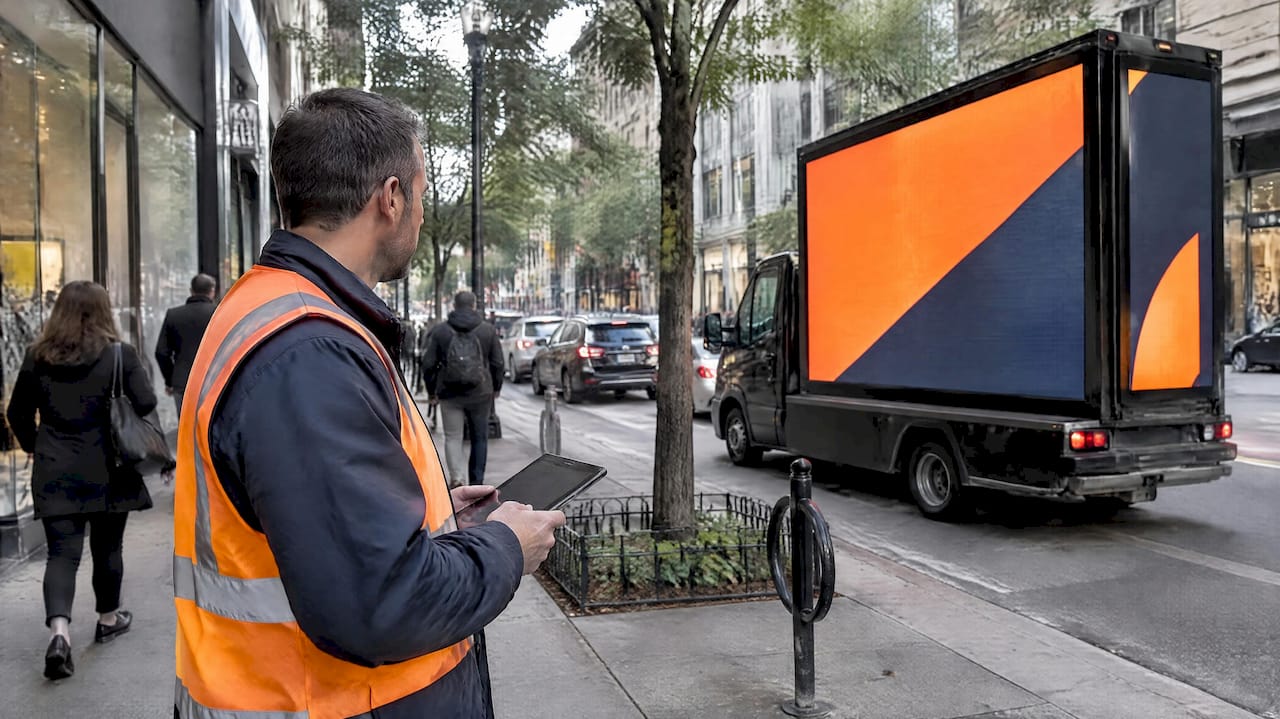
The best billboard strategy for most Suffolk businesses in 2026 blends targeted mobile LED trucks with a handful of static or digital poster placements. This combination gives you precise local routing, real attribution data, and the flexibility to shift budget as a campaign performs.
- Mobile-first, data-backed: Beacon Mobile Media runs LED trucks and wrapped rideshare vehicles with GPS proof-of-posting and QR tracking built in.
- Pricing anchor: Suffolk County posters and bulletins run roughly $363 to $5,633 per 4 weeks, depending on format and digital versus static.
- Digital loop standard: most digital boards cycle ads every 60 to 90 seconds, which shapes how you buy dayparts.
Pro Tip: Budget for fabrication separately from media cost. A static poster’s design and print run can add several hundred dollars on top of the 4-week rental, and that line item catches new advertisers off guard almost every time.
Key Takeaways
A data-driven mix of mobile LED trucks, wrapped rideshare vehicles, and select static or digital poster buys delivers stronger, more measurable results than static billboards alone.
| Point | Details |
|---|---|
| Budget for both media and fabrication | Suffolk pricing runs roughly $363 to $5,633 per 4 weeks depending on format, plus separate fabrication costs for statics. |
| Understand digital loop timing | Digital billboards cycle ads every 60 to 90 seconds, so buy dayparts strategically for time-sensitive promotions. |
| Match format to location | Arterial routes, service stations, and retail corridors favor static and digital boards; events and shifting audiences favor mobile LED. |
| Build in measurement from day one | QR codes, geofencing, and proof-of-posting turn a billboard into a trackable, attributable campaign. |
| Choose mobile-first for flexibility | Beacon Mobile Media combines LED trucks and wrapped rideshare vehicles with route customization and attribution reporting for measurable Suffolk campaigns. |
Table of Contents
- What Types of Suffolk Billboards Are Available?
- What Permits Do You Need for Billboard Advertising in Suffolk?
- Where Can You Place Billboards in Suffolk County?
- Billboards vs. Transit Ads and Digital Screens: Which Wins?
- Do Suffolk Billboard Campaigns Actually Deliver ROI?
- Why Mobile-First OOH Fits Suffolk Businesses
- Ready to Launch a Suffolk Billboard Campaign?
- Where to Learn More
- Frequently Asked Questions
- Sources
What Types of Suffolk Billboards Are Available?
Suffolk advertisers have four practical format categories to choose from, and each fits a different budget and goal.

Static posters are the entry point. These smaller printed boards, often 6-sheet or similar sizes, work well for local businesses testing outdoor advertising for the first time. UK market data on comparable poster formats shows smaller sizes make cost-effective test buys before committing to a bigger campaign.
Bulletins are the large, static roadside boards most people picture when they hear “billboard.” They sit on high-traffic arterial routes and cost more than posters, but the visibility per dollar tends to be strong for brand awareness plays.
Digital billboards rotate multiple advertisers on the same screen throughout the day. You are not renting the whole board, just a slice of the loop, which is why digital slots often run at the top of the local pricing range.
Mobile LED trucks and wrapped rideshare vehicles are the fourth category, and the one that separates static advertising from active audience targeting. Instead of waiting for traffic to pass a fixed board, the ad moves to wherever your customers already are, whether that’s a retail corridor in Ipswich or an event parking lot. Local outdoor suppliers in the region recommend mixing formats like bus shelters, digital screens, and traditional billboards based on the audience you’re chasing, and mobile LED extends that same logic with a vehicle instead of a fixed site.

What Permits Do You Need for Billboard Advertising in Suffolk?
Fixed billboard structures, whether posters or digital bulletins, are permanent installations tied to specific parcels of land. That means any new static board typically requires sign permits from the local building or planning department, plus sign-off from the property owner if the board sits on private land facing a public roadway. Digital billboards often carry additional scrutiny because of brightness and dimming requirements meant to prevent driver distraction at night.
If you’re leasing space on an existing static or digital board through an outdoor advertising company, the permitting work is usually already handled. The vendor owns the structure and the permit; you’re simply buying advertising time or space on something already approved. This is one reason static and digital board rentals move faster than building new structures from scratch.
Mobile LED trucks and wrapped rideshare vehicles operate under a different framework entirely. Because the advertising surface is attached to a vehicle rather than fixed to land, it generally falls under vehicle advertising and registration rules rather than static sign permitting. That distinction matters for timeline: a mobile campaign can often launch in days, while a new static structure can take weeks to clear local approval. Always confirm current requirements with your municipality or with your OOH vendor before finalizing a route or a site, since rules vary by town within Suffolk.
Where Can You Place Billboards in Suffolk County?
Zoning is the first filter for any static board. Suffolk towns generally restrict new billboard structures to commercial and industrial corridors, keeping them off purely residential streets. Regional outdoor specialists note that many of the highest-performing sites sit outside convenience stores, service stations, and along main arterial routes, which tend to be zoned for exactly this kind of signage.
Distance rules are common too: many jurisdictions require minimum spacing between billboard structures and set back distances from residential zones, intersections, and highway interchanges. Digital boards frequently face extra restrictions around brightness, motion, and how often content can change, since regulators want to limit driver distraction near busy intersections.
Mobile LED trucks sidestep most static zoning restrictions because they’re vehicles, not permanent structures. That doesn’t mean anything goes. Local ordinances around vehicle signage, parking duration in one spot, and general traffic safety still apply, so route planning still needs a strategy behind it rather than just picking busy roads at random. This is exactly where working with an established operator pays off: they already know which Suffolk corridors deliver traffic without running into local restrictions on where a wrapped vehicle can idle or park for extended periods.
Billboards vs. Transit Ads and Digital Screens: Which Wins?
Static and digital billboards aren’t the only outdoor options in Suffolk. Transit ads on buses and at bus shelters, along with digital screens at retail and transit hubs, compete for the same budget.
Large regional media owners in the area position bus-shelter digital screens and station posters near shopping centers and transit hubs specifically for shopper and commuter reach. That’s a legitimate strategy for retail-adjacent businesses, and it overlaps with what a well-routed mobile LED campaign can do.
Here’s the practical difference: a fixed transit shelter or bus wrap reaches whoever passes that one location. A mobile LED truck or wrapped rideshare vehicle can be re-routed mid-campaign to chase a different neighborhood, follow an event, or concentrate on a commuter corridor during rush hour and shift to a retail zone in the evening. Static and transit placements lock you into one audience for the full rental term. Mobile campaigns let you adjust.
Digital billboards split the difference. They offer some flexibility through dayparting, since ads typically loop every 60 to 90 seconds, letting you buy specific time windows. But the board itself stays in one place. For a Suffolk business trying to hit both commuters and a specific event or promotion window, a mix of static or digital anchoring plus mobile flexibility tends to outperform any single format alone.
Do Suffolk Billboard Campaigns Actually Deliver ROI?
Outdoor advertising’s return depends heavily on how it’s targeted and measured, not just where the board sits. Industry guidance is consistent on this point: OOH performs best when aimed at people already in motion, commuters and shoppers, and folded into a broader media mix rather than run in isolation. Repetition is what builds recognition, which is why a single static board for one month rarely moves the needle the way a sustained, multi-touch campaign does.
The measurement layer is what turns a billboard from a brand-awareness expense into something you can actually evaluate. Smart QR codes placed on mobile LED trucks or wrapped vehicles capture scans directly, feeding a landing page and a lead list. Geofencing around a route lets you retarget people who passed the vehicle with follow-up digital ads days later, connecting the physical impression to an online action. Proof-of-posting documentation, GPS logs and timestamped photos confirming the vehicle actually ran its assigned route, gives you the audit trail to know your media dollars were spent as agreed.
For local retail businesses, a Suffolk-focused case pattern looks like this: a mobile LED truck runs a retail corridor during a two-week promotional window, a QR code drives scans to a landing page, and geofenced retargeting follows up with anyone who was near the route. The attribution report at the end shows scans, retargeted impressions, and conversions tied back to a specific route and time window, giving the business a defensible answer to “did this work” instead of a guess.
Why Mobile-First OOH Fits Suffolk Businesses
We recommend mobile LED trucks and wrapped rideshare vehicles paired with geofencing and proof-of-posting because Beacon Mobile Media builds campaigns around exactly that combination. Route customization means a vehicle isn’t stuck on one street for a month.
A short case pattern we’ve seen work: pairing a mobile route through a retail corridor with QR-first landing pages and attribution analytics gives owners a real number, not a hunch, on what the campaign returned. That’s the same logic that makes commuter corridors, retail zones, and event locations the strongest places to run a Suffolk campaign.
Ready to Launch a Suffolk Billboard Campaign?
Static posters and transit ads can build local awareness, but they hand you no data once the campaign ends. Beacon-ads is built for Suffolk businesses that want to know exactly who saw their ad and what they did next, combining mobile LED trucks and wrapped rideshare vehicles with geofencing, smart QR capture, and proof-of-posting on every route.

Booking a campaign follows three steps: define your scope (budget, format mix of mobile versus static or digital), set your targeting (route, demographic, or affinity filters), and lock a timeline. Most mobile campaigns can launch within days once creative is approved, while static boards may need a longer lead time for fabrication and permitting. Start by reviewing the out-of-home advertising formats guide to map out which mix fits your goals, then reach out to scope your route, timeline, and budget for a measurable Suffolk campaign.
Where to Learn More
Pricing figures in this article come from local Suffolk County market data, while digital scheduling details reflect standard industry loop practices.
- Outdoor Advertising Rentals in Suffolk backs the 4-week pricing range and fabrication cost callout.
- The outdoor advertising guide supports the commuter-targeting and media-mix guidance.
- Beacon’s billboard advertising campaign page details proof-of-posting, QR integration, and attribution reporting capabilities.
- For a broader digital marketing partner beyond OOH, see digital marketing services for complementary campaign support.
Frequently Asked Questions
How much does billboard advertising cost in Suffolk?
Local pricing examples range from about $363 per 4 weeks for smaller static posters up to roughly $5,633 per 4 weeks for large digital billboards. Fabrication and design for static boards add cost on top of the rental rate, so budget for both when planning a short campaign.
How do digital billboard loops work in Suffolk?
Digital boards rotate multiple ads on a repeating cycle, commonly every 60 to 90 seconds, which means you’re buying a slice of screen time rather than the whole board. This structure supports dayparting, letting you target morning commuters or evening shoppers with different creative.
How do I book a billboard in Suffolk?
Start by scoping your budget and format mix, then define your targeting, whether that’s a commuter route, a retail zone, or an event location. Static boards often need longer lead time for permitting and fabrication, while mobile LED campaigns can typically launch within days of creative approval.
Do I need a permit for a mobile LED truck in Suffolk?
Mobile LED trucks and wrapped rideshare vehicles fall under vehicle advertising rules rather than static sign permitting, since they’re not permanent structures. Local ordinances on parking duration and traffic safety still apply, so confirm specifics with your vendor or municipality before finalizing a route.
Can I measure the ROI of a Suffolk billboard campaign?
Yes. Smart QR codes capture scans and leads directly, geofencing enables retargeting of people who passed your vehicle’s route, and proof-of-posting documentation confirms the campaign ran as planned. Together, these tools turn a billboard from a brand-awareness spend into a trackable channel with attribution data.