For most experiential activations, the highest-performing combination is LED mobile billboards paired with geofencing, smart QR codes, and digital retargeting. That stack gives you physical visibility in the right location, on-site data capture, and a post-event conversion window that turns foot traffic into measurable pipeline. Beacon-ads runs exactly this setup across the country, with proof-of-posting and attribution reporting built in. If you need a shorter answer, start there, then layer in gamification or in-app ads based on your audience and budget.
Table of Contents
- What do mobile advertising tools for experiential marketing actually cover?
- Which mobile advertising tools should you use on-site and digitally?
- How do you choose the right tools for your campaign?
- What budgets and timelines should you plan for?
- How do you measure and attribute results from mobile experiential campaigns?
- What does a Beacon-ads campaign setup look like in practice?
- What creative and operational tips actually move the needle?
- Key Takeaways
- The trade-off most experiential marketers get wrong
- Beacon-ads runs the full stack so you do not have to piece it together
- Useful sources and further reading
What do mobile advertising tools for experiential marketing actually cover?
The phrase covers every technology that extends an experiential activation’s reach or measurability through a mobile device or mobile-format medium. That includes physical mobile OOH formats like LED billboard trucks and wrapped rideshare vehicles, location-based ad delivery via geofencing, proximity triggers via Bluetooth Low Energy (BLE) beacons, QR and smart codes for on-site capture, mobile gamification apps, and in-app or social ad placements that run alongside or after the live event.
The use cases span a wide range of activation types:
- Marketing tours and mobile pop-ups — a branded vehicle or pop-up unit moves through multiple markets, collecting scan data and building retargeting lists at each stop
- Trade shows and conferences — LED trucks circle the venue perimeter; QR codes on the creative drive attendees to a landing page or lead form
- Stadium and arena activations — geofenced ads reach fans in the parking lot before tip-off or kickoff; proximity beacons push app notifications inside the venue
- Street teams and product sampling — staff carry QR-linked collateral; every scan feeds a CRM or retargeting audience
- Weekend pop-up tours with drive-to-store incentives — time-limited offers tied to a scan funnel push nearby consumers into a retail location
The reason these tools matter beyond pure awareness is the data layer. A static billboard tells you impressions. An LED truck with a geofence and a QR code tells you impressions, scans, landing page visits, form completions, and post-event conversions. That shift from awareness to measurable conversion is what makes mobile advertising tools the backbone of a defensible experiential budget.
Which mobile advertising tools should you use on-site and digitally?
Each tool category has a distinct role in the activation funnel. Here is how they break down tactically.

LED mobile billboards and wrapped rideshares
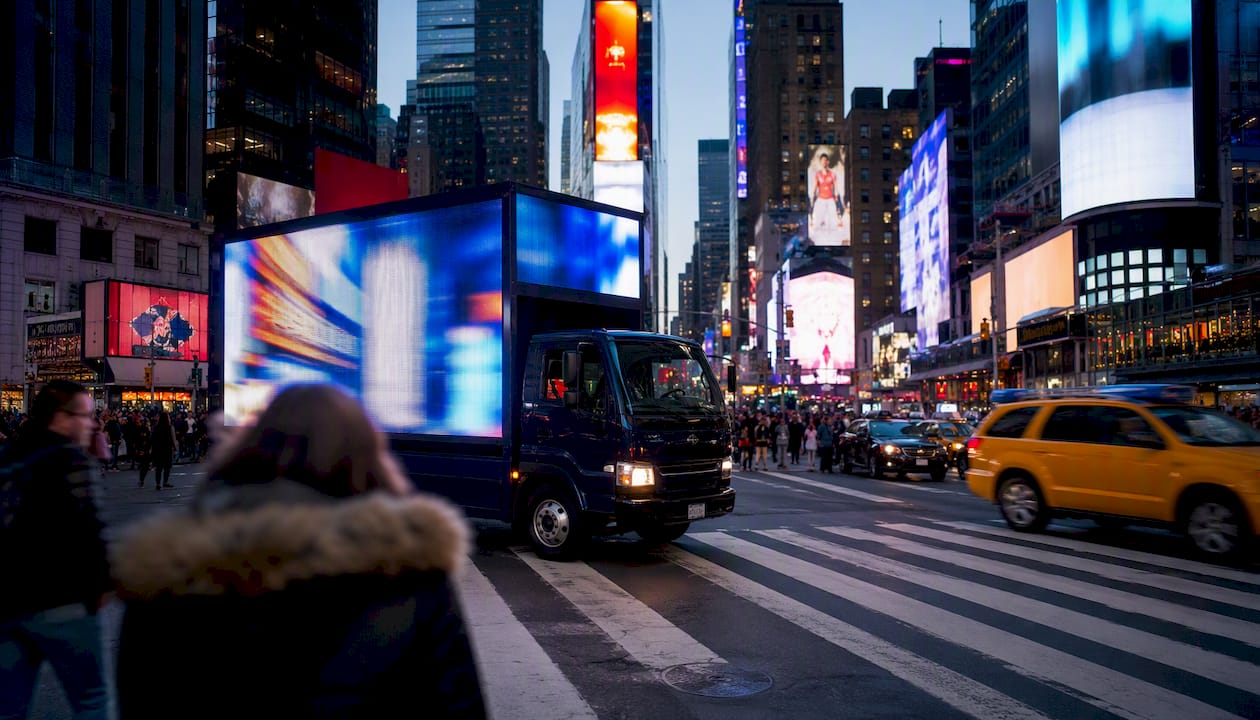
An LED billboard truck or a wrapped Uber or Lyft vehicle is the highest-visibility format in the stack. It moves through high-traffic corridors, parks near venue entrances, and reaches audiences who are already in the right mindset. The creative rotates in real time, so you can run a morning teaser and an afternoon call-to-action on the same route. Beacon-ads operates LED mobile billboards nationwide with route customization and GPS-verified proof-of-posting.
Geofencing and location targeting
Geofencing draws a virtual boundary around a location and serves mobile ads to anyone whose device enters that boundary. For experiential campaigns, you typically set a geofence around the activation zone and a second, wider fence around competitor locations or transit hubs. Geotargeting in advertising lets you layer demographic and affinity filters on top of the location trigger, so you are not just reaching people nearby but people nearby who match your buyer profile.

Proximity beacons and BLE
BLE beacons broadcast a signal that triggers content on nearby smartphones, usually through a dedicated app or a browser prompt. They work best inside venues where GPS is unreliable — convention centers, arenas, retail floors. The data captured is deterministic: you know exactly which device was at which checkpoint and when. That makes beacon data particularly valuable for building high-quality retargeting audiences.

Smart QR codes and dynamic landing pages
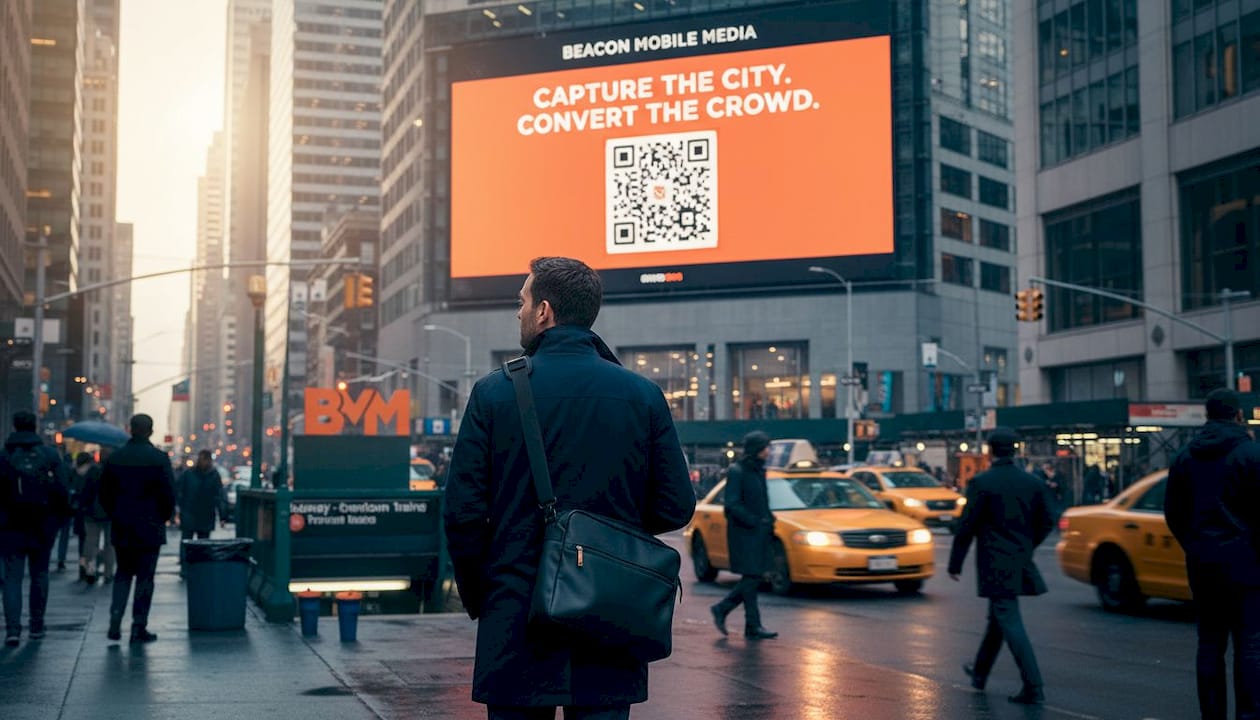
A smart QR code is not a static redirect. It tracks every scan with a timestamp, device type, and location, and it can route different users to different landing pages based on rules you set. For experiential campaigns, the QR code is the primary on-site data capture mechanism. Place it on the LED creative, on staff collateral, on sampling packaging, and on any printed material at the activation. Every scan is a first-party data point. Pair it with a fast-loading mobile landing page (under two seconds) and a single-field form to maximize conversion.
Pro Tip: Set your QR code to route returning visitors to a different page than first-time scanners. A repeat visitor who already filled out your form should see a loyalty offer, not the same lead capture screen.
Mobile gamification and interactive apps
Platforms like WeExplore and Seeker XP let you build scan-based checkpoint experiences where attendees earn points, unlock rewards, and appear on live leaderboards. The engagement mechanic increases dwell time and, more importantly, generates deterministic IDs tied to real behavior. A participant who scanned five checkpoints and claimed a reward is a far higher-quality retargeting prospect than someone who walked past a billboard. Gamification works especially well at multi-day events and trade shows where you want repeat engagement across sessions.
In-app and social mobile ad integration
Running paid social or in-app ads in parallel with a physical activation amplifies reach beyond the footprint of the vehicle or pop-up. Target the same geofence audience on Meta, TikTok, or programmatic display. Use the activation’s creative assets so the digital ad feels like a continuation of what someone just saw on the street. The overlap between physical exposure and digital impression is where frequency builds and recall spikes.
Real-time retargeting
Retargeting is where experiential campaigns earn their ROI numbers. Once you have a list of scans, app interactions, or geofence exposures, you push that audience into a retargeting sequence: a reminder ad the same evening, a stronger offer 48 hours later, a final urgency message at the end of the campaign window. Real-time retargeting platforms like MoEngage handle cross-channel sequencing and let you personalize each message based on what the user did on-site.
How do you choose the right tools for your campaign?
Start with your objective, not the technology. The tool selection follows from what you need to prove at the end of the campaign.
Objective alignment:
- Brand awareness at scale — prioritize LED mobile billboards with wide route coverage and in-app/social amplification
- Lead generation — prioritize smart QR codes, fast landing pages, and a CRM integration that captures form data in real time
- Footfall and drive-to-store — prioritize geofencing with a time-limited offer and a retargeting sequence that fires within 24 hours of exposure
- Event engagement and dwell — prioritize gamification platforms and BLE beacons for checkpoint-based interaction
Vendor questions to ask before signing anything:
- Who owns the scan and location data after the campaign ends?
- Can you provide GPS-stamped proof-of-posting photos for every route segment?
- How does your retargeting list get passed to our ad platform — raw export, API, or managed service?
- What audience filters are available (demographic, affinity, behavioral)?
- How quickly can you pull real-time reporting during the activation?
- Are your data collection practices compliant with applicable privacy regulations?
Red flags to watch for:
- Attribution reports that show only impressions with no downstream conversion data
- No proof-of-posting documentation or GPS verification
- Inability to export raw event-level scan or location data
- Audience targeting limited to broad geographic radius with no demographic or affinity layer
- Reporting delivered only as a post-campaign PDF with no live dashboard access
The absence of proof-of-posting is the single biggest red flag in mobile OOH. If a vendor cannot show you a GPS-stamped photo of the vehicle at the claimed location and time, you have no way to verify delivery.
What budgets and timelines should you plan for?
Lead time is the variable most brands underestimate. RMNG’s production guidance recommends at least one month for mobile activations and two months for pop-ups. Multi-city tours with custom fabrication, permit pulling, and creative builds across multiple markets need at least four to eight weeks.
| Phase | Timeline | Key tasks |
|---|---|---|
| Pre-production | 4–8 weeks out | Route planning, permit applications, creative brief, vendor contracts |
| Permit and booking | 3–4 weeks out | Secure permits, confirm vehicle availability, finalize route |
| Creative build | 2–3 weeks out | LED creative production, QR code setup, landing page build and QA |
| Staff training | 1 week out | Script rehearsal, scan flow walkthrough, contingency routing |
| On-site execution | Campaign days | Proof-of-posting verification, real-time scan monitoring, staff check-ins |
| Post-campaign retargeting | Days 1–2 post-event | Retargeting list handoff, ad sequence launch, conversion tracking |
Budget bands by activation type:
- Small local pop-up (1–3 days, single market): The primary cost buckets are vehicle hours, permits, and basic QR/landing page setup. Creative is typically repurposed from existing brand assets. Plan for a modest day rate plus permit fees that vary significantly by city.
- Regional tour (2–4 markets, 1–2 weeks): Add route customization, multi-market permit pulling, staffing across locations, and a retargeting data add-on. Creative production becomes a meaningful line item when you need market-specific messaging.
- National mobile tour (10+ markets, multi-week): Fabrication or vehicle wrapping, national permit coordination, dedicated campaign management, full attribution reporting, and a retargeting budget running in parallel with the physical tour. This is where data-driven OOH strategies pay off most clearly.
Operational checklist before launch:
- Confirm permits for every route segment and venue perimeter
- Verify insurance coverage for all vehicles and staff
- Set up proof-of-posting plan with GPS and photo checkpoints
- Build and QA the QR scan flow end-to-end on multiple device types
- Place privacy notice at all data capture points
- Confirm retargeting list handoff process with your ad platform
- Brief staff on scan conversion scripts and contingency routing
How do you measure and attribute results from mobile experiential campaigns?
The measurement gap in experiential marketing is not a data problem. It is a framing problem. Most campaigns track the wrong things and then struggle to defend the budget.
KPIs worth tracking:
- Footfall: total verified visits to the activation zone, ideally GPS-confirmed
- Scan-to-visit rate: percentage of QR scans that result in a landing page visit (a low rate signals a friction problem in the scan flow)
- QR conversion rate: percentage of landing page visitors who complete the desired action (form fill, coupon claim, purchase)
- Post-event retargeting lift: the conversion rate of your retargeted audience compared to a matched control group
- Assisted conversions: downstream purchases or sign-ups where the experiential touchpoint appears in the attribution path
- CPA/ROAS for promotion-driven activations: cost per acquisition and return on ad spend when the activation includes a direct offer
Attribution flow:
Proof-of-posting and GPS verification establish that the vehicle was at the claimed location. On-site data capture (QR scans, BLE interactions, app check-ins) creates a first-party audience. Deterministic or probabilistic matching connects those IDs to your ad platform. Retargeting sequences then fire against that audience, and your ad server tracks conversions back to the original exposure. That chain is what turns an experiential event into a data-driven OOH campaign with a defensible ROI number.
Pro Tip: When presenting experiential ROI to finance, lead with post-event retargeting lift and assisted conversions rather than footfall. Those numbers connect directly to revenue, which is the language finance teams respond to.
Beyond standard KPIs, Ether’s Emotion Intelligence framework measures attention, intent, and memory signals during activations. These metrics capture whether your creative actually registered with the audience, not just whether they walked past it. Integrating even a lightweight version of this thinking into your standard KPI set — asking “did this activation create intent?” alongside “how many people showed up?” — gives you a much stronger story when defending the budget.
What does a Beacon-ads campaign setup look like in practice?
A well-structured Beacon-ads campaign follows a clear sequence from route selection to post-event conversion.
Sample campaign flow:
- Route selection: Beacon-ads maps high-traffic corridors near the activation zone, competitor locations, and transit hubs. Routes are customized by time of day and audience density.
- On-site activation mechanics: The LED truck runs rotating creative. Staff stationed near the vehicle engage passersby and direct them to scan the QR code on the display.
- QR scan funnel: The smart QR code routes scanners to a mobile landing page with a time-limited offer. Every scan is logged with timestamp and location data.
- Immediate offer capture: Form completions feed directly into a CRM or retargeting audience in real time.
- Geofence-triggered retargeting: Within hours of the activation, a retargeting sequence fires to everyone who entered the geofence zone, reinforcing the on-site message with a digital follow-up.
- Measurement handoff: Beacon-ads delivers GPS-stamped proof-of-posting, scan volume, retargeting list size, and post-campaign lift data.
Client features to request in your SOW:
- GPS and photo proof-of-posting for every route segment
- Real-time retargeting integration with your ad platform
- Route customization by time, location, and audience density
- Affinity and demographic audience targeting layered on geofencing
- Smart QR code setup with scan tracking and dynamic landing page routing
- Reporting cadence: daily during the campaign, full attribution report within 72 hours post-event
Metrics to specify in the SOW: total scans, retargeting list size, scan-to-visit rate, post-campaign retargeting lift, and assisted conversions. If the vendor cannot commit to delivering these numbers, that is a procurement red flag.
What creative and operational tips actually move the needle?
The difference between a forgettable activation and one that generates a retargeting list worth running is usually execution detail, not budget size.
Creative prompts that drive scan behavior:
- A time-limited offer displayed on the LED creative (“Scan before 6 PM for 20% off”) creates urgency that a generic brand message does not
- A live leaderboard for gamified activations, visible on a screen at the pop-up, pulls participants back to check their rank and drives repeat scans
- Moment-based creative tied to a local sports event, weather condition, or breaking cultural moment makes the activation feel relevant rather than planned months in advance
Operational practices that protect scan conversion:
- Pre-book permission windows for every location on the route; a vehicle that cannot park near the venue entrance loses most of its scan potential
- Build a contingency route for every primary location so the team can pivot without losing activation hours
- Staff scripts matter more than most brands realize. A team member who can explain the offer in one sentence and physically point to the QR code converts at a meaningfully higher rate than one who just hands out flyers.
- QR landing pages must load in under two seconds on a 4G connection. Every additional second of load time costs you a measurable percentage of completions.
Mini use cases:
Trade show lead capture: An LED truck circles the convention center during morning registration. The QR code on the display routes to a short form offering a free resource download. Scans collected during the two-hour window feed a retargeting sequence that fires during the show’s lunch break with a booth visit incentive. Platforms like Jam Van have built national mobile experience programs around exactly this kind of geo-targeted consumer reach.
Stadium pre-game promo: A wrapped rideshare vehicle picks up fans near the stadium two hours before kickoff. The wrap carries a QR code for a contest entry. A geofence around the parking lot serves a matching social ad to fans who are already in the area. The combination of physical and digital exposure in the same 90-minute window drives recall that neither format achieves alone.
Weekend pop-up tour with drive-to-store: A mobile pop-up unit visits three neighborhoods over a Saturday and Sunday. Each stop has a unique QR code tied to a store-specific offer. Scan data tells you which neighborhood converted at the highest rate, which informs the next weekend’s route. YouShould’s pass-based format and Seeker XP’s checkpoint gamification are both worth evaluating for the digital engagement layer on this type of multi-stop tour.
Pro Tip: For multi-stop tours, use a unique QR code at each location rather than a single campaign-wide code. The location-level scan data tells you exactly where your audience is most responsive, which is worth more than the simplicity of managing one code.
Key Takeaways
The most effective mobile advertising setup for experiential campaigns combines LED mobile billboards, geofencing, smart QR codes, and digital retargeting into a single measurable funnel.
| Point | Details |
|---|---|
| Lead with the proven stack | LED mobile billboards + geofencing + smart QR codes + retargeting is the highest-ROI combination for most activations. |
| Plan lead time realistically | Small activations need at least one month; pop-ups need two months; multi-city tours require four to eight weeks for permits, creative, and booking. |
| Measure what finance cares about | Track post-event retargeting lift and assisted conversions, not just footfall or dwell time. |
| Require proof-of-posting | GPS-stamped photo verification is non-negotiable; a vendor who cannot provide it cannot prove delivery. |
| Beacon-ads for rapid execution | Beacon-ads delivers the full stack nationwide: LED trucks, geofencing, smart QR capture, and attribution reporting with proof-of-posting. |
The trade-off most experiential marketers get wrong
The conventional tension in experiential marketing is reach versus measurability. Big physical presence means broad awareness but fuzzy attribution. Digital-only campaigns are measurable but lack the visceral impact of a live activation. Most brands pick one and accept the trade-off.
The argument for combining LED mobile billboards with geofencing and QR codes is that you do not have to choose. The physical format delivers the reach and the emotional impact. The geofence and QR layer deliver the data. What gets underestimated is how much the physical presence improves the digital performance: a person who just saw a 10-foot LED display and then receives a retargeting ad two hours later is in a fundamentally different mental state than someone who only saw the digital ad. The physical exposure primes recall. The retargeting ad converts it.
The brands that defend experiential budgets most effectively are not the ones with the biggest activations. They are the ones who built the measurement infrastructure before the truck left the lot. Proof-of-posting, a clean QR scan flow, and a retargeting list handed off within 24 hours of the event are what separate a campaign that proves ROI from one that produces a great photo and a vague impression count.
Beacon-ads runs the full stack so you do not have to piece it together
Most brands building an experiential campaign for the first time spend weeks sourcing a vehicle vendor, a geofencing platform, a QR tool, and a retargeting partner separately. Beacon-ads delivers all of it as a single managed campaign: LED mobile billboards and wrapped rideshare vehicles across all 50 states, geofencing with affinity and demographic targeting, smart QR code capture with real-time scan tracking, and a post-event retargeting sequence with full attribution reporting.

Every campaign includes GPS-stamped proof-of-posting and a reporting package that covers scans, retargeting list size, and post-campaign lift. For brands that need to show ROI to a finance team, that documentation is the difference between a one-time activation and a recurring budget line. Request a sample route plan or campaign estimate at beacon-ads.com and see what a data-driven out-of-home media strategy looks like for your market.
Useful sources and further reading
The sources below back the measurement, planning, and tool claims throughout this article.
- Beacon Mobile Media — home: primary reference for LED mobile billboard capabilities, geofencing, QR capture, and proof-of-posting workflows
- Smart QR codes — Beacon Mobile Media: product detail on QR-based data capture and dynamic landing page routing
- Geotargeting in advertising — Beacon Mobile Media: geolocation strategy guidance for local OOH campaigns
- How to target conferences and trade shows with LED mobile billboards — Beacon Mobile Media: operational guide for event-perimeter activations and proof-of-posting
- Ether — Experiential Marketing Measurement Platform: Emotion Intelligence framework for measuring attention, intent, and memory during activations
- WeExplore — interactive event engagement platform: scan-based gamification and checkpoint engagement for in-venue campaigns
- Seeker XP — gamification platform: no-code gamified experience builder for scavenger hunts, check-in challenges, and reward flows
- RMNG — experiential marketing and mobile pop-ups: production timeline and budget guidance for mobile activations and pop-ups
- Jam Van Inc. — mobile media experiences: national mobile pop-up and tour experience reference
- MoEngage — customer engagement platform: cross-channel mobile personalization and retargeting automation