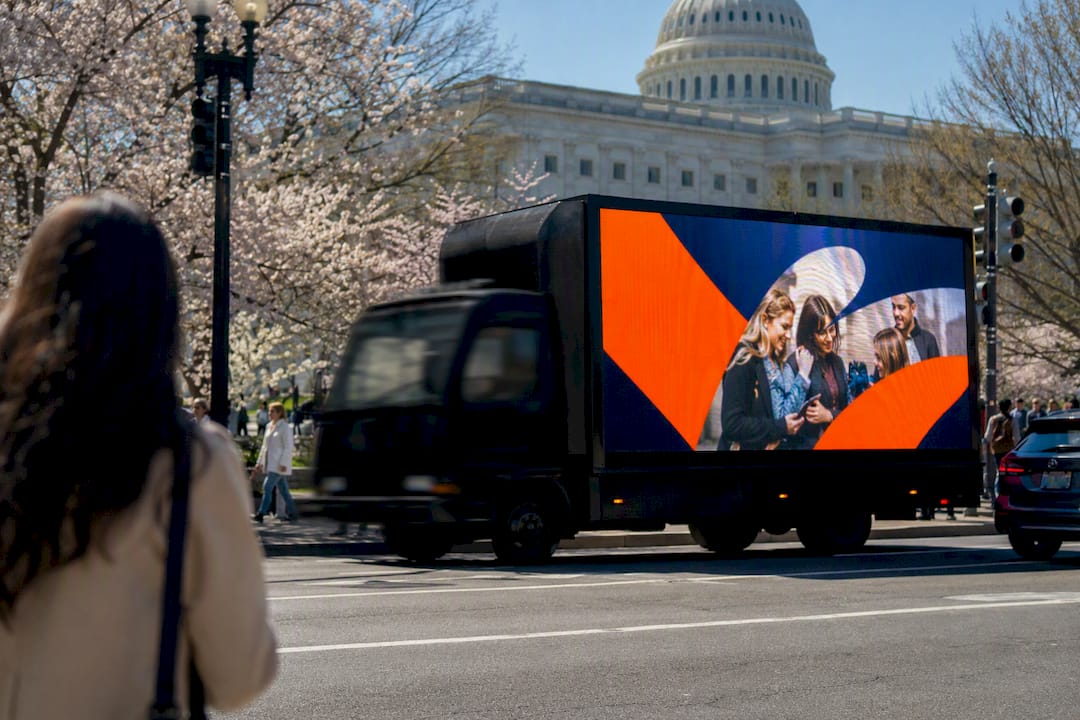
Operating a vehicle on New York City streets primarily to display commercial advertising is illegal under the city’s traffic rules, full stop. The governing standard, 34 RCNY §4-12(j)(1), bars parking or standing a vehicle for that purpose, though exceptions exist for business-use vehicles, taxis and for-hire cars under Taxi & Limousine Commission (TLC) rules, and properly permitted signage. The sections below break down exactly which agency oversees which piece of that puzzle, and what you need on hand before your truck hits Fifth Avenue.
TL;DR:
- Vehicles used mainly for advertising without a business function face strict scrutiny and cannot have roof-mounted displays or illuminated panels.
- Four agencies enforce NYC mobile billboard rules independently: TLC for taxis, DOB for sign permits, DOT for parking, and NYPD for traffic violations.
- Registering with DOB as an outdoor advertising company costs at least $1,500, with additional fees for sign registration and maintenance permits near major infrastructure.
- The business-use exemption applies to vehicles engaged in normal operations, but dedicated ad vehicles with no other role typically face penalties.
- Pre-deployment checks include vehicle inspections, route mapping, permit documentation, and separate TLC approval for taxi or for-hire vehicle advertising.
Table of Contents
- New York Mobile Billboard Rules: The Legal Framework
- Which Agency Enforces Mobile Advertising Rules in NYC
- Permits and Registrations You Need Before You Launch
- Exemptions That Actually Hold Up, and What Still Gets Flagged
- Your Pre-Deployment Compliance Checklist
- Enforcement Actions and How to Appeal a Citation
- Where to File Permits and What They Cost
- How Beacon Mobile Media Handles NYC Compliance Operationally
- A Compliance Officer’s Honest Take on Visibility Versus Risk
- A Practical Next Step for Compliant NYC Campaigns
- Sources
- FAQ
New York Mobile Billboard Rules: The Legal Framework
The core prohibition comes from a New York City Council traffic rule change referenced in Int 0541-2024, which codifies that no one may operate, stand, or park a vehicle on a city street for the primary purpose of commercial advertising. That single sentence drives almost every enforcement action you’ll encounter.
It doesn’t operate in isolation, though. The rule intersects with Department of Buildings (DOB) sign regulations under Building Code Title 26, which governs fixed and semi-fixed outdoor advertising, and with TLC rules that carve out specific allowances for taxis and for-hire vehicles.
A few practical distinctions matter most for advertisers:
- Vehicles built or modified specifically to carry advertising, rather than to conduct ordinary business, face the tightest scrutiny.
- LED displays, animated panels, reflectorized surfaces, and roof-mounted billboard structures are commonly treated as red flags by enforcement officers.
- A vehicle running routine deliveries or service calls with an ad wrap is judged differently than a dedicated ad truck with no other function.
Which Agency Enforces Mobile Advertising Rules in NYC
Four different city agencies touch mobile billboard advertising, and each one polices a separate slice of the problem.
- TLC governs advertising on taxis, green cabs, and other for-hire vehicles, and requires its own approval process separate from anything DOB or DOT administers.
- DOB enforces sign permits, the Outdoor Advertising Company (OAC) registration program, and maintenance rules for any structure that meets the code’s definition of a sign.
- DOT handles parking, standing, and street-use enforcement, including where a vehicle can legally stop and for how long.
- NYPD enforces public-safety and traffic violations on the ground, often issuing the actual summons when a mobile billboard is parked illegally.
Mixing these up costs advertisers real money. A truck cleared by DOB’s sign rules can still get ticketed by DOT for illegal standing, and a wrapped for-hire vehicle that skips TLC approval risks penalties regardless of what DOB says about the wrap itself. Contacting TLC directly before launching a taxi or for-hire campaign is worth doing early, since its approval process runs independently of DOB and DOT timelines.
Permits and Registrations You Need Before You Launch
Static and semi-permanent outdoor advertising structures fall under DOB’s Outdoor Advertising Registration Program, and the paperwork starts with Outdoor Advertising Company registration. Any company that owns, operates, or maintains outdoor advertising signage in the city has to register as an OAC, using forms numbered OAC1 through OAC6 depending on the sign type and transaction.
The DOB fee schedule sets initial OAC registration at $1,500, with an initial sign registration fee of $125 per sign. Those numbers apply to structures, not to typical mobile billboard trucks or wrapped vehicles, but they matter if your campaign includes any static signage component tied to a location.
Title 26 also triggers maintenance permit requirements for signs within specific distances of major infrastructure:
- Signs within 900 feet of an arterial highway generally require a maintenance permit and inspection.
- Signs within 200 feet of a large public park face the same requirement.
- DOB plan review applies when a sign structure requires new construction or a change to an existing structure’s footprint or wiring.
Here’s where the distinction gets confusing for advertisers new to New York. A vehicle used in a company’s ordinary business operations, carrying a wrap or ad panel but not built primarily as a billboard, typically doesn’t need DOB sign registration at all. That business-use exemption is the reason most rideshare wraps and delivery-fleet advertising can operate without a DOB filing, while a dedicated LED truck parked for hours in one spot draws different scrutiny. If your campaign spans multiple vehicle types, treating each one under the correct framework, rather than assuming one permit covers everything, saves time and avoids duplicate paperwork. Beacon-ads walks through this distinction in more detail in its mobile billboard permits guide.
Exemptions That Actually Hold Up, and What Still Gets Flagged
The business-use exemption is the most important carve-out in the entire framework. Case law from People v. Target Advertising Inc. confirmed that vehicles engaged in a company’s normal operations, rather than deployed primarily to advertise, can legally display non-illuminated signage without running afoul of the traffic rule.
TLC-licensed taxis and for-hire vehicles get their own sanctioned pathway too, separate from the general traffic rule, as long as advertising stays within TLC’s approved formats.
What doesn’t survive scrutiny:
- Roof-mounted billboard structures bolted onto a vehicle chassis.
- Animated, reflectorized, or illuminated panels designed to catch the eye from a distance.
- Vehicles whose only functional purpose is carrying an ad, with no delivery, service, or business role attached.
Your Pre-Deployment Compliance Checklist
Run through this before any vehicle leaves the lot for a New York City deployment.
- Inspect the vehicle itself. Confirm the display isn’t roof-mounted, isn’t reflectorized, and sits within standard height and width limits for city streets.
- Map the route and parking plan. Identify restricted curb zones in advance and request DOT permission for any extended standing near high-traffic corridors.
- Assemble your documentation folder. Carry copies of any relevant permits, OAC registration if applicable, proof of insurance, and GPS-tagged photo logs showing where and when the vehicle was deployed.
- Confirm TLC status separately if any part of the campaign touches a taxi or for-hire vehicle, since that approval doesn’t come bundled with DOB or DOT clearance.
- Have a response plan ready for a citation or removal request, including a named contact who can produce documentation on the spot.
Pro Tip: Keep a digital copy of every permit and registration on a phone or tablet in the vehicle. An officer who can verify compliance in sixty seconds is far less likely to issue a citation than one waiting on a phone call to your office.
Other cities use different mechanisms, like Lubbock, Texas’s mobile billboard ordinance, which sets explicit vehicle-size limits and message-timing rules for electronic displays. Those specifics don’t govern New York, but they’re a useful sanity check for what “reasonable vehicle specs” tend to look like across U.S. jurisdictions.
Enforcement Actions and How to Appeal a Citation
Enforcement in New York typically escalates through a few predictable channels. DOT and NYPD issue parking tickets for illegal standing, and repeated violations can trigger vehicle removal or towing. DOB issues administrative orders and penalties tied to unregistered outdoor advertising structures or missed sign maintenance permits.
- Parking citations can be contested through the city’s standard ticket appeal process, typically within 30 days of issuance.
- DOB administrative violations follow a separate appeals track through the department’s own hearing process.
- Keeping proof-of-posting documentation and photo/GPS logs on hand speeds up any appeal significantly, since it shows exactly when and where the vehicle operated.
- Legal counsel is worth bringing in early for OAC registration disputes, since those penalties can compound if left unaddressed.
Fast correction beats a long fight almost every time. Fixing a documentation gap voluntarily, before a second citation lands, is usually cheaper than contesting the charge after the fact.
Where to File Permits and What They Cost
Start with the DOB Outdoor Advertising Registration Program page, which hosts the OAC1 through OAC6 forms and the current fee schedule.
- Initial OAC registration requires a substantial fee; initial sign registration also requires a fee per sign.
- TLC approvals for taxi and for-hire vehicle advertising go through a separate application channel; contact TLC directly rather than assuming DOB paperwork covers it.
- DOT handles curb-use and extended parking permissions for campaigns that need to hold a specific street location for hours at a time.
- Processing timelines vary by filing type, so building in a few weeks of buffer before a launch date is a smart hedge.
Beacon-ads breaks down a broader digital advertising preparation workflow in its SEO best practices checklist for agencies growth, which pairs well with the permit steps above.
How Beacon Mobile Media Handles NYC Compliance Operationally
Vendor-managed compliance exists because the paperwork above adds up fast, especially for campaigns running across multiple vehicles or vehicle types. Proof-of-posting with GPS and photo logs tied to each route can be folded into campaign attribution reporting so that compliance data is seen alongside performance metrics.
Registration fees can add up significantly once you include per-sign costs across a multi-truck campaign, which is a meaningful administrative burden according to the DOB’s own fee schedule. Before deployment, the process typically includes verifying agency contacts, inspecting vehicles, and confirming insurance coverage. That kind of prechecking doesn’t eliminate the need for advertisers to understand the rules themselves, but it does reduce the odds of a surprise citation mid-campaign.

A Compliance Officer’s Honest Take on Visibility Versus Risk
Conservative deployments almost always beat aggressive ones in New York. A truck that skips the roof-mounted display and sticks to a clean panel wrap draws less attention from enforcement, and less attention means fewer disruptions to your campaign timeline.
Vendor prechecks help, but they don’t replace legal counsel when a campaign involves TLC-licensed vehicles or multi-borough routing. Build in lead time for documentation. It’s the cheapest insurance you’ll buy all campaign.
— Scott
A Practical Next Step for Compliant NYC Campaigns
There’s a lot of ground to cover between DOB registration, TLC approvals, and DOT parking rules, and most advertising teams don’t have a compliance officer on staff to track it all. Some mobile advertising services offer LED mobile billboards and wrapped rideshare vehicles with route customization, GPS and photo proof-of-posting, and campaign reporting documenting where and when each vehicle operated.

That documentation matters twice over in New York, once for your own compliance records and once if an officer or agency ever asks for proof mid-campaign. Precheck routines around vehicle inspection and insurance verification are important steps in planning deployments before a truck ever leaves the lot. If you’re planning a New York campaign, get a quote through Beacon Mobile Media’s main services page and ask about route customization for your specific neighborhoods and event dates.
This article is general information, not a substitute for advice from a qualified lawyer. Consult a qualified legal professional about your own circumstances before acting on anything here.
Sources
- The New York City Council – File #: Int 0541-2024
- PEOPLE v. TARGET ADVERTISING INC (2000)
- Building Code Title 26 Subchapter 4
FAQ
Are mobile billboards legal in New York City?
Yes, but only under specific conditions. Vehicles used primarily for commercial advertising are prohibited under 34 RCNY §4-12(j)(1), while business-use vehicles and TLC-licensed vehicles have separate, narrower pathways.
What four US states do not allow billboards?
Maine, Vermont, Hawaii, and Alaska have banned most billboards statewide, though New York has no comparable statewide ban and instead regulates through city-level traffic rules and DOB sign registration.
How much is a 30-second ad in Times Square?
Pricing for Times Square digital displays varies widely by screen, time slot, and duration, and isn’t published as a fixed rate, so advertisers typically request custom quotes from screen operators or mobile OOH vendors for current pricing.
What are you not allowed to put on a billboard in NYC?
Roof-mounted structures, animated or reflectorized panels, and illuminated advertising bodies on vehicles used primarily for advertising are commonly prohibited, based on both the traffic rule and case law like People v. Target Advertising.
Does Beacon-ads handle NYC permit compliance for clients?
Beacon Mobile Media builds proof-of-posting documentation and vehicle prechecks into its campaign process, which helps clients keep records aligned with DOB, DOT, and TLC expectations. Current service details are available on the Beacon-ads website.