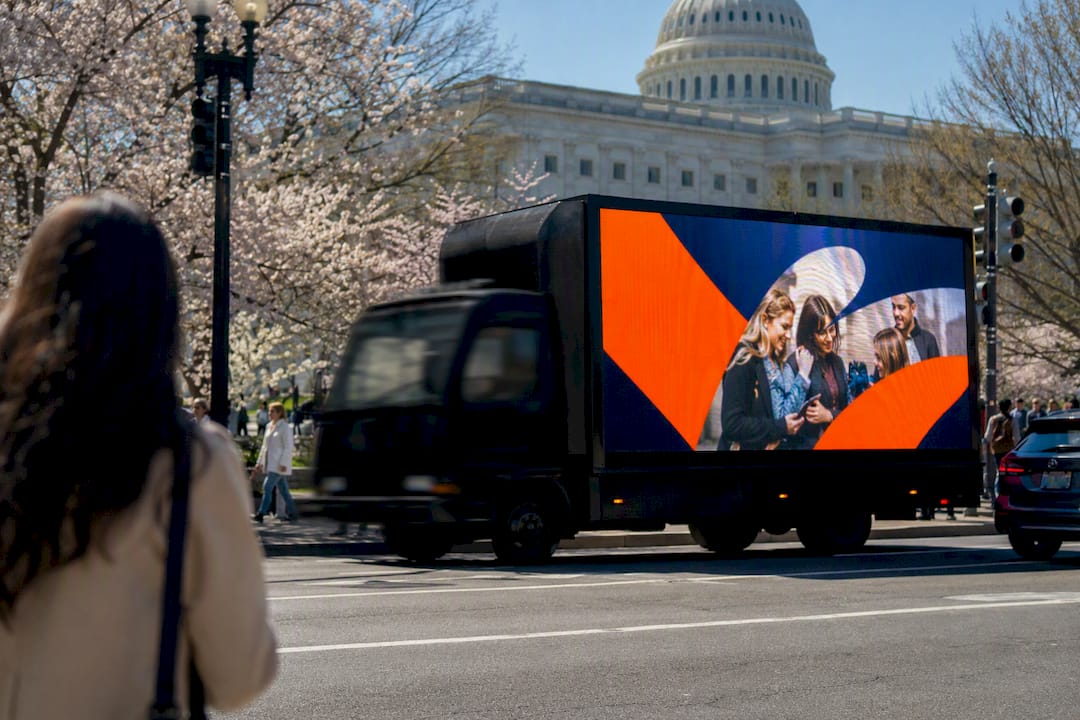
Mobile billboards deliver positive ROI reliably when campaigns target a specific route, venue, or event rather than driving miles for miles’ sake. The formula matters less than three levers—who sees the truck, what the creative asks them to do, and whether you can actually track what happened next. Get those right and a mobile billboard campaign competes with, and often beats, static outdoor formats on relevant impressions per dollar. Get them wrong and you have an expensive truck.
TL;DR:
- Mobile billboard ROI is highly dependent on targeting a specific route, venue, or event and implementing accurate attribution methods such as QR codes and geofencing.
- Cost-effectiveness is typically better in concentrated locations like trade shows or local events, where impressions and conversions are easier to track and optimize.
- Campaign success hinges on proper planning, including route audience focus, simple creative calls to action, and layered retargeting strategies.
- Tracking efforts like unique landing pages, GPS proof, and visit lift measurement are crucial to accurately assess ROI and avoid mistaken attribution.
- Static trucks cost $500 to $3,000 daily, while digital trucks range from $1,000 to $5,000 daily, with cost-effective campaigns requiring disciplined measurement and reporting.
Table of Contents
- How Do You Calculate Mobile Billboard ROI?
- What ROI Can You Expect by Campaign Type?
- How Much Do Mobile Billboards Cost?
- How Do You Track Mobile Billboard Attribution?
- How Can You Improve Mobile Billboard ROI?
- What Do Real Mobile Billboard Campaigns Look Like?
- Should You Run a Mobile Billboard Campaign?
- What Marketers Get Wrong About Measuring This
- Get a Measurable Mobile Billboard Campaign Running
- Sources
- FAQ
How Do You Calculate Mobile Billboard ROI?
The core formula is simple: ROI = (Net Profit ÷ Total Campaign Cost) × 100. For direct-response campaigns, you can estimate revenue by multiplying your conversion count by average order value or lifetime value, then subtract total cost before dividing.
To run either version, you need four inputs:
- Impressions — daily traffic count along your route or dwell time at a venue, often supplied by the provider or estimated from DOT traffic data.
- Conversion rate — the percentage of viewers who scan a QR code, visit a landing page, or redeem a promo code.
- Average order value or lead value — what a converted customer is worth to your business.
- Total cost — truck rental, creative production, permits, and tracking tools combined.
Here’s a worked example for a two-day local product launch. A digital truck runs 16 hours across two days, generating impressions at a concentrated downtown route. Truck cost plus creative and a landing page comes to several thousand dollars. If a small percentage of viewers scan the QR code or visit the campaign URL, that results in some conversions. Based on average order value, gross revenue exceeds the total costs, resulting in a positive ROI.
The biggest overestimation error is inflating conversion rate.
What ROI Can You Expect by Campaign Type?
Expectations should shift based on what you’re actually optimizing for, and OOH consistently ranks among the strongest audience-ROI channels tracked by the industry’s trade association.
- Brand awareness campaigns: judge success on recall and reach, not clicks. CPM for mobile trucks in mid-size markets typically lands lower than digital billboards in premium fixed locations, because you’re buying concentrated frequency rather than static exposure.
- Event and venue activations: geofence tracking around a conference center or stadium can show visit-lift in the double digits when the route is timed to arrivals and departures.
- Retail and local promo campaigns: expect modest but real offline uplift. A large-scale field experiment on location-based mobile advertising found roughly a 2% uplift in offline sales under controlled conditions, a useful baseline for setting expectations rather than promising a windfall.
Quick benchmark: direct-response campaigns targeting a defined venue or event routinely outperform city-wide awareness runs on cost-per-conversion simply because the audience is already self-selected.
How Much Do Mobile Billboards Cost?
Pricing splits cleanly by truck type. According to industry cost guides, static mobile trucks generally run $500 to $3,000 per day, while digital or LED trucks run $1,000 to $5,000 per day depending on market size and campaign length. Multi-week bookings usually bring the daily rate down.
Your total budget needs more than the truck rate:
- Creative production (static wraps or digital ad loops)
- Permits, where cities require them for extended parking or specific zones
- Driver fees and fuel, often bundled into daily rates but not always
- Tracking software or QR platform fees
To compare mobile against fixed billboards fairly, calculate a daily-equivalent CPM: divide daily cost by estimated daily impressions, then multiply by 1,000. Mobile trucks tend to win this math when the audience is concentrated, like a trade show parking lot, rather than spread across a general commute corridor.
How Do You Track Mobile Billboard Attribution?
Attribution is where most mobile billboard campaigns fall apart, not because the tactics are complicated but because nobody sets them up before launch.
- Unique landing pages with UTM parameters for every route or market, so you can isolate which truck run drove which traffic.
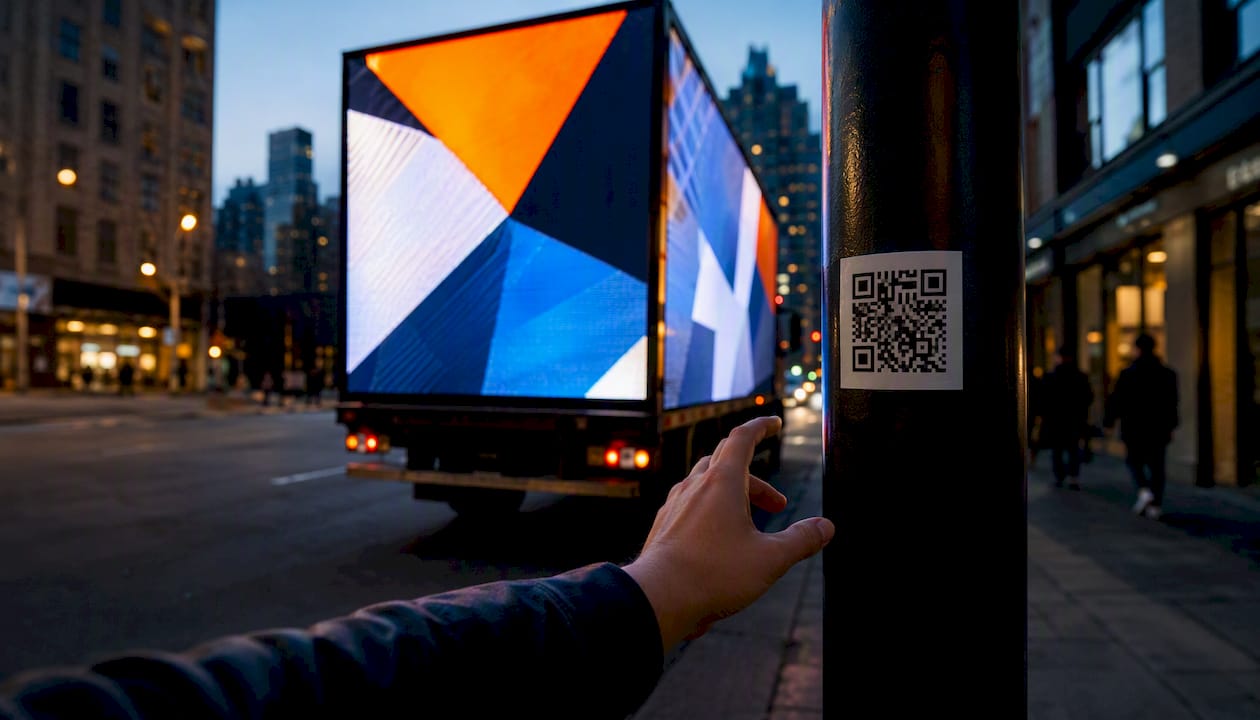
- QR codes tied to short URLs, which double as a legibility check. Our QR code tracking guide walks through setup step by step.
- Proof-of-posting via GPS and timestamped photos, confirming the truck actually ran the agreed route on schedule.
- Geofence-based visit lift, comparing foot traffic in the exposed zone against a holdout area with no truck coverage.
- Digital retargeting for anyone who engaged with a geofenced ad but didn’t convert on the spot.
For OOH-heavy media mixes, a multi-touch model combined with an incremental holdout test gives the most defensible read on true impact, an approach OAAA’s own measurement resources back as well.
Pro Tip: Run your holdout window longer than you think you need. Field research on mobile ad experiments shows short pre/post windows systematically undercount delayed, awareness-driven conversions.
How Can You Improve Mobile Billboard ROI?
Small operational choices move the needle more than most marketers expect.
- Route audience-first, not mileage-first. Planning around event doorways, hotel clusters, and lunch corridors consistently beats routes optimized for total distance covered, since audience-first routing puts the truck where eyeballs already are.
- Keep creative to one call to action. Legibility at 35 miles per hour means large type, high contrast, and a single QR code, not three offers competing for attention.
- Favor product-focused messaging over price callouts. A 2025 field study on mobile advertising cue types found product-focused cues convert to purchases better than price or word-of-mouth cues, which tend to generate clicks without closing the sale.
- Match flight length to objective. Short, concentrated flights work for events; awareness campaigns need repeated exposure over one to two weeks to build recall.
- Layer in retargeting. Pairing truck exposure with geofenced digital ads recaptures people who saw the truck but couldn’t act immediately, a tactic that consistently lifts measured conversions.
What Do Real Mobile Billboard Campaigns Look Like?
- Event activation: a two-day trade show route cost $3,800, tracked through a QR-coded landing page. Of an estimated 22,000 impressions, 3.1% converted to booth visits, and the campaign posted a 140% ROI once badge-scan data confirmed attendance. See a similar setup in our event venue case guide.
- Retail footfall: a five-day local route drove promo-code redemptions reconciled against POS data, showing a measurable lift in weekday foot traffic versus the prior month’s baseline.
- Takeaway: the lever that moved results both times was tracking discipline, not truck size or route length.
Should You Run a Mobile Billboard Campaign?
Mobile billboards fit best when you have a defined venue, event, or launch window and a way to measure what happens after the truck rolls by. Before you brief a provider, ask for a route plan, a proof-of-posting sample, and a reporting cadence. Start with a small pilot, one clear KPI, and a retargeting layer already built in.

What Marketers Get Wrong About Measuring This
Most ROI complaints trace back to skipped tracking, not weak creative. Beacon Mobile Media’s clients consistently see stronger numbers once QR capture and geofence visit-lift are built into the plan from day one, not bolted on after launch.
— Scott
Get a Measurable Mobile Billboard Campaign Running
Our services provide an alternative to booking a truck without attribution data. Beacon Mobile Media builds real-time retargeting, geofencing, smart QR capture, and proof-of-posting documentation into every route from the start, so you get attribution data instead of a guess at what the campaign did.

When you send an RFP, ask for a route plan tied to your audience, a sample proof-of-posting report, a reporting cadence you can actually use, and clear test KPIs before the truck leaves the lot. That’s the checklist that separates a campaign you can defend to a CFO from one you can’t. Start by reviewing the types of out-of-home advertising Beacon Mobile Media runs nationwide, then request a quote for a pilot route built around your next event or launch.
Sources
For deeper benchmarking, consult the Outdoor Advertising Association of America for industry ROI data, the peer-reviewed study on mobile advertising cue types, and the Mobibo ROI calculator for modeling your own campaign numbers.
- The Impact of Mobile Advertising Cue Types on Consumer Response Behaviors — 2025
- Guide to Mobile Billboard Costs and Types for Advertising — PTCLED
FAQ
Are Mobile Billboards Profitable?
Yes, for campaigns with a defined audience and tracking in place. Untracked, broad-awareness runs are harder to prove profitable even when they work.
What Is a Realistic ROI for a Billboard Campaign?
Targeted event or retail activations often land between 100% and 200% ROI when measured with QR codes and geofence visit-lift; broad awareness campaigns should be judged on recall rather than a single ROI number.
How Much Does a 30-Second Ad in Times Square Cost?
Times Square digital billboard spots can run into the tens of thousands of dollars monthly for premium placements, a different pricing model entirely from mobile trucks, which charge daily rather than per spot.
How Much Do Mobile Billboards Cost per Day?
Static trucks typically run $500 to $3,000 per day, while digital or LED trucks run $1,000 to $5,000 per day depending on market and campaign length.