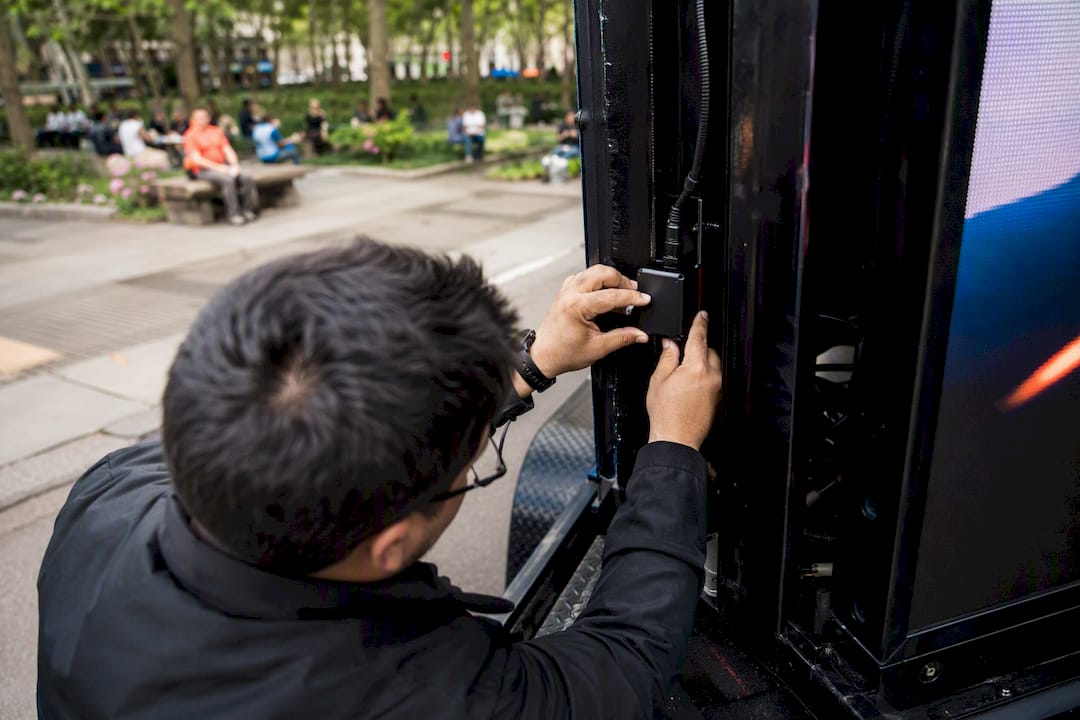
Omnichannel event marketing is the orchestration of every online and offline touchpoint into a single, data-driven attendee journey — where mobile OOH exposure, digital retargeting, registration, and post-event follow-up all feed one unified attendee profile and share data in real time.
Two reasons this architecture pays off for localized campaigns:
- Consistent messaging: Every channel, from a LED mobile billboard rolling through a target neighborhood to a follow-up SMS, carries the same creative and offer, so no attendee sees a contradictory message.
- Measurable attribution: Because data flows across channels rather than sitting in silos, you can trace a conversion back to the OOH route that triggered it, not just the last click.
The core discipline: Set SMART goals and document proof-of-posting before the campaign launches. Without those two anchors, cross-channel attribution becomes guesswork the moment you try to reconcile reports.
Table of Contents
- What is omnichannel event marketing, and how does it differ from multichannel?
- What channels and technologies make up an omnichannel event campaign?
- How do you build an omnichannel event campaign step by step?
- How do you measure omnichannel event success?
- What U.S. privacy rules apply to omnichannel data capture and targeting?
- How do you connect mobile OOH with digital targeting for localized events?
- A Beacon Mobile Media omnichannel event campaign in practice
- Key Takeaways
- Why omnichannel is harder than it looks, and worth it anyway
- Beacon-ads powers the OOH layer of your omnichannel event campaign
- Useful sources and further reading
What is omnichannel event marketing, and how does it differ from multichannel?
Omnichannel marketing connects platforms and data rather than running channels in parallel. Multichannel means you are present on several platforms; omnichannel means those platforms communicate in real time and update a single attendee record with every interaction.
The practical gap shows up in three places:
- Registration: Multichannel teams often run separate landing pages per channel. Omnichannel uses one registration source so every sign-up, regardless of origin, feeds the same CRM record.
- Attendee profile: In a multichannel setup, your email platform knows one thing and your event app knows another. Omnichannel collapses those into a single view that updates when someone scans a QR code on a mobile billboard, clicks a retargeting ad, or checks in at the door.
- Attribution: Multichannel produces disconnected reports. Omnichannel produces a journey-level view where you can see that a geofenced OOH exposure preceded 34% of registrations from a given zip code.
| Dimension | Multichannel | Omnichannel |
|---|---|---|
| Data flow | Siloed per platform | Shared across all channels in real time |
| Attendee profile | Fragmented, per-tool | Single unified record |
| Attribution | Last-click or per-channel | Multi-touch, cross-channel |
| Campaign planning | Teams plan channels separately | Centralized, cross-functional architecture |
A purely in-person event can still be omnichannel if every interaction, from booth scans to app engagement, feeds that single profile. Delivery mode (in-person vs. virtual) is a separate question from data architecture.

What channels and technologies make up an omnichannel event campaign?

The channel mix for a localized event campaign typically spans three tiers. Owned, earned, and paid channels each play a distinct role, and the technology stack is what connects them.
Channels by tier:
- Owned: Registration pages, email nurture sequences, SMS, event app, CRM, post-event landing pages
- Earned: Attendee social sharing, referral programs, press coverage
- Paid: Programmatic display, paid social, mobile OOH (LED billboards, wrapped rideshare vehicles), geofenced digital ads
Technology taxonomy:
| Channel / Tool | Role in the campaign | Data it contributes |
|---|---|---|
| CRM / CDP | Attendee profile hub | Identity, history, segment membership |
| Marketing automation | Trigger-based nurture and reminders | Engagement timestamps, open/click rates |
| Mobile OOH (LED billboards) | High-visibility exposure in target zones | Geo-timestamp, route telemetry, proof-of-posting |
| Geofencing platform | Location-based audience capture | Device IDs, dwell time, entry/exit events |
| Smart QR codes | Physical-to-digital bridge on OOH assets | Scan count, device type, landing-page entry source |
| Retargeting platform | Re-engage exposed audiences digitally | Click-through, conversion, frequency |
| Headless content layer | Push consistent creative to all surfaces | Version control, metadata consistency |
Headless content architectures let teams push the same managed content to web, mobile apps, digital screens, and mobile billboards without rebuilding delivery layers for each surface. Automation is the connective tissue: it acts as the real-time coordinator that fires the right message the moment an attendee crosses a trigger threshold, whether that is a QR scan, a geofence entry, or a registration confirmation.
Pro Tip: Treat your CDP or CRM as the single source of truth from day one. Every tool in the stack should write to it, not maintain its own attendee record.
How do you build an omnichannel event campaign step by step?
Start with SMART goals tied to attendee outcomes, not channel vanity metrics. A well-formed goal sounds like: “Generate 100 qualified leads from the Chicago metro within four weeks of the event date.” That specificity forces you to define what counts as qualified, which channels will be measured, and what the attribution window is.
Pre-launch decision gates (complete before any creative goes live):
- Define the data model: what fields constitute a complete attendee record?
- Confirm a single registration source and connect it to the CRM.
- Map required integrations: CDP, automation platform, proof-of-posting feed, geofencing vendor.
- Assign owners for each channel and each data handoff.
- Document the measurement gate: who signs off that attribution is working before spend scales?
Multi-touch timeline:
- 6–8 weeks out: Early announcement via email and paid social; launch mobile OOH routes in target neighborhoods.
- 4–5 weeks out: Nurture sequence begins; retargeting audiences built from OOH-exposed devices and site visitors.
- 2–3 weeks out: Registration drive with segmented messaging; geofence windows set around venue and competitor events.
- 1 week out: Last-minute geo-targeted OOH pushes in high-traffic corridors; SMS reminders to registered attendees.
- On-site: QR capture at entry points and activations; real-time CRM updates.
- Post-event: Automated follow-up sequence triggered by attendance status; conversion offers for no-shows.
See the step-by-step event advertising guide for a phased checklist you can adapt to your timeline.
Pro Tip: Collect only name and email at registration. Use progressive profiling in post-registration flows to enrich the attendee record without tanking your conversion rate.
How do you measure omnichannel event success?
Documented decision gates prevent measurement drift. Before the campaign runs, define which KPIs matter, where the data comes from, and who reconciles the numbers.
Core KPIs for a localized mobile OOH + digital event campaign:
- Attendance rate (registered vs. attended)
- Qualified leads generated
- Cost per qualified lead
- Viewable OOH exposures (from route telemetry and proof-of-posting)
- QR scan rate and landing-page conversion rate
- Post-event conversion rate (offer accepted within 30 days)
| Metric | Data source | Reporting frequency |
|---|---|---|
| OOH exposures | Proof-of-posting + route telemetry | Per campaign flight |
| QR scan rate | Smart QR platform | Daily during campaign |
| Registration conversion | CRM / registration platform | Weekly |
| Cost per qualified lead | CRM + ad spend data | Weekly |
| Post-event conversion | CRM + sales pipeline | 30-day post-event |
For attribution, multi-touch models work best when OOH is in the mix because a single billboard exposure rarely closes a registration on its own. Assign credit across the exposure window (typically 7–14 days for OOH), the digital retargeting click, and the registration confirmation. Tracking advertising ROI across these touchpoints requires that each channel passes a consistent identifier, usually a hashed email or device ID, to the CRM at the moment of conversion.
What U.S. privacy rules apply to omnichannel data capture and targeting?
U.S. teams must navigate a patchwork of state statutes rather than a single federal framework. California (CCPA/CPRA), Virginia (VCDPA), and Colorado (CPA) each impose consent, notice, and opt-out requirements that affect how you capture data at registration, via QR codes, and through geofencing.
Compliance checklist:
- Consent language on every registration page, including a clear description of how data will be used for retargeting.
- QR landing pages must display a privacy notice before any data is captured.
- Use hashed identifiers (SHA-256 email hashes) when passing audiences to retargeting platforms.
- Build opt-out flows into every automated sequence, including SMS.
- Review vendor contracts for data processing agreements (DPAs) before connecting any third-party tool to your CRM.
- Restrict storage and access: attendee data should be accessible only to roles that need it for campaign execution.
- Platform ad policies for location-based targeting (Meta, Google) impose additional consent and audience-size minimums; verify these before launching geofenced campaigns.
Pro Tip: Use proof-of-posting records and documented decision gates as your audit trail. If a regulator asks how a device ID ended up in a retargeting audience, you need a paper trail that traces it back to a consented registration.
How do you connect mobile OOH with digital targeting for localized events?
The integration of digital and OOH channels is where localized event campaigns get their edge. A mobile billboard is not just an impression; it is a geo-stamped data event that can seed a retargeting audience.
Tactical plays:
- Route-triggered retargeting: Devices detected in the geofence around a mobile OOH route are added to a retargeting pool. They then see digital ads that mirror the billboard creative.
- Lookback windows: Set a 7–14 day lookback on OOH-exposed audiences so retargeting captures people who saw the billboard but did not act immediately.
- Smart QR codes on mobile billboards: Each route gets a unique QR code. Scan data tells you which route drove the most physical-to-digital conversions, down to the neighborhood level. See how smart QR codes feed event funnels directly.
- Time-of-day creative swaps: Swap billboard creative and corresponding digital ads by daypart. Morning commute messaging differs from evening event-reminder messaging.
- Proximity triggers: Where available, beaconing or proximity detection near the venue can fire an SMS or push notification to registered attendees as they approach.
Example flow: Mobile billboard rolls through a target zip code → device IDs captured in geofence → retargeting ad served within 24 hours → user clicks to event landing page → registers → enters automation nurture → attends event → post-event offer delivered by email.
Pro Tip: Assign a unique UTM parameter and QR code to every route. When you reconcile attribution, you will know exactly which street-level exposure drove which registrations, not just that OOH contributed.
A Beacon Mobile Media omnichannel event campaign in practice
A regional B2B conference used Beacon Mobile Media to anchor the OOH layer of a localized omnichannel campaign targeting a mid-sized U.S. metro. The goal: drive qualified registrations from a defined geographic radius in under six weeks.
Campaign architecture:
- LED mobile billboards ran customized routes through business districts and near competitor venues during peak commute hours.
- Each billboard carried a unique smart QR code linked to a dedicated registration landing page with UTM tracking.
- Proof-of-posting documentation confirmed route coverage daily, feeding the attribution model.
- Geofence audiences built from OOH-exposed devices were pushed to programmatic display and paid social retargeting within 48 hours.
- Registered attendees entered an automated email and SMS nurture sequence segmented by industry vertical.
- On-site QR capture at check-in updated attendee records in real time, triggering post-event follow-up flows automatically.
What moved: QR scan-to-registration conversion was meaningfully higher from routes in the core business district than from peripheral routes, which allowed the team to reallocate OOH budget mid-flight toward higher-performing corridors. Post-event, the automation sequence converted a material share of attendees into pipeline opportunities within 30 days, with attribution traceable to the specific OOH exposure that initiated the journey.
For more on mobile billboards at event venues and how route customization works in practice, Beacon-ads has operational detail on targeting conferences and trade shows directly.
Key Takeaways
Omnichannel event marketing works when a single attendee profile connects every touchpoint, from the first OOH exposure to the post-event conversion, and every channel writes to that profile in real time.
| Point | Details |
|---|---|
| Start with SMART goals | Define a specific, measurable attendee outcome before any channel goes live. |
| Centralize registration | One registration source feeding one CRM record prevents fragmented attribution. |
| Instrument proof-of-posting | Route telemetry and proof-of-posting are the OOH data inputs your attribution model depends on. |
| Use unique QR codes per route | Per-route QR codes and UTMs let you reconcile which street-level exposure drove which registrations. |
| Beacon-ads for mobile OOH | Beacon Mobile Media provides route customization, LED billboard proof-of-posting, and QR-linked attribution across all 50 states. |
Why omnichannel is harder than it looks, and worth it anyway
The conventional pitch for omnichannel event marketing makes it sound like a technology problem: connect the right tools, and the unified experience follows. That is not quite right. The harder problem is organizational. Most event teams are structured around channels, not around the attendee journey, so the data handoffs that omnichannel depends on fall through the cracks between the email team, the OOH vendor, and the CRM admin.
The teams that execute this well share one habit: they define decision gates before tactics. They agree on what a qualified lead looks like, who owns the attribution model, and what measurement stability looks like before they spend a dollar on creative. That discipline prevents the two most common failure modes: registration inflation (counting every scan as a lead) and measurement drift (changing KPI definitions mid-campaign because the numbers look bad).
Start smaller than you think you need to. A pilot with two or three connected channels, one registration source, and a documented attribution model will teach you more than a sprawling eight-channel launch with no reconciliation plan. Scale only when the measurement is stable.
Beacon-ads powers the OOH layer of your omnichannel event campaign

Beacon Mobile Media runs LED mobile billboards and wrapped rideshare vehicles across all 50 states, combining physical route coverage with the digital targeting stack your omnichannel campaign needs. Every campaign includes route customization, proof-of-posting documentation, smart QR code integration, and attribution analytics that connect OOH exposures to registrations and post-event conversions.
If you are planning a localized event campaign and need the OOH layer to feed your retargeting audiences and attribution model, Beacon-ads is built for exactly that. Explore OOH formats and mobile billboard options, or get a quote for a pilot campaign targeting your event’s metro area at beacon-ads.com.
Useful sources and further reading
- Omnichannel Marketing Guide, Emarsys — foundational definition of omnichannel orchestration and the role of automation.
- What Is Omnichannel Marketing, Wharton Online — strategic rationale for customer-centric channel architecture.
- Event Marketing Best Practices, Eventbrite — SMART goal frameworks and multi-touch promotion timelines.
- Event Marketing Best Practices: 20 Rules, FroggyAds — decision gates, measurement discipline, and scaling criteria.
- Omnichannel Marketing Guide for Events, Cvent — event-specific omnichannel strategy and pre/during/post-event communication planning.
- Headless and Omnichannel Marketing, Hygraph — technical overview of headless content architecture for consistent cross-channel delivery.
- Omnichannel Marketing: Unifying Customer Experience — practical perspective on connecting channels for growth.
- Beacon-ads: How to target conferences and trade shows with LED mobile billboards — operational tactics for event-specific OOH targeting.
- Beacon-ads: Out-of-home media strategies for data-driven campaigns — measurement and attribution approaches for OOH in omnichannel campaigns.