For most NYC campaigns, the fastest path to measurable results is a combination of digital spectaculars for broad reach and mobile LED trucks for geo-targeted, attributable activation. Book Beacon Mobile Media for the mobile-led layer. For static or digital spectacular inventory, contact a media owner or use a curated marketplace. Either way, plan for a minimum several-week lead time, a production budget separate from media spend, and a vendor contract that includes Geopath-audited impressions and GPS proof-of-posting.
New York City is the #1 U.S. media market, which means you have more inventory, more formats, and more competition for attention than anywhere else in the country. That scale is an advantage when your plan is tight. It becomes expensive noise when it is not.
Here is the recommended sequence before you spend a dollar:
- Define your objective and audience (awareness, foot traffic, event activation, or lead capture)
- Pick your format mix (static bulletin, digital spectacular, transit, mobile LED, or rideshare wrap)
- Set a realistic budget that includes media, production, permitting, and measurement fees
- Request media kits and Geopath-audited audience metrics from every vendor
- Book inventory and submit production files with enough lead time for approvals
- Require proof-of-posting (GPS coordinates and timestamped photos) and a final attribution report
If you have a defined audience, a specific geography, and a need to prove delivery, book a mobile-led provider now rather than waiting for a full agency RFP process. If you are running a brand-awareness campaign across multiple boroughs, a media agency or marketplace buy makes more sense.
Pro Tip: Request a sample proof-of-posting package from any vendor before signing. A vendor who cannot show you a GPS log and timestamped photo from a past campaign will not deliver one for yours.
Table of Contents
- What inventory can you buy for billboard advertising in NYC?
- What does NYC billboard advertising actually cost?
- How do you book a NYC billboard campaign step by step?
- What are the creative specs for NYC static and digital billboards?
- What permits and compliance rules apply to NYC OOH placements?
- How do you measure reach and validate OOH delivery in NYC?
- When does a mobile LED campaign outperform a fixed spectacular?
- Key Takeaways
- What NYC OOH trends are actually worth your attention right now
- Beacon-ads brings mobile OOH measurement to NYC campaigns
- Useful sources for verifying specs, permits, and market data
What inventory can you buy for billboard advertising in NYC?
New York City’s out-of-home inventory spans six primary formats, and the right choice depends almost entirely on your objective, not your budget.
Static bulletins and wallscapes are the large painted or printed panels on building sides and highway corridors. They deliver consistent impressions over a several-week flight and work well for brand awareness in a fixed geography. Midtown, the West Side Highway, and the Brooklyn-Queens Expressway are the most requested corridors.
Digital spectaculars are the LED-lit large-format displays concentrated in Times Square, Herald Square, and the Hudson Yards area. Times Square’s digital inventory includes some of the highest-footfall placements in the world, with display sizes ranging from hundreds to thousands of square feet. These are premium buys with premium complexity: longer lead times, stricter creative specs, and higher production costs. They are the right choice for national launches, entertainment releases, and campaigns where the “I saw it in Times Square” moment has brand value.
Street furniture and bus shelters cover the five boroughs at eye level. The MTA and city-contracted operators manage most of this inventory. These placements reach pedestrians and transit riders at close range, which makes them effective for local retail, app downloads, and neighborhood-level promotions.
Transit and subway placements include station dominations, platform posters, and in-car cards. Subway advertising reaches a captive audience during commute time, with dwell times that static highway placements cannot match.
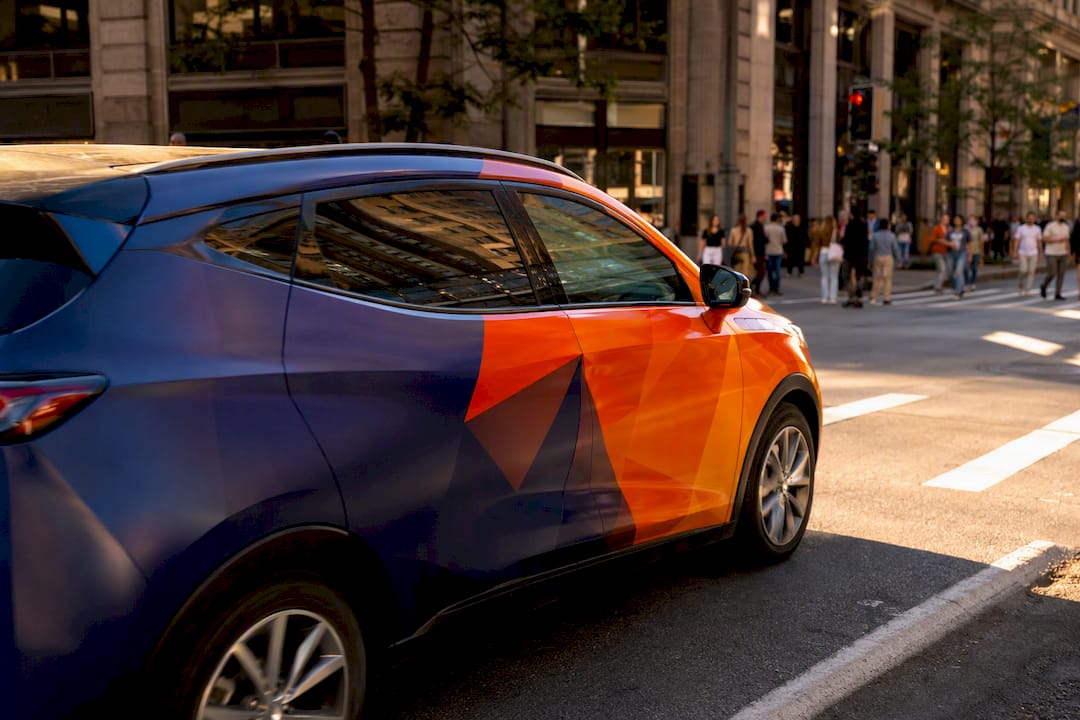
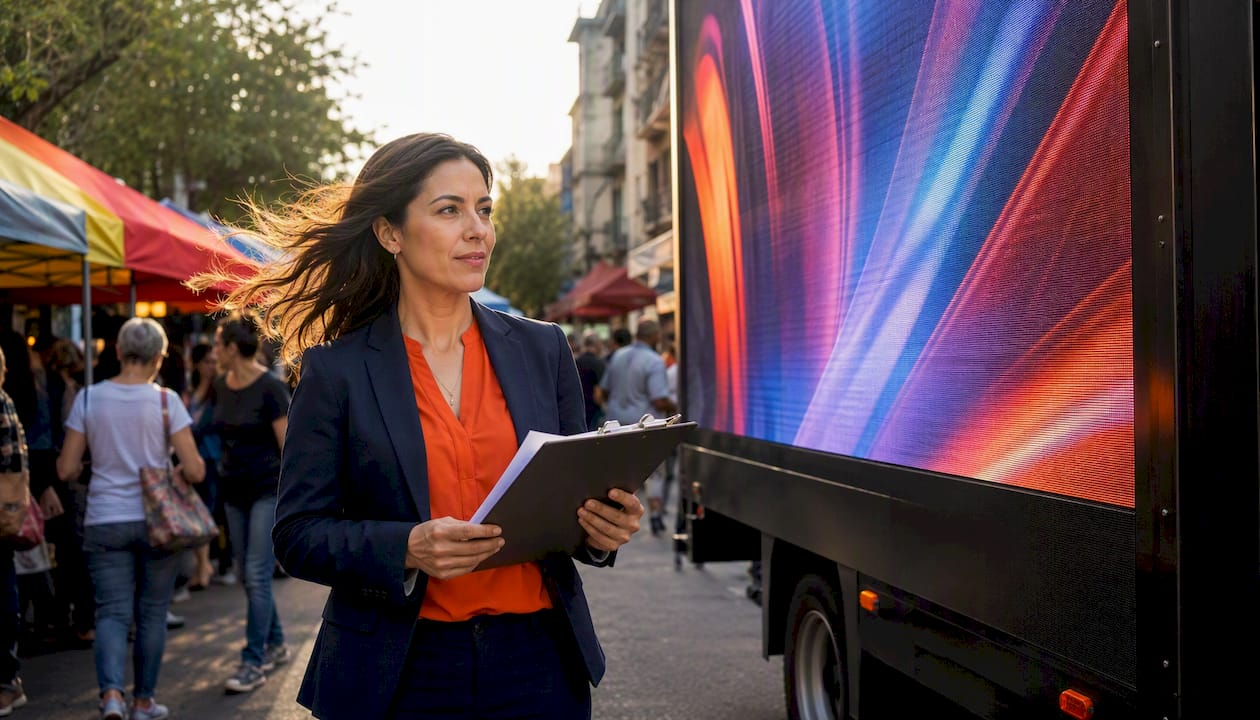
Mobile LED trucks and rideshare-wrapped vehicles are the most flexible format in the city. A truck can follow a conference crowd from the Javits Center to their hotel corridor, circle a competitor’s store opening, or anchor a product launch outside a venue. Wrapped Uber and Lyft vehicles extend that reach across neighborhoods without a fixed route. Beacon-ads’s mobile LED platform adds GPS proof-of-posting, route customization, and digital retargeting to every deployment, which turns a physical impression into a trackable event.
Experiential activations combine OOH with live engagement: branded installations, pop-up structures, and interactive displays. These require the most permitting and logistics but generate the highest earned media when executed well.
Mobile LED trucks can be repositioned mid-flight based on real-time foot traffic data, something no static or digital spectacular can do. For event-driven campaigns, that flexibility is worth more than the reach premium of a fixed spectacular.
Pro Tip: Pair a Times Square digital spectacular with a mobile LED truck deployment for the same campaign week. The spectacular builds reach; the truck activates specific audiences near the venue, conference, or retail location you actually care about. You can learn more about combining OOH formats in Beacon-ads’s format guide.
What does NYC billboard advertising actually cost?
Pricing in New York City’s OOH market varies by format, location, flight length, and whether you are buying directly from a media owner or through a marketplace. The table below gives representative ranges; treat them as planning anchors, not firm quotes.

| Format | Typical Rate | Notes |
|---|---|---|
| Local static bulletin (outer boroughs) | $1,500/month | Production and installation extra |
| Midtown static bulletin | $5,000/month | High-traffic corridors command the top end |
| Bus shelter / street furniture | $1,000/unit/month | MTA-contracted; volume packages available |
| Subway station poster | $2,000/month | Station dominations priced separately |
| Digital spectacular (non-Times Square) | $10,000/month | Impression-based pricing increasingly common |
| Times Square digital spectacular | $25,000/month | Short-term bookings available at premium rates |
| Mobile LED truck | $800/day | Route customization and GPS reporting included with Beacon-ads |
| Rideshare vehicle wrap | $1,500/vehicle/month | Geo-targeted routing available |
Production costs are separate from media costs and are a common budget surprise. A static bulletin print runs costs vary based on size. Digital creative adaptation for a spectacular can run production costs vary for DOOH-ready assets. Mobile LED content is typically simpler to produce but still requires a correctly formatted file.
Permitting adds cost and time. Static wallscapes on private buildings require a Department of Buildings sign permit in New York City. Temporary installations and mobile activations have their own rules. Budget permit fees vary depending on format and location, and add two to four weeks to your timeline.
Negotiation levers that actually move the price: flight length (a 12-week buy gets better rates than a four-week buy), location clustering (buying multiple units from one operator), daypart restrictions on digital inventory (off-peak hours cost less), and production amortization across a longer flight. Curated NYC OOH marketplaces can simplify the buying process, but you still need to negotiate specs, lead times, and permit responsibilities directly.
Pro Tip: Always ask whether the quoted rate includes production, installation, and permitting, or whether those are line items. A $10,000 billboard that requires $4,000 in production and $1,500 in permits is a $15,500 buy.
How do you book a NYC billboard campaign step by step?
The buying process has more steps than most marketers expect the first time. Here is the sequence with realistic time estimates at each stage.
- Write a campaign brief (a few days): Define objective, target audience, geography, flight dates, and budget. The more specific this document, the faster vendors can respond with relevant proposals.
- Audience and reach planning (several days): Use Geopath data and vendor media kits to model impressions, reach, and frequency for candidate locations. The OAAA publishes measurement standards that define how these numbers are calculated.
- Request proposals and media kits (about a week): Contact media owners directly or use a marketplace. Ask for Geopath-audited impressions, available inventory dates, creative specs, and production requirements.
- Negotiate and sign contracts (several days): Key contract items: cancellation terms (most static OOH is non-cancelable after signing), makegood policy, proof-of-posting requirements, and invoicing schedule.
- Creative production and approvals (one to a few weeks): Static production takes longer than digital. Digital spectacular files go through a vendor approval process that can take three to five business days. Never assume same-week turnaround.
- Permitting and installation (up to several weeks): Vendor typically handles this for static placements. Mobile activations may require event permits or street-use permits depending on the route.
- Campaign flight and proof-of-posting (campaign duration): Require GPS coordinates and timestamped photos for every placement. For mobile units, require daily route logs.
- Final reporting (within two weeks of flight end): Impressions delivered, reach and frequency, proof-of-posting documentation, and attribution data if retargeting was activated.
For a Times Square spectacular, minimum lead time is typically multiple weeks. For a local static bulletin, four weeks is usually sufficient. Mobile LED trucks can be deployed in as little as one to two weeks when creative is ready.
- For event-driven buys, work backward from the event date and add a two-week buffer for every step.
- For brand-awareness campaigns, a 12-week flight with a four-week creative refresh cycle is a common structure.
- Always confirm the vendor’s cancellation window before signing. Most static OOH contracts are non-cancelable after execution.
Pro Tip: Ask the vendor to include proof-of-posting requirements in the Statement of Work, not just the email thread. A contract clause is enforceable; an email promise is not.
What are the creative specs for NYC static and digital billboards?
Getting specs wrong costs you time and money. Here is what production teams need before they open a file.
Static bulletins and wallscapes
- Dimensions: supplied by the media owner per unit; confirm before design begins
- Resolution: 300 DPI at final print size minimum; some large-format vendors accept 100 DPI for very large surfaces
- Color profile: CMYK for print; confirm with vendor whether they require ICC profile
- File type: PDF (press-quality) or high-resolution TIFF; EPS accepted by most vendors
- Bleed: typically 0.5–1 inch on all sides; confirm per vendor
- Safety area: keep all critical text and logos at least 10% inside the trim edge
Digital spectaculars and DOOH screens
| Spec | Typical Requirement |
|---|---|
| File type | MP4, static JPG/PNG also accepted |
| Resolution | Varies by screen; common sizes vary |
| Frame rate | 24 fps |
| Loop duration | 10–a short duration (Times Square standard); confirm per unit |
| File size | Under 50 MB per loop |
| Color space | RGB |
| Audio | No audio for most exterior DOOH |
| Safety area | 5–10% inset from all edges |
Motion specs matter more than most buyers realize. A 15-second loop that tries to tell a three-act story will fail. The standard for DOOH creative is one message, one visual, one call to action. High contrast between text and background is non-negotiable in Times Square, where ambient light competes with your display at every hour of the day.
For digital billboard targeting, daypart scheduling means your creative may run at 7 AM in direct sunlight and at 11 PM against a dark sky. Design for both conditions, or ask the vendor for a daypart-specific brightness calibration.
Pro Tip: Submit a test file to the vendor’s upload portal at least five business days before the campaign start date. Most digital spectacular operators run a hardware calibration check that takes 24–48 hours. Missing this step is the most common cause of delayed launches.
What permits and compliance rules apply to NYC OOH placements?
New York City has some of the most detailed sign regulations in the country, administered primarily by the NYC Department of Buildings (DOB) and, for transit placements, the MTA.
- Mobile LED trucks — must comply with NYC commercial vehicle regulations, including weight limits, route restrictions in certain zones, and idling rules. Some event venues and BIDs (Business Improvement Districts) have their own access rules for branded vehicles.
- Times Square — has specific rules managed in coordination with the Times Square Alliance and the DOB. Spectacular displays on Times Square buildings are subject to the Special Midtown District zoning, which actually requires a minimum amount of illuminated signage on certain facades.
In New York City, the permit is not a formality. A wallscape that goes up without a DOB sign permit can be ordered down immediately, and the media owner, not the advertiser, typically bears that risk. Confirm permit status in writing before your campaign launches.
When a vendor says they “handle permits,” ask for the permit number and a copy of the approval before your creative goes to print. For mobile activations, ask for the vehicle registration and any event-specific permits relevant to your deployment dates.
Pro Tip: Include a permit-contingency clause in your contract: if a required permit is not obtained before the campaign start date, the vendor must either provide a comparable alternative placement or refund the media fee for the affected period.
How do you measure reach and validate OOH delivery in NYC?
OOH measurement has improved significantly with Geopath’s audience-based methodology, but buyers still need to know what to ask for and what the numbers actually mean.
Geopath is the industry’s nonprofit measurement organization. Its audited impressions figures are the closest thing OOH has to a standardized currency. A Geopath impression is an opportunity-to-see estimate based on traffic counts, panel visibility, and audience composition data. It is not a guaranteed view, but it is an audited, third-party figure that allows apples-to-apples comparison across placements.
| Measurement Deliverable | What It Measures | When to Require It |
|---|---|---|
| Geopath impressions | Estimated audience exposures per period | Every static and digital placement |
| Reach and frequency | Unique audience reached; average exposures | Brand-awareness campaigns |
| GPS proof-of-posting | Confirms mobile unit location and route | All mobile LED and rideshare deployments |
| Timestamped photo proof | Visual confirmation of display and creative | All formats |
| Route logs | Full path data for mobile units | Mobile LED campaigns |
| Digital retargeting report | Devices exposed near OOH unit, then served digital ads | Campaigns with retargeting layer |
| Web conversion attribution | Visits or conversions from exposed audience | Performance-focused campaigns |
For outdoor ad performance measurement, require a weekly delivery report during the flight and a final report within 10 business days of campaign end. The final report should include total impressions delivered, reach and frequency breakdown, all proof-of-posting documentation, and attribution data if a retargeting pixel was activated.
Smart QR codes on static or mobile OOH add a direct-response layer: a scan event is a confirmed engagement, not an estimated impression. When integrated with a landing page and a retargeting pixel, each scan feeds a CRM workflow and triggers follow-up digital ads to that device.
- Ask every vendor for their Geopath member status and whether their inventory is audited.
- For digital spectaculars, ask for play logs that confirm your creative ran at the contracted frequency.
- For mobile units, GPS route logs should show timestamps, coordinates, and dwell time at key locations.
When does a mobile LED campaign outperform a fixed spectacular?
Fixed spectaculars win on raw reach. Mobile LED wins on precision, flexibility, and attribution. The choice is not either/or; it is a question of which objective is driving the buy.
Mobile-led OOH is the stronger choice when you need to reach a specific audience at a specific time and place: a conference crowd arriving at the Javits Center, a competitor’s store opening in SoHo, a product launch tied to a sporting event at Madison Square Garden. A truck can be routed to circle the venue, park at the entrance, and follow the audience to their next destination. A fixed spectacular cannot do any of that.
Beacon-ads’s mobile LED platform delivers route customization, affinity and demographic audience targeting, GPS proof-of-posting, and integration with digital retargeting. For conference and trade show targeting, the workflow is: deploy the truck near the venue, capture device IDs from exposed pedestrians via geofencing, then serve digital follow-up ads to those same devices after the event ends. The OOH impression becomes the top of a measurable funnel.
The most underused capability in mobile OOH is post-exposure retargeting. Most buyers treat the truck as a reach vehicle and stop there. The brands getting the best attribution are the ones who connect the physical impression to a digital follow-up within 24 hours of exposure.
Contract clauses to require when booking mobile OOH:
- GPS route logs with timestamps, delivered daily during the flight
- Timestamped photo proof at key locations and times
- QR code scan data if smart QR is activated
- Attribution report showing device exposure and downstream digital engagement
- Route modification rights if foot traffic patterns shift during the flight
Pro Tip: Run a one-week mobile LED pilot in a single NYC neighborhood before committing to a full citywide campaign. The pilot gives you real impression data, proof-of-posting documentation, and a baseline for scaling the buy.
Key Takeaways
NYC billboard advertising delivers the highest reach of any U.S. market, but measurable results require the right format mix, Geopath-audited metrics, GPS proof-of-posting, and a vendor contract that locks in attribution reporting from day one.
| Point | Details |
|---|---|
| Format by objective | Use digital spectaculars for broad awareness; mobile LED trucks for geo-targeted, attributable activation. |
| Budget anchors | Static bulletins start at moderate monthly rates; Times Square spectaculars command premium pricing; mobile LED trucks are available with flexible daily rates. |
| Minimum lead times | Plan several weeks for most formats; longer lead times for Times Square spectaculars. |
| Vendor must-haves | Require Geopath-audited impressions, GPS proof-of-posting, timestamped photos, and a final attribution report. |
| Beacon-ads for mobile OOH | Beacon Mobile Media provides route-customized LED trucks with GPS proof-of-posting, geofencing, and digital retargeting across NYC. |
What NYC OOH trends are actually worth your attention right now
The conventional wisdom in NYC OOH is that Times Square is the pinnacle and everything else is secondary. That framing made sense when reach was the only metric that mattered. It does not hold up when your CMO asks you to connect the billboard to a business outcome.
What is working right now is the combination of a short-flight digital spectacular for awareness and a mobile LED deployment for activation. The spectacular gets the brand in front of a large audience. The truck goes to where that audience actually makes decisions: outside the conference, near the retail location, in front of the venue. The QR code on the truck captures the scan. The retargeting pixel captures the device. The attribution report closes the loop.
Short flights tied to specific events are outperforming long-term static buys for brands that have a defined conversion goal. A four-day mobile deployment around a product launch generates more attributable data than a longer static bulletin campaign, even if the static bulletin delivers more raw impressions. The question is not which format reaches more people; it is which format gives you something to show the CFO.
The creative formats cutting through NYC’s visual noise right now are simple: one message, high contrast, a clear action. The brands that try to replicate a digital ad’s information density on a billboard are the ones whose campaigns disappear into the background. A truck with a single bold headline and a QR code outperforms a truck with six copy points every time.
Pro Tip: Before scaling a mobile LED campaign citywide, run a two-neighborhood pilot with QR tracking active. Compare scan rates and retargeting conversion rates by neighborhood. The data will tell you exactly where to concentrate your next flight.
Beacon-ads brings mobile OOH measurement to NYC campaigns
NYC has no shortage of billboard inventory. What most campaigns lack is a way to prove the billboard did anything. Beacon Mobile Media solves that directly: LED mobile billboard campaigns with GPS route logs, timestamped proof-of-posting, geofencing, smart QR lead capture, and digital retargeting built into every deployment. No separate measurement vendor. No guessing whether the truck showed up.

The platform covers all 50 states, which means a campaign that starts in Manhattan can extend to a conference in Chicago or a launch event in Los Angeles without switching vendors or rebuilding the attribution setup. For brands running event-driven or multi-city campaigns, that continuity matters. For brands running a single NYC activation, the data-driven OOH approach gives you a final report you can actually present to a client or a CFO.
Request a campaign estimate at beacon-ads.com and get a proposal with route options, impression estimates, and proof-of-posting documentation included.
Useful sources for verifying specs, permits, and market data
Before you finalize a NYC OOH buy, these are the authoritative sources worth bookmarking.
- Outdoor Advertising Association of America (OAAA)
- Advertisement & Sponsorships | Times Square Alliance
- Targeted Advertising in New York City | Broadsign Billboard & OOH Packages
- List of television stations in North America by media market — Wikipedia
- Times Square Billboard: Your Photo on Display Now!
- Top 3 LED Mobile Billboard Agencies for ledtruckmedia.com Alternatives 2026 — Beacon Mobile Media
- How to target conferences and trade shows with LED mobile billboards — Beacon Mobile Media
| Source | What It Covers | When to Use It |
|---|---|---|
| OAAA | Measurement standards, member operators, buyer guides | Validating Geopath metrics and vendor credentials |
| Times Square Alliance | Spectacular inventory, display specs, sponsorship contacts | Planning or buying Times Square placements |
| Broadsign NYC Marketplace | Curated inventory packages across NYC venues | Discovery and package comparison |
| NYC DOB | Sign permits, structural requirements | Before any static wallscape or bulletin installation |
| NYC DOT | Street-use permits, temporary installations | Experiential activations and mobile route planning |
| Beacon-ads | Mobile LED specs, proof-of-posting, retargeting setup | Mobile OOH campaign planning and booking |
Always request a media kit and proof-of-posting documentation from every vendor before signing a contract. A vendor who cannot produce both before the campaign starts will not produce them after.