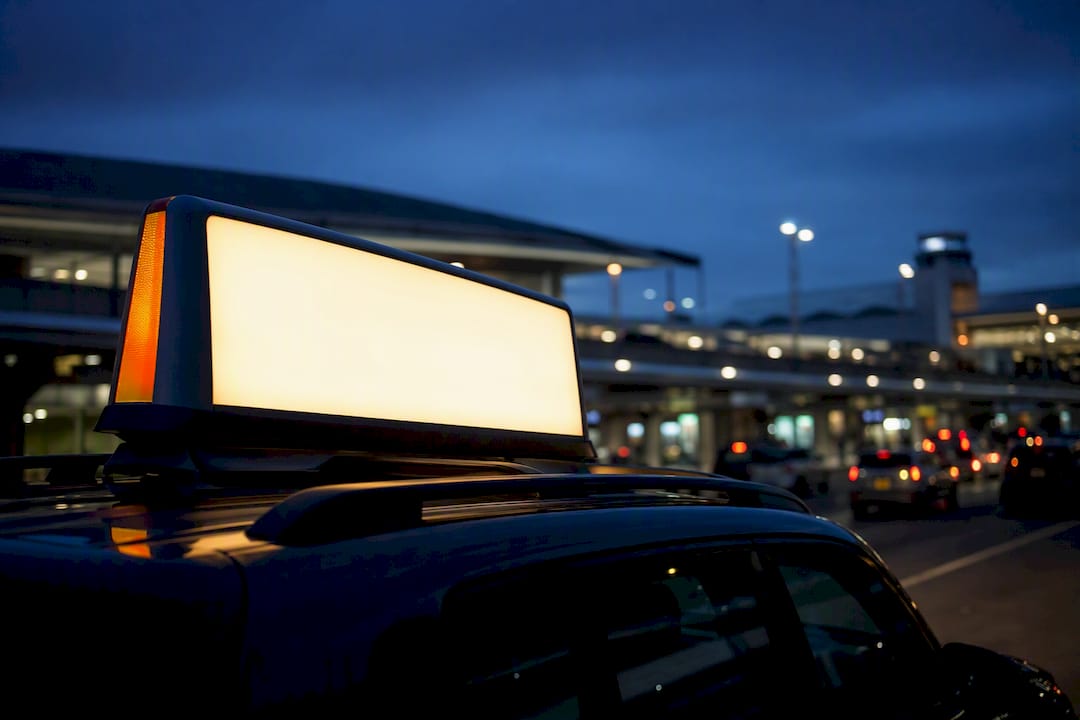
OOH dayparting means dividing the day and week into defined segments and deciding what your out-of-home ad shows, where, and when in each one. A billboard truck near a stadium at 6 p.m. on game day is doing a different job than the same truck near a business district at 8 a.m. on a Tuesday. If you plan around the clock instead of around a flat 24/7 schedule, you spend media dollars when your audience is actually there.
This guide is for marketers and agencies buying mobile out-of-home: LED billboard trucks and wrapped rideshare vehicles. It covers what a daypart is, how to build a schedule, how to measure it, and the mistakes that waste budget.
TL;DR
- A daypart is a defined segment of the day or week used to schedule, report and optimize ads around audience activity.
- Mobile OOH is easier to daypart than fixed signs, because the inventory can move to where the audience will be, not just change what it displays.
- Build dayparts from location data on how your audience moves, not from guesses about “rush hour.”
- Tie each daypart to a measurable action, such as a QR scan, a retargeting audience or a store visit, so you can compare segments.
- Start with three or four dayparts, review results weekly, and shift budget toward the segments that convert.
Table of Contents
- What a daypart means in out-of-home
- Why mobile OOH changes the dayparting question
- Build dayparts from audience movement, not habit
- A real example of dayparting at work
- Micro-dayparting: going finer than “morning” and “evening”
- Match the creative to the daypart
- Measuring a daypart without fooling yourself
- Our perspective: fewer dayparts, tested harder
- Plan a daypart-based mobile campaign with us
- Common dayparting mistakes
- A simple workflow to set up your first schedule
- FAQ
- Sources
What a daypart means in out-of-home
The term comes from broadcast, but out-of-home has adopted it with a precise meaning. In the Media Rating Council’s out-of-home measurement standards, a daypart is a specific period or segment of the day during which a particular type of advertising is displayed. The same standards require that exposure metrics align with the contracted daypart. In plain terms: if you buy the 7 a.m. to 10 a.m. window, the numbers you get back should describe that window, not a blended all-day average.
The Out of Home Advertising Association of America (OAAA) uses the idea the same way. Its buyers guide for video out-of-home describes dayparts such as morning rush hour or weekend evenings, used to schedule, report and optimize content around when a target audience is active.
A quick note on spelling, since readers ask: the industry standard is “daypart” as one word, and “dayparting” for the practice. You will see “day part” and “day-parting” in older documents, but the standards documents above use the one-word form.
Dayparting is not the same as ad scheduling in search
Most pages that rank for this term describe dayparting in paid search or Amazon ads, where you adjust bids by hour. Out-of-home works differently. You usually are not bidding in an auction by the second. You are choosing routes, hours, creative and sometimes physical placement, then proving afterward who was exposed. The logic is the same (right message, right moment), but the levers and the measurement are different.
Why mobile OOH changes the dayparting question
A fixed billboard sits in one place. Its audience changes through the day, but the sign does not. You can swap creative on a digital face, and that is useful, but the location is a fixed bet.
Mobile out-of-home removes that constraint. An LED truck can park near a commuter hub in the morning, move to a lunch district at noon and sit near an evening venue after work. A wrapped rideshare vehicle follows the demand patterns of the city itself, which means exposure naturally clusters around commutes, nightlife and airport runs.
The OAAA’s guidelines for digital moving out-of-home point at the core challenge: with moving inventory, you are not only counting people, you are accounting for the movement of the media itself. The practical consequence is that you should map impressions against audience segments over time, not against a single static location.
That is why a mobile daypart has three parts, not one:
- When: the hours and days.
- Where: the route or zone the vehicle covers in that window.
- What: the creative and call to action shown to the people there.
Build dayparts from audience movement, not habit
The default plan is “morning commute, lunch, evening commute.” It is a fine starting point, but it is a guess. Modern planning leans on anonymous mobile location data. Geopath, the industry’s audience measurement organization, explains in its methodology that its aggregated, anonymous audience insights unify billboards, street furniture, transit and place-based media into one connected resource. The point for a planner: you can ask how a specific audience segment moves through the day, instead of relying on old traffic counts.
The OAAA frames this as a shift from location to audience. Reaching people in a geography has always been OOH’s strength. The newer question is which people, at what time.
A starter daypart framework
Use this as a draft, then test it against your own audience data.
| Daypart | Typical window | Who is often there | Creative approach | Best action to measure |
|---|---|---|---|---|
| Morning commute | 6 a.m. to 10 a.m. weekdays | Commuters, early shift workers | Short, clear offer; coffee, breakfast, services | QR scan, retargeting audience built |
| Midday | 11 a.m. to 2 p.m. | Office and retail foot traffic, lunch crowds | Local, immediate offers | Store or venue visit |
| Evening commute | 4 p.m. to 7 p.m. weekdays | Commuters, errands | Considered purchases, appointments | QR scan, landing page visit |
| Evening and nightlife | 7 p.m. to midnight | Diners, event-goers, entertainment seekers | Event promotion, food, rides | Event proximity visits |
| Weekend daytime | Sat and Sun, 10 a.m. to 5 p.m. | Shoppers, families, sports fans | Retail, local services, seasonal | Store visits, QR scans |
These windows are illustrative, not industry rules. A trade show hall, a college town and a suburban mall each have their own rhythm.
A real example of dayparting at work
The OAAA’s buyers guide describes a national case: a quick-service restaurant promoted a breakfast deal on gas station screens and day-parted the ads to reach morning commuters, then used mobile location data to measure the result. The lesson carries over to mobile billboards. The offer, the audience and the hour all pointed at the same moment, and the measurement was designed before the campaign ran.
The guide also notes that dayparting is about relevance, not only reach. It lets you tailor a message to factors like time of day, weather and traffic conditions.
Micro-dayparting: going finer than “morning” and “evening”
High-level dayparts are common. Practitioners who get more from the medium go finer, aligning rotations with hyper-local patterns: a congested corridor at 5:15 p.m., a rainy Friday, a stadium letting out. The same OAAA guide reports that about half of consumers find weather- or traffic-aware messaging more relevant than static messaging.
Examples of micro-dayparts that work for mobile units:
- Pre-event window: the 90 minutes before doors open at a conference, concert or game, when attendees are arriving and deciding where to eat or what to visit.
- Session breaks at a trade show: when attendees leave the hall for lunch or between keynotes.
- Post-event window: when people leave and look for a restaurant, a ride or a hotel bar.
- Traffic-driven windows: slow-moving congestion gives longer viewing time than free-flowing traffic, so a message with a bit more copy can work.
If you are targeting a show, our guide on how to target conferences and trade shows with LED mobile billboards walks through how to plan around the event schedule.
Match the creative to the daypart
Dayparting fails when the schedule changes but the creative does not. Three adjustments matter most.
Change the ask, not just the picture. A morning audience is moving fast and has little patience: one offer, one QR code. An evening or weekend audience has more time and can take a richer message.
Use the QR code as the daypart’s tracking key. If each daypart carries its own code or landing parameter, you can see which windows drive scans. Our QR code engagement guide covers design and placement so the code is scannable from a moving or stopped vehicle, and the guide on how to leverage QR codes outdoors goes deeper.
Keep the legibility rules constant. Whatever the hour, an LED face seen at distance needs large type, high contrast and few words. Night brightness and daytime glare change how the same design reads, so check proofs in both conditions.
Measuring a daypart without fooling yourself
A daypart you cannot measure is just a hunch with a schedule. Four measurement practices keep the numbers honest.

1. Insist on exposure reporting that matches the window
As noted above, the MRC standards call for exposure metrics aligned to the contracted daypart. They also draw a line between general impressions and ad impressions: dwell time should be counted only while the ad content is actually viewable, not the whole time a screen is active in a loop. When you compare vendors or reports, ask which definition is used.
2. Require proof of posting
For a mobile campaign, you want to know the vehicle was where the plan said, when the plan said. GPS logs and time-stamped photos give you that. Without them, a “morning commute” daypart is a claim, not a record.
3. Connect exposure to a digital action
Industry guidance recommends pairing dayparting with digital retargeting so that physical exposure can be linked to something countable, such as a QR scan or a visit. The OAAA’s paper on OOH data and its uses covers how audience data bridges the physical and the digital. For a marketer’s view of closing that gap from the digital side, this piece on overcoming digital marketing challenges is a useful companion read.
If you want the mechanics, see our tutorials on out-of-home ad retargeting and geofencing versus geotargeting.
4. Compare dayparts on one metric
Pick a single primary measure before launch (scans per thousand impressions, cost per lead, visit lift) and compare every daypart against it. Reporting five different metrics per window makes it easy to find a winner after the fact and hard to be right.
Privacy matters here too. Location-based measurement should use anonymous or properly consented data. Our summary of geofencing legal gates for U.S. marketers lays out what to confirm before you launch.
Our perspective: fewer dayparts, tested harder
We run mobile OOH for a living, and the pattern we see most often is over-engineering. A planner builds twelve dayparts, splits a modest budget across all of them, and ends up with too little exposure in each window to learn anything.
Our view is simple:
- Start with three or four dayparts that your audience data supports, and give each enough media weight to produce a readable result.
- Let the vehicle do the work that a fixed sign cannot. The reason to use a truck or a wrapped rideshare car is that location can change with the hour. If your plan keeps a truck in one place all day, you are paying for mobility you are not using.
- Build the measurement in first. Smart QR codes, geofenced audiences and real-time retargeting let us connect a daypart to an action, and proof-of-posting with GPS and photos shows the plan was executed as written.
- Review weekly and move budget. Short lead times let us shift routes and hours while a campaign is live, so a weak window does not run to the end of the flight.
Dayparting is not a trick for getting more out of a media buy. It is a way of being honest about when your audience can actually be reached.
— Scott
Plan a daypart-based mobile campaign with us
Beacon Mobile Media runs LED mobile billboards, wrapped rideshare cars and localized mixed media campaigns across all 50 states, with route customization, geofencing, audience filtering, smart QR codes, proof-of-posting and attribution reporting. If you want a schedule built around your audience’s day, tell us about your campaign and we will map the dayparts, routes and measurement together. For a closer look at the truck format, read our LED ad truck guide.
Common dayparting mistakes
Treating “rush hour” as one thing. Morning and evening commutes draw different people in different moods, and different cities have different peaks. Check the data.
Slicing too thin. Many tiny segments produce noisy results. If a window will deliver only a few hundred impressions, merge it with a neighbor.
Ignoring the day of the week. A Tuesday at 8 a.m. and a Saturday at 8 a.m. are not the same daypart. Weekday and weekend patterns should be planned separately.
Scheduling without a reason. Dayparting should follow a specific audience behavior or business constraint (a restaurant that serves breakfast only until 11, a venue open evenings). If you cannot state the reason, you probably do not need the cut.
Skipping the retargeting layer. Exposure without a follow-up is hard to attribute. Linking each daypart to a retargeting audience and a QR code keeps the loop closed. Our guide to targeted out-of-home advertising explains how those pieces fit together.

If you want to see how timing, route and format come together in practice, our post on the best times for mobile billboards is a good next read.
A simple workflow to set up your first schedule
- Define the audience and the action. Who do you need, and what should they do (scan, visit, call)?
- Pull movement data. Use location-based audience insight to see when and where that audience concentrates.
- Choose three or four dayparts and assign each a route or zone.
- Write creative per daypart. Change the offer or call to action, not only the visual.
- Tag each window. Separate QR codes or link parameters for each daypart.
- Confirm reporting terms. Exposure by daypart, proof-of-posting, and the definition of an impression.
- Launch, review weekly, reallocate. Move hours from the weakest window to the strongest.
FAQ
What does OOH stand for in marketing?
OOH stands for out-of-home, meaning advertising that reaches people while they are outside their homes. The OAAA’s planning guide describes it as a mix of billboards, digital displays, transit, street furniture, cinema and place-based media. Mobile billboards and wrapped rideshare vehicles belong to the same family.
What is a daypart in advertising?
A daypart is a defined segment of the day or week during which an ad is scheduled and reported. Examples include morning commute, midday and weekend evenings. In out-of-home, reporting should line up with the daypart you contracted.
Is it daypart or day part?
The standards documents from the Media Rating Council use “daypart” as one word, and that is the form we recommend. “Day part” and “day-parting” still appear in some older material, and most readers will understand them.
What are examples of OOH advertising?
Common formats include roadside billboards, digital bulletins, transit shelters, bus and taxi advertising, LED billboard trucks, wrapped rideshare cars and place-based screens in malls and offices. A Nielsen study for the OAAA found that 82% of U.S. respondents had noticed roadside billboards in the past month. For campaign examples, see our overview of rideshare advertising examples.
Can you daypart a rideshare wrap?
Not in the same way you schedule a digital screen, because a wrap is static. You influence timing through the vehicles, routes and hours you select, and you verify the result through location-based reporting. LED trucks offer more direct control, since both the route and the displayed creative can change through the day.
Sources
- Media Rating Council: Out-of-Home Measurement Standards
- OAAA: Video Out-of-Home Buyers Guide
- OAAA: Digital Moving OOH Exposure Guidelines
- Geopath: Methodology
- OAAA: Understanding Out of Home Data and its Uses
- OAAA: Planning for OOH Media
- Nielsen and OAAA: OOH Advertising Study 2016