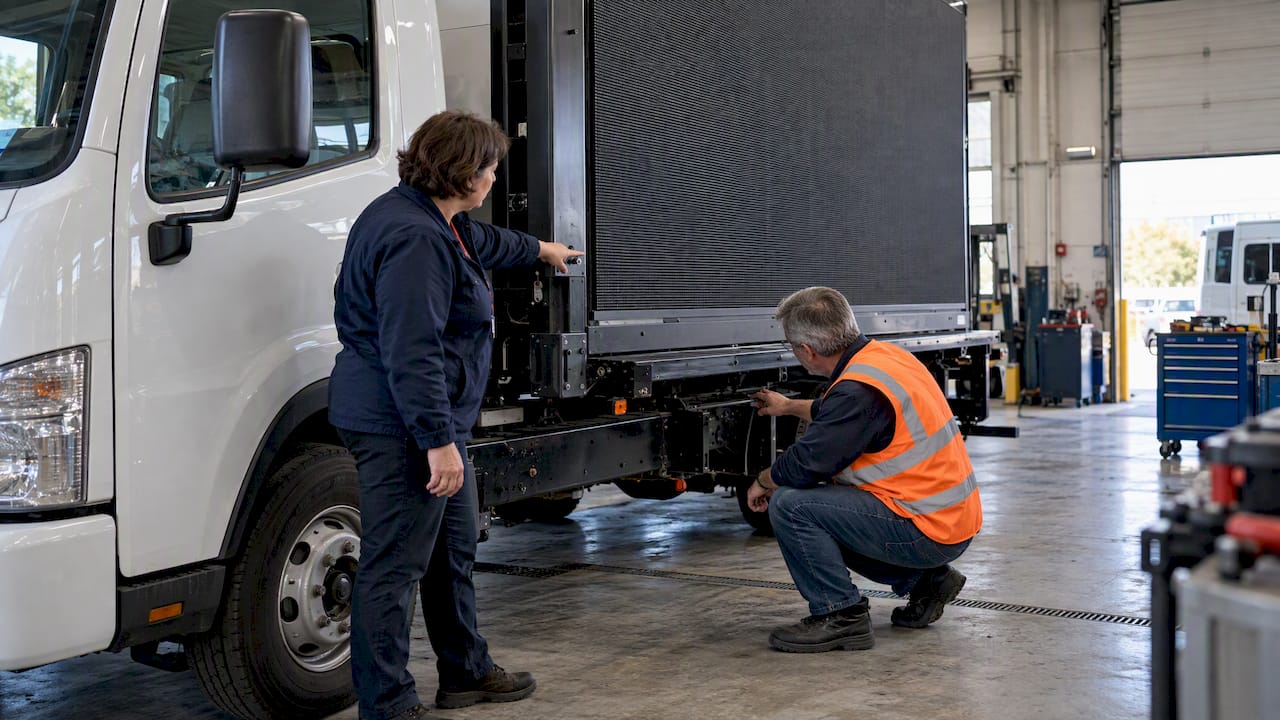
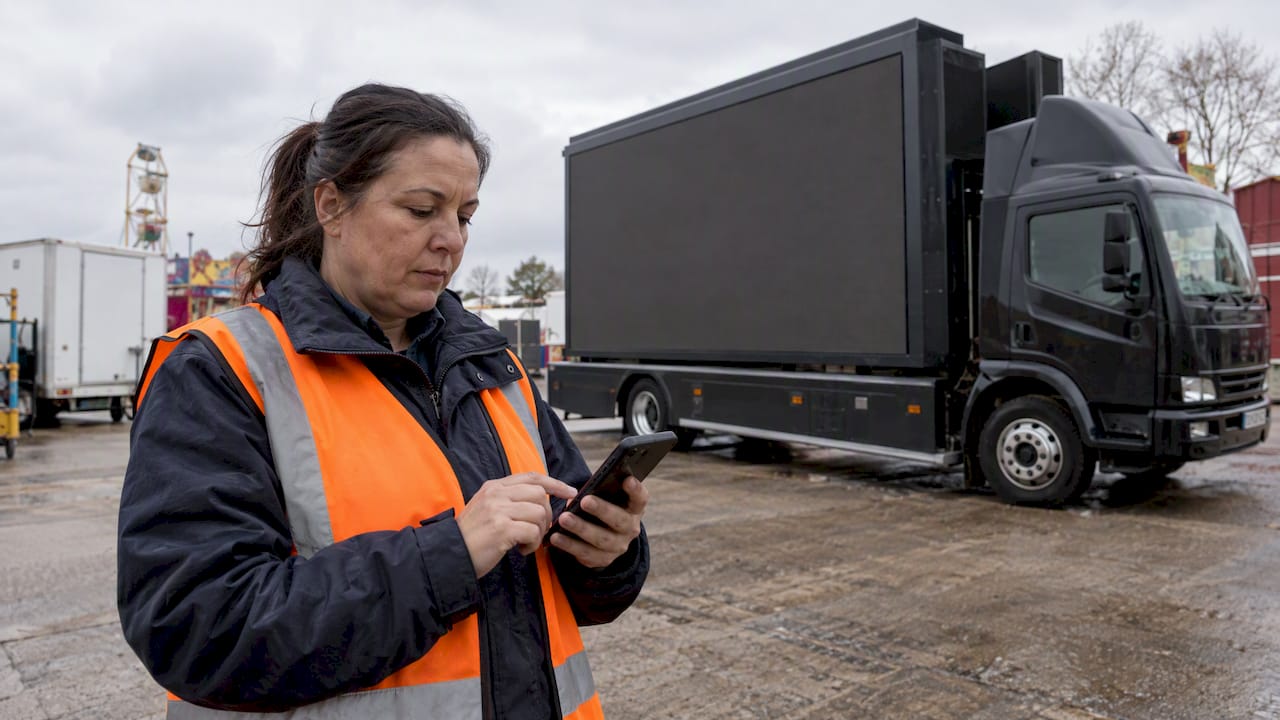
A good billboard truck route starts with your audience, not your map. Pick the corridors where your buyers actually travel, schedule the truck for the hours they travel them, and demand proof that the truck was where the contract said it would be. Everything else is detail, and this guide covers that detail.
We run LED mobile billboard and wrapped rideshare campaigns across the United States, so this is written for marketing teams, agencies and event organizers who are about to brief a route and want to avoid paying for empty miles.
TL;DR
- Build the route around a defined audience and a single goal, then choose corridors, venues and time windows to match.
- Schedule around peak travel: nearly 25% of daily OOH audience falls between 4 p.m. and 7 p.m., so a route that is strong at 2 p.m. can be weak at 5 p.m.
- Mobile exposure is inferred from GPS breadcrumbs, so ask how the provider handles gaps and verifies the route.
- Judge cost by effective CPM and total campaign cost, not by the day rate alone.
- If you add retargeting to a route, confirm consent and data-partner compliance before launch.
Table of Contents
- Why the route is the product
- Start with the audience and one goal
- The four route patterns we plan around
- Match the route to peak hours
- A worked example: a three-day trade show route
- LED truck or wrapped rideshare car?
- How mobile exposure is measured
- Proof of posting that holds up
- What a route really costs
- Our perspective
- Adding retargeting without creating risk
- Check the rules on your route
- A seven-step route brief
- Plan your route with us
- FAQ
- Sources
Why the route is the product
A fixed billboard sells a location. A billboard truck sells a path. You are not buying a screen, you are buying where that screen goes, when, and how many of the right people see it on the way.
That matters because the money in the category is large and still growing. U.S. out-of-home revenue reached a record $9.46 billion in 2025, with digital formats accounting for 36.3% of the total. Buyers are putting more budget into formats that can be changed and measured, and a mobile route is one of the most flexible of them.
It is also the format where a weak plan costs you the most. A static board that sits on a mediocre road still gets seen by that road’s traffic. A truck on a mediocre route burns fuel and driver hours in front of people who will never buy from you.
Start with the audience and one goal
Before you open a map, write two sentences: who needs to see this, and what should they do afterward. A retailer announcing a grand opening, a software company at a conference and a political-free brand launch in a new metro each need a different route.
Useful goal types for a route:
- Footfall: send people to a store, showroom or venue.
- Awareness in a defined zone: own a neighborhood, a campus district or a downtown for a few weeks.
- Event pull: reach attendees and exhibitors before and during a show.
- Lead capture: put a scannable code in front of people who can act on it now.
Once the goal is set, the route choices become easier to defend. If a stop or a street does not serve the goal, it comes off the route.
The four route patterns we plan around
Most effective billboard truck routes are a variation of four shapes.
Corridor loops
The truck circulates a loop of arterial streets and a stretch of freeway or boulevard. It suits awareness campaigns in a metro where your audience commutes. Loops let you hit the same drivers several times, which builds frequency without extra media.
Venue ring routes
The truck circles a venue or cluster of venues: a convention center, a stadium district, a hospital campus, a retail center. Dwell time is higher because traffic around venues is slow and people are looking around. AdQuick’s guide makes the same point: slow-moving traffic zones and pedestrian corridors give ads more time to be read, which can justify higher pricing.
Hub-and-spoke routes
The truck starts at your location, travels out along the roads customers use to reach you, and returns. It suits local businesses with a trade area, and it works well with a short promotion that has an address attached.
Daypart routes
The route changes by time of day: business districts in the morning, shopping and dining areas at midday, commuter corridors and entertainment districts in the evening. This is the pattern that most rewards planning, because the same truck serves different audiences at different hours.
Match the route to peak hours
Traffic volume is not flat. According to Geopath, the industry’s measurement body, close to a quarter of the total daily audience for OOH media occurs in the three hours between 4 p.m. and 7 p.m. For a truck, that means the evening commute is the most valuable block on the schedule in most markets.
In practice:
- Reserve the 4 to 7 p.m. window for your densest corridors.
- Use mornings for office districts and school or campus zones if they match your audience.
- Use midday for retail clusters, lunch districts and tourist areas.
- Check local weekday and weekend patterns. A shopping district can be a different place on Saturday.
If you are promoting an event, align the truck with arrival times and the surrounding traffic. Pairing the route with promotion on Instagram for event organizers keeps people who see the truck seeing the same message on their phones.
A worked example: a three-day trade show route
Say a B2B software company is exhibiting at a downtown convention center and wants booth traffic. A route we would sketch:
| Time | Route focus | Reason |
|---|---|---|
| 7 to 9 a.m. | Hotel district and main arrival roads | Attendees are heading to the venue |
| 9 a.m. to noon | Ring around the convention center | Slow traffic, pedestrians, rideshare drop-offs |
| Noon to 3 p.m. | Restaurants and nearby business district | Lunch crowds and local decision makers |
| 4 to 7 p.m. | Main commuter corridor and hotel-to-venue roads | Peak audience, evening events |
A smart QR code on the creative gives the booth a way to turn a glance into a conversation. For more on this scenario, see our guide to targeting conferences and trade shows with LED mobile billboards.
LED truck or wrapped rideshare car?
The vehicle type changes the route logic.
| LED billboard truck | Wrapped rideshare car | |
|---|---|---|
| Route control | You set it, stop by stop | Follows driver trips, shaped by the zones and hours you choose |
| Creative | Animated, changeable by daypart | Static wrap |
| Best for | Events, launches, dense zones, timed messages | Broad, sustained presence across a metro |
| Reach pattern | Concentrated and scheduled | Distributed and continuous |
Many campaigns combine both: trucks for the moments and places that matter most, rideshare wraps for the background presence between them. We cover the format in more depth in what “LED on wheels” means for mobile OOH buyers and show real setups in examples of rideshare advertising.
How mobile exposure is measured
This is the part many buyers skip, and the part that separates a plan from a guess.
A fixed billboard has an audited viewshed. A moving truck does not. According to the OAAA’s exposure guidelines for moving OOH, mobile exposure has to be inferred from vehicle GPS data as continuous line segments rather than observed directly. If too much time passes between two GPS points, the segment can become inconclusive, and exposure for that stretch cannot be verified.
What to ask a provider:
- How often does the vehicle report its position?
- What happens in tunnels, garages and dense downtowns where GPS drops?
- Does the routing engine account for speed, traffic and the actual road, or does it just draw straight lines between points?
Transit-type media also needs its own calibration. Geopath’s transit methodology aggregates circulation by operational units such as garages or depots, and uses an opportunity-to-see approach that counts only people who could physically have seen the ad, based on orientation and proximity. When a vendor quotes impressions, ask which method sits behind the number.
Proof of posting that holds up
Your report should show where the truck was and prove it. The OAAA’s modeling best-practices paper stresses complete coverage of the campaign geography, and the practical takeaway for buyers is to ask for GPS timestamps plus photo evidence, in the same place you track your other campaign numbers. Impressions that are only modeled, with no unit-level validation behind them, are the weak link.
Our reporting includes proof-of-posting with GPS and photo tracking, and attribution analytics that tie the route to outcomes. If you want to see how we test effectiveness quickly, read how marketers can prove mobile billboard effectiveness in two weeks.
What a route really costs
The day rate is only part of it. Industry sources put traditional static billboard CPMs at roughly $3 to $6, with an average near $3.65, while digital rotations can run $12 to $24 or more depending on rotation frequency. Those are market ranges, not our pricing, and a truck is not a rotation on a shared board, so treat them as a rough yardstick only.
A better lens is effective CPM. AdQuick’s guide argues that value is no longer the lowest media cost, and recommends counting the full campaign cost, including creative production, trafficking and measurement. Budget for the extras: creative production and data or compliance integration are the line items that tend to get left out of early quotes, and the OAAA modeling paper is the source for that warning.
We do not publish campaign prices, because they depend on route, hours, market and add-ons. For a framework on payback, see our breakdown of mobile billboard cost and break-even and the ROI formula.

Our perspective
We have seen the same mistake repeatedly: a team picks a route because it passes the places everyone knows, then wonders why nothing moved. The route that looks impressive on a map is rarely the route that does the work.
Three convictions shape how we plan:
- Audience first, then geography. Geofencing, affinity targeting and demographic filtering let us tie a route to who is likely on it, not only how many cars pass.
- A route is a hypothesis. With real-time retargeting and scan data from smart QR codes, we can see which stretches and hours earn attention and adjust. Short lead times and national coverage make that adjustment practical.
- Measurement is part of the media. Proof-of-posting and attribution are not an add-on report at the end. They are how you know whether to renew.
A truck that loops the same boulevard on a fixed schedule for a month, with no review, is not a data-driven campaign, whatever the deck says.
— Scott
Adding retargeting without creating risk
Pairing a route with digital retargeting can extend a single pass into a longer conversation. It also brings location data into the plan, and regulators are paying attention. The FTC has banned a data broker from selling precise consumer location data in an enforcement action built around consent and opt-out failures.
Before you launch:
- Ask where audience data comes from and how consent was obtained.
- Confirm there is a clear opt-out and deletion path.
- Get the answers in writing from your vendor and your data partners.
Our 10 to 14 day retargeting pilot is built around consent proof, and our digital targeting tips cover the planning side.
Check the rules on your route
Municipal rules vary. Some cities restrict where mobile billboards can run or park, and requirements for permits and insurance differ by place. Confirm the rules in each city on your route before you commit, and ask your provider to document compliance. Our mobile billboard insurance checklist covers the coverage questions.
A seven-step route brief
- State the audience and the single outcome.
- List target zones and venues, ranked by value.
- Assign dayparts, with the 4 to 7 p.m. block going to your best corridors.
- Decide the vehicle mix: truck, rideshare or both.
- Add a trackable call to action, such as a smart QR code.
- Specify reporting: GPS timestamps, photos, attribution.
- Set a review point in the first week and be ready to move the route.
For a more detailed local process, see our localized marketing workflow and targeted route planning for local campaigns.
Plan your route with us
If you have a market, an audience and a date, we can turn them into a route. Beacon Mobile Media offers LED mobile billboards, wrapped rideshare cars and localized mixed media campaigns in all 50 states, with geofencing, route customization and proof-of-posting reporting included in the plan. Tell us what you want to achieve and we will propose where the truck should go. Start at beacon-ads.com.
FAQ
How do I choose the best route for a billboard truck?
Start with who you want to reach and what you want them to do. Then choose corridors and venues where that audience travels, and schedule the busiest corridors for the 4 to 7 p.m. window. Review results early and shift the route if some stretches underperform.
Can I see exactly who saw my billboard truck?
Not exactly. Mobile exposure is inferred from GPS data and routing models, not directly observed. You can strengthen the picture with proof-of-posting photos, scan data from QR codes and attribution reporting.
Is a billboard truck better than a static billboard?
It depends on the goal. A static board gives constant presence in one place, while a truck lets you go to the audience, change creative by time of day and concentrate around events. Many campaigns use both.
How long should a billboard truck campaign run?
There is no single answer, because it depends on goal and market. An event may need a few days, while an awareness push needs enough weeks to build frequency. We recommend setting a review point in the first week and adjusting from there.
Sources
- Out of Home Advertising Revenue Reaches Record $9.46 Billion, OAAA
- Geopath
- AdQuick: Cost-Effective Digital Billboard Guide
- OAAA Digital Moving OOH Exposure Guidelines, 2022
- Geopath transit research
- OAAA Modeling Best Practices White Paper
- Mad Genius: Billboard Advertising, Effective as Ever in 2025
- FTC order on selling precise consumer location data