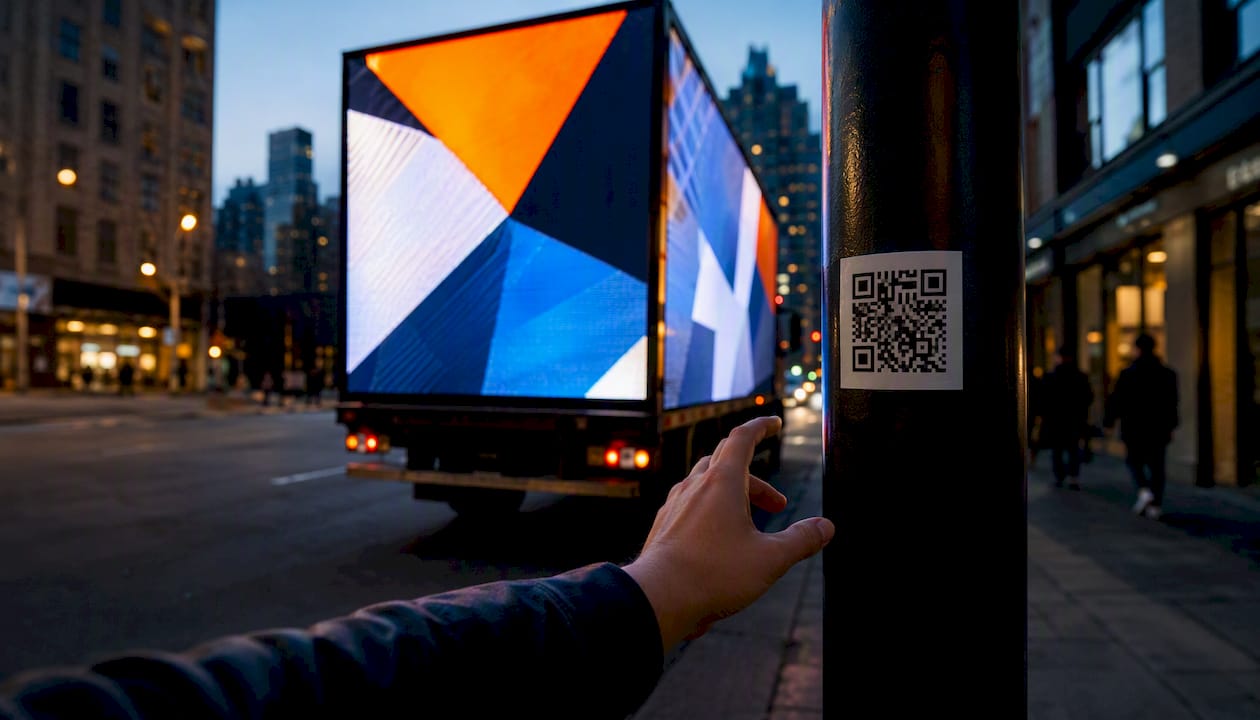
Here, mobile billboard insurance means choosing a mobile out-of-home advertising provider, whether an LED truck fleet or a wrapped rideshare program, that backs every mile with route customization, proof-of-posting, and attribution-ready data exports. There are in-market options built around those standards. The sections below walk through the shortlist, the vetting checklist, and the measurement, permit, and pricing questions that separate a vendor you can audit from one you simply have to trust.
TL;DR:
- Ensure the mobile billboard provider supplies route-level GPS data, timestamps, and playlogs to verify delivery and prevent vague reach claims.
- Confirm that measurement reports include synchronized GPS traces, timestamps, media position metadata, and are tied to creative identifiers for auditability.
- Use Geopath’s methodology to differentiate opportunity-to-see from likely-to-see impressions, ensuring reach estimates reflect actual visibility.
- Verify coverage for permits and compliance in each target city before campaign launch to avoid delays, fines, or mid-flight halts.
- Recognize that pricing depends on campaign length, vehicle count, route complexity, and digital add-ons, with regional operators often faster on permits than nationwide providers.
Table of Contents
- Shortlist: Beacon Mobile Media and practical service categories to consider
- The checklist and contract questions that vet a vendor
- How Geopath models reach, frequency, and visibility
- Proof-of-posting: what a real delivery report contains
- Retargeting and attribution need different data
- Getting QR and NFC touchpoints right on a moving ad
- Permits and local compliance risks that can derail a campaign
- What pricing shapes and lead times to expect
- Liability, physical damage, and cargo coverage on ad vehicles
- Common risks in mobile billboard campaigns and how coverage responds
- How to apply for coverage: process and documentation
- Who provides specialized coverage for mobile advertising fleets
- What drives the cost of coverage up or down
- Insurance requirements vary by state and city
- What actually separates a trustworthy mobile OOH vendor
- Get a measurable mobile campaign running
- FAQ
- Sources
Shortlist: Beacon Mobile Media and practical service categories to consider
Four kinds of providers show up when marketing teams start sourcing mobile out-of-home campaigns, and each fits a different brief. Nationwide operators that pair LED trucks with wrapped rideshare vehicles, large national LED truck networks, regional fleet operators, and standalone rideshare wrap programs all compete for the same budget line, but they are not interchangeable.
We run Beacon Mobile Media as a nationwide option combining LED mobile billboards and wrapped rideshare cars with geofencing, real-time retargeting, and attribution-ready reporting. National LED truck networks tend to offer broad daytime coverage across many markets, useful when a brand needs visibility in several cities at once. Regional fleet operators specialize in one city or region, often with faster local permit handling because of standing relationships with city offices. Rideshare wrap programs concentrate on dense urban impressions and point-of-decision proximity near event venues and retail corridors.
| Provider | Best for | Targeting & digital features | Measurement & reporting | Inventory type |
|---|---|---|---|---|
| Beacon Mobile Media | Measurable, data-driven local and multi-market campaigns needing attribution-ready reporting | Geofencing, real-time retargeting, smart QR/NFC capture | Proof-of-posting, GPS playlogs, attribution exports | LED trucks and rideshare wraps, nationwide |
| National LED truck networks | Broad-reach daytime campaigns and large-market brand presence | Varies by operator | Varies by operator | LED trucks, wide geographic coverage |
| Regional fleet operators | Targeted local campaigns and single-city event activations | Varies by operator | Varies by operator | LED trucks, flexible local routing |
| Rideshare wrap programs | Event promotions and dense urban reach | Varies by operator | Varies by operator | Rideshare wraps, concentrated in metro cores |
A few things to keep in mind as you narrow the list:
- National networks win on footprint, but ask each one directly whether they supply route-level GPS data or only aggregate mileage.
- Regional operators often move faster on permits since they already know a city’s sign and vehicle ordinances.
- Rideshare wraps deliver strong pedestrian proximity but typically cover a smaller radius per vehicle than an LED truck route.
The checklist and contract questions that vet a vendor
Before signing anything, run every mobile out-of-home proposal through the same checklist. Treat these as non-negotiables, not nice-to-haves.
- Does the vendor supply GPS coordinates with start and end timestamps for every play, not just a daily summary?
- Will they provide playlogs tied to Ad-ID or an equivalent creative identifier, matching the OAAA’s moving-OOH exposure guidance?
- Can they export a full route map, not a marketing summary of “neighborhoods covered”?
- What formats do delivery reports export in, and can your analytics team ingest them directly?
- Do they distinguish between measurement (exposure) and attribution (outcome), per OAAA’s measurement and analytics guidance?
- How do they handle CCPA and mobile ad ID consent when retargeting is part of the package?
Pro Tip: Ask for a sample delivery report from a past campaign before you sign; if a vendor hesitates to show one, that is itself an answer.
Watch for red flags: a vendor that cannot produce playlogs, one that describes audience reach only in round numbers with no visibility modeling behind them, or one that refuses to export raw delivery data in a format your team can independently check. Vague claims about “high traffic areas” with no route-level evidence usually mean the reporting layer does not exist. For a deeper walkthrough of route geometry and timestamp requirements, see our guide to data-driven out-of-home strategies.
How Geopath models reach, frequency, and visibility
Audience planning for mobile out-of-home relies on Geopath’s methodology, which standardizes metrics like location, hour, day, season, circulation, dwell time, demographics, reach, and frequency rather than letting each vendor define its own terms. The distinction that matters most to a buyer is between opportunity-to-see and likely-to-see: opportunity-to-see counts anyone who passed a given point, while likely-to-see applies a visibility adjustment, accounting for angle, distance, speed, and obstruction, to estimate who could plausibly have noticed the ad.
Geopath treats visibility as a probability rather than a raw pass-by count, which keeps vendors from inflating impressions based on simple traffic volume. A route through a congested avenue with slow-moving traffic and clear sightliness produces a higher likely-to-see rate than the same mileage on a highway at speed, even though both might log similar opportunity-to-see numbers.
When a vendor quotes reach and frequency, ask whether those figures come from Geopath-aligned modeling or from an internal estimate. The two are not the same, and only the former gives you a planning metric comparable across providers and markets.
Proof-of-posting: what a real delivery report contains
A delivery report worth trusting includes specific fields, not a narrative summary. For moving digital billboard campaigns, proof-of-posting should include synchronized vehicle GPS traces, timestamps for each individual ad play, vehicle type and media position metadata, and playlogs keyed to Ad-ID so that every exposure claim can be checked against the raw data.
OAAA’s exposure guidance requires moving-vehicle inputs such as start and end latitude and longitude, timestamps, vehicle type, media position, connectivity, and routing data, since the ad unit itself changes location throughout the day. A static billboard only needs to prove it was up; a moving one needs to prove where it was, when, and for how long at each point.
Some reporting is built around GPS timestamps, photo verification, and playlogs for LED truck and rideshare wrap deployments, which is the kind of granularity an RFP should specify by name rather than assuming a vendor already provides. If a report cannot answer “which block was this creative on at 2:14 PM on a Tuesday,” it is not proof-of-posting, it is a summary.
Retargeting and attribution need different data
Retargeting and attribution solve different problems, and conflating them leads to disappointing campaign reviews. OAAA’s measurement guidance separates measurement, which captures audience exposure, from attribution, which links that exposure to an outcome, and recommends keeping planning, delivery, and attribution datasets aligned from the start.
Retargeting needs mobile ad IDs collected from devices that passed near the exposure zone, so a follow-up digital ad can reach that same audience later. Attribution needs something stricter: timestamps, creative IDs, and outcome data (store visits, web conversions, app installs) that can be matched against a control group that looks like the exposed group in every way except the ad exposure itself. OAAA’s attribution best practices stress that without a properly matched control, lift claims overstate the campaign’s actual effect.
Impressions, retargetable device IDs, QR scans, and downstream conversions each serve a different role in a campaign report, and a vendor that bundles them into one number is hiding the method. Ask specifically which of these your contract covers: a retargeting pool, an attribution study, or both. For a longer walkthrough of how the two connect, see Outdoor Ad Performance Measurement: 2026 Marketer’s Guide and what digital retargeting actually means for a mobile OOH buyer.
Getting QR and NFC touchpoints right on a moving ad
A QR code on the side of a moving truck has one job: survive a glance from a pedestrian who is not going to chase the vehicle down the block. Geopath’s methodology guidance recommends a unique campaign or route-specific QR code (or a short URL as a fallback) paired with a lightweight mobile landing page, since a slow-loading page defeats the purpose of a code scanned mid-sidewalk.
Drivers cannot be expected to scan safely, so QR and NFC placements should target pedestrian-facing surfaces: rideshare door wraps at curbside stops, truck panels visible at crosswalks and event entrances, not highway-facing creative. A 2016 Nielsen study found that nearly one-quarter of out-of-home viewers who owned a smartphone had, at some point, interacted with an out-of-home ad through a QR code or similar mechanism, providing useful historical context for planning engagement expectations even though mobile habits have shifted since.

Some providers route smart QR codes through tracking layers so every scan ties back to specific routes and creatives, which separates a data capture tool from a decorative code nobody checks. When briefing creative for mobile units, build in a route-specific code, a one-tap landing experience, and a clear fallback URL printed alongside it. Our geolocation strategies guide covers how to pair these touchpoints with geofenced retargeting for a fuller funnel.
Permits and local compliance risks that can derail a campaign
Every city sets its own rules for vehicle-mounted advertising, sign brightness, and parking or idling near display units, and those rules can shut down a campaign mid-flight if a vendor has not cleared them in advance. The FHWA’s review of electronic variable message signs flags brightness, motion, and visual clutter as the variables regulators most often evaluate when assessing digital roadside displays, and city permitting offices frequently draw on similar concerns when approving mobile LED units.
Ask any vendor for proof of permit coverage in each target city before launch, not after a truck gets flagged. Regional fleet operators often move faster here because of standing relationships with local permitting offices, while a nationwide provider needs a repeatable process for clearing each new market. Confirm who owns the liability if a route runs through a zone with sign restrictions the vendor missed.
A compliance misstep does not just risk a fine, it risks the campaign itself: an impounded vehicle or a pulled permit mid-flight means lost delivery days you cannot get back. Our compliance playbook walks through the city-specific factors that most often trip up mobile OOH campaigns, and it is worth reviewing before finalizing any multi-city route plan.
What pricing shapes and lead times to expect
Mobile out-of-home pricing is typically structured around campaign duration, number of vehicles, and market density rather than a flat per-impression rate, which makes apples-to-apples comparison harder than it looks on a rate card. A single-market activation with one or two vehicles over a few days runs on a different budget logic than a multi-city rollout with a dozen wrapped rideshare vehicles over several weeks.
Lead time depends heavily on permitting. A regional operator with existing city relationships can sometimes turn around a campaign faster than a nationwide provider clearing a new market for the first time, though a nationwide provider’s experience across many jurisdictions often offsets that gap once the route plan is set. Build in buffer time for permit approval, especially in markets with stricter sign ordinances.
What moves the price: number of vehicles, campaign length, route complexity (a single fixed loop costs less to plan than a dynamic, geofenced route that shifts by time of day), and whether digital add-ons like retargeting and QR tracking are bundled in. We publish our core service lines, LED mobile billboards, wrapped rideshare cars, and localized mixed media campaigns, on our main site, with pricing available on request once a route and market scope are defined. Our rideshare advertising cost guide walks through sample budget shapes if you need a starting reference point before requesting a quote.
Liability, physical damage, and cargo coverage on ad vehicles
Any vehicle carrying a mounted LED display or a full exterior wrap needs coverage that goes beyond a standard commercial auto policy. Liability coverage protects against third-party claims if the vehicle or its signage causes an accident or injury, which matters more for an LED truck than a typical delivery van because of the mounted structure’s size and weight distribution.
Physical damage coverage protects the vehicle itself and the mounted display equipment, since an LED panel or structural mount represents a meaningful investment beyond the vehicle’s base value. Cargo or equipment coverage applies when displays, mounting hardware, or electronic components are transported separately or stored between deployments, protecting against loss or damage outside of active drive time.
A wrapped rideshare vehicle carries a narrower set of physical risks since the wrap itself is a surface application rather than a structural addition, but liability exposure remains relevant given the vehicle’s extended time on the road and proximity to pedestrians at curbside stops. Any vendor running a fleet, whether LED trucks or wrapped rideshare cars, should carry policies that reflect which category of vehicle and equipment is involved rather than treating all mobile ad vehicles as a single risk class.
Common risks in mobile billboard campaigns and how coverage responds
The most frequent claim categories in mobile out-of-home advertising involve vehicle collisions, damage to mounted display equipment, and incidents tied to the vehicle’s extended time in high-traffic pedestrian areas. An LED truck parked or idling near an event entrance for hours carries different exposure than the same vehicle moving steadily through a route, and coverage terms should reflect both operating modes.
Weather and transit damage to mounted panels is another common claim category, particularly for fleets operating across multiple climates on a nationwide route plan. A truck running a winter route in one market and a summer event circuit in another needs coverage that does not assume a single operating environment.
Liability claims tied to a vehicle’s visibility or lighting are the category the FHWA’s safety review speaks to most directly, since brightness, motion, and visual clutter are the variables regulators and insurers alike scrutinize when a digital display is implicated in a driver distraction claim. Proper coverage does not eliminate this risk, but it ensures a single incident does not become a campaign-ending financial event, and it is one more reason a vendor’s permit compliance and equipment maintenance records matter as much as its creative capabilities.
How to apply for coverage: process and documentation
Securing coverage for a mobile billboard vehicle generally starts with documenting the vehicle type, the mounted equipment specifications, and the intended operating territory, since insurers price risk differently for a single-city regional route than a nationwide multi-market deployment. Expect to provide vehicle registration, equipment valuation for the LED panel or wrap, and a description of typical campaign duration and vehicle usage patterns.
Insurers will also want details on driver qualifications and any existing commercial auto history, since a fleet with established safe-driving records typically underwrites more favorably than a new fleet with no track record. For a nationwide operation, documentation often needs to reflect operations across multiple states, which can mean coordinating with an insurer that understands multi-jurisdiction commercial auto requirements rather than a single-state policy.
Once documentation is submitted, expect a review period before binding coverage, and build that timeline into your campaign launch planning the same way you would build in time for permit approval. A vendor managing its own fleet coverage should be able to speak to this process directly if you ask; one that cannot explain how its vehicles are insured is a sign to ask more questions before signing a campaign contract.
Who provides specialized coverage for mobile advertising fleets
Coverage for mobile billboard vehicles typically comes through commercial auto insurers that write policies for specialty vehicles, rather than a single niche “mobile billboard insurance” product line marketed broadly to advertisers. Fleet operators generally work with commercial insurance brokers who can structure a policy around the specific combination of vehicle type, mounted equipment, and operating territory involved.
For a nationwide fleet running both LED trucks and wrapped rideshare vehicles, the coverage structure often differs by vehicle class since the risk profile of a structurally mounted LED panel differs from a surface-applied vehicle wrap. Buyers evaluating a prospective mobile OOH vendor should ask directly how that vendor’s fleet is insured and whether coverage is managed centrally or per-vehicle, since that answer says as much about operational maturity as any marketing claim about reach or reporting.
What drives the cost of coverage up or down
The cost of insuring a mobile billboard vehicle depends on the vehicle class, the value of the mounted display equipment, the operating territory, and the driving record associated with the fleet. A structural LED mount on a box truck represents a higher equipment value to insure than a vehicle wrap, which tends to push liability and physical damage premiums higher for LED fleets relative to wrapped rideshare vehicles.
Operating territory matters as well: a fleet running routes across many states carries different underwriting considerations than one confined to a single metro region, since multi-state operation means exposure to a wider range of traffic conditions and legal environments. Campaign duration and vehicle utilization also factor in, since a vehicle in near-constant daily operation represents more road exposure than one used intermittently for occasional activations.
Fleet size and claims history influence pricing over time the same way they do for any commercial auto policy: a fleet with a clean record typically sees more favorable renewal terms than one with recent claims. None of these figures are standardized or publicly published in a way that supports a single quoted price range, so any specific premium figure should come directly from an insurer or broker quote based on your fleet’s actual specifications.
Insurance requirements vary by state and city
Coverage requirements for commercial vehicles, including those carrying mobile advertising displays, are set primarily at the state level in the United States, and minimum liability thresholds differ from state to state. A nationwide mobile OOH operator needs to confirm that its coverage meets or exceeds the minimum commercial auto requirements in every state where its vehicles operate, not just the state where the fleet is based.
Beyond state-level insurance minimums, individual cities may layer on additional permit requirements tied to vehicle-mounted signage, and some permitting processes ask for proof of insurance as a condition of approval. This is a separate requirement from the state-level coverage minimum, and a vendor operating in multiple cities needs a process for confirming both layers before a route launches in a new market.

Because requirements vary this much by jurisdiction, treat any general statement about “the insurance requirement” for mobile billboards with caution. The accurate answer is always jurisdiction-specific, and confirming it means checking the relevant state’s commercial auto requirements alongside the specific city’s sign and vehicle permit rules before finalizing a route.
What actually separates a trustworthy mobile OOH vendor
Most of the advice circulating about mobile out-of-home advertising focuses on creative and placement, wrapped trucks turning heads, rideshare wraps hitting dense neighborhoods, and treats measurement as an afterthought mentioned once near the end of a pitch deck. That ordering is backwards. The vendors worth hiring are the ones who can produce a route-level delivery report before you ask twice, not the ones with the most striking truck design.
The overrated metric in this category is raw impression count. A number like “2 million impressions” means little without knowing whether it reflects opportunity-to-see or a visibility-adjusted likely-to-see figure, and without a playlog behind it, there is no way to audit the claim at all. Buyers who anchor their vendor decision on reach alone end up comparing numbers that were never calculated the same way.
What we would prioritize first, before creative, before even price, is the reporting layer: ask for a sample delivery report, confirm it includes GPS timestamps and playlogs, and only then evaluate routes and creative. A campaign with mediocre creative but auditable data will teach you something for the next one. A campaign with striking creative and no verifiable delivery record teaches you nothing.
— Scott
Get a measurable mobile campaign running
If your next campaign needs to hold up under a performance review, not just look good from the sidewalk, that starts with a vendor who treats proof-of-posting and attribution as the default, not an add-on. Some providers build deployments around geofencing, real-time retargeting, smart QR capture, and GPS-backed delivery reporting to enable reports useful for analytics teams.

- Nationwide inventory across LED trucks and wrapped rideshare vehicles, with route customization built around your target markets.
- Attribution-ready exports and proof-of-posting documentation included in every campaign report.
- Smart QR code integration for direct lead capture tied to specific routes and creative.
Visit our main site to outline your markets and timeline, or start with a focused pilot through our conference and trade show targeting page if your next activation is tied to a single event.
FAQ
What does “mobile billboard insurance” mean for a marketing buyer?
In this context, it means selecting a mobile out-of-home provider, LED truck or rideshare wrap, that backs its campaigns with route customization, proof-of-posting, and attribution-ready data rather than vague reach claims. The standards to check against come from OAAA’s exposure guidance and Geopath’s methodology.
What is the difference between likely-to-see and opportunity-to-see?
Opportunity-to-see counts everyone who passed a given location, while likely-to-see applies a visibility adjustment for angle, distance, and obstruction to estimate who could plausibly have noticed the ad, per Geopath’s methodology. Likely-to-see is the more conservative and more useful planning figure.
Do I need separate data for retargeting versus attribution?
Yes. Retargeting relies on mobile ad IDs collected near the exposure zone, while attribution requires timestamps, creative IDs, and outcome data matched against a control group, as outlined in OAAA’s measurement guidance. A single data feed rarely supports both needs equally well.
What should a proof-of-posting report include?
A complete report includes GPS traces with timestamps for each ad play, vehicle type, media position, and playlogs tied to an Ad-ID or equivalent creative identifier. Some vendors build this level of detail into campaigns, and it is the standard any mobile OOH vendor should be asked to meet.
Does Beacon Mobile Media operate nationwide?
Yes, we run LED mobile billboard and wrapped rideshare campaigns nationwide, combining geofencing, retargeting, and attribution-ready reporting for each market. Pricing for a specific route or market is available on request through our main site.
Sources
- Driving digital moving out-of-home (DMOOH) forward with a new exposure methodology
- OOH measurement & analytics guide
- Geopath methodology
- FHWA review of CEVMS and driver safety