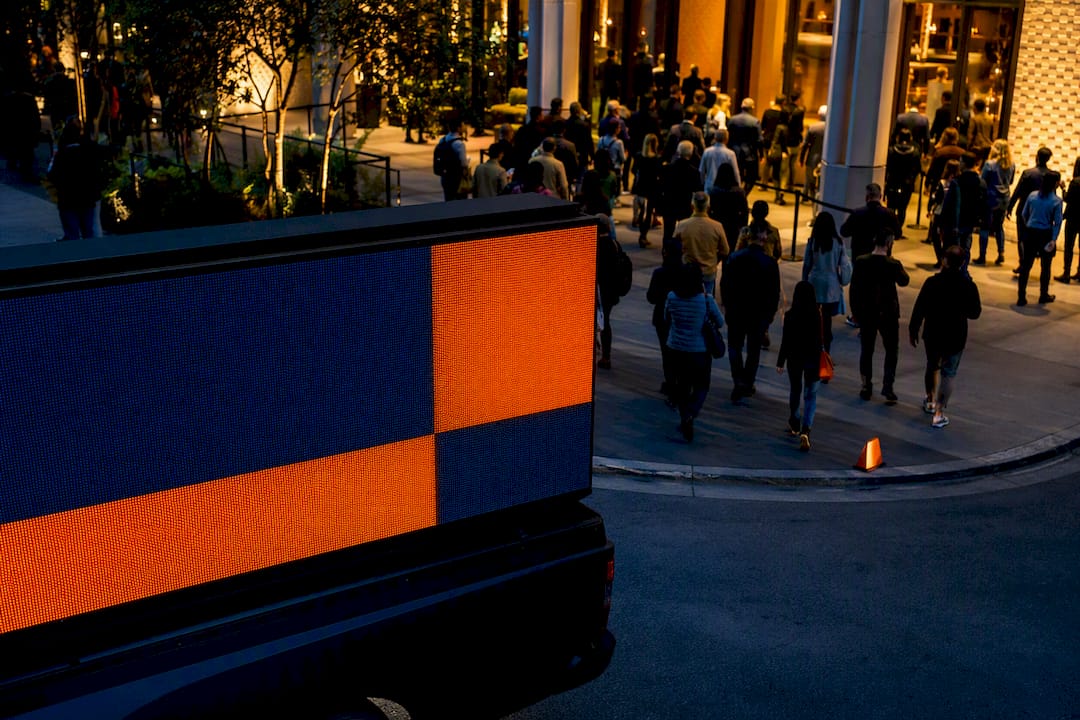
Cookieless retargeting in out-of-home (OOH) means reaching people who were likely exposed to a billboard, truck or rideshare ad with follow-up messages that do not depend on a third-party cookie. Instead of tracking a named individual across websites, you work from location, timing, first-party data and aggregated or cohort-based audiences. It is directional rather than exact, and it needs clean consent practices. Done well, it gives mobile OOH something it has always lacked: a measurable link to what people do next.
TL;DR
- Cookieless OOH retargeting builds audiences from where and when an ad ran, plus your own first-party data, not from third-party cookies.
- Exposure is always “potential exposure.” A phone near a screen or truck does not prove someone saw the ad, so treat results as directional.
- U.S. privacy rules on precise location data are tightening, so consent, sensitive-location exclusions and aggregation belong in the plan from day one.
- Prove impact with test and control design, and use smart QR scans as a clean, consented response path.
- Mobile OOH (LED trucks and wrapped rideshare vehicles) suits this model because routes and time windows are easy to define and document.
Table of Contents
- What cookieless retargeting means for out-of-home
- Cookie-based vs. cookieless retargeting at a glance
- How exposure connects to later digital ads without cookies
- What data supports cookieless OOH targeting, and where it falls short
- Privacy and consent: the U.S. rules that shape the plan
- Measuring whether it worked
- Perspective: where we think cookieless OOH is heading
- A practical cookieless OOH retargeting plan
- Putting it into a campaign with Beacon
- FAQ
- Sources
What cookieless retargeting means for out-of-home
Traditional retargeting follows a browser. A cookie or reusable identifier marks a visitor, and an ad platform shows that same person ads elsewhere. OOH never worked that way, because a billboard cannot read a cookie. When marketers talked about “OOH retargeting,” they meant a bridge: use exposure to a physical ad as the trigger for later digital ads.
The IAB Tech Lab’s 2025 ID-less guidance draws the line clearly. ID-based systems match a persistent or reusable identifier across publishers. ID-less systems target a cohort or audience group, and the advertiser does not learn which specific individuals received the later ads. The same document describes the deprecation of third-party cookies as part of a wider move toward privacy-preserving approaches, including cohorts and processing that stays on the device or in a secure environment.

For OOH, that shift is less disruptive than it is for display advertising. Your core signals were never cookies. They were place, time, route and context. What changes is how you turn those signals into a follow-up audience and how carefully you handle the location data behind it.
Cookie-based vs. cookieless retargeting at a glance
| Cookie-based retargeting | Cookieless OOH retargeting | |
|---|---|---|
| Starting signal | A site visit or ad click tied to a browser | Where and when an OOH ad ran, or a QR scan |
| Audience unit | An individual browser or device | A cohort, an aggregated group or your own first-party list |
| Precision | High on the web, tied to one browser | Directional; exposure is potential, not confirmed |
| Privacy exposure | Relies on cross-site tracking | Depends on consent, aggregation and location rules |
| Best for | Re-engaging known site visitors | Extending reach after physical exposure and capturing leads in the field |
The two are not rivals. A brand that already holds first-party data can combine both. The table simply shows where each one is strong.
How exposure connects to later digital ads without cookies
The basic mechanics have been stable for years. AdExchanger described OOH-triggered retargeting as using geofenced exposure areas and device IDs to build online audiences, and it noted the method is directional because a device near an ad may not have actually seen it. That caveat still holds in 2026, and it is the honest frame for every cookieless approach.
In practice, there are four routes.
1. Location and time matching
You record exactly where and when the ad ran: the truck route, the zone, the hour. You then build an audience of devices that were in those places during those windows, usually through a privacy-compliant data partner working with aggregated signals. Follow-up mobile or social ads go to that audience. With a moving LED truck or a rideshare vehicle, the route log is what makes the match credible, which is why proof-of-posting with GPS and photos matters.
2. First-party audiences you already own
Your CRM, email list and customer records are the sturdiest foundation. You do not need to identify anyone from a billboard. You use OOH to lift awareness in a market, then retarget the people who already gave you their details, and measure whether that audience responds more strongly in markets where the OOH ran.
3. Smart QR codes as an opt-in bridge
A QR code on a truck or wrapped vehicle turns passive exposure into an active, consented event. Someone scans, lands on a page you control, and you collect first-party data through that visit. We cover how that data flows in our guide to smart data collection in OOH. The limit is obvious: only a fraction of people scan, so QR proves a tracked response path, not the full effect of the ad.
4. Contextual and cohort targeting
Some follow-up targeting needs no individual-level match at all. You can show related ads to audiences defined by the places they visit or the content they consume. If you want a primer on how audience definitions work across channels, this overview of audience targeting basics is a good starting point.
What data supports cookieless OOH targeting, and where it falls short
The IAB’s July 2025 DOOH measurement guide is blunt about the limits. Cookieless targeting can use location indexing and contextual factors, but location indexing does not reveal intent or guarantee an ad was viewed, and less precise location data may over-count exposures. It also recommends that mobile location data used for OOH measurement be aggregated, privacy-compliant and deduplicated.
That translates into a few working rules:
- Treat audiences as modeled, not observed. Report them as “potentially exposed,” never as “viewers.”
- Prefer tighter location data with a defined radius. Loose data inflates reach. Our notes on geofencing radius best practices cover how to size zones around a route or venue.
- Deduplicate. The same phone passing a truck three times is one person, not three.
- Keep a record. Route logs, timestamps and photos let you defend the audience you built.
If you are choosing between a fixed geofence and broader area targeting, see geofencing vs. geotargeting for when each fits.
Privacy and consent: the U.S. rules that shape the plan
Cookieless does not mean consequence-free. Location data is where U.S. regulators are looking, and it is the data cookieless OOH retargeting leans on most.
The FTC’s finalized January 2025 order against Mobilewalla prohibits using, transferring, selling or disclosing location data from sensitive locations, and the agency said the company had not taken reasonable steps to verify that consumers had consented. Any vendor supplying you with location-based audiences should be able to explain how consent was obtained and how sensitive places are excluded.
State law adds another layer. Under the CCPA, precise geolocation, defined as data locating a consumer within a 1,850-foot radius, counts as sensitive personal information, which carries stricter rules on collection, use and the consumer’s right to limit its disclosure. The same California Privacy Protection Agency memo describes AB 322, which, as amended in June 2025, would limit collection and retention of precise geolocation information and prohibit its sale, trade or lease to third parties. Check its current status before you plan around it, and ask counsel how it applies to your campaign.
Before you buy any location-based audience:
- Ask where the data comes from and how consent was captured.
- Confirm that sensitive locations (health facilities, places of worship, and similar) are excluded.
- Make sure data is aggregated or anonymized before it reaches your team.
- Keep your own opt-in language clear on any QR landing page.
We turned this into a working document in our 72-hour OOH privacy checklist, and our piece on geofencing legal gates goes deeper on FTC orders. None of this replaces advice from your own privacy counsel, who should sign off before launch if your audience includes California residents or sensitive locations.
Measuring whether it worked
Audience match counts are not results. The question is whether the OOH exposure changed behavior beyond what would have happened anyway.
The OAAA’s attribution best practices recommend matching exposed test groups with unexposed control groups, with the groups matched on propensity and other conversion drivers, and note that single-channel OOH attribution studies typically use a test/control method. That is the right backbone for cookieless work, because it needs no individual identifier. You compare markets or zones, not people.
A simple design looks like this:
- Pick two comparable markets or route zones.
- Run OOH in one (test) and hold the other back (control).
- Keep every other channel as steady as you can.
- Compare branded search, site visits, QR scans and conversions between the two over the same weeks.
- Read the difference as lift only if the markets behaved alike before launch.
Our guide to geo lift testing walks through the setup, and our page on proving mobile billboard effectiveness covers a two-week approach. The IAB also notes that some DOOH networks incorporate opt-in mobile panel data to compare perceived engagement with actual engagement, which is a useful cross-check when you can get it.
Two cautions keep reports honest. A rise in web traffic during a campaign is not proof the campaign caused it. And QR scans, while valuable, only capture the people who chose to scan.
Perspective: where we think cookieless OOH is heading
We run LED mobile billboards and wrapped rideshare vehicles across all 50 states, so we see the same pattern in planning calls. Marketers worry that losing cookies breaks OOH retargeting. We think it is closer to the opposite: it removes a crutch and pushes teams back to what OOH does well.
Three convictions shape how we build campaigns.
First, the route is the audience definition. A truck parked outside a trade show hall or looping a downtown district creates a precise, documentable exposure area. That is a stronger starting point than a vague device list, and it is why we log GPS and photo proof for every placement.
Second, consented data beats inferred data. Smart QR codes give a brand a first-party record the moment someone scans. It is a smaller pool than a modeled audience, but it is yours, it is permissioned, and it does not disappear when a policy changes.

Third, honesty about uncertainty is a selling point. We would rather show a client a test/control result with a modest lift than a dashboard of inflated impressions. Directional data used carefully still moves budgets in the right direction.
The IAB expects DOOH measurement to rely on a blend of accurate exposure data, attention metrics and cross-channel connections. We agree, and we build reporting around that blend rather than any single signal.
— Scott
A practical cookieless OOH retargeting plan
Here is a sequence we would hand to a marketing team starting from zero.
- Define the goal and the response. Leads, store visits, registrations? Pick one primary action and decide how you will see it (QR scan, landing page, CRM match).
- Choose the exposure setting. Trade shows, event venues, commuter corridors and dense retail districts all work. For events, our event retargeting playbook shows how to pair a truck with follow-up ads, and our page on targeting conferences and trade shows covers the on-site side.
- Set route, timing and zone size. Tight windows give cleaner audiences.
- Add a consented capture point. Put a smart QR code and a clear value exchange on the creative.
- Build follow-up audiences from approved sources. Aggregated location cohorts, your own lists and QR responders. Exclude sensitive locations.
- Sequence the follow-up message. If you want the mechanics of timing, see our notes on real-time retargeting and the step-by-step retargeting guide.
- Hold out a control market. Decide this before launch, not after.
- Report with proof. Proof-of-posting, route maps, scan counts and lift versus control.
For a broader view of the technique itself, our guide to how retargeting works in OOH and the out-of-home retargeting tutorial cover the fundamentals.
Putting it into a campaign with Beacon
If you want this setup without stitching together several vendors, Beacon Mobile Media combines LED mobile billboards and wrapped Uber and Lyft vehicles with geofencing, route customization, audience filtering, real-time retargeting and smart QR lead capture. Every campaign comes with proof-of-posting and attribution reporting, so you can show where the ad ran and what followed. National coverage and short lead times mean you can test in one market and expand. Pricing is scoped per campaign, so start with a conversation about your market, dates and goal.
FAQ
Is cookieless retargeting possible for out-of-home ads?
Yes, but it works through cohorts, location and time signals and first-party data rather than individual tracking. The audience is a group that was potentially exposed, not a confirmed list of viewers. Accuracy depends on the quality and consent of the underlying location data.
Do I still need cookies for OOH retargeting?
No. Your starting signals are the place, route and timing of the ad, plus QR scans and your own customer data. Cookies were only ever one way to link an exposed person to later ads, and the IAB Tech Lab describes ID-less methods that target cohorts without revealing individuals.
Is using location data for OOH retargeting legal in the U.S.?
It can be, with care. The FTC has taken action over location data from sensitive places and unverified consent, and California treats precise geolocation as sensitive personal information. Use aggregated, consented data, exclude sensitive locations and have privacy counsel review the plan.
How do I know OOH retargeting actually worked?
Use a test and control design: run the campaign in one market, hold back a comparable one, and compare outcomes such as branded search, site visits and conversions. QR scans add a direct response signal but do not capture every effect of the ad.
Does mobile OOH work better than static billboards for this?
Mobile formats make the exposure area and time window easier to define and prove, because a route can be logged with GPS and photos. That gives your audience-building step a cleaner starting point than a fixed site with a wide catchment.
Sources
- IAB Tech Lab, ID-Less Solutions Guidance 1.0
- IAB, DOOH Measurement Guide, July 2025
- AdExchanger, OOH-triggered retargeting
- FTC, order banning Mobilewalla from selling sensitive location data
- California Privacy Protection Agency, AB 322 memo
- OAAA, OOH attribution modeling best practices