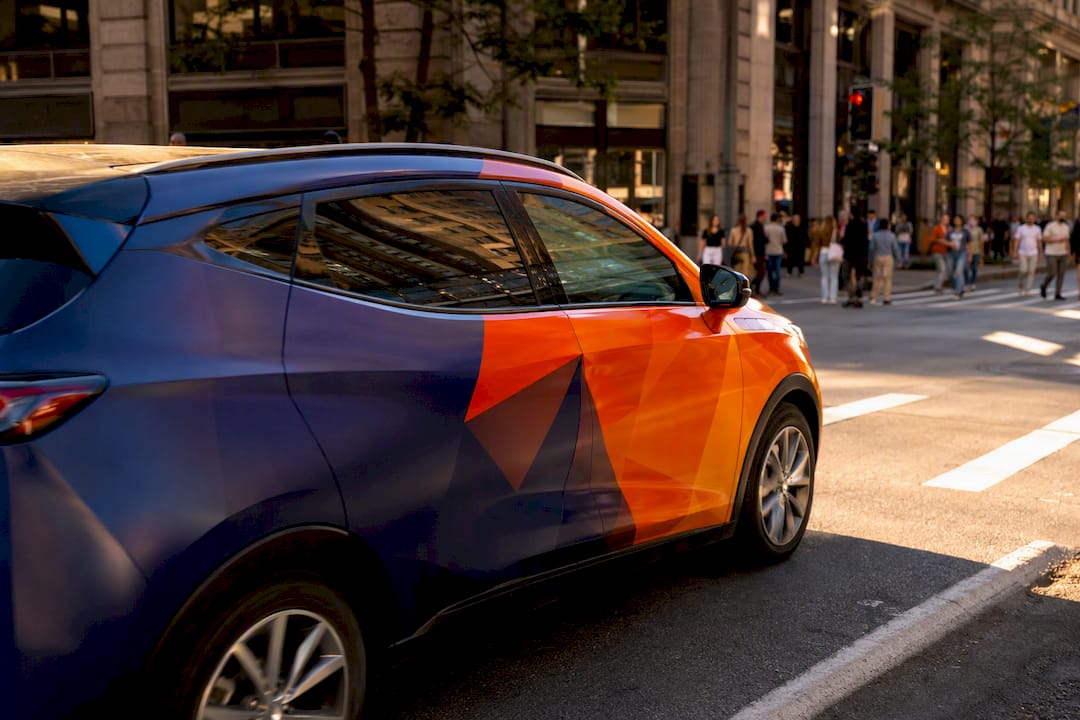
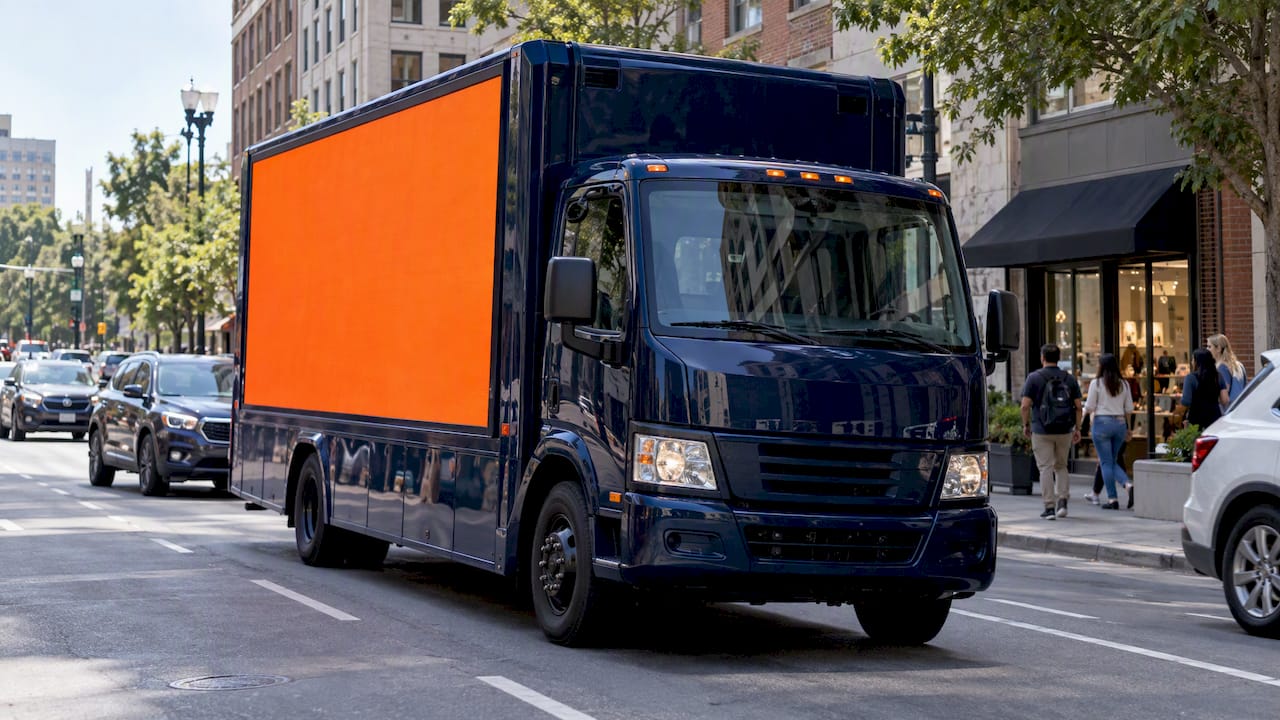
Programmatic DOOH buying, for mobile fleets, means purchasing LED truck and rideshare-wrap campaigns that carry digital targeting and GPS-verified attribution instead of a flat rate card. The rule that makes these campaigns work is simple: start with a measurable business goal, and let that goal define your route, your creative, and your metrics. The ideal stack combines GPS-verified exposure, device retargeting, and foot-traffic or point-of-sale lift data.
TL;DR:
- Most campaigns use blocks of four weeks, so align retargeting and sales measurement with that schedule and set the measurement dates before launch.
- Use checkpoint routes for repeated exposure near defined locations; choose fixed routes for wider unique reach, while budgeting for checkpoint GPS costs and added complexity.
- Require GPS route traces and logs of ad play with matching timestamps, geotagged proof photos, and one reconciled report; mismatched clocks undermine attribution.
- Measure outcomes through store visits linked to device location, tagged web links, and sales comparisons between test and control groups, rather than impressions alone.
- A launch flight lasting two weeks can work, but shorter measurement windows produce noisier lift studies, so use a tight test and control design.
Table of Contents
- How to plan a measurable programmatic mobile DOOH campaign
- Targeting and audience activation for mobile DOOH
- Measurement and attribution: what to demand in reports and how to validate results
- Creative and activation tactics that enable measurement and boost engagement
- Beacon Mobile Media: practical proofs and a buyer checklist
- When and why mobile DOOH should be a strategic channel in omnichannel plans
- How Beacon Mobile Media can execute programmatic mobile DOOH for you
- FAQ
- Sources
How to plan a measurable programmatic mobile DOOH campaign
Every effective mobile DOOH plan begins with a number you can defend to a finance team, not an impression count. Decide whether you are chasing store visits, online conversions, or sales lift, and set the measurement window before a truck leaves the lot.
- Pick one primary KPI (visits, conversions, or sales lift) and write down the exact date range you will measure it over.
- Choose between checkpoint routing, which hits fixed high-traffic locations repeatedly, and fixed-route driving, which maximizes unique reach across a wider area.
- Set dayparts, frequency, and campaign length around standard OOH weekly cycles rather than arbitrary start dates.
- Align your retargeting window and point-of-sale data pull with the days your trucks or wraps are actually active.
Checkpoint systems work best when the goal is repeated exposure to a defined audience, like commuters near a transit hub or shoppers circling a retail corridor. Fixed routing works better for broad awareness pushes, such as a product launch that needs citywide visibility in a short window. OAAA’s digital moving OOH exposure guidelines describe checkpoint routing in detail and flag the data-collection tradeoffs that come with it, including added GPS costs and complexity.
Most OOH buying cycles run on four-week blocks, and your retargeting and POS measurement should follow the same rhythm so the numbers line up at the end of the campaign. A two-week flight can still work for a product launch, but shrinking the measurement window too far below that cycle makes lift studies noisy and harder to defend.
Targeting and audience activation for mobile DOOH
Mobile DOOH targeting starts with geography but does not stop there. Geofencing draws a digital boundary around a venue, neighborhood, or competitor location and triggers retargeting the moment a device enters it. Geotargeting is broader: it aims creative and routing at a city, zip code, or metro area without the tight trigger radius. Affinity and behavioral filters layer audience data on top, letting you prioritize routes through areas where your likely buyers already spend time.
- Geofence a competitor’s parking lot to retarget shoppers who cross into your own store’s geofence later that week.
- Use affinity filters to route a fitness brand’s truck past gyms, running trails, and sporting goods stores instead of a generic downtown loop.
- Apply dayparting so a breakfast QSR campaign runs heaviest from 6 AM to 10 AM rather than spreading evenly across 24 hours.
- Build lookalike audiences from mobile ad IDs captured during the campaign to extend retargeting after the trucks stop rolling.
Device-level tactics turn a route into a data asset. Mobile ad IDs collected within a geofence feed a retargeting passback, so a person who walked past your truck on Tuesday can see your digital ad on Thursday. Competitive mapping, plotting where your audience’s daily movement overlaps with competitor locations, helps decide where checkpoints go before a single mile is driven. For a deeper walkthrough of this workflow, our audience targeting playbook covers segment selection and activation steps in more detail.
Pro Tip: Confirm your retargeting vendor’s consent and data-retention policy before launch, since mobile ad ID collection near sensitive venues (schools, medical offices) often needs tighter handling than a standard retail geofence.
Measurement and attribution: what to demand in reports and how to validate results
A mobile DOOH report that only counts impressions is not a measurement report. Require these deliverables before you sign off on any campaign:
- GPS-verified route traces showing exactly where and when the vehicle traveled.
- Time-stamped ad-play logs confirming the creative that was live at each point on the route.
- Geotagged, time-stamped photos documenting proof-of-posting at key checkpoints.
- Web lift tied to vanity URLs or UTM-tagged links, plus test versus control foot-traffic or POS comparisons.
Mobile OOH measurement is shifting away from raw impression counts toward verified route traces and outcome-based metrics like device retargeting response and foot-traffic lift, according to industry reporting on mobile OOH accountability. That shift matters because impressions tell you a truck drove somewhere, not whether anyone acted on it.
Attribution works best when you triangulate it. Visit attribution ties device geolocation to a store entry, web lift measures digital response through vanity URLs or UTMs, and test versus control POS data isolates the sales impact of the campaign itself from normal foot traffic. ABCS’s OOH Advertising Quantified report recommends exactly this kind of triangulated approach, combining geolocation, time-stamped POS receipts, and an experimental test-control design to isolate incremental sales lift. The MRC’s OOH measurement standards reinforce this by recommending a measurement hierarchy that runs from gross impressions up to true audience metrics, with independent measurers preferred for accuracy.

The most common failure point is synchronization. When GPS traces and ad-play logs run on different clocks or different reporting intervals, attribution falls apart even when both data sets are individually accurate. Ask any vendor how GPS pulls and play logs are time-stamped, and whether both feed into a single reconciled report rather than two separate files you have to match by hand.
Creative and activation tactics that enable measurement and boost engagement
Creative choices decide whether a mobile DOOH impression converts into a trackable action, especially when you use dynamic creative variants by daypart to optimize messaging. Dynamic creative lets you swap messaging by daypart, so a coffee brand can run a breakfast-focused ad in the morning and a dessert angle in the evening, then compare response rates between the two.
- Run dynamic creative variants by daypart and treat each as an A/B test against the same route.
- Use smart QR codes on truck panels and rideshare wraps to capture scans directly tied to a specific vehicle and time window.
- Pair vanity URLs or NFC tags with directional, store-locator style creative when the goal is driving visits from a moving asset.
- Time creative rotation to match your retargeting window, so the message a person saw on the street still feels current when the retargeted ad appears.
Smart QR codes work best when the offer on the panel matches the landing page exactly, since a mismatch kills scan-to-conversion rates before attribution even enters the picture. Our retargeting tutorial walks through passback mechanics for buyers who want the technical detail behind this step.
Beacon Mobile Media: practical proofs and a buyer checklist
We built our service around the measurement gaps most mobile DOOH campaigns leave open. Our route customization lets a client define checkpoints or fixed routes based on the same goal-first logic covered above, and our geofencing and real-time retargeting hand off device data the moment a vehicle passes through a target zone. Smart QR codes on every truck and wrap capture leads directly, and every campaign ships with GPS-based proof-of-posting.
When you brief a vendor or write an RFP, ask for:
- GPS-verified route traces and time-stamped play logs for every active day.
- Geotagged photos documenting posting at agreed checkpoints.
- A written attribution plan covering retargeting, vanity URL or QR tracking, and any POS comparison.
- A contract clause specifying delivery timing for all reporting assets.
Our digital out-of-home strategy page and LED truck guide walk through these deliverables in more operational depth.
When and why mobile DOOH should be a strategic channel in omnichannel plans
Mobile DOOH earns its place in a media plan when a campaign needs physical presence tied to a measurable moment: a store opening, a trade show, a competitor-conquesting push, or a local blitz timed to an event. It complements digital channels well, since the same device IDs captured on the street feed retargeting on display and social later that week. For planning purposes, build in lead time for route approval and expect reporting a few days after each weekly cycle closes, not in real time.
— Scott
How Beacon Mobile Media can execute programmatic mobile DOOH for you
We run LED mobile billboards and wrapped rideshare vehicles, built around the same goal-first planning this article covers. Our route customization, geofencing, real-time retargeting, and smart QR lead capture turn a driving campaign into a measurable one, backed by GPS proofs and attribution reporting you can hand to finance.

- Broad fleet coverage with efficient lead times for launch.
- Route customization paired with geofencing and real-time retargeting.
- GPS-based proof-of-posting and attribution reporting on every campaign.
If you want to see how this looks for your own launch or local push, start with our core campaign offerings and request a sample measurement plan before you commit a budget.
FAQ
What makes DOOH buying “programmatic” for mobile fleets?
It refers to buying LED truck and rideshare-wrap campaigns with built-in digital targeting, like geofencing and retargeting, plus attribution reporting, rather than booking a flat route with no measurement attached. The targeting and reporting layer is what separates it from traditional static billboard buys.
How long should a mobile DOOH campaign run to get reliable data?
Most reporting and rate structures follow four-week delivery cycles, so aligning your measurement window to that cycle gives cleaner results. Shorter flights, such as two weeks for a launch, can still work but need a tighter test-control setup to avoid noisy lift numbers.
What is the difference between checkpoint and fixed-route targeting?
Checkpoint routing repeats passes through a defined set of high-value locations, which suits repeated exposure to a known audience. Fixed routing covers more unique ground and suits broad awareness goals where reach matters more than frequency.
How do I know if my attribution data is trustworthy?
Check that GPS route traces and ad-play logs share synchronized timestamps, since mismatched clocks are the most common cause of inaccurate attribution. Independent measurement aligned with MRC’s OOH standards adds another layer of confidence beyond vendor-reported numbers.
Can mobile DOOH integrate with my existing digital retargeting setup?
Yes, device IDs captured through geofencing during the campaign can feed directly into display and social retargeting pools you already run. This is one of the main reasons mobile DOOH works well as part of a broader channel mix rather than a standalone tactic.
Sources
- OAAA Digital Moving OOH Exposure Guidelines (2022)
- MRC Out-of-Home Measurement Standards
- OUT-OF-HOME (OOH) ADVERTISING QUANTIFIED
- Beyond Impressions, Beyond Guesswork: How Mobile OOH Finally Got Accountable – OOH TODAY