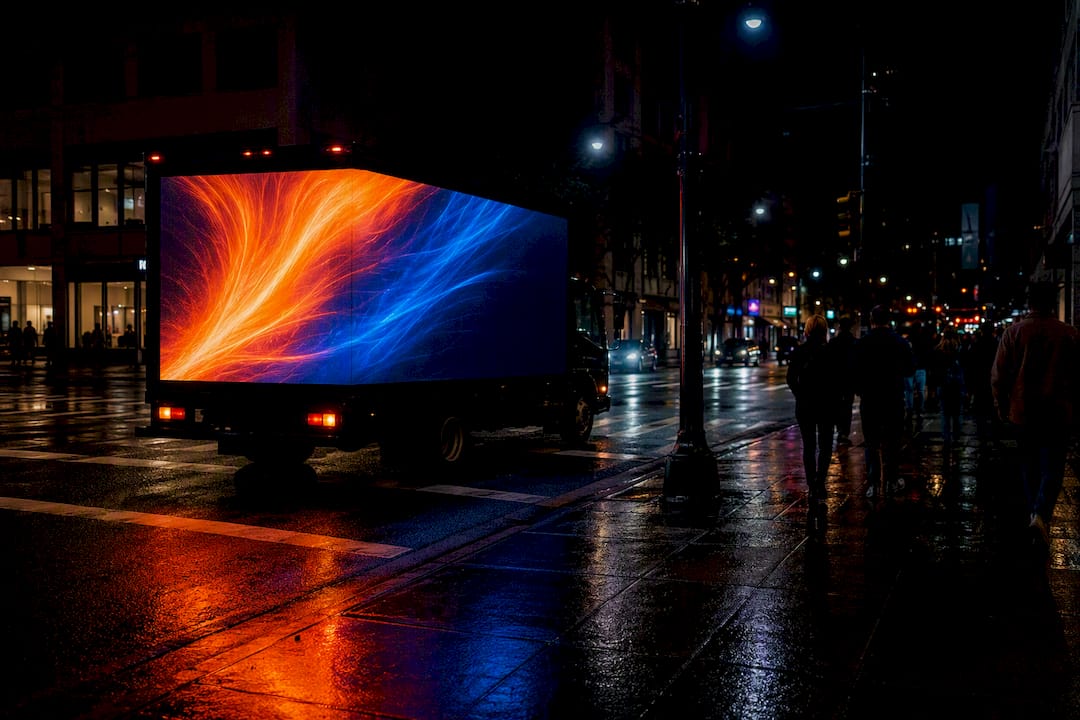
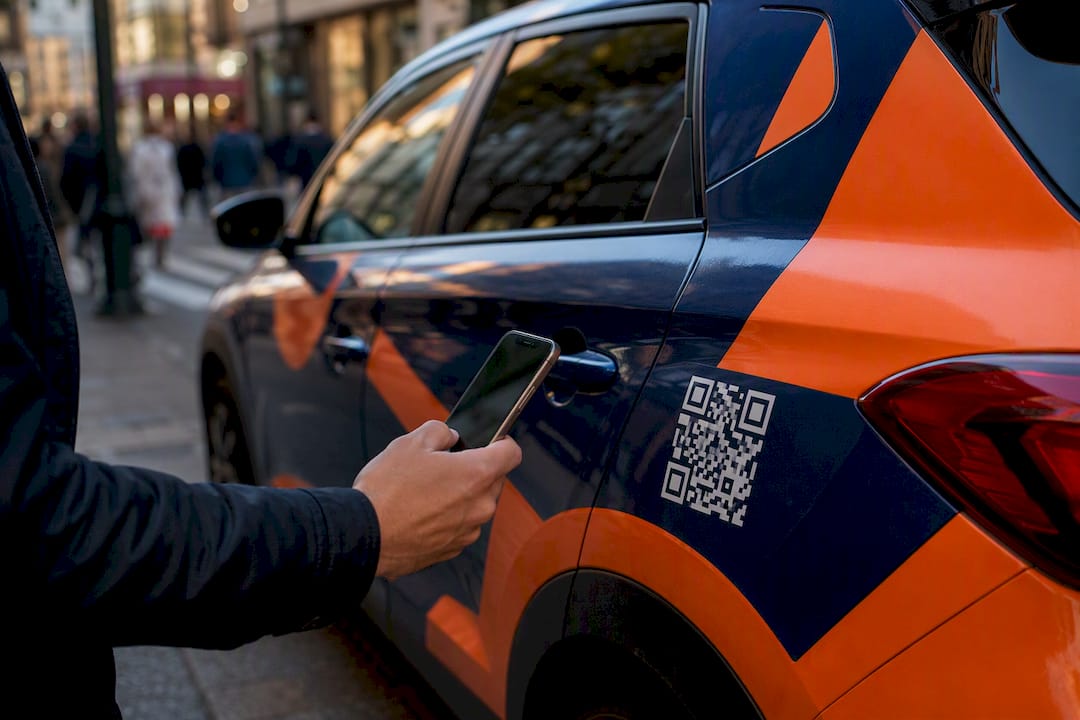
Ad truck compliance means following the local permitting and operating rules that govern mobile billboards and wrapped rideshare vehicles, not federal trucking or driver safety law. Before you book a campaign, check your target city’s sign or transportation ordinance, confirm the permit and insurance documents the vendor holds, and require proof-of-posting records. We build these steps into every campaign with compliance playbooks and documentation ready before a truck ever hits the street.
TL;DR:
- Check each city’s ordinance before booking: some prohibit motor operated billboards, while Lubbock charges $300 per vehicle for a one year permit.
- A permit packet may require each vehicle’s VIN, photos, registration, commercial insurance, display specifications, sample creative, and notarized forms before submission.
- Require time stamped photos, GPS route logs, inspection reports, driver records, and permit numbers; one public complaint can prompt officials to review the entire fleet.
- For LED trucks, disclose brightness and message duration, avoid red or blinking lights, and verify local limits before approving creative or setting routes.
- Treat each city as a separate permit process: reuse vehicle records, but begin applications across cities four to six weeks before launch to accommodate inspections.
Table of Contents
- Who Regulates Mobile Billboards and What They Check
- Local Rules and Typical Numbers You Will See in a City Code
- Step-by-Step Permit and Documentation Checklist
- Proof-of-Posting and the Records You Should Require From a Vendor
- Enforcement and Penalties: What Actually Happens
- Insurance Requirements Specific to Mobile Ad Trucks
- Environmental and Noise Ordinances Affecting Mobile Ad Truck Operations
- Restrictions on Digital Content and Messaging for LED Mobile Billboards
- Permits Across Multiple Jurisdictions: Process and Timelines
- How Compliance Planning Shapes Campaign Timelines and Briefs
- Beacon Mobile Media Compliance Support for Your Campaign
- FAQ
- Sources
Who Regulates Mobile Billboards and What They Check
Mobile billboard rules rarely come from a single office. A marketing team chasing a permit usually needs to touch several departments before a truck can legally operate in a given city.
- City sign or planning department: defines what counts as a mobile billboard and issues the underlying permit.
- City secretary or permits office: processes applications, fees, and renewals in many mid-sized cities.
- Police or parking enforcement: handles complaints, citations, and towing for vehicles that violate parking or display rules.
- Local transportation or public works department: sets routing, weight, and right-of-way restrictions.
- State DOT: occasionally applies when a vehicle crosses into highway right-of-way signage rules, though most mobile billboard regulation sits at the city or county level.
Across these offices, the rules tend to fall into a handful of categories: registration and permitting, vehicle specifications like height and weight, illumination and electronic display limits, parking and time restrictions, and broader content-neutral time, place, and manner rules that cities use to justify regulating where and when a display can operate. Municipal codes typically define a “mobile billboard” as a vehicle whose primary purpose is carrying advertising rather than transporting goods or people, and they commonly exempt transit buses, vehicles advertising the owner’s own business, and non-motorized displays. Knowing which exemption category your campaign falls into, or doesn’t, is the first filter before you spend time on a permit application.
Local Rules and Typical Numbers You Will See in a City Code
Once you start pulling actual ordinance language, a pattern shows up: cities tend to regulate the same handful of variables, just with different numbers attached. Lubbock’s mobile billboard vehicle code sets a maximum height of 14 feet, a width cap of 8 feet 6 inches, and a weight threshold tied to fleet inspection and decal requirements, and it also requires a $300 nonrefundable permit fee per vehicle with a one-year validity window, according to the city’s mobile billboard ordinance. Illumination rules commonly prohibit red or blinking lights and cap how long a single message can display before rotating.
| Rule category | Typical example found in city codes |
|---|---|
| Permit fee | $300 nonrefundable fee per vehicle, Lubbock MBV permit |
| Permit term | Valid for one year, Lubbock MBV permit |
| Height limit | 14 feet maximum, Lubbock mobile billboard code |
| Width limit | 8 feet 6 inches maximum, Lubbock mobile billboard code |
Not every city permits mobile billboards at all. Austin’s planning staff reviewed amendments that would prohibit motor-operated mobile billboards outright, impose registration fees on vehicles like taxicabs displaying unrelated ads, and route enforcement of moving displays through the police department, according to Austin’s ordinance review materials. State law shapes what cities can do here too. California’s AB-2756 added statutory language explicitly allowing local governments to regulate mobile billboard displays, including penalties and removal authority, which gave cities across the state a clear legal basis for ordinances covering parking duration and move-after-time rules, per the California legislative text.
- Some cities ban motor-operated mobile billboards entirely but carve out exemptions for transit vehicles and owner-business signage.
- Others allow mobile billboards only under a conditional permit tied to inspection and insurance proof.
- A smaller group treats mobile billboards as a standard commercial vehicle sign, with minimal added restriction.
For a deeper bank of permit examples across cities, our mobile billboard permit guide walks through fee ranges and rule types city by city.
Step-by-Step Permit and Documentation Checklist
Getting a mobile billboard permit approved on the first submission comes down to having the right paperwork ready before you ever open the application. Most municipal reviewers reject submissions for missing attachments rather than policy conflicts, so treat this like an assembly task.
- Build a vehicle inventory. Collect VIN numbers and photos of all four sides of every truck you plan to deploy.
- Gather proof of legal control. This means a lease agreement or title showing you or your vendor controls the vehicle.
- Pull current registration. Each vehicle needs valid state registration on file at the time of application.
- Secure insurance documentation. Public liability and property damage certificates need to match the coverage limits the city specifies.
- Document the electronic display specs. Brightness levels, frame rate, and message duration all need to be disclosed for LED units.
- Prepare sample creative. Some cities want to see what will actually display before issuing a permit.
- Schedule a fleet inspection. Many jurisdictions require a physical inspection before the decal is issued.
- Complete and notarize required forms. Skipping notarization is a common reason applications bounce back.
- Pay the permit fee. Fees are typically nonrefundable, so confirm every attachment is complete before submitting payment.
- Display the issued decal and follow operating rules. Once approved, the truck must carry proof of permit, follow move-after-time limits, respect restricted zones, and keep a driver reachable around the clock in case of a compliance issue.
Pro Tip: Build one master document per vehicle that bundles the VIN, photos, insurance certificate, and registration together, so you can drop it into any city’s application without hunting for files at the last minute.
Our compliance playbook includes sample permit packet templates built around this exact sequence.
Proof-of-Posting and the Records You Should Require From a Vendor
A permit gets your truck on the road. Proof-of-posting is what protects you when a city official or a competitor files a complaint, and it’s what lets you show a client the campaign actually ran as booked. At minimum, a marketing team should require:
- Time-stamped photos of each vehicle at scheduled stops or along its route.
- GPS route logs showing exact timing and location coverage.
- Fleet inspection reports confirming the vehicle met physical safety and display specs.
- Driver logs noting hours on route and any deviations.
- Permit decals and permit numbers kept on file and cross-referenced to each vehicle.
Complaint-driven enforcement is common enough that a documented audit trail matters more than most marketers expect. A single public complaint can prompt a city to review an operator’s entire fleet, not just the vehicle named in the complaint, based on reporting on municipal enforcement practices.
Campaigns can include smart QR codes for on-the-spot engagement tracking, route-level attribution tied to GPS logs, and full proof-of-posting documentation delivered alongside standard campaign reporting. We recommend keeping this audit packet, photos, logs, permits, and inspection records, for at least the length of the campaign plus one renewal cycle, so you have everything assembled if a municipal reviewer asks for it later.
Enforcement and Penalties: What Actually Happens
Cities don’t usually start with a fine. A first violation commonly draws a warning, especially when the operator responds quickly once notified. Repeat or unaddressed violations escalate to per-day fines, vehicle impoundment, or suspension of the permit itself, and in serious cases a city can revoke the permit entirely.
- Warnings for first-time or minor violations, often tied to a quick correction window.
- Per-day fines that accumulate the longer a vehicle stays out of compliance.
- Impoundment for vehicles operating without a valid permit or decal.
- Permit suspension or revocation for repeat offenders.
Enforcement is frequently triggered by a single complaint rather than a routine patrol, which means one unhappy resident or competitor can set off a review of your entire fleet.
Pro Tip: Notify the local parking or traffic enforcement office before a multi-hour event deployment, since proactive contact often prevents a complaint from turning into a citation.
Insurance Requirements Specific to Mobile Ad Trucks
Insurance is one of the few requirements nearly every city asks for regardless of how it treats mobile billboards otherwise. Most permit applications require proof of public liability and property damage coverage, with the certificate naming the vehicle by VIN and matching the coverage limits the city specifies in its ordinance or permit form. Lubbock’s permit checklist, for example, lists insurance documentation as a required attachment alongside vehicle photos and VIN numbers, per the city’s permit application.
Because mobile billboards operate in dense urban traffic and often park temporarily in high-pedestrian areas, cities tend to treat them more like commercial advertising structures than ordinary passenger vehicles for insurance purposes. That means a standard personal auto policy will not satisfy most permit offices. Coverage needs to reflect commercial use, the added structure of an LED display or wrap, and the higher liability exposure of a vehicle designed to attract attention and sometimes stop or slow near crowds.
Before signing a vendor contract, ask for the certificate of insurance directly, confirm it names the specific vehicles in your campaign, and verify the limits meet or exceed what your target city’s permit office requires. Our insurance checklist walks through the coverage categories advertising teams should confirm before a campaign starts, and partner resources like Latitude Park’s digital ads management guidance are useful if you’re layering digital retargeting spend on top of the physical campaign and want your insurance and measurement planning aligned.
Environmental and Noise Ordinances Affecting Mobile Ad Truck Operations
Mobile billboard trucks are motor vehicles first, which means they fall under the same idling, emissions, and noise rules that apply to any commercial vehicle operating in a given city, on top of whatever sign-specific ordinance governs the display itself. Idling restrictions are common in dense downtown districts, and a truck parked for an extended static display can run into the same limits that apply to delivery vehicles or buses.
Noise ordinances typically target amplified sound rather than the visual display, so a truck running a static or slow-rotating LED board usually isn’t the target of a noise complaint unless it’s paired with audio equipment. If your campaign includes any sound component, from a speaker system to a generator powering the display, check the local noise ordinance separately from the sign code, since the two are enforced by different departments and carry different complaint thresholds.
Generator noise is worth flagging specifically. Trucks that rely on an onboard generator to power an LED board can trigger noise complaints even when the ordinance has nothing to do with advertising content, simply because the generator itself exceeds a decibel threshold in a residential or mixed-use zone. Scheduling deployments to avoid overnight hours in residential areas sidesteps most of this risk, and it’s a detail worth confirming with your vendor before locking a route. It is advisable to factor generator type and noise output into route planning so a campaign doesn’t collide with a city’s general noise code even when the mobile billboard ordinance itself is silent on the subject.

Restrictions on Digital Content and Messaging for LED Mobile Billboards
LED and digital mobile billboards draw a separate layer of scrutiny beyond the vehicle-specification rules that apply to static wraps. The most common content-neutral restrictions cap message duration, so a single image or line of text can only display for a set number of seconds before rotating, and prohibit red or blinking lights that could be mistaken for emergency vehicle signals or traffic control devices.
Brightness and frame rate also show up as application requirements rather than just operating rules. Permit forms frequently ask applicants to disclose the display’s brightness level and how quickly content transitions, since cities use those specs to judge whether a board creates a driver distraction risk near intersections or highway on-ramps. Courts have generally treated these kinds of restrictions as content-neutral time, place, and manner rules rather than restrictions on speech itself, meaning cities can regulate how and where a display operates without regulating what it says, according to a Ninth Circuit opinion addressing municipal mobile billboard regulation.
That legal framing matters for creative planning. It means a city can reject your display for running too bright at night or rotating messages too quickly, independent of whether the ad content itself is controversial. Before finalizing creative, confirm your vendor has already matched the display specs to the target city’s brightness and duration limits rather than assuming any LED board will pass review.
Permits Across Multiple Jurisdictions: Process and Timelines
A campaign that spans more than one city means more than one application, and the timelines rarely line up. Some cities process a mobile billboard permit in a matter of days once the paperwork is complete, while others require a scheduled fleet inspection that can push approval out by a couple of weeks, particularly if the inspection office only reviews mobile billboard vehicles on specific days.
The practical approach is to treat each jurisdiction as its own application track rather than assuming one approved permit transfers elsewhere. Vehicle photos, VIN numbers, and insurance certificates can usually be reused across applications, but fees, inspection scheduling, and decal issuance are handled locally and don’t carry over. Building a submission calendar that accounts for each city’s own review and inspection cadence, rather than a single blanket timeline, avoids the scramble of discovering a permit is still pending the week a campaign is supposed to launch.

For campaigns running in and around Los Angeles specifically, local rules under LAMC 87.53 and 87.54 add another layer of parking-specific restriction that’s worth reviewing separately from the standard permit process, covered in our Los Angeles mobile billboard guide. Starting multi-city applications at least four to six weeks ahead of launch gives enough buffer for inspection scheduling delays without holding the whole campaign hostage to the slowest jurisdiction.
How Compliance Planning Shapes Campaign Timelines and Briefs
Compliance belongs in the campaign brief from day one, not as an afterthought once creative is locked. Permit lead times, inspection windows, and display restrictions all shape what’s realistically possible on a given launch date, and a brief that accounts for a four to six week runway avoids the scramble of a delayed start. Vendors with pre-built compliance playbooks and established city relationships tend to shorten that runway considerably, because the paperwork and inspection scheduling are already routine rather than improvised.
— Scott
Beacon Mobile Media Compliance Support for Your Campaign
Our process addresses common friction points marketing teams encounter when buying mobile billboard or wrapped rideshare campaigns, such as permit uncertainty and inconsistent proof-of-posting. Campaigns often include compliance playbooks, proof-of-posting documentation, route customization, geofencing, smart QR codes for engagement capture, and attribution reporting tied directly to the routes driven.

Before signing with any vendor, ask these questions:
- What cities have they already secured approvals in, and can they share a sample permit packet?
- What are their insurance coverage limits, and do certificates name the specific vehicles on your campaign?
- What does their proof-of-posting workflow actually deliver: photos, GPS logs, or both?
- How do they handle a multi-city campaign with staggered permit timelines?
If you’re ready to see how this works for your next campaign, visit our services page to get a compliance-ready quote, or review our LED ad truck guide for a closer look at how we document reach and measurable results.
FAQ
What counts as a mobile billboard under most city codes?
Most municipal codes define a mobile billboard as a vehicle whose primary purpose is displaying advertising rather than transporting goods or passengers. Common exemptions include transit buses, vehicles advertising the owner’s own business, and non-motorized displays.
Do I need a separate permit in every city my campaign runs in?
Yes, mobile billboard permits are issued locally and generally don’t transfer between jurisdictions. Vehicle documentation like photos, VINs, and insurance certificates can be reused across applications, but fees and inspections are handled city by city, as shown in Lubbock’s permit process.
What happens if a mobile billboard truck operates without a valid permit?
Operating without a valid permit typically starts with a warning, but repeat violations can lead to per-day fines, impoundment, or permit suspension. Enforcement is often triggered by a public complaint rather than routine patrol, per reporting on municipal enforcement.
What insurance coverage do mobile ad trucks need?
Cities generally require proof of public liability and property damage insurance that names the specific vehicle by VIN, since mobile billboards operate under commercial use rather than standard personal auto policies. Review our insurance checklist for the coverage categories to confirm with a vendor.
Can cities restrict what displays on an LED mobile billboard?
Cities commonly restrict how a display operates, capping message duration, brightness, and prohibiting red or blinking lights, rather than regulating the content itself. Courts have generally upheld these as content-neutral time, place, and manner rules, as discussed in a Ninth Circuit opinion on mobile billboard regulation.
Sources
- Austin mobile billboard amendment review sheet (City of Austin)
- AB-2756 Mobile billboard advertising displays: local ordinances (California legislative text)
- Ninth Circuit opinion discussing municipal mobile billboard regulations