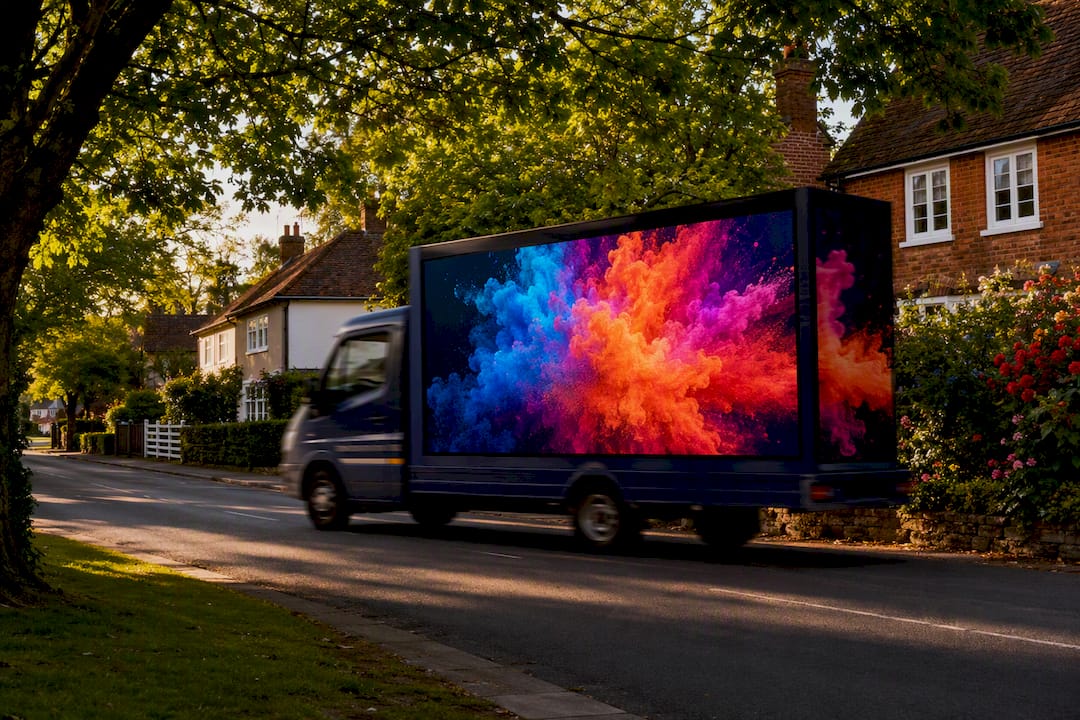
Wrapped vehicles are one of the most underused tools in conference marketing, and the gap between brands that use them and those that don’t shows up clearly in booth traffic and brand recall. A wrapped vehicle functions as a mobile ad campaign throughout the entire event day, not just during exhibit hours. Attendees see your brand in the parking garage, at the hotel shuttle lane, on the highway exit ramp, and again at the entrance. By the time they reach your booth, your logo already feels familiar.
Here is what that pre-exposure actually does for you:
- Wrapped vehicles extend brand exposure before, during, and after the conference, reaching attendees at every touchpoint along their journey.
- They cut through venue clutter by functioning as moving billboards in spaces where static signage competes with dozens of other brands.
- High-contrast visuals paired with a clear call to action, such as a booth number or QR code, turn passive impressions into active engagement.
- A single wrap investment keeps working long after the event ends, continuing to generate impressions on highways and local streets.
- Pre-event exposure builds familiarity, so attendees arrive at your booth already primed rather than encountering your brand cold.
1. Twelve key benefits of deploying vehicle wraps in conference marketing
Vehicle wrap advertising at conferences delivers advantages that most booth-only strategies simply cannot replicate. Here are the twelve that matter most.
- Continuous exposure across the full event timeline. Your brand appears before the doors open and keeps running after they close. A wrapped vehicle seen on the highway Monday morning is still working when the show floor shuts down Friday afternoon.
- Cost efficiency per impression. Vehicle wraps deliver a lower cost per thousand impressions than digital, print, radio, and outdoor advertising combined, making them one of the most budget-friendly formats available to event marketers.
- Mobile, targeted local reach. Unlike a digital ad that scatters impressions across a broad audience, a wrapped vehicle concentrates exposure in the exact geographic zone where your conference attendees are staying, eating, and traveling.
- Professional credibility on arrival. A clean, well-branded vehicle signals that your company is established. It tells a prospect you are serious before they ever shake your hand.
- Measurable engagement through QR codes. Embedding QR codes on a wrap converts passive impressions into trackable actions, linking outdoor exposure directly to booth visits, landing pages, or meeting schedulers.
- Multi-location brand presence with a fleet. Multiple wrapped vehicles positioned around a venue, at the hotel, the parking deck, and the loading dock, create the sense of a major brand presence even when your booth footprint is modest.
- Organic social media amplification. A bold, photogenic wrap parked in a well-lit spot gets photographed and shared. Attendees post it without being asked, extending your event reach to audiences who never set foot in the building.
- Flexible, event-specific messaging. Wraps can carry show-specific promotions, booth numbers, or limited-time offers that create urgency as attendees walk past.
- Paint protection as a bonus. The vinyl protects the vehicle’s original paint, preserving resale value while the wrap does its marketing work.
- VIP chauffeur program compatibility. Wrapped luxury vehicles used to transport key stakeholders deliver a full sensory brand experience from the moment a VIP steps in.
- Integrated marketing platform. Wrap visuals can mirror booth graphics, digital ads, and social content, creating a consistent brand thread across every channel an attendee encounters.
- Booth traffic priming. Trade show marketing starts outside the venue. Attendees who recognize your brand from a wrapped vehicle in the parking lot are more likely to stop at your booth than those encountering you for the first time inside.
2. Design best practices for wrapped vehicles at conference venues
Good wrap design at a conference is not about looking impressive. It is about being understood in two seconds or less by someone walking through a crowded parking lot.
- Lead with a large, unmissable logo. Your brand mark should be readable from across a parking lane. If someone has to squint, it is too small.
- Write a short headline, not a paragraph. One line that states what you do. Five words maximum. Attendees are moving; they will not stop to read.
- Make the call to action obvious. A booth number, a short URL, or a QR code placed prominently. Wraps achieve higher engagement when the call to action is direct and impossible to miss.
- Use high-contrast color combinations. Your wrap competes against concrete, asphalt, and dozens of other vehicles. Colors that pop in a parking garage are not the same as colors that look good on a screen.
- Match the wrap to your booth aesthetic. When attendees see the same palette and typography on your vehicle and your display, the connection clicks instantly. Consistency is what turns a glance into recognition.
- Avoid small text and cluttered graphics. Detail that reads well in a design file becomes invisible at 20 feet. If the message requires explanation, it is not ready for a wrap.
- Add event-specific urgency. A line like “Visit Booth 412 for a show-only demo” gives passing attendees a reason to act now rather than later.
- Design for photography. Bold, clean wraps get shared on social media. Think about how the vehicle looks in a smartphone photo taken from 15 feet away.
- Use a certified professional installer. Avery Dennison recommends professional installation in a controlled environment to ensure wrap quality and longevity. Bubbles, misaligned seams, and peeling edges undermine the professional image you are trying to project.
- Plan the layout around the vehicle’s shape. Wheel wells, door handles, and body curves all affect how graphics read in motion. A wrap designed flat on a screen can distort badly on an actual vehicle.
Pro Tip: Design your wrap so the most critical information, logo, booth number, and QR code, appears on the driver’s side rear quarter panel. That is the panel most visible to pedestrians walking through a parking lot.
3. How long do vehicle wraps last, and what does maintenance look like?
Durability is a practical concern for any marketing director building a multi-conference calendar. The good news is that wraps hold up well when they are installed and maintained correctly.

Vehicle wraps last 3–5 years with proper professional installation and routine care. That lifespan covers multiple conference seasons, which means the cost of a single wrap spreads across years of event marketing. The per-event cost drops considerably when you run the same vehicle through five or six conferences annually.
Cleaning is straightforward but specific. Hand washing with mild detergent preserves the vinyl surface. Automatic car washes with rotating brushes are a problem; the bristles catch wrap edges and cause peeling. A quick hand wash after each event keeps the graphics looking sharp for the next one.
Material quality and installer certification matter more than most buyers expect. A wrap applied by an uncertified installer in a non-climate-controlled space is likely to fail early, regardless of the vinyl brand. Protective laminates add another layer of defense against UV fading, minor scratches, and surface stains, which is worth the added cost for vehicles that will be used repeatedly at outdoor events.
When a wrap reaches the end of its life or a brand refresh requires new graphics, removal should be handled professionally. Improper removal can damage the underlying paint, which defeats one of the core benefits of wrapping in the first place.
4. How do vehicle wraps compare to traditional conference advertising methods?
The honest comparison is not “wraps versus booths.” Both serve different functions. The real question is whether wraps outperform other supplemental advertising formats, such as print ads in conference programs, static banners, and digital display ads targeted at attendees.

| Metric | Vehicle wraps | Static signage / print ads |
|---|---|---|
| Duration of exposure | Before, during, and after the event | Limited to venue hours or publication window |
| Geographic reach | Entire event zone, hotels, highways | Fixed location only |
| Cost per impression | Very low over multi-year lifespan | Higher per placement, no residual value |
| Audience targeting | Concentrated in event geography | Broad or venue-specific |
| Engagement capability | QR codes, URLs, booth numbers | Limited interactivity |
| Visual impact | Full-vehicle, three-dimensional | Flat, two-dimensional |
| Flexibility | Updatable between events | Reprinting required for changes |
A few qualitative points worth noting:
- Wraps attract incidental attention in high-traffic zones, such as shuttle lanes and parking structures, where attendees are not yet in “ignore the ads” mode.
- Print ads in conference programs reach a captive audience but compete with editorial content and other advertisers on the same page.
- Static banners inside the venue are useful for wayfinding but do nothing for attendees who have not yet entered the building.
- Digital display ads can be precisely targeted but require ongoing spend and disappear the moment the budget runs out.
The core advantage of vehicle wrap advertising is that it generates impressions continuously without recurring costs. Once the wrap is installed, it works whether you are actively managing a campaign or not.
5. Conference-specific strategies that maximize your wrapped vehicle’s impact
Placement and integration separate a wrap that gets noticed from one that just exists in a parking lot. The following approaches consistently produce better results at conferences and trade shows.
- Claim high-traffic access points early. Shuttle lanes, hotel drop-off zones, and venue entrance roads are where attendees spend time waiting. A wrapped vehicle parked or circulating in these zones gets seen repeatedly by the same people.
- Pair wraps with interactive elements. QR codes linked to conference offers or meeting schedulers convert a visual impression into a booked appointment. The wrap gets the attention; the QR code closes the loop.
- Build a branded environment around the vehicle. A wrapped vehicle surrounded by feather flags, A-frame signs, and branded barriers becomes a destination rather than just a parked truck. Creating that environment transforms passive exposure into a physical brand experience attendees can engage with.
- Use multiple vehicles to create omnipresence. One vehicle at the hotel, one near the loading dock, one circling the venue. Attendees who see your brand three times before entering the hall arrive at your booth with a sense of familiarity that a cold introduction cannot replicate.
- Deploy wrapped VIP chauffeur vehicles for key stakeholders. Carvertise’s Branded Chauffeur program demonstrated this at the Destinations International Annual Convention, transporting VIPs in fully wrapped luxury vehicles complete with branded giveaways and curated playlists. The brand experience begins the moment the door closes.
- Align wrap visuals with booth and digital assets. When the colors, fonts, and imagery on your vehicle match your booth display and your retargeting ads, every touchpoint reinforces the others. Attendees who saw your wrap in the parking lot and your ad on their phone that morning arrive at your booth already oriented.
- Plan logistics around venue rules before the event. Some convention centers restrict vehicle access to specific zones or require advance permits. Knowing this before arrival prevents the scenario where your wrapped vehicle ends up in a back lot no one walks through.
- Track engagement with scan data. Every QR code scan from a wrapped vehicle is a data point. Monitoring scan volume by location and time of day tells you which placements are working and which are not.
For a broader view of how mobile outdoor formats work together at conferences, Beacon-ads covers LED billboard targeting at trade shows in detail.

6. What does a wrapped vehicle campaign actually cost, and what is the ROI?
Wraps are a one-time production cost with a multi-year return, which makes the ROI math different from most advertising formats. A full vehicle wrap typically runs between $2,500 and $5,000 depending on vehicle size, design complexity, and installer quality. That cost does not recur annually. Spread across a five-year lifespan and multiple conference appearances, the effective cost per event drops to a level that most digital or print placements cannot match.
The cost per impression is where wraps genuinely stand out. Fleet wraps deliver a cost per thousand impressions of roughly $0.04–$0.15, lower than digital display, print, radio, and outdoor formats. A single wrapped vehicle generating consistent impressions around a busy convention center produces a volume of brand exposures that would require a significant digital ad budget to replicate.
ROI at conferences is not purely about impressions, though. The more direct measure is booth traffic and lead quality. Brands that coordinate wrapped vehicle placement with QR code tracking can connect specific scan events to booth visits and downstream conversions. That attribution chain, from parking lot impression to scanned code to booked meeting, is what turns a qualitative benefit into a reportable metric.
One practical note: the wrap investment also protects the vehicle’s paint, which has real resale value implications. That is not a marketing metric, but it does reduce the net cost of the program when you account for the full asset lifecycle.
7. Logistics and legal considerations before you deploy wrapped vehicles at a venue
Most conference venues have rules about vehicle access that are not published anywhere obvious. Getting this wrong means your wrapped vehicle ends up in a restricted zone or, worse, gets towed the morning of the event.
Start with the venue’s exhibitor services manual. Most major convention centers publish one, and it typically specifies where vendor vehicles may park, whether overnight parking is permitted, and what signage restrictions apply to the exterior of the building. If the manual does not address wrapped vehicles specifically, contact the venue operations team directly before the event.
Permit requirements vary by city and venue. Some municipalities require a commercial vehicle permit for any vehicle used for advertising purposes on public streets adjacent to an event. Others have no such requirement. Checking with the local city or county transportation office a few weeks before the event is the safest approach.
Insurance is another consideration that gets overlooked. If a wrapped vehicle is being used to transport VIP guests or operate as a branded shuttle, the driver and vehicle need appropriate commercial auto coverage. A standard personal auto policy does not cover commercial transportation activities.
For multi-city conference schedules, build a logistics checklist that covers venue access rules, parking zone maps, permit requirements, and insurance verification for each stop. Beacon-ads’s trade show advertising checklist is a useful starting framework for this kind of pre-event planning.
8. How do you measure the impact of wrapped vehicles during a conference?
Measurement is the part of vehicle wrap campaigns that most marketers handle poorly, usually because they treat wraps as awareness plays with no trackable output. That framing leaves real data on the table.
QR codes are the most direct measurement tool available. Each code on a wrapped vehicle should link to a unique URL, not your homepage, so scans from the vehicle are distinguishable from other traffic sources. Monitoring scan volume by day and location tells you which placements generated the most engagement. Pair that data with your QR code engagement tracking setup to capture lead information at the point of scan.
Social media monitoring adds a second data layer. Search the event hashtag and your brand name during and after the conference. Attendee photos of your wrapped vehicle that appear in social posts are organic impressions you did not pay for. Counting those posts and their combined reach gives you a rough amplification figure to include in your post-event report.
Booth traffic correlation is a third approach. If your team tracks the number of booth visitors who mention seeing your vehicle, or who arrived already knowing your booth number, that self-reported data points to wrap-driven attribution. It is not a perfect metric, but it is more useful than no measurement at all.
Finally, compare lead volume and quality at conferences where you deployed wrapped vehicles against events where you did not. Over several events, a pattern will emerge. Brands that run data-driven out-of-home campaigns consistently find that the combination of physical presence and digital tracking produces attribution clarity that standalone booth marketing cannot achieve.
Key Takeaways
Wrapped vehicles at conferences deliver measurable brand exposure across the full event timeline, from the parking lot to the show floor, at a cost per impression that most digital formats cannot match.
| Point | Details |
|---|---|
| Pre-event exposure drives booth traffic | Attendees who recognize your brand before entering the venue are more likely to visit your booth. |
| Wraps last multiple years | A single professional installation covers multiple conference seasons, lowering the per-event cost significantly. |
| QR codes make wraps trackable | Unique QR codes per vehicle placement convert impressions into measurable scans and lead data. |
| Fleet placement creates omnipresence | Multiple vehicles at hotels, parking zones, and shuttle lanes build brand familiarity without a large booth footprint. |
| Venue logistics require advance planning | Permit requirements, parking restrictions, and insurance needs vary by city and venue, so check early. |