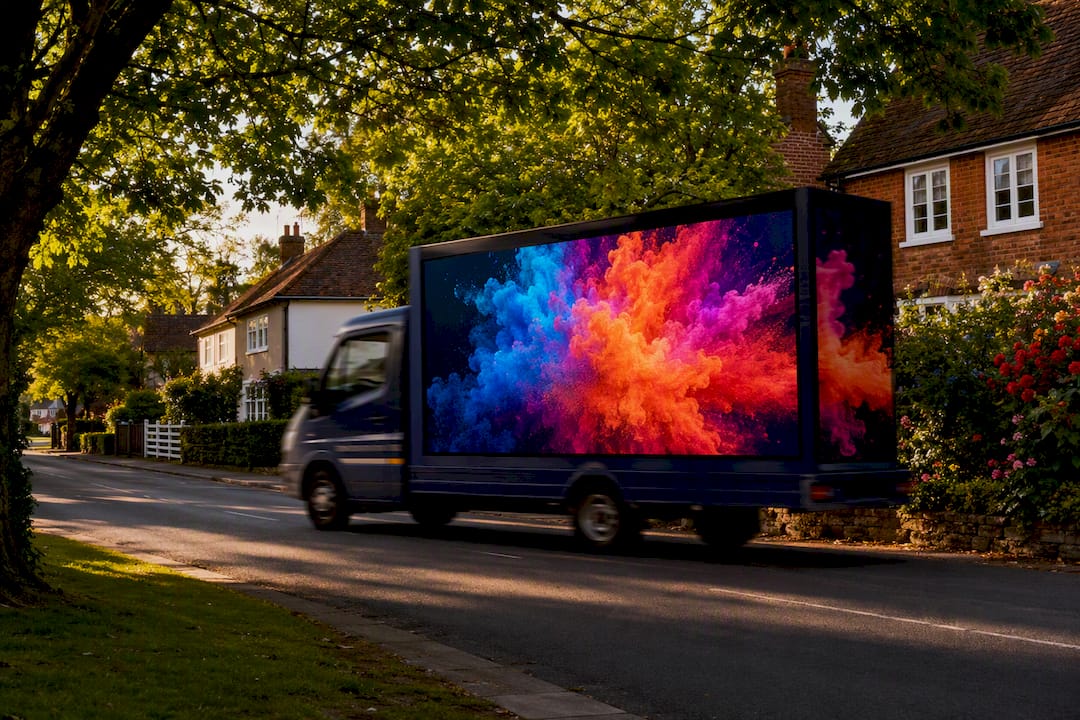
Billboard retargeting means capturing the mobile devices exposed to a physical billboard and then following up with digital ads on those same devices, turning a one-time glance into a measurable sequence of touchpoints. It works best for events, high-traffic placements, and local promotions where you want to extend an impression into a visit, a click, or a signup rather than just hoping someone remembers the ad.
TL;DR:
- Accurate viewshed modeling is essential, as simple geofences can overstate exposure and lead to false positives, especially for moving billboards.
- Vendors should provide verifiable proof-of-posting, detailed exposure logs, and transparent consent artifacts to ensure compliance and data integrity.
- Short-duration pilots in a single city with clear KPIs and GPS-stamped proof-of-posting help identify data-quality issues early before expanding campaigns.
- Retargeting effectiveness hinges on high-quality data, a limited lookback window, and proper control groups to measure true lift and engagement.
- Legal compliance requires documented consent, exclusion of sensitive locations, and rigorous deletion proof to meet FTC and data privacy standards.
Table of Contents
- How OOH Exposure Becomes a Mobile Audience
- A Step-by-Step Checklist for Your Retargeting Pilot
- How to Measure Impact and Report Results Honestly
- Privacy and Legal Essentials Every Buyer Should Know
- Real-World Campaign Sequences Worth Copying
- A Practitioner’s Checklist for Your First Pilot
- What a Realistic Pilot Actually Looks Like
- Get an Integrated Billboard and Retargeting Campaign Running
- FAQ
- Sources
How OOH Exposure Becomes a Mobile Audience
Billboard retargeting starts with defining where the ad was actually seen, not just where it was parked. A simple geofence draws a radius around a location, but it ignores line of sight, traffic direction, and obstructions. A viewshed is more precise: it models the area where the billboard is genuinely visible, accounting for angle, distance, and sightlines. The OAAA’s digital moving OOH exposure guidelines recommend building exposure polygons from viewsheds rather than loose geofences, especially for mobile billboards that move through multiple routes in a single day.
Once the polygon exists, vendors observe mobile advertising IDs that pass through it during active display windows, then join that device list to a demand-side platform for ad delivery. A few mechanics determine quality:
- Exposure window: the start and stop times when the display was actually live and visible.
- Lookback period: how long after exposure a device remains eligible for retargeting, often 24 to 72 hours depending on the campaign goal.
- Sequencing: whether ads fire immediately for urgency or delayed for consideration-stage products.
The same OAAA guidance warns that bidstream data, the low-fidelity signal harvested from real-time bidding auctions, can inflate exposure counts with false positives. Treat bidstream-derived audiences as a secondary check, never the primary source of truth for who actually saw the billboard.
A Step-by-Step Checklist for Your Retargeting Pilot
A pilot works best when it is scoped tightly enough to produce a clean read within a few weeks. Follow this sequence:
- Define the objective and KPI. Decide upfront whether success means visit lift, click-through rate, or conversions, and set a numeric threshold before launch.
- Map the viewshed and lookback window. Work with your vendor to draw exposure polygons for each billboard location and pick a lookback period that matches the buying cycle.
- Vet the data vendor. Ask for consent provenance documentation, a deletion SLA, sensitive-location exclusions, and audit rights before signing.
- Sequence the creative. Pair the first mobile touch with a QR-driven landing page, then follow with a retargeting ad that reinforces the same offer.
- Run operational QA. Require proof-of-posting with GPS and timestamped photos, and test your pixel or SDK tags before the campaign goes live.
Pro Tip: Run your first pilot in a single city for 10 to 14 days before committing budget to a multi-market rollout; a short, contained test tends to expose data-quality issues more quickly than a longer one.
The out-of-home ad retargeting tutorial for marketers walks through creative sequencing in more detail if you want a template to start from.
How to Measure Impact and Report Results Honestly
Measurement for billboard retargeting rests on a handful of core metrics: exposure-to-impression overlap (how many exposed devices actually received a follow-up ad), mobile engagement rate, and visit lift compared to a control group that was not exposed. Lift tests and matched control audiences are the most reliable methods, since they isolate the billboard’s effect from normal foot traffic patterns. Panel validation adds another layer of confidence when the sample size allows it.
Vendor-reported uplift from pairing OOH with mobile retargeting varies by campaign and provider, which means a single percentage claim from a sales deck tells you very little on its own.
Insist that any post-campaign report include:
- The exact exposure definition used (viewshed dimensions, not just a zip code).
- Raw sample counts, not just percentages.
- Confidence intervals or a statement of statistical limitations.
- A side-by-side comparison against the control or baseline group.
Our marketing measurement strategies list for 2026 covers additional frameworks if you need to benchmark against other channels.
Privacy and Legal Essentials Every Buyer Should Know
Location-based advertising has drawn sustained FTC attention, and buyers, not just data vendors, carry compliance responsibility when something goes wrong. The Mobilewalla enforcement action shows how derived sensitive inferences from location data, even when unintentional, can trigger legal exposure for everyone in the data chain.
Before signing with any retargeting vendor, require:
- Documented consent-chain provenance for every device audience segment.
- Pipeline exclusions for sensitive points of interest (health clinics, places of worship, shelters).
- A deletion SLA with proof of propagation, not just a contractual promise.
- Audit rights and a current subprocessor list.
Buyer guidance following recent enforcement cycles now recommends engineering-level proof, such as a deletion propagation test on a synthetic opt-out, rather than relying on contract language alone.
Pro Tip: Keep a compliance folder for every campaign with consent artifacts, exclusion lists, and vendor audit responses; procurement and legal teams will ask for it eventually.

Real-World Campaign Sequences Worth Copying
The same mechanics apply across very different goals. A few patterns show up repeatedly:
- Event activation: billboard exposure near a venue, followed by mobile ads driving ticket or registration conversions within a tight lookback window.
- Retail drive-to-store: a billboard near a shopping corridor paired with a time-sensitive coupon that expires within 48 hours of exposure.
- Product launch: broad awareness billboards followed by segmented mobile creative that narrows toward a purchase decision over several days.
- QR-enabled first-party capture: a scan at the billboard location replaces or supplements third-party device matching, giving you a cleaner, consent-explicit audience.
The retargeting strategies for events playbook breaks the event flow down further if that is your primary use case.
A Practitioner’s Checklist for Your First Pilot
Before you launch, pull together the pieces that make a pilot auditable, not just measurable:
- Route customization: confirm the billboard’s route or placement matches your target viewshed, not a generic high-traffic path.
- Proof-of-posting: require GPS-stamped photos for every display window.
- QR integration: build a landing page tied to the QR code so first-party capture starts on day one.
- Attribution artifacts: request exposure logs, device counts, and the consent documentation behind them before the campaign starts.
A typical pilot runs for a few weeks with a single KPI, such as visit lift or signup rate, measured against a matched control group.
What a Realistic Pilot Actually Looks Like
Start smaller than feels comfortable: one city, one creative sequence, one KPI. A 24 to 48 hour lookback window tends to outperform longer ones for urgency-driven offers, while consideration purchases need several days of sequencing. The caution I’d pass along from watching these pilots run: never accept a vendor’s consent documentation on faith, ask to see the actual artifact.
— Scott
Get an Integrated Billboard and Retargeting Campaign Running
We run LED mobile billboards and wrapped rideshare vehicles across the country, and we built our geofencing and retargeting integrations specifically so the mobile follow-up never has to be a separate vendor relationship. Every campaign includes proof-of-posting documentation, smart QR code capture, and attribution reporting, providing exposure data and mobile engagement numbers from the same source instead of needing to reconcile two reports.

If you are evaluating us against another provider, ask for the same things we recommend above:
- A sample proof-of-posting report from a recent campaign.
- The consent artifacts behind any location-based audience segment.
- A short pilot window of a few days before committing to a full campaign.
Our LED mobile billboards and wrapped rideshare campaigns page outlines route customization, affinity targeting, and funnel metrics in more detail, and it’s the fastest way to start a conversation about a pilot in your market.
FAQ
What is retargeting in advertising?
Retargeting is the practice of serving follow-up ads to people who have already been exposed to a brand, typically through a website visit, app interaction, or in this case a physical billboard. It relies on matching an identifier, such as a mobile advertising ID, back to a known exposure event so the follow-up ad reaches the right device.
How does billboard retargeting work?
A vendor defines a viewshed around the billboard’s location, observes which mobile devices were present during the active display window, and then delivers digital ads to those same devices through a demand-side platform. The OAAA’s exposure guidelines recommend viewshed-based polygons over simple geofences for accuracy.
Is billboard advertising still effective?
Billboard advertising remains a widely used channel for building local and regional awareness, and pairing it with mobile retargeting gives marketers a way to measure engagement that traditional OOH alone cannot provide. Industry case discussions show that OOH combined with mobile follow-up can produce measurable visit or engagement lift, though results vary by campaign.
Is retargeting still effective?
Retargeting remains one of the more reliable methods for converting prior exposure into action, particularly when paired with a clear lookback window and a matched control group to validate lift. Effectiveness depends heavily on data quality and consent provenance, which is why buyer diligence matters as much as the creative itself.
Sources
- OAAA Digital Moving OOH Exposure Guidelines 2022
- Mobilewalla: Deriving Sensitive Information from Location Data Creates Legal Exposure – Ivory Law Group
- FTC location-data enforcement: what data buyers need to know (GSDSI)
- Appraising the value of truck-side mobile billboards + mobile retargeting